

Modern vs Vintage Fine Jewelry: Which Style Suits You
Table of Contents
- Modern vs Vintage Fine Jewelry: Key Differences at a Glance
- Craftsmanship and Design Philosophy
- How to Identify Vintage Jewellery and Authenticate Pieces
- Material Composition, Metal Purity, and Durability
- Styling Vintage Jewellery with Modern Outfits
- Fine Jewellery Investment Guide: Resale Value and Long-Term Worth
- Maintenance, Care, and Insurance Considerations
- Conclusion
Last Updated: August 27, 2026
Modern vs Vintage Fine Jewellery: Key Differences at a Glance
The choice between modern and vintage fine jewellery shapes not just your collection, but how you present yourself to the world. Modern fine jewellery prioritises clean lines, precision engineering, and contemporary design. Vintage pieces carry intricate hand-finishing, specific gemstone cuts reflecting historical preferences, and a narrative of provenance that modern pieces cannot replicate. The distinction lies not in superiority but in what each offers: modern jewellery delivers consistency and forward-looking design; vintage jewellery offers heirloom quality and historical aesthetic weight.
| Aspect | Modern Fine Jewellery | Vintage Fine Jewellery |
|---|---|---|
| Design Philosophy | Contemporary aesthetics, geometric precision | Era-specific design (Art Deco, Victorian, etc.) |
| Craftsmanship | Machine-assisted with hand-finishing | Predominantly handcrafted |
| Gemstone Cuts | Brilliant cut, modern modifications | Old European cut, cushion cut, rose cut |
| Metal Purity | Standardised (18ct, 14ct gold; 950 platinum) | Varies by era; may require testing |
| Design Trends | Current market preferences | Timeless, vintage revival appeal |
| Resale Value | Moderate depreciation initially | Often appreciates; depends on rarity |
| Durability | Optimised for everyday wear | Highly durable; may need restoration |
| Best For | Those seeking contemporary style and consistency | Collectors, investment-minded buyers |
Craftsmanship and Design Philosophy
Modern fine jewellery emerges from industrial precision combined with artisanal finishing. Contemporary designers use computer-aided design (CAD) to specify exact proportions, stone placements, and metal thicknesses, ensuring consistency across production runs and enabling complex geometric forms.
Vintage jewellery, particularly pieces from the early 20th century through the 1980s, represents a different philosophy. Before CAD and mass production, jewellers hand-drew designs and crafted pieces individually or in small batches. Each vintage piece carries subtle variations, slight asymmetries in stone setting, and unique tool marks that distinguish one example from another. Art Deco jewellery, for instance, achieved exceptional precision in geometric patterning through skilled handiwork rather than computer specification.
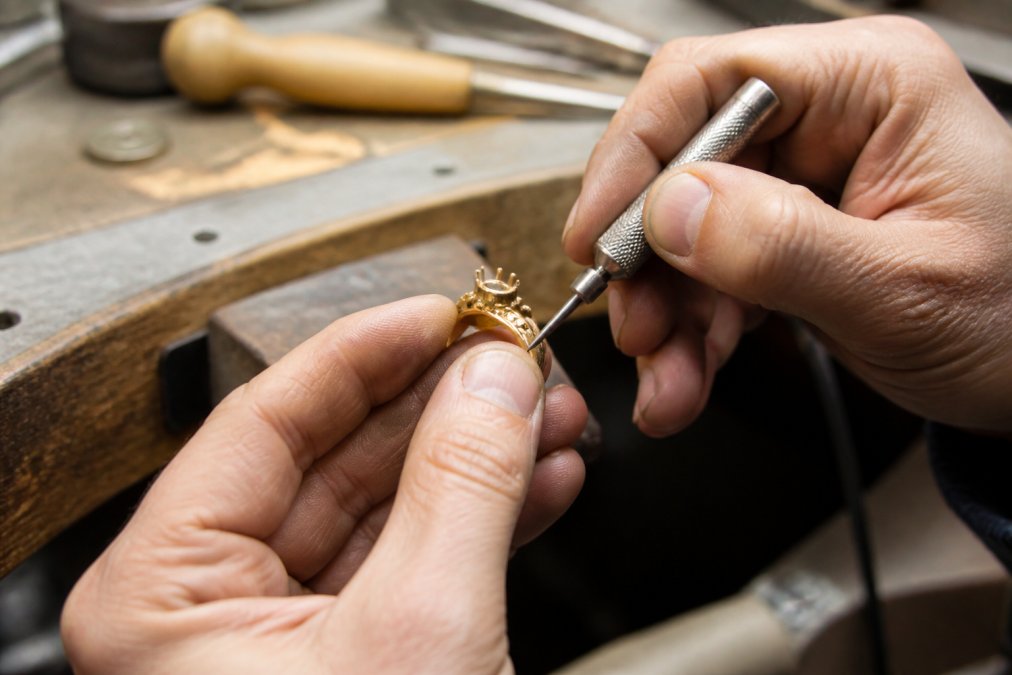
Vintage jewellery's perceived "imperfections" are actually markers of authenticity and skilled labour. A slight variation in stone alignment on a 1930s emerald brooch is evidence of hand-setting by a craftsperson working without modern tools. Modern fine jewellery achieves its appeal through design clarity and technical consistency, with every stone positioned exactly as specified and every metal thickness optimised for durability.
The aesthetic consequence matters. Vintage pieces often feel heavier, more sculptural, and visually complex due to their era's design language. Art Deco favoured geometric repetition and contrasting metals. Victorian jewellery embraced ornate filigree. Modern fine jewellery tends toward minimalism, solitaire settings, and negative space. If you're drawn to intricate, ornamental pieces with historical narrative, vintage jewellery delivers authenticity. If you prefer contemporary aesthetics and precise engineering, modern fine jewellery is the logical choice.
How to Identify Vintage Jewellery and Authenticate Pieces
Authenticating vintage jewellery requires technical knowledge. Start with hallmarks, the maker's mark, metal purity stamp, and sometimes the jeweller's initials struck into the metal. British hallmarks follow a standardised system regulated by the British Assay Office. A piece marked with the lion passant (sterling silver), crown (gold), or other symbols indicates it passed official testing for metal purity.
The gemstone cut provides another authentication clue. Old European cut diamonds dominated until the 1940s, featuring a smaller table, deeper pavilion, and larger culet than modern brilliant cuts. If a piece is represented as 1920s but contains a modern brilliant-cut diamond, either the stone is a later replacement or the dating is incorrect. Rose cuts (flat-backed, dome-topped stones) indicate 18th or 19th-century origin.
Metal composition reveals authenticity through testing. Pre-1930s gold jewellery in Britain was typically 15ct or 18ct. Post-1932, 9ct gold became standard. If a piece claimed to be Victorian contains only 9ct gold, the dating is suspect. Platinum work emerged in the early 1900s and became prominent in Art Deco jewellery, but it's rarely found before 1905 (si.edu).
A common mistake is assuming age equals value. A 1960s costume brooch is older than last year's modern fine jewellery, but it holds minimal investment value. Vintage fine jewellery, pieces made from precious metals and genuine gemstones, commands resale value. Costume jewellery does not.
Condition matters enormously. A perfectly preserved Art Deco diamond brooch commands significantly higher prices than an identical piece requiring restoration. Before purchasing vintage pieces online, request high-resolution images showing stone security, metal condition, and any repairs or alterations.
Material Composition, Metal Purity, and Durability
Modern fine jewellery operates within standardised material specifications. In the UK, gold jewellery is typically 18ct (75% gold), 14ct (58.3% gold), or 9ct (37.5% gold). Platinum fine jewellery usually contains 950 platinum (95% pure).
Vintage fine jewellery presents greater variability. Pre-1932 British pieces often contain 15ct gold, a standard no longer common (assayoffice.co.uk). This affects durability: 15ct gold is softer than 18ct, meaning vintage rings may show more wear on prongs and bands. However, this softness made hand-working easier for historical craftspeople, contributing to intricate designs.
Platinum work in vintage jewellery deserves specific attention. Platinum is extraordinarily durable, doesn't oxidize, and maintains its lustre indefinitely. A vintage platinum ring from the 1920s will outlast almost any modern jewellery in terms of metal integrity.
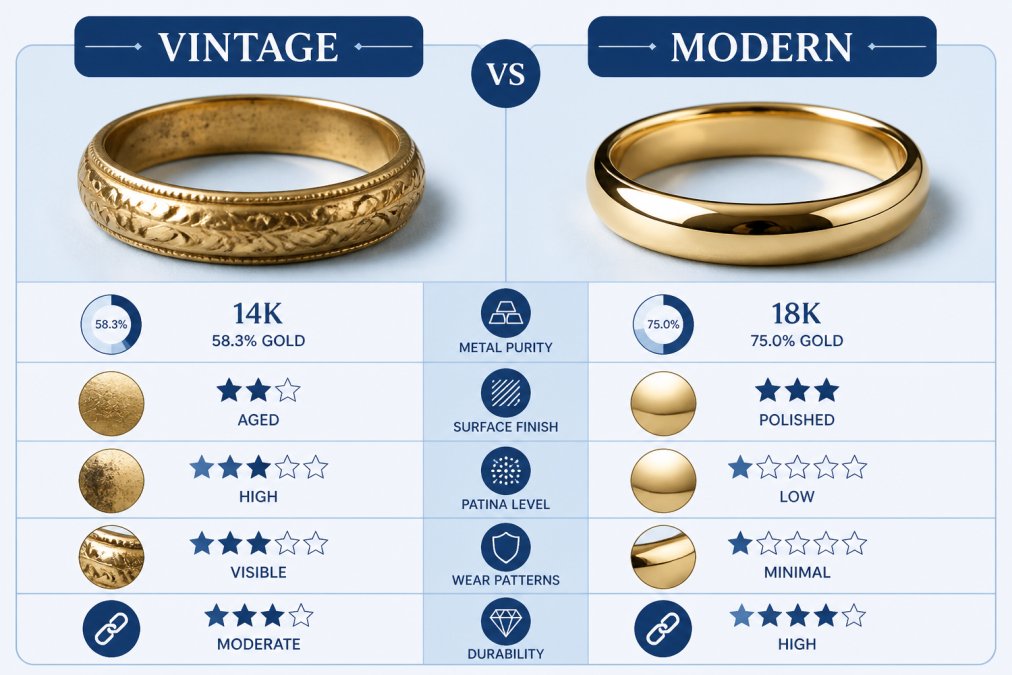
Durability between modern and vintage pieces depends less on era than on design and use. A modern solitaire engagement ring engineered with reinforced prongs will withstand daily wear better than a delicate vintage Art Nouveau pendant designed for occasional wear.
Vintage gold develops subtle surface character, slight scratches, and oxidization in recessed areas. Some collectors prize this patina as evidence of authenticity; others prefer the bright appearance of modern jewellery or newly polished vintage pieces. If you're considering a vintage piece, ask whether it's been recently refinished.
For daily wear, modern fine jewellery engineered for durability is the safer choice. For occasional-wear pieces or investment jewellery, vintage pieces' material integrity, particularly platinum or high-carat gold, often exceeds modern equivalents.
Styling Vintage Jewellery with Modern Outfits
Vintage jewellery often layers and mixes more successfully with modern clothing because it carries design clarity from its era. A 1960s geometric brooch in gold and turquoise works with minimalist contemporary dress because its design language is self-contained.
Art Deco pieces (1920s-1930s) feature geometric repetition, symmetry, and contrasting metals, pairing exceptionally well with contemporary minimalism. Wear an Art Deco diamond brooch on a simple black blazer, and the piece becomes a statement rather than an anachronism.
Victorian and Edwardian jewellery (1880s-1910s) tends toward ornamental complexity and romantic symbolism. These pieces work best as singular focal points, a Victorian locket as a pendant, an Edwardian ring as a statement piece, rather than layered with multiple modern items.
Layering vintage with modern fine jewellery requires intentionality. A delicate vintage gold chain worn with a contemporary solitaire pendant creates visual interest through contrast. What doesn't work is layering two equally ornate pieces.
Most stylists recommend the "70/30 rule": if 70% of your jewellery is contemporary and 30% is vintage, the vintage pieces read as curated accents.
Fine Jewellery Investment Guide: Resale Value and Long-Term Worth
Modern fine jewellery typically depreciates 20-30% immediately upon purchase (peer-reviewed research). A £3,000 contemporary engagement ring loses value once it leaves the retailer, though it stabilises thereafter.
Vintage fine jewellery often appreciates over time, particularly pieces from recognised design eras. A rare Art Deco diamond brooch purchased for £2,000 in 2020 might command £2,500-£3,000 in 2026 if the design is distinctive and condition excellent. This appreciation reflects scarcity; Art Deco pieces are no longer produced.
However, not all vintage jewellery appreciates. A 1970s gold pendant with generic design holds resale value roughly equivalent to its gold weight. An identical-weight piece from the 1920s with exceptional design might command 3-5 times the gold-weight value due to design desirability and rarity.
Resale value hinges on three factors: design era and recognition, condition, and provenance. Jewellery from peak design periods (Art Deco, Victorian, Edwardian) commands higher multiples than pieces from transitional eras. Mint condition pieces sell for 30-50% premiums over worn examples. Documented provenance adds significant value.
Modern fine jewellery's investment case is weaker but more predictable. A contemporary diamond solitaire holds value primarily based on the diamond's specifications and current market prices. The setting's designer carries minimal resale value unless exceptionally renowned. For investment-minded buyers, vintage fine jewellery offers appreciation potential that modern pieces cannot match.
Maintenance, Care, and Insurance Considerations
Vintage fine jewellery requires specialised maintenance. Older settings frequently contain solder joints and hand-set stones with minimal prong security. Professional ultrasonic cleaning risks loosening vintage stones. Hand-cleaning with mild soap and soft brushes is safer.
Modern fine jewellery engineered with reinforced settings tolerates ultrasonic cleaning and professional polishing without risk. This durability advantage extends to everyday wear.
Insurance considerations differ significantly. Modern fine jewellery is straightforward to insure with a receipt or professional appraisal. Vintage fine jewellery requires specialist appraisal because replacement cost differs from market value. Most insurers require specialist jewellery appraisals for vintage pieces, with coverage reflecting fair market value rather than replacement cost.
Vintage pieces benefit from professional certification, a gemological report confirming stone specifications, an appraisal documenting condition and estimated fair market value, and ideally historical research supporting design era and maker attribution. Modern fine jewellery from reputable retailers typically includes gemological certification, simplifying insurance and future resale.
Budget 1-2% of your vintage jewellery collection's value annually for professional cleaning and maintenance. Modern fine jewellery requires minimal maintenance, perhaps 0.5% annually.
The choice between modern and vintage fine jewellery reflects your priorities: contemporary consistency and engineering precision versus historical narrative and investment potential. Modern pieces from trusted retailers like Diamonds by daisy offer standardised materials, transparent gemological certification, and a 30-day satisfaction guarantee. Vintage pieces reward those patient enough to authenticate thoroughly and willing to embrace the character that age imparts. The best approach often combines both: contemporary pieces for daily wear and significant milestones, vintage pieces for investment and occasional-wear statement jewellery. Start with Diamonds by daisy's curated collection to establish your foundation, then build outward into vintage markets once you've developed an eye for quality and authenticity.
Frequently Asked Questions
What is the difference between vintage and antique jewellery?
Vintage jewellery typically dates between 20 and 100 years old, while antique pieces are over 100 years old. Both feature distinctive hallmarks, patina, and craftsmanship from their era. Antique jewellery often commands higher investment value due to rarity and historical significance. Vintage pieces offer heirloom quality with more accessible pricing. Understanding these distinctions helps you assess authenticity, durability, and resale potential when evaluating fine jewellery for purchase.
Is vintage-inspired jewellery a good investment?
Yes, vintage-inspired fine jewellery can be an excellent investment when crafted with quality precious metals and gemstones. Pieces with strong craftsmanship, provenance, and timeless design retain value better than trendy modern pieces. Estate jewellery and vintage revival designs often appreciate over time, particularly if authenticated and well-maintained. Investment potential depends on material composition, gemstone clarity, and brand reputation. Consider pieces with documented appraisals and certification for the strongest long-term value.
How do I mix modern and vintage jewellery styles together?
Layering works best when you balance proportions: pair delicate vintage pieces with bolder contemporary designs, or vice versa. Start with a neutral metal base, mixing gold and silver is acceptable if pieces share similar warmth. Choose one statement piece (vintage or modern) and complement it with simpler designs in the opposite style. Consider design eras: art deco pairs well with minimalist contemporary pieces, while vintage revival designs bridge both aesthetics naturally. Experiment with necklace lengths and bracelet stacking to create visual interest without overwhelming your look.
What should I look for when identifying authentic vintage jewellery?
Examine hallmarks stamped inside the band or setting, genuine pieces display maker's marks, metal purity stamps, and date indicators. Check for patina and oxidization patterns consistent with age; modern reproductions often lack authentic wear. Inspect gemstone cuts: old European cut and brilliant cut diamonds show different light reflection than contemporary cuts. Verify metal composition by weight and feel; vintage precious metals have distinct density. Request certification or appraisal from a qualified jeweller to confirm authenticity and establish insurance and resale value.
This article was written using GrandRanker