

Buy Certified Diamond Jewelry Online: A 2026 Guide
Table of Contents
- Why Certification Matters When You Buy Certified Diamond Jewelry Online
- GIA Certified Diamonds UK: Understanding the Gold Standard
- Lab Grown Certified Diamonds UK: Quality and Ethics
- Diamond Certification Explained: The 4 Cs and Beyond
- Best Online Diamond Jewellers UK: What to Look For
- Verifying Your Diamond Before Purchase
- Resale Value and Long-Term Care of Certified Diamonds
- Customisation and Bespoke Options for Certified Diamonds
Last Updated: August 2, 2026
When you're ready to buy certified diamond jewelry online, certification becomes your most important protection. Without it, you're trusting promises instead of verified facts. At Diamonds by daisy, we help clients navigate the certified diamond market with confidence, ensuring every piece they invest in comes with documented proof of quality and authenticity. This guide walks you through exactly what certification means, how to read grading reports, and what separates trustworthy online jewellers from those cutting corners.
The certified diamond market has grown significantly as more buyers demand transparency. According to Gemological Institute of America research on diamond grading, diamonds without proper certification create unnecessary risk for buyers who can't independently verify quality claims. A grading report is your insurance policy against overpaying for a stone that doesn't match its description.
Why Certification Matters When You Buy Certified Diamond Jewelry Online
Buying diamonds online removes one critical advantage: you can't hold the stone before committing your money. Certification fills that gap by documenting exactly what you're purchasing against standardised criteria that apply globally. A grading report tells you the diamond's carat weight, colour grade, clarity grade, cut quality, and whether fluorescence is present, measurements that determine value far more reliably than marketing language.
Certification also protects your investment's resale value. A grading report from a recognised laboratory instantly establishes the diamond's credentials, so future buyers won't question whether the stone matches its description.
What a grading report actually tells you
A grading report is a detailed assessment of your diamond's physical characteristics, recorded by trained gemologists using standardised equipment. It includes the stone's exact proportions, any inclusions or surface features, and colour assessment under controlled lighting. The report also indicates whether the diamond is natural or lab-grown, a distinction that dramatically affects both price and ethical sourcing.
The four main measurements, the 4 Cs, form the foundation of every grading report. Carat weight measures mass, colour grades the absence of colour on a D-to-Z scale, clarity rates the visibility of inclusions, and cut assesses how well the diamond's facets interact with light.
How certification protects your investment
Without certification, a seller might misrepresent colour grade, claiming a stone is D colour when it's actually H, a difference worth thousands of pounds. A grading report from a recognised laboratory creates accountability and gives you grounds for a refund if the diamond doesn't match the report.
Certification also protects against fraud involving treated or enhanced diamonds. A certified report documents whether treatments have been applied, allowing you to make an informed decision about whether the stone's appearance will hold up long-term.
GIA Certified Diamonds UK: Understanding the Gold Standard
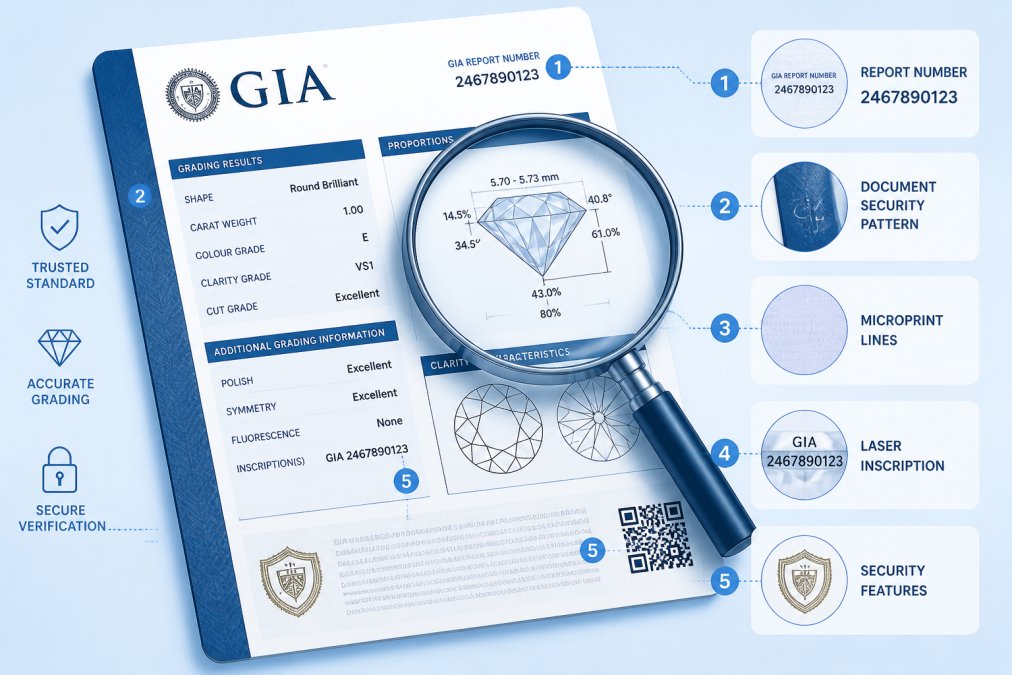
The Gemological Institute of America (GIA) is the most widely recognised diamond grading authority globally. A GIA grading report means your diamond has been assessed by gemologists trained to the highest standards, using equipment calibrated to industry specifications. GIA certificates are difficult to counterfeit because they include security features like serial numbers linked to the diamond itself, often laser-inscribed on the stone's girdle.
What GIA certification includes
A GIA grading report contains the diamond's dimensions measured to the nearest 0.01mm, depth and table percentages (measurements that indicate cut quality), girdle thickness, and culet size. It documents whether the diamond exhibits fluorescence under ultraviolet light, an important factor because strong fluorescence can affect the stone's appearance in daylight.
The report includes a colour plot, a diagram showing the location and nature of any inclusions or surface features visible under magnification. This plot is unique to your diamond and serves as a fingerprint. If someone claims to have your diamond but the inclusion pattern doesn't match, you know immediately it's not the same stone.
Reading your GIA grading report
The report begins with identifying information: the report number (unique to your diamond), the date of grading, and the diamond's dimensions. The 4 Cs follow: carat weight, colour grade, clarity grade, and cut grade. The colour plot shows a bird's-eye view of the diamond with symbols indicating where inclusions sit. Red symbols indicate internal features, while black symbols show surface features. A completely clean plot indicates a flawless or internally flawless diamond.
The cut grade reflects how well the diamond's proportions allow light to enter, reflect internally, and exit as visible brilliance. A well-cut diamond with good proportions will appear brighter and more sparkly than a poorly cut stone of identical colour and clarity.
Lab Grown Certified Diamonds UK: Quality and Ethics
Lab-grown diamonds have transformed the certified diamond market by offering buyers a choice between natural and laboratory-created stones. Both are chemically identical carbon crystallised into diamond form. The difference lies in origin: natural diamonds formed over billions of years under extreme pressure deep within the Earth, while lab-grown diamonds are created in controlled environments over weeks or months.
When you buy certified diamond jewelry online with a lab-grown stone, you're often paying 30-40% less for an identical-looking diamond. GIA, IGI, and other major laboratories grade lab-grown diamonds using the same 4 Cs system they apply to natural stones. The grading report will clearly state "Laboratory Grown" so there's no confusion about the stone's origin.
How lab-grown diamonds compare to natural stones
Lab-grown diamonds are optically and chemically indistinguishable from natural diamonds. A gemologist cannot tell them apart by looking at the finished stone. The only reliable way to identify a lab-grown diamond is through specialised testing equipment that measures subtle differences in crystal structure.
The key difference is ethical sourcing. Lab-grown diamonds eliminate sourcing concerns entirely because they're created in auditable facilities with known supply chains. For conscious consumers, this certainty justifies the lower cost.
Resale value is where lab-grown and natural diamonds diverge most significantly. Natural diamonds retain value more reliably because the market for them is established and global. Lab-grown diamonds have a smaller resale market, meaning you may struggle to find buyers willing to pay close to your original purchase price. If you're buying jewelry as an investment you plan to sell later, natural diamonds are the safer choice.
Certification for lab-grown diamonds
Lab-grown diamonds receive the same certification as natural stones, with one critical addition: the report clearly identifies the stone as "Laboratory Grown" or "Lab-Created." This disclosure is mandatory from all reputable laboratories. When you buy certified diamond jewelry online with a lab-grown stone, ensure the grading report comes from a major laboratory like GIA or IGI.
Diamond Certification Explained: The 4 Cs and Beyond
The 4 Cs, carat, colour, clarity, and cut, form the foundation of every diamond grading system. Understanding these measurements is essential when you buy certified diamond jewelry online because they determine both the stone's price and its visual appearance. Beyond the 4 Cs, a comprehensive grading report includes information about fluorescence, polish, symmetry, and the location of any inclusions.
| Factor | What It Measures | Impact on Price | Impact on Appearance |
|---|---|---|---|
| Carat Weight | Mass of the diamond | Highest impact, price increases exponentially | Larger stone appears more prominent |
| Colour Grade | Absence of colour (D-Z scale) | Moderate to high impact | Higher grades appear more colourless |
| Clarity Grade | Visibility of inclusions | Moderate impact | Higher grades appear cleaner to the naked eye |
| Cut Quality | Light reflection and refraction | High impact on sparkle | Well-cut stones appear brighter |
| Fluorescence | Glow under UV light | Can reduce value if strong | May affect appearance in daylight |
Carat weight and price impact
Carat weight is the easiest of the 4 Cs to understand: it's simply the mass of the diamond, with one carat equalling 200 milligrams. However, carat weight's effect on price is not linear. A 2-carat diamond costs significantly more than twice the price of a 1-carat diamond of identical colour and clarity because larger diamonds are rarer.
The price difference becomes dramatic at certain weight thresholds. A 0.99-carat diamond might cost £4,000, while a 1.01-carat diamond of identical quality could cost £5,500. Savvy buyers sometimes choose stones just under these thresholds because a 0.95-carat diamond looks nearly identical to a 1-carat stone to the naked eye but costs noticeably less.
Cut quality, colour grading, and clarity
Cut quality determines how brilliantly a diamond sparkles. The GIA cut grade assesses the stone's proportions, depth percentage, table percentage, crown angle, and pavilion angle all affect how light behaves inside the diamond. A well-cut diamond will display more fire and scintillation than a poorly cut stone, even if both have identical colour and clarity grades.
Colour grading uses a D-to-Z scale where D represents completely colourless and Z indicates light colour. The difference between a D-colour diamond and an H-colour diamond is invisible to the naked eye, but the price difference is substantial. For engagement rings and visible jewelry, H or I colour offers excellent value because the colour difference only becomes apparent under magnification.
Clarity grades range from FL (Flawless) down to I3 (Included, inclusions visible to the naked eye). The jump from SI1 (Small Inclusions, eye-clean) to VS2 (Very Slightly Included) is often not visible to the naked eye, yet the price difference can be 20-30%. When you buy certified diamond jewelry online, VS2 or SI1 clarity often represents the best value.
Fluorescence and other factors in your grading report
Fluorescence is the diamond's tendency to glow under ultraviolet light. Strong blue fluorescence can actually make a diamond appear more colourless in daylight because it masks subtle yellow tints. However, very strong fluorescence can occasionally cause a diamond to appear slightly hazy in bright sunlight, which is why diamonds with strong fluorescence typically cost less.
The grading report also notes polish and symmetry. The inclusion plot shows exactly where any inclusions sit within the diamond. An inclusion near the diamond's edge is less concerning than one in the centre because it's less likely to affect light performance or durability.
Best Online Diamond Jewellers UK: What to Look For
Buying certified diamond jewelry online requires choosing a retailer you can trust to deliver exactly what they promise. The best online jewellers combine transparent certification practices, ethical sourcing documentation, and strong customer protection policies. They make it easy to request certification before you buy and provide detailed photography and video evidence of each stone.
Diamonds by daisy stands out because every piece comes with full certification documentation and a 30-day satisfaction guarantee. The team handpicks gemstones and precious metals, ensuring every piece meets strict quality standards before it reaches you.
Certification transparency and documentation
The best online jewellers make certification their first selling point. They display full grading reports prominently, allow you to download PDFs before purchase, and encourage you to have the stone independently appraised if you wish. Be cautious of diamonds certified by lesser-known laboratories, some have been accused of inflating grades.
The jeweller should make it easy to request certification before you commit to a purchase. A retailer willing to provide this information upfront demonstrates confidence in their inventory.
Ethical sourcing and conflict-free guarantees
When you buy certified diamond jewelry online, ethical sourcing should matter to you. Conflict-free certification means the diamond didn't finance armed conflict, but it doesn't necessarily mean the mining operation met environmental or labour standards. The best jewellers provide information about where their diamonds originate and how they were sourced.
Lab-grown diamonds offer a shortcut to ethical sourcing because their origin is documented and auditable. If ethical sourcing is your primary concern, lab-grown diamonds eliminate the uncertainty surrounding natural diamonds entirely.
Returns, guarantees, and customer protection
A strong guarantee policy is essential when buying jewelry online. Diamonds by daisy offers a 30-day satisfaction guarantee, meaning you can return any piece within 30 days if it doesn't meet your expectations. Check whether the jeweller offers independent appraisal services or will cover the cost of having the piece appraised by a third-party gemologist.
Look for jewellers who use secure delivery methods, insured shipping, and require signatures on receipt. The best retailers provide tracking information and insurance documentation so you know exactly where your piece is at every stage.
Verifying Your Diamond Before Purchase
Before you complete your purchase when you buy certified diamond jewelry online, take steps to verify that you're receiving exactly what the seller promised. Request the full grading report, ask for high-resolution photographs from multiple angles, and if the retailer offers it, request a video showing the diamond under different lighting conditions.
Many online jewellers now provide 360-degree videos of diamonds, allowing you to see the stone rotate under controlled lighting. This is far more informative than static photographs because it shows how the diamond performs under different angles and light sources.
Requesting certification before you buy
Never commit to purchasing a diamond without seeing its full grading report. The report is your contract, documenting exactly what you're paying for. Request the report in PDF format so you can download it and review it carefully. Check that the report number matches any laser inscription on the diamond's girdle.
Verify the 4 Cs on the report match the seller's description. Check the colour grade, clarity grade, carat weight, and cut assessment. Look at the inclusion plot and verify that the inclusions shown match the clarity grade assigned. If anything seems inconsistent, ask for clarification before purchasing.
Photo and video evidence of your stone
Request high-resolution photographs showing the diamond from the top (table view), the side (profile view), and the bottom (pavilion view). These images should be taken under consistent lighting so you can accurately assess the stone's colour and clarity.
Video evidence is even more valuable because it shows the diamond's behaviour under moving light. Before the diamond ships, ask the retailer to confirm that the laser inscription on the girdle matches the report number.
Resale Value and Long-Term Care of Certified Diamonds
A diamond is only as valuable as someone is willing to pay for it. While diamonds are durable and don't deteriorate over time, their resale value depends on market demand, the stone's characteristics, and whether you can prove its authenticity through certification. Natural diamonds with GIA certification retain value more reliably than lab-grown stones because the market for natural diamonds is established and global. However, even natural diamonds typically sell for 30-50% less than their original purchase price when resold.
What affects resale value
The 4 Cs determine resale value more than any other factor. A well-cut diamond with excellent colour and clarity will be easier to sell than a poorly cut stone with visible inclusions. Certification significantly affects resale value. A diamond with a GIA or IGI certificate will sell for substantially more than an uncertified stone of identical quality because buyers don't have to pay for independent appraisal.
Maintaining your diamond's condition
Diamonds are incredibly durable, but they're not indestructible. A diamond can chip or crack if struck hard enough, particularly along the grain. Protect your diamond by removing it during activities where it might be struck, such as sports or manual labour.
Clean your diamond regularly to maintain its sparkle. A simple solution of warm water and mild dish soap works well. Use a soft brush to gently scrub the diamond and setting, paying special attention to the back of the stone where dust accumulates. Have your diamond professionally cleaned and inspected annually.
Customisation and Bespoke Options for Certified Diamonds
When you buy certified diamond jewelry online, customisation allows you to create a piece that reflects your personal style. Many retailers, including Diamonds by daisy, offer bespoke design services where you can choose the diamond, the metal, and the setting design.
Setting choices: platinum, 18k gold, and alternatives
The metal you choose affects both the appearance and durability of your jewelry. Platinum is the most durable choice, it's denser than gold, doesn't require replating, and holds stones securely. Platinum settings are heavier and more expensive than gold, but they last longer and require less maintenance.
18k gold is the standard for fine jewelry in the UK. It contains 75% pure gold mixed with other metals for durability. 18k gold is softer than platinum, meaning it can wear thin over time, but it's still durable enough for daily wear. 18k gold is available in white, yellow, and rose finishes, each affecting how your diamond appears.
White gold requires rhodium plating to achieve its silvery appearance. Over time, this plating wears away and the underlying yellow gold shows through. Replating every 2-3 years keeps white gold looking fresh. Rose gold has become increasingly popular for engagement rings and statement pieces. It's 18k gold mixed with copper, giving it a warm, pinkish tone.
Designing your piece with certified stones
A bespoke design process typically begins with a consultation where you discuss your vision, budget, and timeline. The designer creates sketches or computer renderings showing how your diamond will look in the proposed setting. You can request modifications until the design matches your vision perfectly.
Once you've approved the design, the jeweller sources materials and begins crafting your piece. For a custom setting with a certified diamond, the process typically takes 4-8 weeks depending on complexity. The advantage of bespoke design is that you control every element, ensuring your piece is exactly what you envisioned.
Choosing where to buy certified diamond jewelry online is one of the most important decisions you'll make when investing in fine jewelry. The difference between a trustworthy retailer and one that cuts corners often comes down to transparency about certification and willingness to stand behind their pieces with strong guarantees. Diamonds by daisy combines handpicked certified gemstones with meticulous metalwork and a 30-day satisfaction guarantee, ensuring you receive exactly what you're promised. Start by reviewing the full certification for any diamond you're considering, then verify the stone matches its documentation through photographs and video before completing your purchase. This approach removes the uncertainty from online diamond buying and gives you confidence that your investment is sound.
Frequently Asked Questions
What does 'certified' actually mean when I buy certified diamond jewelry online?
A certified diamond has been independently graded by a recognised laboratory such as GIA or IGI. The grading report documents the stone's characteristics including carat weight, cut quality, colour grade, and clarity. This certification provides objective verification of quality and helps protect your investment. When you buy certified diamond jewelry online, you receive documentation that confirms the stone's authenticity and specifications, giving you confidence in your purchase.
Are lab grown certified diamonds UK a reliable choice, and how do they differ from natural diamonds?
Lab-grown diamonds are chemically identical to natural diamonds and are certified using the same standards by bodies like GIA. The main differences are origin and price: lab-grown stones cost less and have a smaller environmental footprint. Both types receive grading reports that detail the 4 Cs. When buying lab grown certified diamonds UK online, ensure the certificate clearly states the diamond is laboratory-created. Many buyers prefer lab-grown for ethical reasons without sacrificing quality or certification standards.
How can I verify a diamond certificate before I complete my online purchase?
Request the full grading report from the retailer before buying. You can verify GIA certificates directly on the GIA website using the certificate number. Check that the report matches the stone's description on the product listing, including carat weight, colour, clarity, and cut grades. Ask for high-resolution photographs or video of the actual stone. Reputable online retailers will provide this documentation without hesitation and may offer a money-back guarantee if the stone doesn't match the certification when it arrives.
What should I know about resale value if I'm spending significant money on certified diamond jewelry?
Certified diamonds typically retain value better than uncertified stones because the grading report provides proof of quality. However, resale value depends on the 4 Cs, current market prices, and condition. Diamonds generally resell for 40-60% of the original purchase price. Lab-grown diamonds have lower resale demand than natural stones. Maintain your certificate and keep the diamond in excellent condition to maximise resale potential. If resale value is important to you, focus on stones with strong grades in cut and colour, as these factors most influence buyer interest.
This article was written using GrandRanker