

Sustainable Jewelry Guide: Buy Less, Choose Well
The fastest way to tell real sustainable jewelry from a marketing pitch is three things: traceable materials, a repair or resizing policy, and independent verification you can actually check. If a brand can’t answer basic questions about where its metal or stones came from, the label doesn’t hold up.
Use this before you buy anything:
- Ask for chain-of-custody or a refiner statement on the metal.
- Request the brand’s repair, resizing, and warranty policy in writing.
- Look for a third-party certification or published impact report, not just a claim on the product page.
Pro Tip: If a brand hesitates to answer any of these three questions directly, treat that hesitation as your answer.
Key Takeaways
Genuinely sustainable jewelry requires traceable materials, a written repair or warranty policy, and independent verification you can check yourself.
| Point | Details |
|---|---|
| Traceability beats labels | Ask for named suppliers and refiner statements before trusting any “sustainable” claim. |
| Recycled gold is a strong default | Hallmarked recycled gold cuts environmental impact dramatically compared to newly mined metal. |
| Repair policy is a longevity signal | A written repair, resizing, or warranty policy predicts how long a piece stays in use. |
| Score before you buy | Use a 0 to 2 scorecard across materials, traceability, labor, longevity, and circularity. |
| Diamonds by Daisy backs its pieces | Diamonds by Daisy pairs durable materials with clear repair and return policies for long-term wear. |
Table of Contents
- What Does “Sustainable Jewelry” Actually Mean?
- Which Materials and Stones Are Actually Worth Choosing?
- How Can You Tell if a Brand Is Greenwashing?
- Why Repair and Resale Matter More Than People Think
- How Do You Keep Jewelry Lasting for Decades?
- What Should Sustainable Jewelry Actually Cost?
- Try This 60-Second Brand Scorecard Before You Buy
- Why This Approach Beats Chasing Perfect Materials
- How Diamonds by Daisy Approaches Sustainable Materials
- Certifications and Bodies Worth Checking
- Frequently Asked Questions
- Sources
What Does “Sustainable Jewelry” Actually Mean?
Sustainable jewelry is jewelry made and sold in a way that minimizes environmental harm, treats workers fairly, discloses its supply chain, and is built to last decades rather than seasons. That’s a mouthful, so break it into five pillars you can actually check against:
- Materials — recycled metals, responsibly mined or lab-grown stones, and low-impact alternatives like moissanite.
- Labor ethics — fair wages and safe conditions across mining, cutting, and setting.
- Transparency — named suppliers, published sourcing documents, and traceable origins.
- Longevity — construction quality, repairability, and resale or heirloom value.
- Circularity — buy-back programs, resale markets, and reuse of existing materials.
Of the five, traceability is the clearest signal of genuine commitment. Certifications matter, but a brand that names its refiner and publishes an audit is telling you more than one that just prints “eco-friendly” on a tag.
A brand that can name its supplier, its refiner, and its cutting facility has nothing to hide. One that answers, “we work with trusted partners,” usually does.
Pro Tip: Weight repairability over material buzzwords. A recycled-gold ring that cracks in two years and can’t be fixed is a worse environmental choice than a solid piece you’ll wear for thirty.
Which Materials and Stones Are Actually Worth Choosing?
Recycled solid gold (14k/18k) is close to a no-brainer. It’s chemically identical to newly mined gold, and industry analysis reports environmental impact reductions as large as roughly 99% compared with virgin gold. Look for a hallmark stamp and ask the retailer for a refiner’s recycled-content statement.
Fairmined and Fairtrade gold go a step further by certifying labor conditions and community impact at the mine level, not just the metal’s recycled status. Recycled content alone doesn’t guarantee fair wages upstream, so pair it with refiner audits when the social side matters to you.
Platinum and sterling silver are durable, widely recyclable, and easy to verify through standard hallmarks (Pt950, 925). Titanium and niobium are lightweight, hypoallergenic alternatives gaining ground in everyday pieces, though they’re harder to resize.
Lab-grown diamonds and moissanite avoid new mining entirely and carry grading reports from IGI or GIA that confirm authenticity. Their sustainability story depends heavily on the growing facility’s energy source, since some labs run on coal-heavy grids and others on renewables.
Vintage and antique pieces are arguably the most circular option available. No new mining, no new manufacturing, and often better craftsmanship than mass-market equivalents.
Pro Tip: When shopping lab-grown stones, ask the retailer or manufacturer where the diamond was grown and whether the facility discloses renewable energy use. That single question separates a genuinely lower-impact stone from one that just sounds like it.
How Can You Tell if a Brand Is Greenwashing?
The fastest tell is an absence, not a presence: if a brand can’t produce named suppliers, audit results, or sourcing documents, that gap is the red flag itself, regardless of how the marketing reads.
Signals that a brand is telling the truth:
- Named suppliers and specific countries of origin, not “responsibly sourced” with no detail.
- Third-party certifications you can verify independently (Fairmined, RJC, B Corp).
- A published sustainability or impact report, even a short one.
- Repair, resizing, or buy-back programs stated in writing.
“Sustainable” and “eco-friendly” are unregulated marketing words with no legal definition in jewelry retail. Treat them as an invitation to ask more questions, not as proof of anything.
Red flags to watch for:
- Vague phrases like “eco-conscious materials” with no material named.
- No hallmark, no certificate number, no lab report on offer.
- Sustainability claims that only appear in ad copy, never on the product page itself.
Ask directly: “Can you name your refiner or mining source?” “Do you publish an audit or impact report?” “What’s your repair policy in writing?” A brand with real answers won’t dodge these.
Why Repair and Resale Matter More Than People Think
Design for long-term wear may matter more to lifetime environmental impact than which metal you pick. A piece that lasts twenty years and gets repaired twice beats a “sustainable” piece that’s replaced every three.
Circular options worth prioritizing:
- Buying vintage or antique pieces, which reuse existing materials entirely.
- Heirloom resets, where an old stone gets a new setting instead of a new stone being mined.
- Buy-back or resale programs that keep pieces circulating instead of landfilled.
- Repair workshops or in-house jewelers who can resize, re-tip, or restring.
Repairability and warranty offerings are one of the clearest indicators of a brand’s actual commitment to longevity, more so than any single material claim.
Before buying, check the policy covers:
- Turnaround time for repairs.
- Repair costs, or whether they’re free within a warranty window.
- Whether repairs happen domestically or get shipped overseas.
Pro Tip: On higher-value pieces, ask about buy-back or trade-in terms before you buy, not after. It’s a lot easier to negotiate that up front than to discover the policy doesn’t exist later.
How Do You Keep Jewelry Lasting for Decades?
Simple, regular care cuts lifetime environmental footprint more than almost any purchase decision. A piece you maintain well doesn’t need replacing, which is the whole point.
- Clean gently with mild soap and a soft brush; avoid ultrasonic cleaners on soft stones like opal or emerald.
- Store pieces separately in fabric pouches to prevent scratching.
- Remove jewelry before swimming, showering, or applying lotion.
- Vermeil pieces need occasional replating as the gold layer wears; ask the brand about their replating service.
- Sterling silver benefits from a polishing cloth every few months to prevent tarnish.
- Prong settings need periodic inspection; bezel settings are more forgiving for daily wear.
See a professional jeweler annually for stone tightening and clasp checks, especially on pieces worn daily.
What Should Sustainable Jewelry Actually Cost?
Price roughly tracks how much verification and labor sit behind a piece, and that’s a fair trade-off to understand before you shop.
- Vintage/antique: $50 to $500, depending on age and craftsmanship; best value per dollar of durability.
- Recycled solid gold: $200 to $2,000+, with cost tied to karat weight and design complexity.
- Fairmined/Fairtrade gold: Often above standard recycled gold due to certification costs.
- Lab-grown diamonds: less than mined diamonds at comparable size and grade.
- Moissanite: $50 to $500, the most budget-friendly durable stone option.
- Plated/fast fashion: Under $50, but with the shortest lifespan and no verifiable sourcing.
Pro Tip: One well-made staple piece, chosen for craftsmanship and repairability, consistently outperforms three trend pieces in cost-per-year of wear. Budget for the repair, too, not just the purchase.
Try This 60-Second Brand Scorecard Before You Buy
Score any brand or piece from 0 to 2 on each factor. Six is a strong result; anything under three is worth walking away from.
| Factor | 0 points | 1 point | 2 points | Sample: Brand X |
|---|---|---|---|---|
| Materials | No disclosure | Recycled claim, no proof | Hallmark + refiner statement | 2 |
| Traceability | No supplier named | Country named only | Named supplier + audit | 1 |
| Labor ethics | No mention | General statement | Certified (Fairmined/RJC) | 1 |
| Longevity | No repair option | Repair available, no policy | Written warranty/repair terms | 2 |
| Circularity | No program | Occasional promotion | Buy-back or resale program | 0 |
- Request sourcing documents or hallmarks before adding to cart.
- Inspect the piece in hand (or photos) for hallmark stamps like 14k, 925, or Pt950.
- Confirm the repair or return policy in writing, not just a verbal promise.
Pro Tip: Keep a running scorecard in your notes app. After scoring three or four brands, patterns in who actually discloses information become obvious fast.
Why This Approach Beats Chasing Perfect Materials
There’s a temptation to treat sustainable jewelry shopping like a purity test, hunting for the one material with zero footprint. That search wastes energy the reader could spend on something that actually moves the needle: buying fewer, better pieces and keeping them in circulation longer.
Recycled gold is not automatically an ethical supply chain just because it skips new mining. Refinery labor conditions and cutting-house practices matter too, which is why pairing recycled content with an actual certification, rather than treating the two as interchangeable, gives a fuller picture. The industry’s biggest blind spot isn’t material choice. It’s that shoppers rarely ask what happens to a ring five years after purchase, and brands rarely volunteer an answer.
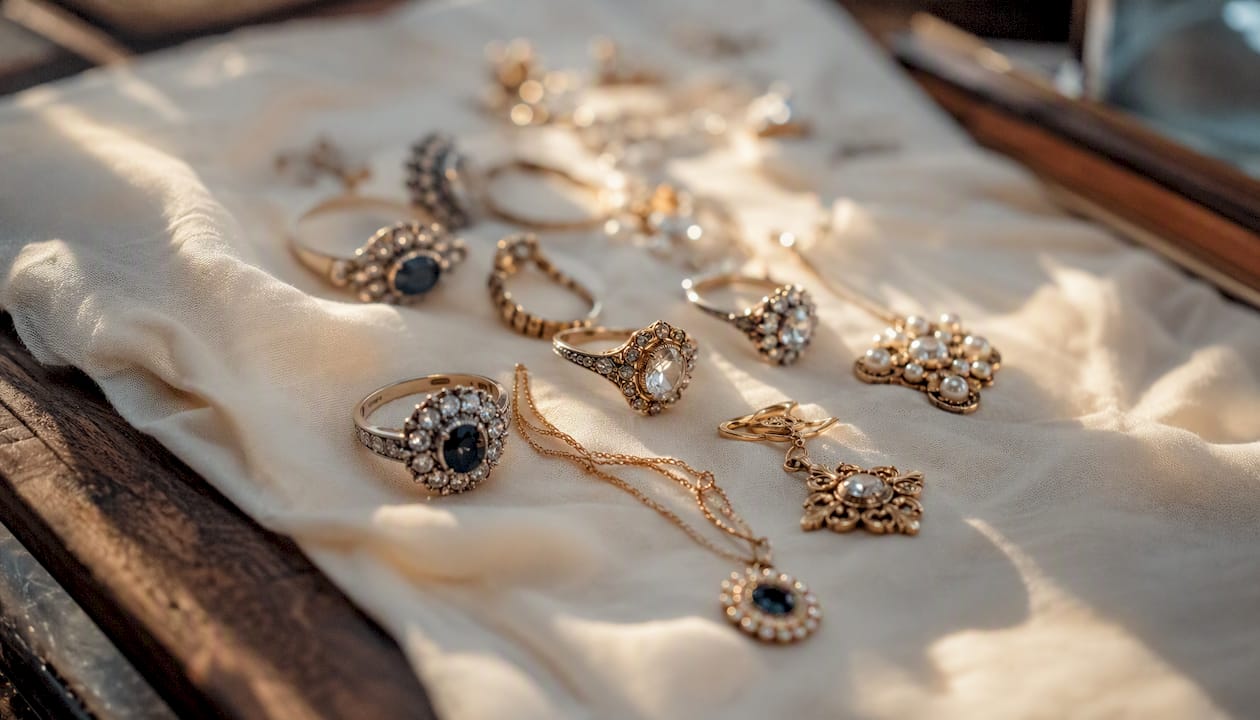
Vintage jewelry deserves more credit than it gets in this conversation. It sidesteps the entire sourcing debate by reusing what already exists, often with craftsmanship modern fast fashion can’t match. If sustainability is genuinely about reducing harm rather than achieving some impossible standard, a well-chosen vintage piece or a well-made staple you’ll wear for decades does more real work than a dozen “eco” labels ever will.
How Diamonds by Daisy Approaches Sustainable Materials
Diamonds by Daisy builds pieces around the idea that a good ring or bracelet should outlast the trend it started in. That means favoring durable, verifiable materials and standing behind repair and return policies that don’t disappear after checkout, so a piece you buy today is one you can still wear, resize, or restore years from now.
If you’re shopping for something that fits the standard laid out in this guide, the everyday gold jewellery collection is a solid starting point for pieces built for daily wear rather than a single season. Browse the full collection and use the scorecard above while you shop. It works on any brand’s site, including this one.
Certifications and Bodies Worth Checking
- Fairmined and Fairtrade verify fair labor and community impact at the mining level.
- Responsible Jewellery Council (RJC) sets a baseline supply-chain standard, though membership alone doesn’t guarantee traceability.
- B Corp certifies overall company practices, not jewelry-specific sourcing.
- SCS Global Services verifies recycled content and environmental claims.
- IGI and GIA issue grading reports confirming stone origin and authenticity for lab-grown and mined diamonds.
- Kimberley Process addresses conflict diamonds specifically, but doesn’t cover labor conditions or environmental impact.
For deeper verification steps, see this guide to buying certified diamond jewelry online.
Frequently Asked Questions
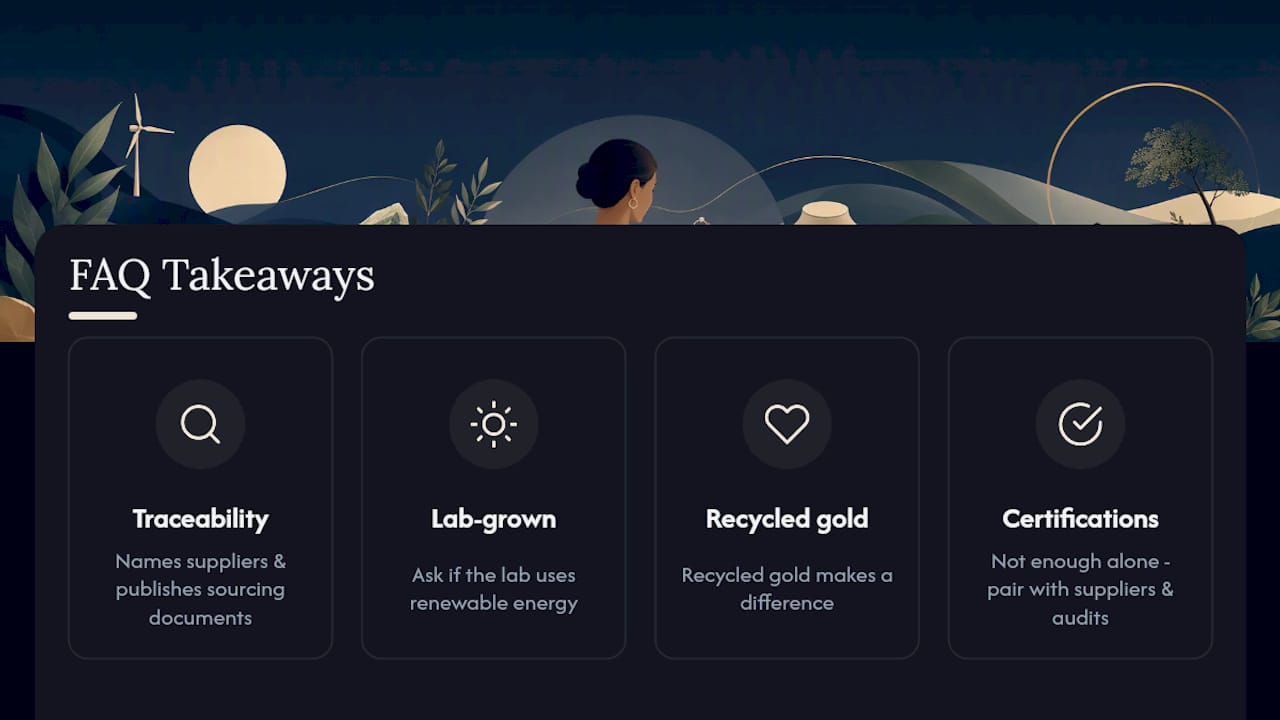
What is the most important factor in sustainable jewelry? Traceability. A brand that names its suppliers and publishes sourcing documents is giving you more proof than any single certification logo.
Is lab-grown better than mined for sustainability? It depends on the growing facility’s energy source. Ask directly whether the lab uses renewable energy before assuming lab-grown automatically means lower impact.
Does recycled gold really make a difference? Yes.
Are certifications enough to trust a brand? Not alone. Certifications cover specific parts of a supply chain, so pair them with named suppliers and published audits for the fuller picture.
How much more should I expect to pay for sustainable jewelry? It varies by category, from vintage pieces under $500 to certified gold pieces running well over $1,000. Prioritizing one durable piece over several trend pieces usually costs less over time.
Sources
- Sustainable Jewelry: The Complete Guide to Ethical and Eco-Friendly Choices | Sustainoverse
- The Sustainable Jewellery Guide: What Ethical Means | Ziracle