

Why Artisanal Jewelry Is More Expensive: A Complete Guide
Table of Contents
- What Makes Artisanal Jewelry More Expensive Than Mass-Produced
- Skilled Labor and Craftsmanship in Jewellery
- Material Quality and Sourcing in Artisanal Pieces
- Ethical Jewellery Brands UK: Fair Wages and Transparency
- Small-Batch Production vs. Economies of Scale
- How to Price Handmade Jewellery: Understanding Production Costs
- Unique Jewellery Materials and Bespoke Design Value
- Environmental Impact and the Hidden Costs of Mass Production
Last Updated: July 27, 2026
Understanding what makes artisanal jewelry more expensive than mass-produced alternatives requires looking beyond surface-level assumptions about price tags. At Diamonds by daisy, we've observed that the cost difference stems from fundamentally different production philosophies, material sourcing practices, and labour standards. This guide breaks down each factor contributing to artisanal jewelry's premium pricing.
What Makes Artisanal Jewelry More Expensive Than Mass-Produced
Mass manufacturers optimize for volume and speed, reducing per-unit costs. Artisanal makers prioritize quality and uniqueness, which increases expenses across every stage. When a jeweller hand-casts a piece, each casting requires individual attention, temperature monitoring, and problem-solving. If a stone doesn't sit properly, the artisan adjusts the setting rather than discarding the piece.
Material sourcing represents another significant cost driver. Artisanal makers typically source gemstones and precious metals through suppliers who guarantee ethical sourcing and quality verification. Mass producers buy in bulk from commodity suppliers, accepting wider quality variations for lower unit costs.
The economics of scale work decisively against small producers. A factory making 10,000 identical rings spreads overhead and equipment costs across those units. An artisan making 50 unique rings spreads the same overhead across far fewer pieces, multiplying per-unit costs.
Skilled Labor and Craftsmanship in Jewellery
A skilled jeweller undergoes years of apprenticeship to develop the technical abilities required for precision work. This expertise commands market rates reflecting both training years and scarcity of truly skilled practitioners.
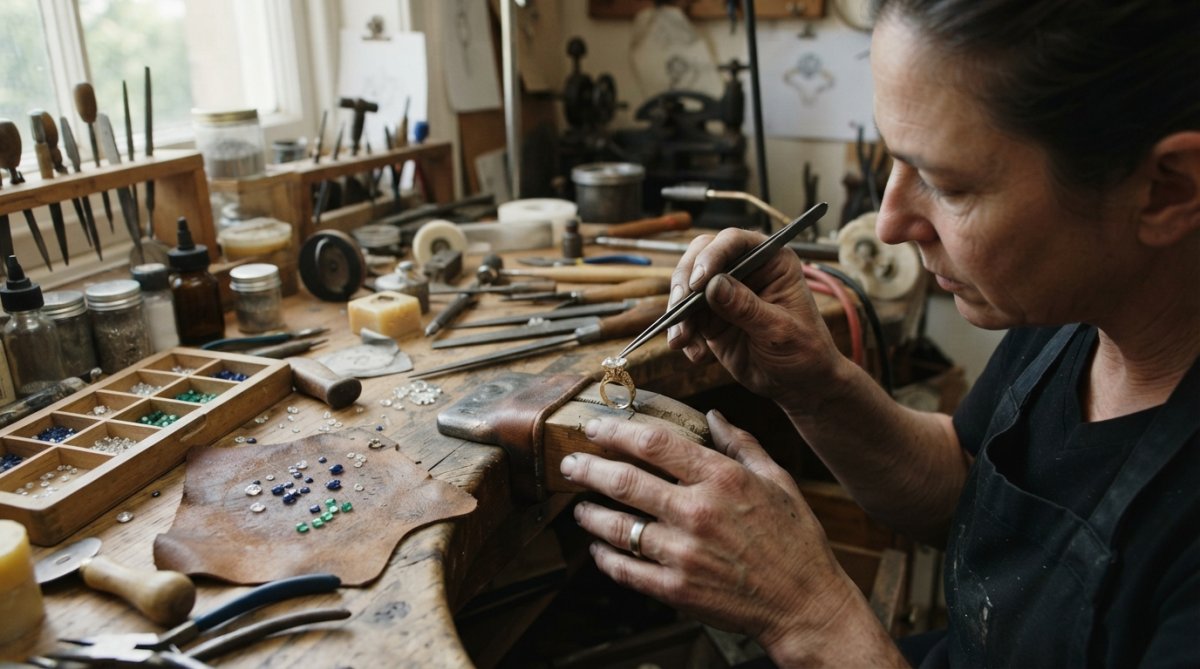
Consider stone-setting as an example. A factory worker might complete 30 settings per day using semi-automated equipment. An artisan hand-setting stones examines each stone individually, assesses how light interacts with its unique characteristics, and adjusts the setting to maximize brilliance. This same task might yield only 8-10 completed settings daily, but each reflects intentional craftsmanship.
Quality control in artisanal work operates on a completely different standard. Rather than checking pieces against templates, artisans evaluate each for aesthetic harmony, structural integrity, and how it will age over decades. A factory might accept a 2% defect rate; an artisan discards pieces that don't meet personal standards.
The hand-finishing process, polishing, texturing, and detailing, represents hours of skilled labour that machines cannot replicate. A hand-polished surface develops character and depth that reflects light differently than uniform machine finishes.
Material Quality and Sourcing in Artisanal Pieces
Artisanal makers typically work with higher purity metals, 18-karat gold rather than 14-karat, which costs more per gram and requires different working techniques. This choice reflects commitment to durability and longevity that mass producers often skip.
Gemstone sourcing illustrates the ethical sourcing premium most clearly. Artisanal jewellers often purchase directly from ethical suppliers or fair-trade networks, ensuring miners receive fair compensation and work under safe conditions. Mass producers source from commodity markets where price is the primary consideration.
An artisan selecting gemstones for a bespoke commission examines dozens of candidates, rejecting stones with inclusions or colour variations that don't meet standards. A factory purchasing stones in bulk accepts wider quality ranges to maintain cost efficiency.
Ethical sourcing adds measurable cost. Certified diamonds, responsibly sourced gemstones, and recycled precious metals all command premiums over conventional materials. These premiums reflect additional verification, documentation, and supply chain transparency required to guarantee ethical sourcing.
The longevity of materials also factors into artisanal pricing. A piece made with high-purity metals and quality gemstones maintains its appearance and structural integrity across generations. From a cost-per-year-of-use perspective, artisanal pieces often represent better value despite higher initial prices.
Ethical Jewellery Brands UK: Fair Wages and Transparency
Fair wages for skilled craftspeople in the UK and Europe are significantly higher than wages in regions with minimal labour protections. A jeweller earning a sustainable living wage in London or Birmingham costs substantially more than labour in jurisdictions with minimal minimum wage standards. This difference compounds across every production stage: design, material preparation, casting, setting, finishing, and quality control.
Transparency in labour practices requires documentation and verification systems that add administrative costs. Ethical makers maintain supply chain records, verify gemstone sourcing, and often undergo third-party audits. These systems protect both workers and customers but require investment that mass producers avoid.
The commitment to fair wages also influences production capacity. A maker can employ only as many artisans as their business can sustain at living wages. This natural limitation prevents scaling, maintaining higher per-unit costs.
According to research from organisations tracking jewellery supply chains, ethical sourcing and fair labour practices typically add 15-25% to production costs compared to conventional approaches.
Small-Batch Production vs. Economies of Scale
A factory producing 50,000 identical rings spreads equipment costs, facility overhead, and administrative expenses across enormous volume. The same equipment producing 500 unique custom rings spreads those costs across just 500 pieces, multiplying per-unit overhead allocation. Smaller production runs necessarily cost more per unit unless prices are artificially suppressed through lower labour costs or material quality compromises.
Small-batch production also prevents efficiency gains that industrial processes achieve through repetition. A factory worker casting the same ring design thousands of times develops muscle memory that reduces labour time per piece. An artisan creating unique designs must approach each piece as a distinct problem-solving exercise, which takes longer but produces greater individuality.
An artisan typically works to commission or produces small batches based on anticipated demand, reducing waste and capital tied up in unsold stock. This leaner approach is more environmentally responsible but less economically efficient.
| Production Model | Batch Size | Labour Hours per Piece | Material Cost | Overhead per Unit |
|---|---|---|---|---|
| Mass Production | 10,000+ | 1-2 hours | Minimized | Very low |
| Small-Batch Artisanal | 50-500 | 8-20 hours | Standard | Moderate to high |
| Bespoke Commission | 1 | 15-30 hours | Premium | Very high |
How to Price Handmade Jewellery: Understanding Production Costs
Many aspiring jewellers underprice their work by calculating only material costs plus a modest markup, ignoring the actual expenses required to operate a professional studio. A professional jewellery studio requires rent, utilities, insurance, equipment maintenance, and tool replacement. These fixed costs exist regardless of production volume.
Realistic labour rates for skilled jewellery work typically range from £35-75 per hour, depending on experience level and location. A piece requiring 15 hours of labour at £50/hour represents £750 in labour alone, before materials, overhead allocation, and profit margin.
The true cost also includes invisible labour: design consultation, material sourcing, quality control, and customer communication. A bespoke commission might involve 5 hours of design consultation, 2 hours of sourcing materials, and 3 hours of documentation, in addition to the 15 hours of actual creation.
Equipment represents another substantial cost factor. Professional-grade jewellery tools cost hundreds to thousands of pounds. Specialized equipment like kilns and casting equipment represent capital investments of tens of thousands of pounds, which must be depreciated across the maker's productive output.
Insurance, licensing, and professional development also factor into true costs. A jeweller working with precious metals requires specialized insurance. Many makers invest in continuing education to maintain and develop their skills.
Unique Jewellery Materials and Bespoke Design Value
A bespoke commission represents a collaboration between maker and wearer, resulting in a piece that exists nowhere else. This uniqueness creates emotional value beyond the material and labour invested.
The design process itself requires significant investment. A maker might spend 5-10 hours developing design concepts, creating sketches, discussing variations with the client, and refining details before production begins.
Unique pieces avoid the obsolescence risk of trendy designs. A truly artisanal piece, designed specifically for an individual, tends to feel timeless because it reflects personal aesthetic rather than temporary trends. This longevity creates long-term value that justifies higher initial investment.
The bespoke design process enables customization that mass production cannot accommodate. A client might request a specific stone, particular metal combination, or design element that references personal meaning. These customizations require problem-solving and technical adjustment that don't exist in any template.
A well-made bespoke piece with quality materials often retains 60-80% of its purchase price in resale value, particularly if it features notable gemstones or precious metals. Mass-produced pieces typically retain 20-40% of retail value when resold.
Environmental Impact and the Hidden Costs of Mass Production
Large-scale mining operations required to supply factory production cause significant environmental disruption, water contamination, and habitat destruction. These costs are externalized, paid by communities and ecosystems rather than reflected in product prices.
Artisanal makers typically source from suppliers who operate smaller-scale operations with stronger environmental controls. Ethical sourcing often includes environmental responsibility standards. Recycled precious metals, increasingly common in artisanal work, eliminate mining impacts entirely.
The durability difference creates environmental implications across the product lifetime. A mass-produced piece requiring replacement within a few years generates more total waste and environmental impact than a durable artisanal piece worn for decades. From a lifecycle perspective, investing in quality pieces that last longer represents environmentally responsible consumption.
Research from the Ellen MacArthur Foundation's circular economy research demonstrates that durable goods with longer lifespans create less total environmental impact than cheaper replaceable alternatives. According to UK Government guidance on sustainable consumption, purchasing durable, high-quality goods from local makers represents one of the most effective ways to reduce personal consumption impact.
Understanding what makes artisanal jewelry more expensive reveals that higher prices reflect genuine differences in creation, materials, and values. At Diamonds by daisy, we specialise in curated fine jewelry featuring meticulously handpicked gemstones and precious metals, designed with the same commitment to quality and ethical sourcing that characterises the best artisanal work. Each piece ensures a high standard of quality and refined aesthetic, backed by our 30-day satisfaction guarantee. When you invest in artisanal jewelry, you're choosing pieces designed to become heirlooms rather than commodities.
Frequently Asked Questions
Why is handmade jewellery more expensive than mass-produced?
Artisanal jewelry costs more due to several interconnected factors: skilled labor commands fair wages, precious metals and gemstones are carefully selected, production is small-batch rather than automated, and studio overhead is distributed across fewer pieces. Unlike mass-produced jewelry, each handmade item involves hours of hand-finishing, stone setting, and quality control. Additionally, ethical sourcing and fair labour practices add cost but ensure transparency and durability that justify the premium.
How do jewellers price handmade jewellery?
Artisanal jewellers typically price based on material costs (precious metals, gemstones), labour time (design, casting, polishing, stone setting), studio overhead (rent, tools, insurance), and profit margin. Unlike high-street retailers using economies of scale, bespoke makers calculate per-piece costs because each design is unique. Factors like ethical sourcing certification, designer reputation, and heirloom-quality durability also influence pricing. Transparency in pricing helps customers understand what they're paying for beyond just materials.
Is artisanal jewellery a good investment?
Artisanal jewelry can hold intrinsic value better than mass-produced pieces, particularly if crafted from quality precious metals and gemstones. Heirloom-quality construction means pieces resist wear and remain beautiful across generations. However, investment value depends on the maker's reputation, the piece's uniqueness, and market demand. Unlike high-street jewelry that depreciates quickly, bespoke artisanal pieces often retain 50-70% of purchase value if well-maintained. The 30-day satisfaction guarantee offered by reputable makers provides confidence in quality.
What materials make artisanal jewellery more expensive?
Precious metals like gold, silver, and platinum form the base cost. Ethically sourced gemstones, whether diamonds, sapphires, or other stones, add significant expense, especially if certified and graded. Artisanal makers invest in superior material quality and often hand-select stones for colour, clarity, and durability rather than buying bulk lots. Unique jewellery materials such as recycled metals or rare gemstones further increase costs. The sourcing transparency required by ethical jewellery brands UK adds traceability costs that mass producers avoid.
This article was written using GrandRanker