

How to Assess Jewelry Quality Online: A 2026 Guide
Table of Contents
- What You'll Need Before You Start
- Step 1: Check the Hallmarks and Fineness Stamps
- Step 2: Understand Jewellery Certification and Appraisal
- Step 3: How to Spot Fake Diamonds Online
- Step 4: Evaluate Precious Metals and Gemstones
- Step 5: Identify Costume Jewelry vs. Fine Jewelry
- Step 6: Research Seller Credentials and Reviews
- Step 7: Use Macro Photography and Digital Verification
- Frequently Asked Questions
Last Updated: September 29, 2026
What You'll Need Before You Start
You can assess jewelry quality online with far more confidence than most buyers realise, provided you know what to look for and what to ask for. The good news: most of the work happens before you add anything to a cart.
Here's what to have ready:
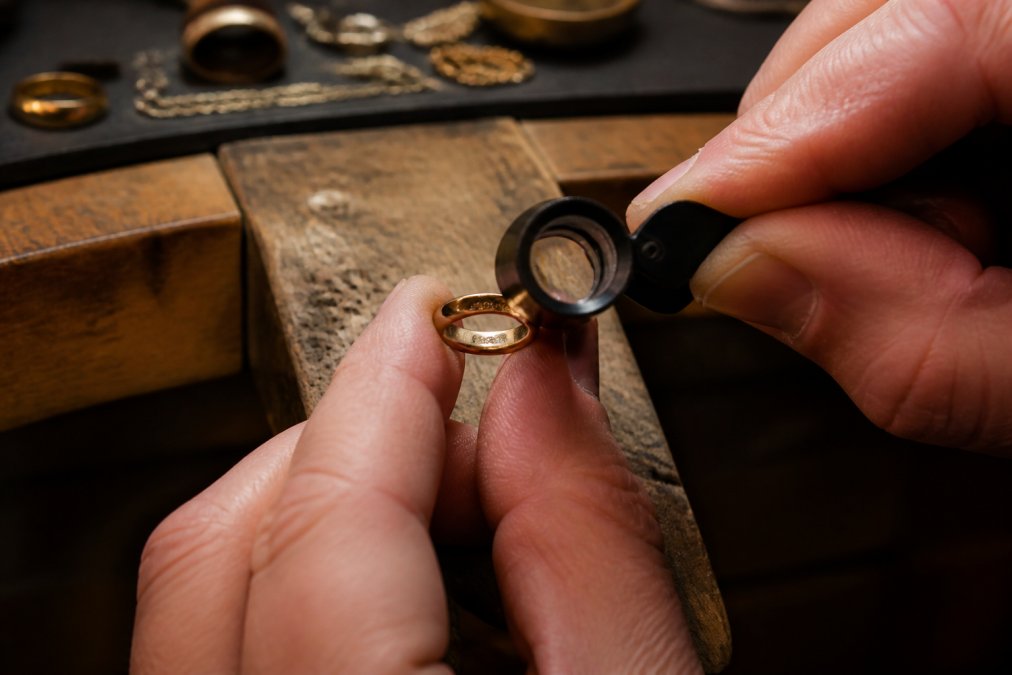
- A magnifying app or a simple jeweller's loupe for checking photos
- The seller's certificate and grading documents
- A list of questions for the seller
- A note of the return policy and any guarantee terms
Below, we'll walk through seven practical steps. Each one builds on the last, and together they give you a clear picture of quality before you buy.
Step 1: Check the Hallmarks and Fineness Stamps
A hallmark is an official stamp struck into precious metal to confirm its purity. In the UK, this is a legal requirement, and it's your fastest quality check.
Understanding UK Hallmarking Law
UK law requires most gold, silver, platinum and palladium items above a set weight to carry a hallmark from an assay office. The hallmark shows three things: the maker's mark, the assay office mark, and a fineness mark showing purity.
Fineness tells you how much precious metal is in the piece.
Step 2: Understand Jewellery Certification and Appraisal
Certification and appraisal are two different things, and sellers sometimes blur the line. Understanding the difference, and knowing how to verify each document, protects you before money changes hands.
Certificate vs. grading report vs. appraisal
- Certificate of authenticity: A seller-issued document confirming materials, gemstone details and origin. Useful, but not independent.
- Grading report: An independent assessment of a stone's quality, issued by a laboratory. This is the document that actually proves quality.
- Appraisal: A valuation for insurance or resale purposes, usually prepared by a qualified valuer. It estimates worth; it does not prove quality.
An appraisal estimates value. It does not prove quality. Only an independent grading report does that.
Recognised grading laboratories
The laboratories most commonly cited in online listings are GIA (Gemological Institute of America), IGI (International Gemological Institute) and HRD Antwerp. For coloured gemstones, look for reports from SSEF, Gübelin or AGL. A report from a laboratory you cannot find independently is a red flag, regardless of how official the PDF looks.
How to verify a grading report online
This is the step most buyers skip, and it is the one that catches the most forgeries.
- Locate the report number. It is printed on the report and usually engraved on the girdle of the stone (for diamonds) or on a tag.
- Go directly to the laboratory's own website. Type the domain yourself rather than clicking a link in the listing.
- Enter the report number in the laboratory's report-check tool.
- Compare the returned record against the PDF the seller sent: carat weight, measurements, clarity grade, colour grade, fluorescence and any plot diagram should match exactly.
- Check the issue date. A report dated years ago may describe a stone that has since been recut, reset or swapped.
What a UK appraisal should contain
GIA Report Check lets you confirm a diamond grading report against the laboratory's own database.
Step 3: How to Spot Fake Diamonds Online
Fake diamonds are common online, but the clues are usually visible in good photos. Start with the certificate, then check the stone itself.
Evaluating the 4Cs and Diamond Quality
The 4Cs are cut, colour, clarity and carat weight. These four measures together determine a diamond's quality and value.
- Cut: How well the stone reflects light. This matters most.
- Colour: Graded from colourless to tinted.
- Clarity: Measures internal flaws, called inclusions.
- Carat weight: The stone's weight, not its size.
Step 4: Evaluate Precious Metals and Gemstones
Metal and gemstone quality vary widely, and the description should tell you exactly what you're getting.
Check these details:
- Metal type and fineness, such as 18 karat gold or 925 sterling silver
- Whether gold plating or vermeil is used, and how thick the layer is
- Gemstone type, treatment and origin
- Whether stones are natural, synthetic or lab-grown
Step 5: Identify Costume Jewelry vs. Fine Jewelry
Fine jewelry uses solid precious metals and genuine gemstones. Costume jewelry uses base metals, plating and imitation stones. Both have a place, but they should never be sold at the same price.
Quick checks:
| Feature | Fine Jewelry | Costume Jewelry |
|---|---|---|
| Metal | Solid gold, platinum, sterling silver | Base metal, thin plating |
| Hallmark | Present | Usually absent |
| Stones | Natural or lab-grown gemstones | Glass, plastic, cubic zirconia |
| Price | Reflects materials | Reflects design only |
Step 6: Research Seller Credentials and Reviews
A verified seller with a clear returns policy is worth more than any single photo. Check the seller before you check the piece, because assessing quality is pointless if you cannot get your money back when the piece does not match the listing.
What to verify about the seller
- A full trading name and a UK correspondence address. A PO box alone is not enough if you need to enforce a return.
- Companies House registration if they trade as a limited company. You can search the register free of charge.
- VAT number if they are VAT-registered and quoting VAT-inclusive prices.
- Consistent reviews across more than one platform. A single five-star profile on the seller's own site proves nothing.
- A written complaints procedure and a response time commitment.
Read the return policy like a contract
Most buyers skim the returns page. Read it for these specific clauses:
- Return window: 14 days is the statutory minimum for most distance sales. Anything shorter is a warning sign.
- Who pays return postage: If the seller requires you to cover insured, tracked shipping on a high-value item, factor that into the total cost.
- Exclusions: Custom-made, engraved, resized and pierced items are commonly excluded. If the piece you want falls into one of those categories, confirm in writing before purchase.
- Restocking fees: Any percentage deducted from your refund should be stated up front.
- Refund method and timing: Refunds should go back to the original payment method, not store credit.
Your statutory protections
When you buy from a trader as a consumer, the Consumer Rights Act 2015 gives you the right to goods that are of satisfactory quality, fit for purpose and as described. If a piece arrives and does not match the listing, you are entitled to a remedy, repair, replacement or refund, regardless of what the seller's own policy says.
Payment methods and escrow safety
How you pay determines how much recourse you have:
- Credit card: Section 75 of the Consumer Credit Act 1974 makes the card issuer jointly liable for breaches of contract or misrepresentation on purchases between £100 and £30,000. This is the strongest protection available for a high-value piece.
- Debit card: Chargeback schemes can help, but they are voluntary and less certain than Section 75.
- PayPal Goods and Services: Offers buyer protection, but check the current exclusions for jewellery and custom items.
- Bank transfer: Almost no recourse. Avoid for any purchase where you cannot inspect the item in person first.
- Cryptocurrency: No recourse. Treat as a red flag for any jewellery purchase.
Citizens Advice on returning goods explains your cancellation and refund rights for online purchases.
Step 7: Use Macro Photography and Digital Verification
Macro photography shows a piece in close detail, and it's one of the best ways to judge craftsmanship from a distance. Ask the seller for sharp close-ups of the setting, the clasp and the hallmark.
Certificates, hallmarks and a solid return policy together give you the strongest protection. No single check is enough on its own.
Frequently Asked Questions
Are online jewelry appraisals accurate?
Online appraisals can be accurate for identifying metal type and gemstone specifications if the appraiser uses high-resolution images and proper tools. However, they are not a substitute for a physical examination. For high-value pieces, a physical appraisal by a qualified professional is recommended. Always check that the appraiser has relevant credentials and experience with the type of jewelry you own.
Can you get jewellery valued for free?
Some jewellers offer complimentary verbal valuations when you visit their store, especially if you are a customer. Online, free valuations are rare and often limited to basic identification. For a formal written valuation suitable for insurance, expect to pay a fee. Always ask what the valuation includes and whether it meets insurer requirements before proceeding.
Is there an online jewelry appraisal?
Yes, some companies offer online jewelry appraisal services. You typically submit clear photos and details, and a gemologist reviews them. This can be useful for a preliminary assessment, but it cannot replace a hands-on inspection for detecting treatments or synthetic stones. Use online appraisals as a starting point, not a final verdict.
How much does it cost to get jewelry evaluated?
The cost varies based on the complexity and value of the piece, as well as the appraiser's expertise. Basic evaluations might start at a modest fee, while comprehensive appraisals for high-value items cost more. Some appraisers charge by the hour, others a flat rate. Always request a quote upfront and confirm what the report will include.
Buying fine jewelry online comes down to doing a few checks well. Ask for hallmarks, certificates and clear photos, and buy from a seller you trust. At Diamonds by daisy, every piece is crafted with handpicked gemstones and precious metals, and backed by a 30-day satisfaction guarantee. Add to cart with confidence and let your next piece speak for itself.