

Ethical Sourcing of Conflict Free Diamonds: 2026 Guide
Table of Contents
- What 'Conflict Free' Really Means (And Where It Falls Short)
- Kimberley Process Certification Scheme: What It Does and Doesn't Guarantee
- How to Verify Diamond Origin: Documentation, Audits and Blockchain
- Lab-Grown vs Natural Diamonds Ethics: Which Choice Aligns With Your Values?
- Beyond Certification: Mining Impact, Community and Environmental Restoration
- The Pros and Cons of Ethically Sourced Conflict Free Diamonds
- Frequently Asked Questions
Last Updated: September 14, 2026
What 'Conflict Free' Really Means (And Where It Falls Short)
A conflict free diamond is a stone whose sale has not funded armed conflict or rebel groups, verified through the Kimberley Process Certification Scheme. That definition addresses one specific harm, in one part of the supply chain, and leaves several others untouched.
Understanding the gap between "conflict free" and genuine ethical sourcing is where the journey to informed choices begins.
Below, we break down what the certification guarantees, what it ignores, and how to verify provenance.
Kimberley Process Certification Scheme: What It Does and Doesn't Guarantee
The Kimberley Process Certification Scheme (KPCS) regulates the rough diamond trade to prevent conflict diamonds from entering mainstream markets. It requires participating governments to certify rough shipments as conflict free and trade only with other participants. It came into force in 2003 and now has more than 80 participants, with the European Union counted as one (What Is The Kimberley Process?).
Here's what most guides get wrong: the scheme governs the rough diamond trade, not the finished jewellery on a shop counter. Once a stone is cut, polished and set, it no longer travels under a Kimberley certificate, which is why that certificate is a starting point, not a guarantee.
The Rough Diamond Trade and How Certification Works
Rough diamonds move across borders in sealed, tamper-resistant containers with government-issued Kimberley certificates. Importing authorities verify the paperwork and seal before entry. The certificate is a government-to-government document, not a consumer-facing one, you'll rarely see the original, only a reference to it.
The system relies on governments policing their own exports, its strength and its weakness. A state lacking enforcement capacity or political will can issue certificates that meet the letter of the scheme without its spirit.
The Three Gaps: Violence, Labour and the Environment
The scheme was designed as a narrow intervention, leaving three significant gaps:
- Violence: It targets conflict diamonds specifically, stones that fund rebel groups fighting recognised governments. State-sanctioned violence at mine sites, including security force abuses against artisanal miners, falls outside its scope.
- Labour: It says nothing about fair wages, child labour, working hours, or occupational safety. A diamond can be Kimberley-compliant and still be mined by a child.
- Environment: It contains no provisions for mining impact, land restoration, water use, or biodiversity. A Kimberley certificate tells you nothing about the land the stone came from.
The Kimberley Process official documentation makes clear the scheme's remit is the trade in rough diamonds, not comprehensive ethical mining standards. That distinction matters when you're standing at a counter deciding what to buy.
Why the Scheme Has Been Criticised, and What Fills the Gap
Critics argue the KPCS is a minimum standard treated as a ceiling. Two criticisms recur:
- The definition of 'conflict diamond' is too narrow. It covers rebel movements but not government forces, and it does not cover other forms of systemic harm.
- Enforcement is uneven. Peer review is voluntary, and a participant can be suspended only by consensus, which makes decisive action against well-connected producers difficult.
Because of those limits, more rigorous voluntary standards have emerged. The most widely recognised is the Responsible Jewellery Council (RJC) Code of Practices, covering labour rights, human rights, environmental impact, and business ethics across the jewellery supply chain. The OECD Due Diligence Guidance for Responsible Supply Chains of Minerals from Conflict-Affected and High-Risk Areas provides a five-step framework for identifying and mitigating supply chain risks. Both are voluntary but go considerably further than Kimberley, a seller showing RJC certification or OECD-aligned due diligence demonstrates accountability the KPCS alone never required.
What This Means for You as a Buyer
A Kimberley certificate is evidence the rough stone crossed a border legally, not evidence of ethical sourcing. When you ask a seller what they mean by 'ethical', listen for whether they mention the KPCS alone or can also point to RJC membership, third-party audits, and named suppliers. The first is the baseline; the second is the standard you want.
How to Verify Diamond Origin: Documentation, Audits and Blockchain
Verifying diamond origin means tracing a stone from mine to market using documentation, independent audits, and increasingly, digital ledger technology. No single document proves ethical sourcing, you need a chain of evidence.
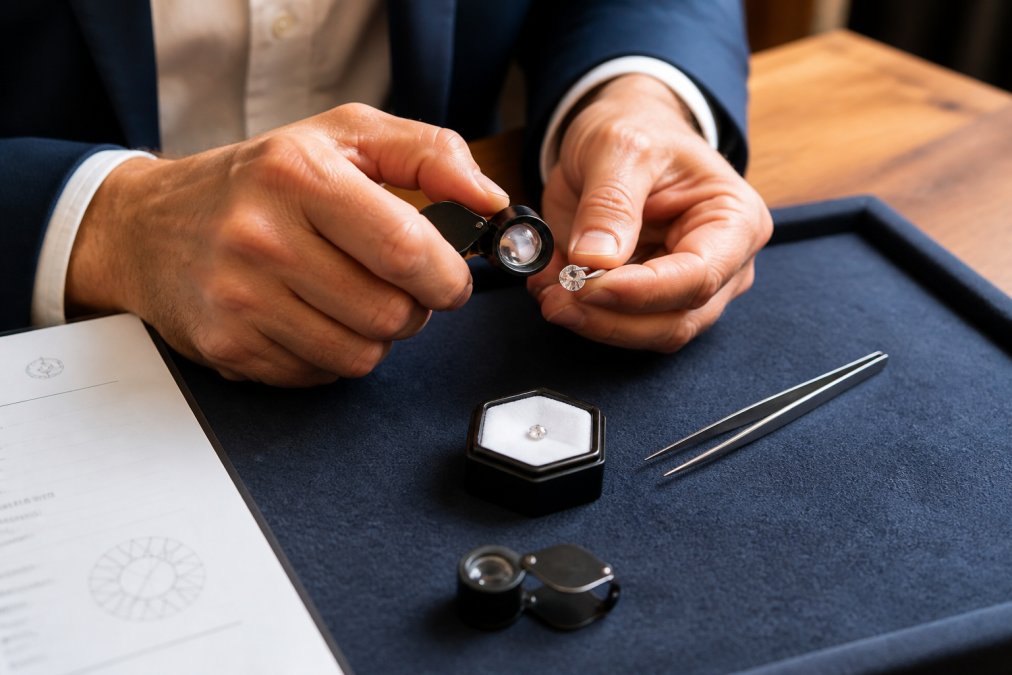
Start with the paperwork you can actually request:
- Kimberley Process certificate covering the rough stone's export and import
- Diamond grading report from an independent gemological laboratory
- Supplier statements naming the mine or country of origin
- Third-party audit reports from organisations that inspect mines and cutters directly
The most promising development is blockchain tracking. Several initiatives record a diamond's journey on a digital ledger at each handover, creating a tamper-resistant provenance record. It isn't universal and works best when every participant opts in, but it's a genuine step beyond paper certificates.
A common mistake buyers make is accepting a verbal assurance of origin. If it isn't documented, it isn't verified.
Lab-Grown vs Natural Diamonds Ethics: Which Choice Aligns With Your Values?
Lab-grown diamonds are created in a laboratory using processes that replicate how natural diamonds form underground. They are chemically and optically identical to mined diamonds, with a different ethical profile.
The comparison isn't "lab-grown good, mined bad." Both have trade-offs, and the right choice depends on what you prioritise.
| Factor | Lab-Grown Diamonds | Natural Diamonds |
|---|---|---|
| Origin certainty | High, created in controlled facilities | Varies by supply chain transparency |
| Land disturbance | Minimal | Depends on mine type and location |
| Labour exposure | Concentrated in fewer facilities | Spans artisanal and industrial mining |
| Community benefit | Limited local employment | Can support mining regions |
| Resale value | Lower and less established | Established secondary market |
Lab-grown stones sidestep many mining concerns but consume significant energy and raise their own production-standard questions. Natural diamonds can support mining-region livelihoods, but only when the supply chain is transparent and revenue reaches the community.
The honest answer: your values decide. If your priority is avoiding land disturbance, lab-grown has the edge. If you want to support artisanal mining communities and traceability is strong, a certified natural stone can be the more responsible choice.
Beyond Certification: Mining Impact, Community and Environmental Restoration
Certification is where ethical sourcing starts, not where it ends. The questions that matter most rarely appear on a certificate, and the gap between 'conflict free' and 'sustainably sourced' is where buyers get lost.
Conflict free means a diamond did not fund armed conflict. Sustainably sourced means the stone was extracted, processed, and traded in a way that respects labour rights, protects the environment, and delivers measurable benefit to the communities where mining happens. The first is a legal baseline. The second is a voluntary standard that only some sellers meet.
Post-Mining Community Impact: What Happens After the Mine Closes
Most guides stop at 'no violence'. The more useful question is what a mine leaves behind. Responsible operations often use a formal community development agreement, negotiated before extraction begins, to fund schools, clinics, roads, or water infrastructure during the mine's life and after closure.
When those agreements exist and are honoured, a mine can leave a region with better infrastructure than it found. When they don't, a community can be left with a closed pit, displaced families, and no replacement economy. The difference is rarely visible on a certificate. It shows up in whether the operator publishes its community investment, whether local employment figures are reported, and whether an independent body verifies the claims.
Environmental Restoration: What Happens to the Land
Environmental restoration, or reclamation, is the other overlooked factor. Responsible operators rehabilitate land after extraction, restoring topsoil, replanting native vegetation, and managing water systems so that pit lakes and tailings don't become long-term hazards. The International Council on Mining and Metals guidance sets out principles for environmental stewardship that go well beyond what any diamond certification requires.
Reclamation is expensive and slow. It can take decades. That's precisely why it's a useful signal: an operator that commits to it publicly, and reports progress against it, is demonstrating a long-term stake in the land. An operator that doesn't mention it is telling you something too.
Blockchain and Digital Ledger Tracking: Provenance You Can Actually Audit
Paper certificates can be forged, lost, or separated from the stones they describe. Blockchain tracking records each handover, mine to sorter, sorter to cutter, cutter to polisher, polisher to jeweller, on a ledger that cannot be altered after the fact.
Several industry initiatives now offer this: each participant logs the transfer, and the ledger creates a tamper-resistant provenance record. It isn't universal and works best when everyone opts in, but it's a genuine step beyond paper certificates.
A practical caveat: blockchain proves that a record exists and hasn't been changed. It does not prove that the record is true. If a participant logs a false origin, the ledger will faithfully preserve the falsehood. Blockchain is a tool for accountability, not a substitute for it.
Third-Party Audit Standards Beyond Kimberley
Independent auditors inspect mine sites, review labour practices, and check environmental compliance. The most recognised frameworks are the Responsible Jewellery Council (RJC) Code of Practices and OECD-aligned due diligence. These audits are voluntary, so brands that submit usually have less to hide.
What most guides miss is that the strongest ethical claims come from sellers who can name their suppliers, show their audit reports, and explain where the money goes. Transparency is the signal. Secrecy is the warning.
The Pros and Cons of Ethically Sourced Conflict Free Diamonds
Ethically sourced diamonds offer real benefits and genuine trade-offs:
Pros:
- Documented provenance gives you confidence in what you're buying
- Certification and audits reduce exposure to human rights abuses
- Choosing verified stones supports responsible mining practices
- Grading reports confirm quality independently of the seller's claims
Cons:
- Verified stones often cost more than undocumented alternatives
- Certification covers the rough trade only, not the full supply chain
- Voluntary audits mean standards vary between sellers
- Blockchain traceability remains limited to a small share of the market
The premium you pay for verified provenance reflects real work: audits, documentation, and accountable supply chains. At Diamonds by daisy, every piece is crafted with handpicked gemstones and precious metals, and our 30-day satisfaction guarantee means you can buy with confidence.
Frequently Asked Questions
Are there ethically sourced real diamonds?
Yes. Real, mined diamonds can be ethically sourced when they come through audited supply chains that go beyond basic certification. Look for documented provenance, third-party audit reports covering labour and environment, and evidence of fair wages at the mining stage. The Kimberley Process blocks rebel-mined stones from legal trade, but it does not cover labour conditions or environmental restoration, so additional assurance matters if those issues drive your purchase.
What percent of diamonds are ethically sourced?
No single figure covers every definition of ethical sourcing. The Kimberley Process covers roughly 99% of the global rough diamond trade, but that measures conflict-free status only. It excludes artisanal mining conditions, fair wages, and environmental impact. If you define ethical sourcing more broadly, the share of fully verified stones is much lower. Ask your jeweller for specifics rather than relying on a headline percentage.
How can I verify the origin of my diamond?
Ask for the diamond grading report and the mine-to-market documentation behind it. Reputable sellers can show a chain of custody, from the mine or cutting centre to the finished piece. Blockchain-based ledgers, used by some larger producers, add a tamper-resistant record at each handover. If a seller cannot say where the stone came from or which audit standard applies, treat that as a gap rather than a guarantee.
Is it illegal to buy conflict diamonds?
Yes. Trading in rough diamonds that fund armed conflict is prohibited under the Kimberley Process, which the UK implements through retained legislation. All rough diamonds entering or leaving signatory countries must travel with a Kimberley Process Certificate. Buying a stone without that certification, or one with falsified paperwork, is unlawful. For polished stones, enforcement relies on retailer due diligence, so documentation still matters at the point of sale.
The gap between a "conflict free" label and a genuinely ethical stone is wider than most buyers realise. Closing it takes documentation, verified provenance, and a seller willing to show their work. At Diamonds by daisy, we handpick every gemstone and precious metal, back each piece with a 30-day satisfaction guarantee, and design jewellery meant to be worn for decades, not seasons. Add to cart with confidence, knowing the details behind your diamond are as considered as the piece itself.