

What Are the 4 Cs of Diamond Quality? A 2026 Guide
Table of Contents
- What Are the 4 Cs of Diamond Quality?
- Diamond Cut: The Most Important C
- Diamond Colour Scale Explained
- Understanding Diamond Clarity
- Diamond Carat Weight vs Size
- Diamond Cut vs Shape: What's the Difference?
- How the 4 Cs Affect Diamond Value and Price
- The 5th C: Diamond Grading Report and Certification
- Frequently Asked Questions
Last Updated: September 13, 2026
What Are the 4 Cs of Diamond Quality?
The 4 Cs of diamond quality are cut, colour, clarity and carat weight, the four universally recognised characteristics that determine a diamond's beauty and value. This guide from Diamonds by daisy explains what each one means, so you can judge a stone with confidence rather than guesswork.
Buying a diamond without understanding these four factors is like buying a car without checking the engine. The certificate tells you plenty, but only if you know what you're reading.
A Brief History of the 4 Cs
The 4 Cs framework was introduced by the Gemological Institute of America in the 1940s and 1950s, replacing a vague and inconsistent vocabulary that varied from one dealer to the next. The GIA's diamond grading documentation sets out how each of the four characteristics is assessed.
That standardisation matters. Before it, "perfect" could mean almost anything. Today, a grading report gives you a shared language, which is exactly what you need when comparing two stones side by side.
Diamond Cut: The Most Important C
Cut is the most important of the 4 Cs of diamond quality because it governs how much light returns to the eye. A well-cut diamond reflects light back through the top; a poorly cut one lets it leak out of the sides, leaving the stone dull.
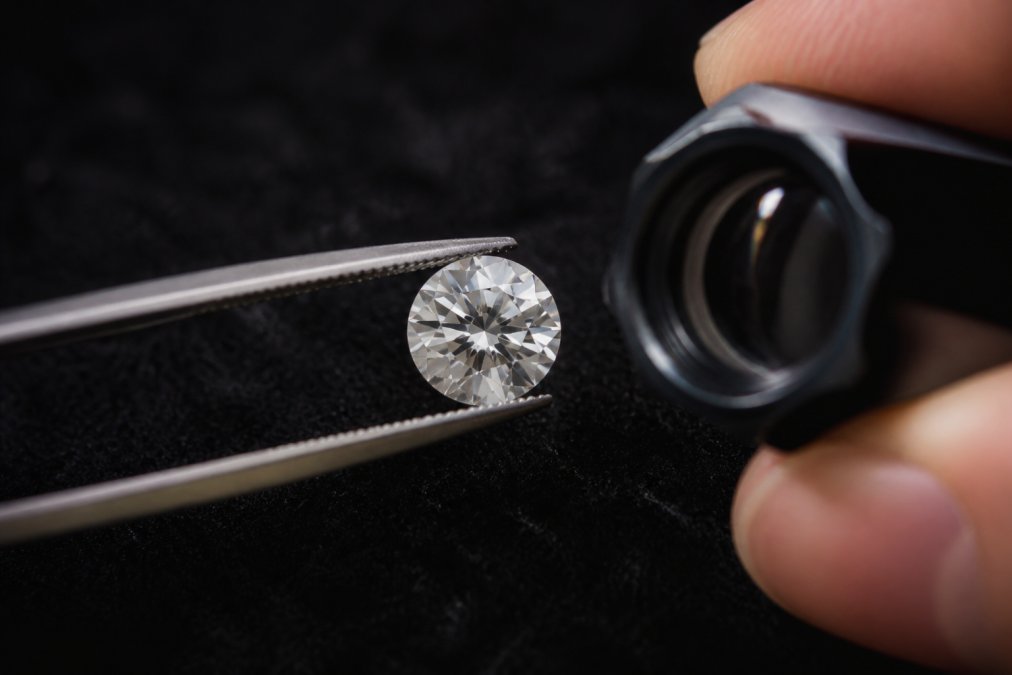
Cut is not the same as shape, a distinction that trips up plenty of buyers.
Cut Grading: From Excellent to Poor
Cut grades run from Excellent down through Very Good, Good, Fair and Poor. Excellent means the proportions, symmetry and polish all work together to return light efficiently. At the Fair and Poor end, you'll see visible dark patches and reduced sparkle even in a stone with a high clarity grade.
How Cut Affects Brilliance, Fire and Scintillation
Three light behaviours define a well-cut stone:
- Brilliance is the total white light reflected back to the viewer
- Fire is the rainbow flashes created when white light splits into spectral colours
- Scintillation is the pattern of light and dark flashes as the stone moves
A stone with an Excellent cut grade will outperform a larger, higher-clarity stone with a mediocre cut almost every time. That's why cut should be your first priority, not your last.
Diamond Colour Scale Explained
The diamond colour scale runs from D, colourless, to Z, light yellow or brown. D to F are colourless, G to J are near-colourless, and K onwards show noticeable warmth to the naked eye.
Grading happens under controlled lighting against a master set of stones. In everyday wear, the difference between a D and a G is often invisible, which is why near-colourless grades offer strong value.
Colourless vs Near-Colourless: What the Grades Mean
The distinction comes down to how much tint is visible face-up. A D-grade stone is essentially colourless. A G-grade stone shows a trace of warmth only to a trained eye. For yellow gold settings, that warmth often disappears entirely against the metal.
Understanding Diamond Clarity
Clarity describes how free a diamond is from internal flaws, called inclusions, and surface flaws, called blemishes. The scale runs from Flawless down to Included, with most commercial stones falling in the VS to SI range.
A gemologist examines the stone under a loupe and microscope at ten times magnification (gia.edu). What matters for you is whether a flaw is visible to the naked eye, not whether it exists at all.
Inclusions, Blemishes and the Clarity Grade
Common inclusions include crystals, clouds and feathers. Blemishes cover surface nicks, scratches and extra facets. Most VS and SI stones look perfectly clean in normal viewing, so paying for Flawless clarity rarely changes what you see.
Diamond Carat Weight vs Size
Carat weight measures mass, not physical size. One carat equals 200 milligrams. Two stones of identical carat weight can look very different depending on how the cutter distributed the weight.
A shallow stone spreads wide but loses light. A deep stone hides weight in the base, where it does nothing for the face-up appearance. This is why carat is the weakest of the 4 Cs on its own, and why a well-proportioned 0.9-carat stone can look larger than a poorly cut 1-carat one.
| The 4 Cs | What It Measures | Priority for Most Buyers |
|---|---|---|
| Cut | Light performance | Highest |
| Colour | Absence of tint | Medium |
| Clarity | Internal and surface flaws | Medium |
| Carat | Mass in milligrams | Lowest alone |
Diamond Cut vs Shape: What's the Difference?
Cut refers to proportions, symmetry and polish; shape refers to the outline of the stone. Round brilliant, oval, emerald, pear and marquise are shapes. Each can be cut well or badly.
This is the single most common confusion in diamond buying. A beautifully shaped oval with a Fair cut grade will disappoint. A plain round with an Excellent cut will sing.
How the 4 Cs Affect Diamond Value and Price
Every one of the 4 Cs moves value, but not equally, and understanding the mechanics lets you spend where it shows. The general pattern most practitioners observe is that carat and clarity carry the steepest price premiums, while cut carries the most visual return. That mismatch is where smart buying happens.
Why Grade Jumps Cost More Than They Show
Price does not rise in a straight line across a grading scale; it steps up sharply at certain thresholds. Two patterns are worth knowing:
- Carat magic weights. A stone just under a round number, 0.90ct rather than 1.00ct, or 1.90ct rather than 2.00ct, is often priced noticeably lower per carat because it falls below a psychological and commercial threshold. Face-up, the size difference is usually imperceptible.
- Clarity and colour plateaus. Moving from SI1 to VS2, or from H to G, typically adds cost without changing what the unaided eye sees. The jump from VS to VVS, and from G to D, is where premiums accelerate fastest relative to visible benefit.
A Trade-Off Framework for Real Budgets
Rather than treating the 4 Cs as four equal dials, decide which one to protect and which to flex. The table below sets out the usual priorities at three broad budget bands. Treat it as a starting position, not a rule.
| Budget band | Protect first | Flex next | Trade last |
|---|---|---|---|
| Entry | Cut (Excellent or Very Good) | Colour (I-J) | Clarity (SI1-SI2, eye-clean) |
| Mid | Cut (Excellent) | Clarity (VS2-SI1) | Colour (G-H) |
| Higher | Cut (Excellent) | Colour (F-G) | Clarity (VS1-VS2) |
Two principles sit behind the table:
- Never trade cut for carat. A larger stone with a Fair cut reads as smaller and duller than a smaller, well-cut one, because light leaks instead of returning to the eye.
- Buy clarity you can see, not clarity on paper. If a grade is eye-clean in normal viewing, the premium above it buys a certificate line, not a difference.
Where Provenance Fits Into Value
Ethical sourcing is increasingly part of how value is judged, not an afterthought. Provenance and traceability now influence resale perception and buyer confidence, particularly for online purchases where the stone cannot be handled first. Guidance from the Responsible Jewellery Council on ethical sourcing explains what responsible supply chains look like in practice, and lab-grown versus natural origin is a separate value axis that sits alongside the 4 Cs rather than replacing them.
The 5th C: Diamond Grading Report and Certification
A grading report is the fifth C, and it's the one that protects you. The report records the cut, colour, clarity and carat weight of a specific stone, assessed by an independent laboratory. Without one, you're relying on the seller's word, and a report is only as useful as your ability to verify it.
What a Report Actually Contains
A full report is more than four grades. Look for:
- The four grades, cut, colour, clarity and carat weight, stated for that specific stone
- Measurements and proportions, table percentage, depth percentage, girdle thickness, culet and finish grades
- A clarity plot, a diagram mapping the position and type of inclusions, which should match what you see under magnification
- Fluorescence, noted separately, since strong fluorescence can affect appearance in some lighting
- The report number and laboratory name, the two details you will use to verify it
How to Verify a Certificate Before You Buy
This is the step most guides skip, and it is the one that matters most for online purchases.
- Check the laboratory. Reports from the major international grading laboratories carry more weight than in-house or unknown ones. An in-house "certificate" from the seller is a sales document, not independent verification.
- Look up the report number. Most recognised laboratories publish an online verification tool. Enter the report number and confirm the grades, measurements and photograph match the document you were shown.
- Match the plot to the stone. The plotted inclusions should correspond to what is visible under a loupe. A plot that does not match is a red flag.
- Confirm the laser inscription. Many stones carry the report number laser-inscribed on the girdle. Ask the seller to confirm it, or have an independent jeweller check it on receipt.
- Watch for reused images. If the same photograph appears across multiple listings, treat it with suspicion.
Why This Matters Beyond the Purchase
A verifiable report is what makes resale, valuation and insurance straightforward later on. Insurers and valuers work from the documented grades, and a stone without independent certification is harder to value and harder to replace like for like.
At Diamonds by daisy, every piece is crafted with handpicked gemstones and precious metals, and each purchase is backed by a 30-day satisfaction guarantee, so you can judge the stone in person and in your own light.
Frequently Asked Questions
Which of the 4 Cs is most important when buying a diamond?
Cut matters most. A well-cut diamond with excellent symmetry and polish reflects light properly, giving it brilliance and fire even if colour or clarity grades are slightly lower. A poorly cut stone can look dull regardless of how colourless or flawless it is. Prioritise cut grade first, then balance colour, clarity and carat weight against your budget. A diamond grading report from a recognised laboratory will confirm the cut grade before you buy.
What is the difference between diamond colour and clarity?
Colour measures how colourless a diamond is, graded on a scale from D (colourless) to Z (light yellow or brown). Clarity measures the presence of internal inclusions and surface blemishes, graded from Flawless to Included. A diamond can have excellent colour but visible inclusions, or flawless clarity but a warm tint. Both affect diamond quality and value, but cut grade usually has the greatest visual impact.
How is diamond carat weight measured?
Carat weight is measured in metric carats, where one carat equals 200 milligrams. A carat is divided into 100 points, so a 0.50ct diamond is also called a 50-pointer. Carat weight does not directly equal physical size because density and cut proportions vary. Two diamonds of the same carat weight can look different in diameter depending on how deeply they are cut. Always compare carat weight alongside the grading report's measurements.
Are the 4 Cs the same for all types of diamonds?
The 4 Cs apply to all diamonds, but how they are graded varies by shape. Round brilliants have a standardised cut grading system, while fancy shapes such as oval, pear or emerald cuts are graded differently because their proportions cannot be compared on the same scale. Colour and clarity grading remain consistent across shapes. Certification from a recognised laboratory ensures the grades are applied fairly regardless of diamond shape.
Why should I look for a certified diamond?
A diamond grading report from an independent laboratory verifies the 4 Cs and confirms the diamond is natural and untreated, unless stated otherwise. Without certification, you are relying on the seller's word. A grading report also supports resale value because future buyers can verify the specifications. Ask to see the report before purchase and check that the report number matches the diamond.
How does diamond cut affect the overall brilliance?
Cut determines how light enters, reflects and exits a diamond. When proportions, symmetry and polish are correct, light bounces from facet to facet and returns through the table, creating brilliance (white light), fire (coloured flashes) and scintillation (sparkle when moved). A cut that is too deep or too shallow lets light leak out the bottom, making the stone appear dark or lifeless even if colour and clarity are high.
Choosing a diamond comes down to knowing which of the 4 Cs of diamond quality actually changes what you see, and refusing to overpay for the ones that don't. Diamonds by daisy handpicks its gemstones and precious metals, designs each piece with a refined, timeless aesthetic, and stands behind every order with a 30-day satisfaction guarantee. Get started with Diamonds by daisy and choose a piece you'll be confident in for decades.