

Identifying Authentic British Hallmark Symbols: A Complete Guide
Table of Contents
- What Is a Hallmark and Why It Matters
- The Four Assay Offices and Their Symbols
- Understanding the Components of a Full Hallmark
- How to Read Date Letters on Jewellery
- How to Check Jewellery Authenticity
- Practical Steps to Identify Your Hallmarks
- Conclusion
Last Updated: August 28, 2026
What Is a Hallmark and Why It Matters
A hallmark is an official mark stamped onto precious metal jewellery to certify its purity and authenticity. These marks represent a centuries-old system of consumer protection, guaranteeing that the piece contains the claimed amount of precious metal. Understanding hallmarks transforms you from a casual buyer into an informed one, you'll know exactly what you're paying for and whether a piece holds its value.
The hallmarking system emerged because precious metals are invisible to the naked eye. A ring that looks identical to another might contain 50% gold or 95% gold. Without verification, buyers had no way to know. Hallmarks solve this by providing government-backed assurance of metal content, maker identity, and the year of manufacture.
For anyone investing in fine jewellery, recognising authentic british hallmark symbols is essential. A piece without proper hallmarks raises immediate questions about its legitimacy. Conversely, a piece bearing clear, correctly-positioned hallmarks signals quality and and trustworthiness. At Diamonds by daisy, we understand that our clients demand transparency about the precious metals in their pieces, which is why proper hallmarking is fundamental to every item we curate. Counterfeit hallmarks exist, and knowing how to read them protects you from overpaying for low-quality metal and helps you authenticate vintage and antique pieces with confidence.
The Four Assay Offices and Their Symbols
The hallmarking system in the UK operates through four independent assay offices, each with its own distinct symbol (assay.org.uk). These offices are the only bodies legally authorised to apply official hallmarks to precious metals.
London Assay Office uses a leopard's head as its symbol, a crowned head facing left in profile. This is the oldest and most recognised mark, dating back centuries, and appears on the vast majority of hallmarked jewellery circulating today.
Birmingham Assay Office marks its pieces with an anchor symbol, representing the city's maritime heritage and industrial strength. The anchor is unmistakable once you know what to look for.
Sheffield Assay Office uses a crown as its symbol, reflecting Sheffield's royal connections and reputation for high-quality metalwork. Many antique and vintage pieces, particularly silver items, bear this mark.
Edinburgh Assay Office applies a thistle symbol to mark pieces tested in Scotland. The thistle is Scotland's national emblem. Scottish jewellery, particularly items made from the 18th century onwards, frequently carries this mark.
Each symbol represents a specific assay office with its own testing protocols and historical records. When evaluating a piece's authenticity, confirming the correct assay office mark for its claimed origin is essential.
Understanding the Components of a Full Hallmark
A complete hallmark typically consists of four separate marks: the sponsor's mark, the fineness mark, the assay office symbol, and the date letter. Each element serves a distinct purpose in the certification chain.
The Sponsor's Mark and Maker's Mark
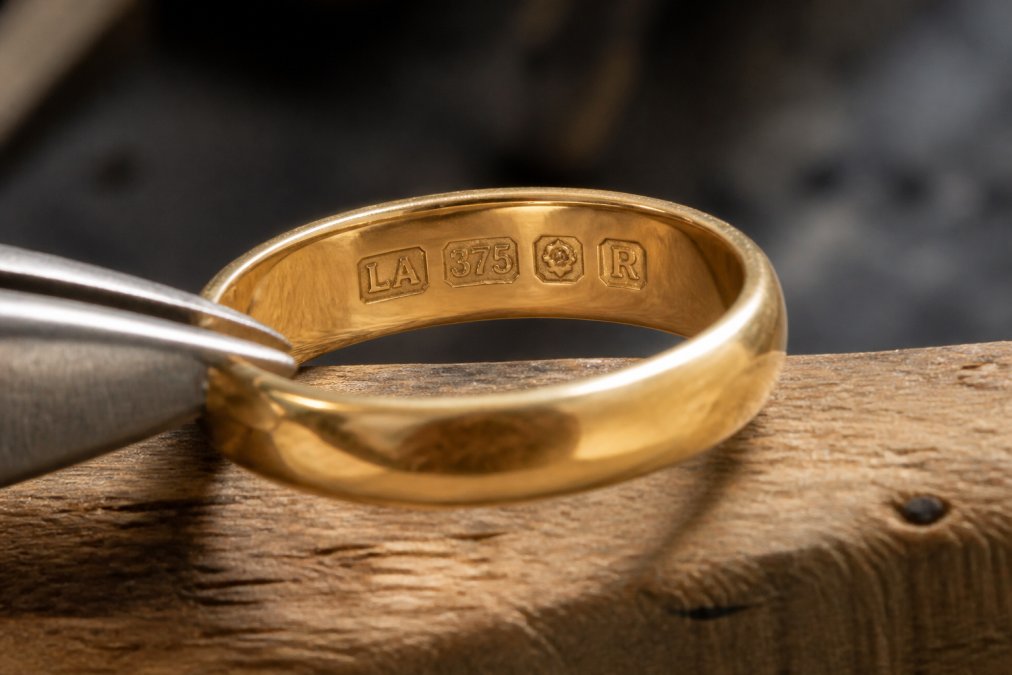
The sponsor's mark, also called the maker's mark, identifies the person or company responsible for the piece. This mark usually consists of initials or a small symbol enclosed in a distinctive shape, often a cartouche, shield, or oval.
Finding a sponsor's mark matters because it creates accountability, helps establish provenance, and allows you to research the piece's history. Many assay offices maintain registers of sponsor's marks, and specialist dealers can sometimes trace a maker's working period and reputation. The sponsor's mark appears first in the hallmark sequence, typically the leftmost mark in the grouping.
Fineness Marks: Traditional and Millesimal
Fineness marks indicate the purity of the precious metal, the percentage of pure metal versus alloy. Two systems exist: traditional fineness symbols and millesimal fineness marks.
Traditional fineness symbols use pictorial images. For sterling silver, you'll see a lion passant (a walking lion) facing left. For gold, a crown with a number indicates the carat rating. For platinum, a different crown symbol applies. These traditional marks have been used for centuries and remain common on older pieces.
Millesimal fineness marks display the actual percentage of pure metal as a three- or four-digit number. Sterling silver is marked 925, meaning 925 parts per thousand are pure silver. Gold marked 750 contains 75% pure gold (18-carat). Platinum marked 950 is 95% pure platinum.
Both systems are legitimate and legally required. Understanding fineness marks is crucial because they determine the piece's actual value. A ring marked 375 (9-carat gold) contains significantly less pure gold than one marked 750 (18-carat), and the price should reflect this difference.
How to Read Date Letters on Jewellery
Date letters identify the year a piece was hallmarked, which typically corresponds to the year it was made. Each assay office uses its own alphabetical sequence, and the letter style changes periodically, usually every 20 to 30 years.
The date letter appears in the hallmark sequence and is usually enclosed in a distinctive shield or frame. The shape and style of the frame itself often indicates which assay office applied the mark and which cycle the letter belongs to.
To identify a date letter correctly, you need to know three things: which assay office applied it (determined by the assay office symbol), which cycle it belongs to (determined by the shape of the letter's frame), and which letter it is (A through Z, skipping J). Cross-referencing these details against a hallmark date chart reveals the exact year. Specialist dealers and appraisers use hallmark reference books that show every cycle for every assay office.
Date letters serve practical purposes beyond curiosity. They help establish whether a piece is genuinely antique or a modern reproduction, confirm the maker's working period, and provide historical context for the piece's design and craftsmanship. For collectors and investors, the date letter can significantly influence a piece's desirability and value.
How to Check Jewellery Authenticity
Authenticating a piece requires examining the hallmarks systematically. Start by confirming that all four components are present: sponsor's mark, fineness mark, assay office symbol, and date letter. A missing element suggests the piece may not have been officially hallmarked.
Next, verify that the marks are properly struck. Authentic hallmarks are stamped with precision, creating clear, consistent impressions. The marks should be sharp and well-defined, not blurry or shallow. Run your finger over the marks; you should feel the indentation. Counterfeit hallmarks are often poorly executed, with fuzzy edges or inconsistent depth.
Check the positioning. Hallmarks are typically grouped together in a specific sequence and location on the jewellery. For rings, they usually appear on the inner band. For bracelets and bangles, they're typically on a flat surface. For chains, they're often on a clasp or tag. Marks scattered randomly or positioned unusually should trigger scepticism.
Examine the fineness mark against the metal's apparent quality. An 18-carat gold mark should correspond to a piece that looks and feels like high-quality gold. If the piece looks pale or feels unusually light for its size, the fineness mark may be incorrect or fraudulent.
Spotting Counterfeit and Fake Hallmarks
Counterfeit hallmarks are stamped onto pieces that haven't been officially tested. Scammers do this to justify inflated prices by falsely claiming higher purity than the metal actually contains.
Poor execution is the most obvious tell. Counterfeit marks are often struck with inadequate pressure, creating shallow, blurry impressions. Authentic hallmarks are crisp and consistent.
Inconsistent positioning is another red flag. Official hallmarks follow strict placement standards. Marks scattered randomly, overlapping awkwardly, or positioned in unusual locations suggest someone applied them after manufacture.
Mismatched components reveal fraud. If a piece bears a London leopard's head but the date letter cycle doesn't match London's records, something is wrong. Cross-referencing all elements against historical hallmark records catches these inconsistencies.
Marks that are too perfect can indicate counterfeiting. Genuine antique marks show age, slight wear, and minor irregularities. A 100-year-old piece shouldn't have pristine, fresh-looking hallmarks.
Missing or incomplete marks are common in counterfeits. Scammers sometimes omit the date letter or sponsor's mark because they lack detailed knowledge of the hallmarking system.
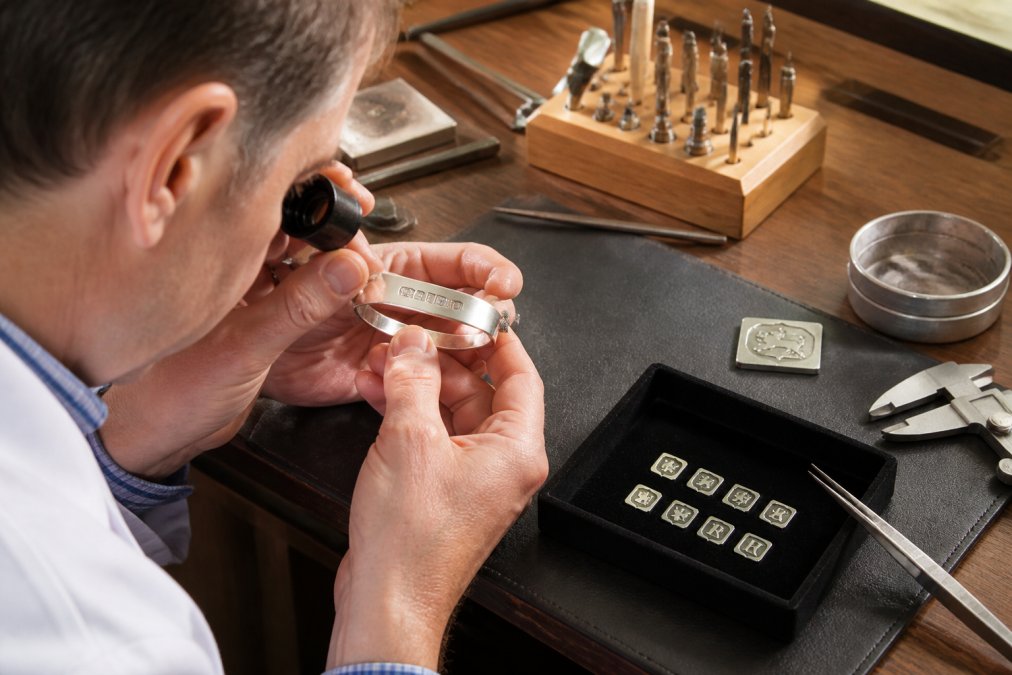
The most reliable defence against counterfeits is professional verification. A qualified jeweller or hallmark appraiser can examine the marks under magnification, test the metal's actual purity, and cross-check against official hallmark records.
Practical Steps to Identify Your Hallmarks
Identifying hallmarks on your own pieces requires patience and the right tools. Start with good lighting, natural daylight or a bright lamp helps you see the marks clearly. Use magnification; a jeweller's loupe (10x magnification) is ideal, but even a smartphone magnifying app helps you see fine details.
Look for the grouping of marks on the jewellery. On rings, check the inner band carefully. On bracelets and bangles, examine flat surfaces. On pendants and lockets, check the back or the attachment point. On chains, look at the clasp or any attached tags.
Once you've located the marks, identify each component in sequence. Start with the assay office symbol, which narrows down which hallmarking system applies. Then locate the fineness mark and note its format. Find the sponsor's mark and the date letter.
Write down what you see, sketch the marks if helpful, and photograph them clearly. Cross-reference your observations against a hallmark reference guide. If you're uncertain at any point, consult a professional. For valuable pieces or those with unclear marks, professional authentication is the safest approach.
| Hallmark Component | What It Shows | How to Identify |
|---|---|---|
| Assay Office Symbol | Which office tested the piece | Leopard's head (London), Anchor (Birmingham), Crown (Sheffield), Thistle (Edinburgh) |
| Fineness Mark | Purity of the precious metal | Lion passant for sterling silver; crown with number for gold; millesimal numbers like 925 or 750 |
| Sponsor's Mark | The maker or company | Initials or symbol in a shield or cartouche shape |
| Date Letter | Year of hallmarking | Single letter A-Z in a distinctive frame, varies by assay office and cycle |
Identifying authentic british hallmark symbols protects your investment and builds confidence in your jewellery purchases. Whether you're buying, selling, or inheriting precious metal pieces, understanding these marks separates informed buyers from vulnerable ones. The hallmarking system has protected consumers for centuries; learning to read it takes you inside that tradition of trust and transparency.
At Diamonds by daisy, we believe every piece deserves to be understood fully. Our curated collection features meticulously handpicked gemstones and precious metals, each bearing the hallmarks that verify their authenticity and quality. When you choose a piece from our collection, you're investing not just in beauty but in verified craftsmanship and genuine precious metal content. Explore our collection with confidence, backed by our 30-day satisfaction guarantee, because your peace of mind matters as much as the elegance of your jewellery.
=== FAQ ANSWERS (audit these too, same rules) ===
Frequently Asked Questions
Q: How do I identify British silver hallmarks?
A: British silver hallmarks contain four mandatory marks: the sponsor's mark (maker's initials), the lion passant (fineness mark for sterling silver), the assay office mark (location symbol), and the date letter. Look for these symbols stamped together on the piece, typically on the inside of rings or the underside of larger items. Sterling silver will always show the lion passant, whilst the assay office mark tells you where the piece was tested and approved.
Q: What are the three mandatory marks on British jewellery?
A: The three core mandatory marks are the sponsor's mark (identifying the maker or sponsor), the standard mark (fineness symbol showing precious metal content), and the assay office mark (indicating which of the four assay offices verified the piece). On items made after 1999, a date letter is also required. Together these marks guarantee the jewellery meets hallmarking act standards and contains the stated precious metal content.
Q: How can I tell if a jewellery hallmark is real?
A: Authentic hallmarks are struck with precision and clarity, with sharp, even edges and consistent depth. Counterfeit marks often appear fuzzy, shallow, or misaligned. Check that all four components (sponsor's mark, fineness symbol, assay office mark, and date letter) are present and properly aligned. Verify the assay office mark matches one of the four official locations: London, Birmingham, Sheffield, or Edinburgh. If marks are missing, poorly executed, or inconsistent, the piece may not be authentic.
Q: Where can I find an official British hallmark finder?
A: The Hallmark Register, maintained by the four assay offices, is a resource for verifying hallmarks. You can search by sponsor's mark, date letter, and assay office to confirm a piece's authenticity and age. Many jewellery appraisers and antique dealers also use this register. If you're purchasing fine jewellery, requesting a certified appraisal report that references the hallmark verification can be helpful.
This article was written using GrandRanker