

Buy Fine Jewellery Online Safely: 7 Essential Tips
Table of Contents
- Verify the Retailer's Reputation and Business Credentials
- Understand Hallmarking Requirements in the UK
- Check Diamond Certification and Gemstone Quality
- Examine Product Photography and Detailed Descriptions
- How to Measure Ring Size at Home
- Secure Your Payment and Know Your Consumer Rights
- Review Return Policies, Warranty and Post-Purchase Authentication
- Frequently Asked Questions
Last Updated: September 24, 2026
Verify the Retailer's Reputation and Business Credentials
Before spending significant money on fine jewellery online, confirm that the retailer is a legitimate, established business. Check how long they've been operating, whether they have physical premises or a verifiable business address, and what their track record looks like across independent review platforms.
A common mistake is assuming that a polished website alone signals trustworthiness. Many scam sites invest heavily in professional design. Instead, search for the retailer's name alongside words like "reviews," "complaints," or "scam." Look for patterns in customer feedback across multiple platforms, not just testimonials on their own site. Independent review sites, consumer forums, and social media comments reveal genuine customer experiences.
Verify their business registration with Companies House if they operate in the UK. Legitimate fine jewellery retailers will have a registered business number you can cross-reference. Check whether they belong to trade associations like the British Jewellers' Association or the National Association of Goldsmiths, which require members to meet specific standards and offer dispute resolution services. These memberships aren't guarantees, but they signal accountability.
Look for clear contact information: a physical address, phone number, and email. Reach out with a question before you buy. How quickly and helpfully they respond tells you something about their customer service standards. Reliable retailers answer questions thoroughly and don't rush you toward checkout.
Understand Hallmarking Requirements in the UK
Every piece of fine jewellery sold in the UK must carry a hallmark unless it's below the minimum weight threshold. Understanding hallmarking requirements protects you from unknowingly purchasing unmarked or misrepresented pieces.
In the UK, hallmarking is governed by the Hallmarking Act 1973. Gold, silver, and platinum jewellery above certain weights must be assayed and hallmarked by an authorised assay office. The hallmark tells you three things: the metal type, the purity (fineness), and the assay office that verified it. For example, a "750" mark on gold means 75% pure gold (18 karat).
When you buy fine jewellery online, ask the retailer to photograph the hallmark or provide documentation confirming it. If a piece is described as gold, silver, or platinum but has no hallmark and exceeds the minimum weight, that's a red flag. Legitimate retailers understand this requirement and can readily provide proof of hallmarking.
The four UK assay offices are located in London, Birmingham, Sheffield, and Edinburgh. Each has a distinctive punch mark on the hallmark. Familiarising yourself with these marks helps you verify authenticity.
Check Diamond Certification and Gemstone Quality
When buying diamonds or high-value gemstones online, certification from an independent grading laboratory is essential. A GIA report (Gemological Institute of America) or equivalent certification provides an objective assessment of the stone's characteristics, including cut, colour, clarity, and carat weight.
Ask the retailer whether the diamond or gemstone comes with a grading report. Reputable sellers provide this documentation or can arrange it before purchase. The report should include a unique identification number that matches the stone you receive, protecting you against substitution.
Understand the "four Cs" of diamond quality: carat weight, cut, colour, and clarity. Each affects both the stone's appearance and its price. A lower-carat diamond with excellent cut and colour may appear more brilliant than a larger stone with poor proportions. The grading report explains these characteristics in detail, helping you understand what you're paying for.
For gemstones other than diamonds, certification is equally important. Rubies, sapphires, and emeralds vary dramatically in quality and value. A certified gemstone report confirms the stone's identity, natural origin (or whether it's been treated), and quality grade. This protects your investment and ensures you're not unknowingly purchasing a synthetic or heavily treated stone.
Diamonds by daisy sources meticulously handpicked gemstones. When you buy fine jewellery online safely, you deserve to know exactly what you're acquiring.
Examine Product Photography and Detailed Descriptions
High-quality product photography is one of your best defences against receiving jewellery that looks different from what you expected. Professional photographs show the piece from multiple angles, in different lighting conditions, and often alongside a size reference.
Look for retailers who provide close-up images of the metalwork, gemstone setting, and any intricate details. Photographs taken under harsh studio lighting, soft natural light, and even indoor lighting reveal how the piece will look in real life. A single, heavily filtered image is insufficient. Multiple angles help you assess the piece's proportions, symmetry, and finish.
Read the product description carefully. It should specify the metal type and purity, gemstone type and quality, dimensions, weight, and any special features like engravings or custom settings. Vague descriptions like "beautiful diamond ring" provide no protection. Detailed descriptions should match the photographs and include technical specifications.
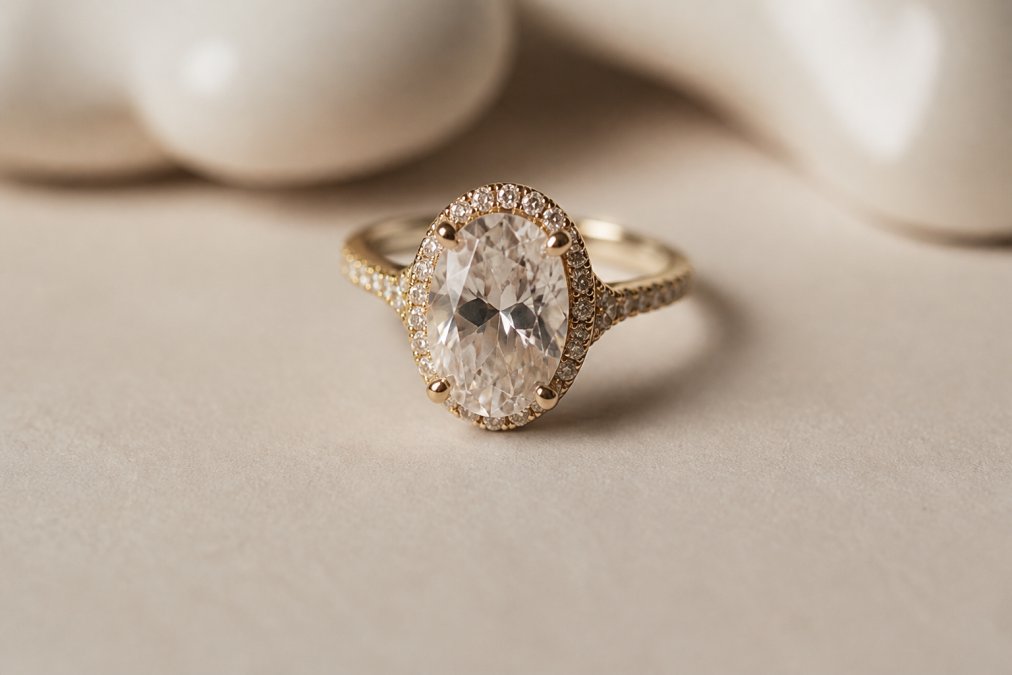
Ask the retailer whether they can provide additional photographs or a video call showing the piece in person. Some retailers offer this service for high-value items. Seeing the piece from multiple angles and in real-time lighting conditions significantly reduces the risk of disappointment. Close inspection during these sessions also provides an opportunity for identifying antique hallmarks that confirm the provenance and authenticity of older pieces.
How to Measure Ring Size at Home
Ordering rings online requires knowing your correct ring size. Measuring at home is straightforward if you follow the right method, and it's far cheaper than ordering the wrong size and paying for resizing.
Use a ring you already wear and know fits comfortably. Place it on a flat surface and measure the inside diameter with a ruler or caliper in millimetres. Cross-reference this measurement against a ring size chart. UK ring sizes run from A to Z+4, with each size representing a specific internal diameter.
Alternatively, wrap a strip of paper or string around your finger at the widest point, mark where it overlaps, and measure the length. Convert this circumference to a ring size using an online calculator or chart. Measure in the evening when your fingers are slightly swollen, as they expand throughout the day.
Width matters too. Wider bands require a slightly larger size than narrow ones for the same comfort level. If you're ordering a significantly wider ring than you normally wear, consider going up half a size. When in doubt, contact the retailer and describe your usual ring size and the band width. Experienced jewellers can advise on the best fit.
Most online retailers accept ring resizing within a certain range at no charge or for a small fee. However, it's easier and faster to get the size right from the start. Take time to measure carefully, and don't hesitate to ask the retailer for guidance.
Secure Your Payment and Know Your Consumer Rights
Online payment security is critical when spending significant money on fine jewellery. Use a credit card or a secure payment gateway rather than bank transfer or cryptocurrency, which offer no protection if something goes wrong.
Credit card payments are protected under the Consumer Rights Act 2015. If the retailer fails to deliver the item, delivers a damaged piece, or the jewellery doesn't match the description, you have the right to a refund, replacement, or compensation.
Review Return Policies, Warranty and Post-Purchase Authentication
Before completing your purchase, read the return policy in full. A reputable retailer clearly states the timeframe for returns, any restocking fees, and the condition the item must be in. Diamonds by daisy offers a 30-day satisfaction guarantee, giving you time to inspect the piece in person and decide whether it meets your expectations.
| Step | Key Action | Why It Matters |
|---|---|---|
| Verify retailer | Check Companies House, trade associations, reviews | Confirms legitimacy and accountability |
| Check hallmarks | Request photographs or documentation of hallmarks | Proves metal purity and authenticity |
| Request certification | Ask for GIA or equivalent gemstone reports | Confirms gemstone quality and identity |
| Examine photos | Look for multiple angles and detailed descriptions | Reduces risk of receiving wrong item |
| Measure ring size | Use existing ring or paper method | Avoids costly resizing |
| Secure payment | Use credit card or verified payment gateway | Provides consumer protection |
| Review returns | Understand timeframe and conditions | Ensures you can return if dissatisfied |
| Post-purchase appraisal | Have independent gemologist verify piece | Confirms authenticity and value |
Frequently Asked Questions
How can I verify the authenticity of fine jewellery purchased online?
Request a GIA report or independent gemstone certification before purchase. Check for UK hallmarks on precious metals, these are legally required and indicate purity. Ask the retailer for their authentication process and whether they offer post-purchase verification. Reputable sellers provide detailed gemstone grading reports and allow you to inspect hallmarks and certifications upon delivery. Third-party verification services can also authenticate pieces after arrival.
What consumer rights do I have when buying jewellery online under the Consumer Rights Act 2015?
The Consumer Rights Act 2015 protects online jewellery buyers with rights to goods that are of satisfactory quality, fit for purpose, and as described. You have 14 days to cancel your order without reason, and 30 days to report faults. If a piece arrives damaged or misrepresented, you can request a full refund or replacement. Sellers must provide clear information about materials, hallmarks, and gemstone specifications before purchase.
What should I look for in an online jeweller's returns policy?
A trustworthy returns policy should offer at least 14-30 days for returns, cover shipping costs for faults or misrepresentation, and clearly state the condition required for return. Check whether the jeweller accepts returns for changes of mind or only for defects. Verify that returns are processed promptly and that you receive a full refund or replacement. Look for policies that cover secure return shipping and insurance, protecting your investment during transit.
How do I ensure a secure payment process for high-value jewellery?
Use credit card payments rather than bank transfers or wire payments, credit cards offer chargeback protection under UK law if goods don't arrive or are misrepresented. Look for secure checkout pages with HTTPS encryption and recognise trusted payment gateways. Avoid paying the full amount upfront to unknown sellers. Check that the retailer uses secure packaging and offers signature-required delivery for high-value items. Never share sensitive payment details via email or unsecured messaging.