

Diamond Store vs Independent Jewelers: Which Suits You?
Table of Contents
- Understanding the Diamond Store vs Independent Jewelers
- Pricing and Markup Differences
- Quality Control and Stone Selection
- How to Verify Diamond Certification
- Bespoke Jewellery Design Services and Customization
- Customer Service, Warranty, and Post-Purchase Support
- Resale Value, Buy-Back Policies, and Long-Term Investment
- Ethical Sourcing and Supply Chain Transparency
- Frequently Asked Questions
Last Updated: August 31, 2026
Understanding the Diamond Store vs Independent Jewelers
When shopping for fine jewelry, the diamond store vs independent jewelers debate hinges on a fundamental tension: convenience and consistency versus personal attention and craftsmanship. Both pathways offer legitimate value, but they serve different needs. Your decision depends on what matters most: transparency in sourcing, customization capabilities, long-term asset value, or warranty peace of mind.
The landscape has shifted significantly. Online retailers have forced traditional chains to compete on value and service, while independent jewelers have embraced digital presence. Consumers now expect both convenience and expertise from the same retailer. This guide examines what actually separates these two models: pricing structure, quality control, customization options, customer service frameworks, and long-term investment potential.
Pricing and Markup Differences
Retail markup is where the diamond store vs independent jewelers comparison becomes tangible. Both models mark up inventory, but the structure differs significantly.
Large diamond store chains typically operate on a 100-150% markup over wholesale cost, covering multiple locations, staff salaries, marketing campaigns, inventory holding costs, and corporate infrastructure. A solitaire diamond ring might cost £3,000 retail when the stone itself cost the retailer £1,200 wholesale.
Independent jewelers often work on similar or slightly higher markups (120-180%), but their lower overhead, one location, smaller team, minimal advertising, is offset by charges for bespoke design work, custom settings, and labour-intensive stone sourcing. The key difference is that independent jewelers often maintain closer alignment between retail price and resale value because customers view them as trusted advisors rather than transactional retailers.
Quality Control and Stone Selection
Large chains use standardised grading protocols with certified gemologists and GIA or AGS certificates, ensuring consistency across locations. The advantage is reliability; the disadvantage is inflexibility, you choose from existing inventory rather than sourcing a specific stone for your vision.
Independent jewelers excel at bespoke stone sourcing through wholesaler relationships and trade show attendance, hunting for stones matching exact criteria. This takes time and requires trust in the jeweler's expertise and integrity rather than relying solely on standardised certificates.
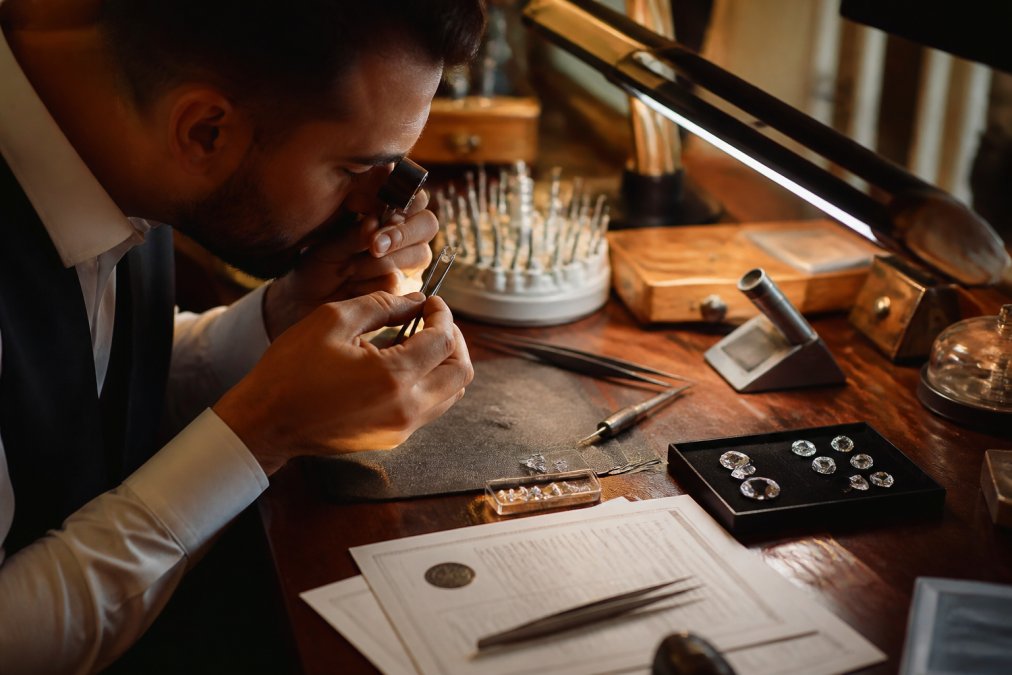
Certification matters in both scenarios. A certified gemologist has completed formal training and passed rigorous examinations. However, certification doesn't guarantee value or suitability for your specific design. Two certified diamonds with identical specifications can perform differently depending on cut quality, fluorescence, and other nuanced factors requiring expert interpretation.
How to Verify Diamond Certification
Verifying diamond certification is non-negotiable, whether buying from a diamond store or independent jeweler. A certificate is only valuable if legitimate and understood.
Start with the issuing lab. GIA and AGS are the most widely recognised and respected laboratories in the UK and internationally. Smaller labs like EGL or IGI are legitimate but less universally accepted; some buyers view them as slightly more lenient in grading. When comparing prices, check the certifying lab first, a "VS1" from GIA and a "VS1" from a smaller lab may not be equivalent in market perception.
Request the certificate number and verify it directly on the lab's website. GIA certificates can be checked at gia.edu, AGS at ags.org. This simple step confirms the certificate is real and hasn't been altered.
Understand what the certificate doesn't tell you. It confirms carat weight, colour, clarity, and cut grade, but not how the stone will look in your specific setting or under your lighting conditions. Ask the jeweler for their interpretation of the certificate and why a particular stone is priced as it is. If they can't or won't explain, that's a red flag regardless of their retail model.
Bespoke Jewellery Design Services and Customization
This is where the diamond store vs independent jewelers comparison becomes most visibly different. Customization capability varies dramatically between the two models.
Large diamond store chains typically offer limited customization. You choose from existing designs with minor modifications like resizing or changing metal type. Their strength is efficiency; their weakness is constraint. If you want something outside their standard catalogue, you face significant delays and additional costs.

Independent jewelers specialise in bespoke design. They sketch your vision, discuss proportions, suggest materials and settings based on your stone, and create something genuinely unique. The process typically takes 4-8 weeks depending on complexity. You're paying for the jeweler's time, expertise, and craft of creating something custom.
Bespoke jewellery design services require trust. You're commissioning a piece rather than buying a finished product. The jeweler needs to understand your aesthetic, lifestyle, and expectations.
Diamonds by daisy offers curated designs with customization options that bridge this gap. You're choosing from thoughtfully crafted pieces rather than mass-produced inventory, but you're not starting from scratch.
Customer Service, Warranty, and Post-Purchase Support
After purchase, customer service becomes the differentiator between a forgettable transaction and a relationship.
Chain retailers offer standardised warranty coverage, typically 1-2 years on craftsmanship and settings, with formal return policies allowing returns within 30 days for store credit or exchange. The advantage is predictability; the disadvantage is dealing with a system rather than a person.
Independent jewelers often provide longer warranties, sometimes lifetime coverage on settings and repairs, because they stand behind their work personally. They're also more flexible on returns and modifications. Post-purchase support includes cleaning, maintenance, resizing, and repairs, typically at lower cost because they're not factoring in corporate overhead.
A 30-day satisfaction guarantee is standard among reputable retailers. Diamonds by daisy offers this as baseline protection, signalling confidence in quality. The real test of customer service is what happens after the guarantee period ends: will the jeweler answer questions, help you understand your piece, and provide fair pricing on repairs and maintenance?
Resale Value, Buy-Back Policies, and Long-Term Investment
Resale value depends on several factors: the stone's certification and characteristics, metal content, design timelessness, and the jeweler's reputation. A certified diamond from a well-known jeweler typically commands 50-70% of its retail price in the secondary market (peer-reviewed research).
Large diamond store chains often have buy-back programs, purchasing pieces at 40-60% of original retail price depending on condition and current market rates. This reflects the markup built into the original sale. The advantage is convenience; the disadvantage is being locked into selling back to the same retailer.
Independent jewelers rarely have formal buy-back programs, but many will purchase pieces from other jewelers or take trade-ins on new designs. The negotiation is more flexible but less transparent.
Fine jewelry is a depreciating asset in financial terms, but high-quality pieces retain value better than mass-produced items, particularly if timeless in design and certified. Vintage and antique jewelry often appreciates because scarcity and craftsmanship become more valued over time.
Ethical Sourcing and Supply Chain Transparency
Ethical sourcing has become non-negotiable for many customers, and it's where transparency separates serious retailers from those paying lip service. The diamond store vs independent jewelers comparison here is about verifiable practices versus marketing claims.
Conflict-free diamonds, stones sourced from regions without active armed conflict, are now standard across reputable retailers (kimberleyprocess.com). However, "conflict-free" is a baseline, not a virtue. It doesn't address labour practices, environmental impact, or fair compensation for miners.
Large chains often have published supply chain policies and third-party audits, providing accountability. Independent jewelers often have direct relationships with suppliers, enabling better traceability, but only if they've actually done the due diligence. Many independents claim ethical sourcing without verifying it.
Provenance matters increasingly. Customers want to know where a diamond was mined, how it was cut, and whether people involved were fairly compensated. Some retailers now offer "traceable" diamonds with documented supply chain records, signalling serious commitment to transparency.
Ethical sourcing also includes metals used in settings. Lab-grown diamonds are becoming mainstream because they eliminate mining-related environmental and labour concerns. Some customers prefer them; others view them as less valuable because they lack geological history. Both positions are defensible; the key is understanding the difference and making an intentional choice.
Ask any retailer for specific documentation of their ethical sourcing practices. Request supplier names, audit frequency, and their response to concerns. Retailers confident in their practices will provide this information readily.
Choosing between a diamond store and an independent jeweler isn't about which model is objectively better, it's about aligning your priorities with the right retailer. If you value transparency, customization, and a personal relationship with your jeweler, independent retailers often deliver superior service. If you prioritise convenience, standardised grading, and predictable warranty terms, established chains excel. Diamonds by daisy combines the curated quality and personal attention of independent jewelers with the transparency and reliability standards of established retailers, offering meticulously handpicked gemstones backed by a 30-day satisfaction guarantee. Your choice should reflect what matters most: price, customization, ethical sourcing, or long-term investment potential.
Frequently Asked Questions
Q: Is it better to buy from a diamond store chain or an independent jeweler?
A: The choice depends on your priorities. Diamond store chains offer consistent pricing, standardised quality control, and established warranty coverage. Independent jewelers typically provide personalised service, bespoke design capabilities, and often deeper expertise in diamond grading and gemstone authenticity. If you value customisation and direct relationships with craftspeople, independent jewelers excel. If you prefer transparency in retail premium pricing and straightforward returns policies, chains may suit you better. Consider your specific needs: are you seeking a standard piece or something truly custom?
Q: How do I verify diamond certification and ensure authenticity?
A: Request a diamond grading report from a certified gemologist before purchase. Reputable jewelers, both chains and independents, provide documentation from recognised gemological laboratories. Check that the report includes carat weight, cut quality, clarity grade, and colour assessment. Ask to see the certification number and verify it directly with the issuing laboratory. For significant purchases, consider obtaining an independent appraisal from a qualified gemologist to confirm the stone's authenticity and value.
Q: What should I look for when choosing a jeweler for an engagement ring or significant purchase?
A: Evaluate the jeweler's transparency in diamond grading and supply chain practices. Ask about their quality standards, warranty coverage, and post-purchase service options including repairs and maintenance. Confirm whether they offer bespoke design services if you want a custom piece. Check their buy-back or trade-in policies for long-term asset value. Request references or customer reviews, and verify that any diamonds are certified by a reputable gemological body. Meet with the jeweler in person to assess their expertise, professionalism, and whether their aesthetic aligns with your vision.
Q: Why do independent jewelers sometimes charge more than chain retailers?
A: Independent jewelers typically invest in higher-quality stone selection, bespoke design capabilities, and in-house repair services. Their overhead includes skilled craftspeople, custom workshop space, and personalised customer service rather than mass-market distribution. Many source conflict-free diamonds with documented provenance, which adds to costs but provides ethical assurance. While chains benefit from bulk purchasing power and standardised production, independents offer customisation, expertise, and often superior craftsmanship, value that justifies the premium for those prioritising quality over price alone.
This article was written using GrandRanker