

How to Verify Ethical Diamond Sourcing: A Buyer's Guide
Table of Contents
- Why Verifying Ethical Diamond Sourcing Matters
- Understanding the Kimberley Process Certification Explained
- Responsible Jewellery Council Certification: What It Means
- Lab-Grown vs Natural Diamond Ethics: Understanding the Difference
- Step-by-Step: How to Verify Ethical Diamond Sourcing Before You Buy
- Key Questions to Ask Your Jeweller
- Beyond Conflict-Free: What Ethical Sourcing Really Means
- Conclusion
Last Updated: August 9, 2026
Why Verifying Ethical Diamond Sourcing Matters
When you're investing in a diamond, you're making a statement about your values. The question of where your diamond comes from, how it was mined, and who benefited from its extraction has become impossible to ignore.
The diamond industry has a complicated history. For decades, "conflict diamonds" or "blood diamonds" referred to stones mined in war zones and sold to finance armed conflict. While the Kimberley Process Certification Scheme was introduced in 2003 to prevent these diamonds from entering the mainstream market, the definition of ethical sourcing has evolved significantly. Today, it encompasses fair labour practices, environmental responsibility, and transparent supply chains, far more than simply avoiding conflict zones.
At Diamonds by Daisy, we understand that conscious consumers want proof, not just promises. This guide will walk you through how to verify ethical diamond sourcing before you buy, ensuring your purchase aligns with your values.
Understanding the Kimberley Process Certification Explained
The Kimberley Process Certification Scheme was established to prevent conflict diamonds from entering the supply chain. However, it's important to understand both what it does and what it doesn't do.
The Kimberley Process is an international system designed to certify that diamonds are conflict-free, meaning they weren't mined in war zones or used to finance armed conflict. When a diamond carries this certification, documentation confirms it didn't originate in a conflict region.
However, the scheme has significant limitations. It focuses narrowly on conflict financing and doesn't address labour practices, environmental impact, or fair wages. A diamond can be certified conflict-free whilst still coming from mines with poor working conditions, minimal environmental protections, or exploitative wages.
Kimberley Process certification is a baseline standard, not a comprehensive guarantee of ethical practices. When you ask your jeweller about provenance, confirm this certification, but don't let it be your only verification.
Responsible Jewellery Council Certification: What It Means
If the Kimberley Process sets a baseline, the Responsible Jewellery Council (RJC) certification goes considerably further.
The Responsible Jewellery Council is an independent, not-for-profit organisation that sets standards for responsible practices across the jewellery supply chain. RJC certification requires compliance with strict criteria covering labour rights, environmental management, business ethics, and human rights. A jeweller or diamond supplier holding RJC certification has undergone rigorous third-party audits to verify their practices.
RJC certification requires:
- Fair wages and safe working conditions for all employees
- Prohibition of child labour and forced labour
- Environmental impact assessments and mitigation strategies
- Transparent supply chain documentation
- Regular independent audits and compliance reporting
When you ask a jeweller whether their diamonds are RJC-certified, you're asking whether they've committed to standards that go well beyond "not financing conflict." Diamonds by Daisy prioritises sourcing from RJC-certified suppliers, recognising that this certification provides the transparency and accountability conscious buyers deserve.
Lab-Grown vs Natural Diamond Ethics: Understanding the Difference
The rise of lab-grown diamonds has fundamentally changed the ethical sourcing conversation. Many consumers assume lab-grown diamonds are automatically more ethical because they avoid traditional mining. The reality is more nuanced.
Lab-grown diamonds are chemically identical to mined diamonds but are created in controlled laboratory environments. They require significantly less land disruption, use less water, and produce fewer carbon emissions than traditional mining. However, the electricity powering the laboratories must come from somewhere; if sourced from fossil fuels, the environmental benefit diminishes. Additionally, the lab-grown diamond industry is newer and less regulated, making supply chain transparency harder to verify.
Natural diamonds come from established mining operations that have had decades to develop responsible practices. The largest, most reputable mining companies have invested in environmental restoration, community development programmes, and fair labour standards. Smaller artisanal mining operations, however, often operate with minimal regulation.
The ethical choice isn't automatically lab-grown or naturally mined, it's whichever option comes with verifiable proof of responsible sourcing. A lab-grown diamond from an unvetted producer might carry more ethical risk than a naturally mined diamond from an RJC-certified supplier. The key is asking the same verification questions regardless of origin: Can the jeweller prove where the diamond came from? Can they document the supply chain? Have third-party auditors verified the practices?
Step-by-Step: How to Verify Ethical Diamond Sourcing Before You Buy
Verifying ethical diamond sourcing requires a systematic approach. Here are the concrete steps to take before committing to a purchase.
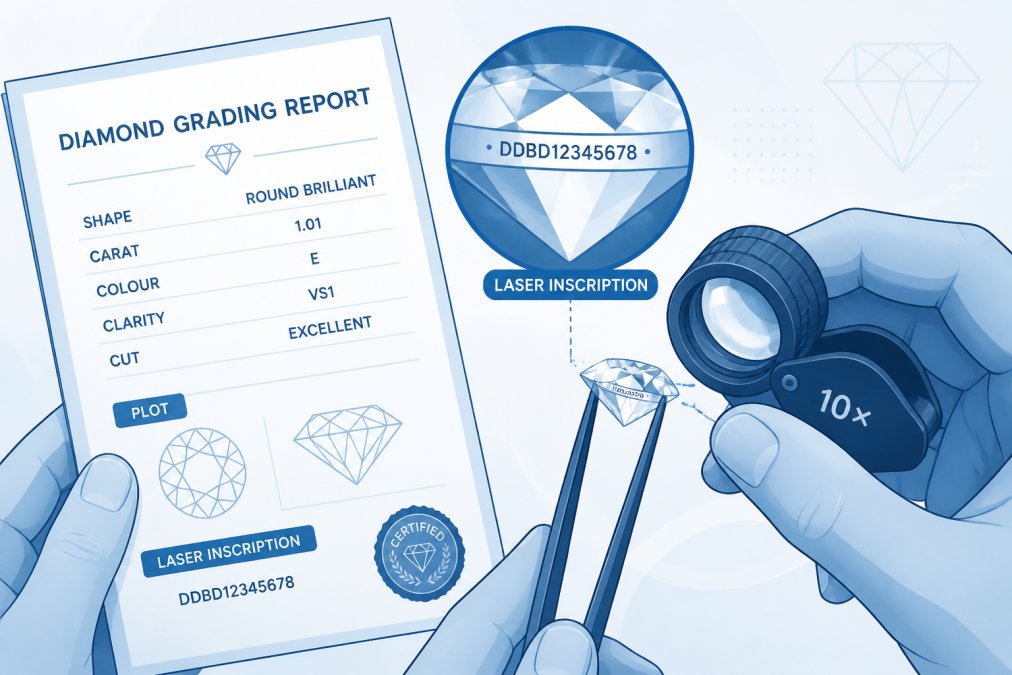
Step 1: Request the Diamond Grading Report
Every high-quality diamond should come with a grading report from an independent, internationally recognised laboratory. This report documents the diamond's characteristics, carat weight, colour, clarity, and cut, serving as proof of authenticity.
Ask your jeweller for the grading report before you buy. Reputable dealers will provide this without hesitation. The report should come from a recognised lab such as the Gemological Institute of America (GIA), the International Gemological Institute (IGI), or the American Gem Society (AGS).
Step 2: Check for Certification from Recognised Grading Labs
Verify that the laboratory issuing the report is legitimate and internationally recognised. The GIA is the most widely respected, but the IGI and AGS are also credible alternatives. Be cautious of lesser-known or regional grading labs.
The grading report will include a serial number or laser inscription on the diamond itself. This unique identifier ties the physical stone to the report, preventing substitution or fraud. When you receive your diamond, ask the jeweller to show you this inscription under magnification.
Step 3: Ask Your Jeweller About Provenance and Chain of Custody
Provenance is the documented history of the diamond from mine to retail. Chain of custody refers to the paper trail proving who handled the stone at each stage.
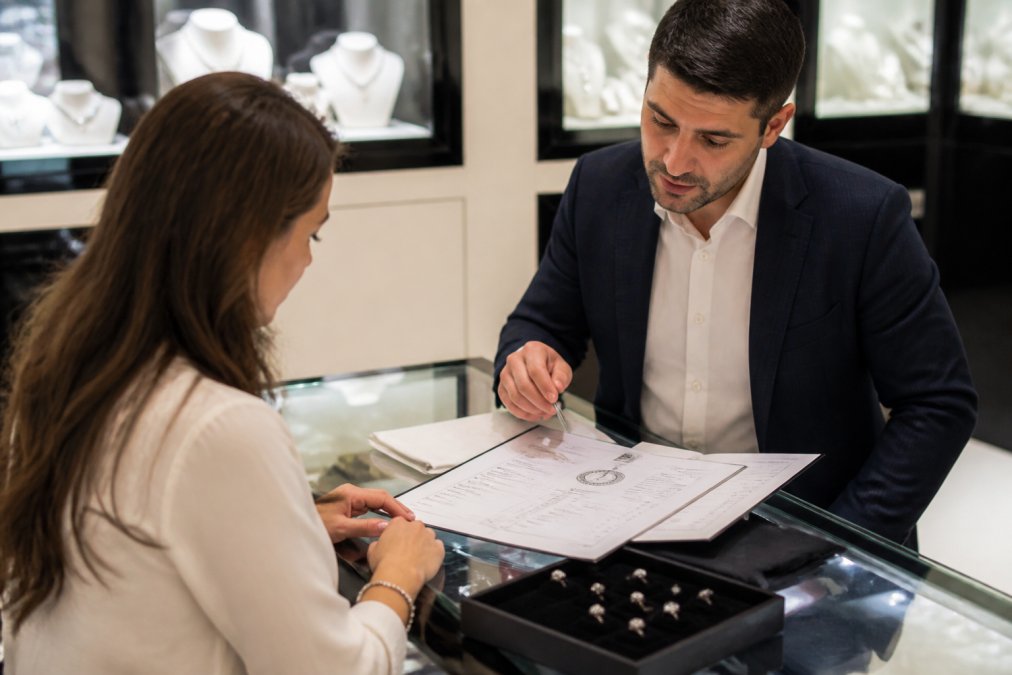
Ask your jeweller directly: "Can you document this diamond's journey from the mine to your shop?" A transparent dealer should be able to provide the mine or region where the diamond was extracted, names of intermediaries, certification documents at each stage, and evidence that the diamond passed through RJC-certified or equivalent suppliers.
If your jeweller can't answer these questions, that's a significant warning sign. Diamonds by Daisy maintains detailed provenance records for every stone, recognising that conscious buyers deserve to know exactly where their purchase came from.
Step 4: Verify Supply Chain Transparency and Documentation
Request copies of certificates of origin from mining operations, RJC certification or equivalent third-party audits, import and export documentation, and any environmental or labour practice certifications.
Legitimate jewellers keep these records and can produce them. If a jeweller is reluctant to share documentation or claims it's "confidential," that's a red flag. Digital ledger systems and blockchain technology are increasingly being used to track diamonds through the supply chain, allowing consumers to view the complete history of a stone.
Step 5: Look for Laser Inscription and Serial Numbers
Modern diamonds often carry a laser inscription, a unique identifier etched onto the girdle (the widest part) of the stone. This ties the physical diamond to its grading report, preventing fraud or substitution.
Ask your jeweller to show you the laser inscription under a jeweller's loupe or microscope. Compare the number on the inscription to the number on your grading report. They should match exactly.
Key Questions to Ask Your Jeweller
The questions you ask your jeweller reveal whether they're genuinely committed to ethical sourcing or simply using the term as marketing language.
"Can you provide the diamond's grading report and verify the laser inscription?" Any reputable jeweller should answer yes without hesitation.
"Is this diamond certified by the Kimberley Process? Does it carry RJC certification or equivalent third-party audit?" This separates jewellers who understand ethical sourcing from those who don't.
"Where was this diamond mined, and can you document the supply chain?" Transparency about origin is non-negotiable.
"What environmental and labour standards did the mining operation meet?" This pushes beyond conflict-free diamonds to the broader definition of ethical sourcing.
"Can you show me the documentation proving this diamond's provenance?" Ask to see actual certificates, audit reports, and supply chain records.
"Does your business hold any certifications or memberships with industry bodies committed to responsible sourcing?" Look for RJC membership or other third-party accountability measures.
"What happens if I discover this diamond wasn't sourced as you described?" A confident answer backed by guarantees shows genuine confidence in sourcing practices.
Beyond Conflict-Free: What Ethical Sourcing Really Means
The term "conflict-free" has become so commonplace in diamond marketing that it's lost much of its meaning. Understanding what ethical sourcing actually encompasses is essential.
Conflict-free means the diamond didn't finance armed conflict. That's a necessary baseline, but it's far from sufficient.
True ethical sourcing addresses multiple dimensions: fair wages and safe working conditions for miners, environmental responsibility through land restoration and water management, community benefit through local investment in schools and healthcare, human rights protection including indigenous rights and community consent, and supply chain transparency with every intermediary documented and verifiable.
When you ask a jeweller about ethical sourcing, you're asking whether they've investigated all these dimensions or simply purchased from a supplier with a "conflict-free" label. Diamonds by Daisy approaches ethical sourcing holistically, prioritising RJC certification and equivalent third-party audits that require verification across all these dimensions.
Conclusion
Verifying ethical diamond sourcing requires effort, but it's effort that pays dividends. When you take the time to ask the right questions, request documentation, and verify certifications, you ensure your purchase aligns with your values.
The steps outlined in this guide, requesting grading reports, checking for RJC certification, investigating provenance, verifying supply chain transparency, and confirming laser inscriptions, give you the tools to make a confident, informed decision. At Diamonds by Daisy, we've built our entire business on this principle: meticulously handpicked gemstones with verified ethical sourcing, supported by documentation and our 30-day satisfaction guarantee. When you choose a diamond backed by genuine verification, you're choosing peace of mind alongside beauty.
Frequently Asked Questions
What is the Kimberley Process and is it enough to guarantee ethical sourcing?
The Kimberley Process Certification Scheme prevents conflict diamonds from entering the supply chain, but it focuses solely on financing armed conflict. It does not cover labour practices, environmental standards, or human rights issues beyond conflict funding. To verify ethical diamond sourcing comprehensively, you need additional certifications like those from the Responsible Jewellery Council or GIA grading reports that document origin and provenance.
Are lab-grown diamonds more ethical than natural diamonds?
Lab-grown diamonds have a smaller environmental footprint and avoid mining-related habitat disruption. However, they require significant energy to produce. Natural diamonds can be ethically sourced from certified suppliers with transparent supply chains and fair labour practices. Neither is inherently more ethical, what matters is verifying the sourcing practices and certifications of the specific diamond you're buying, whether lab-grown or mined.
What certifications should I look for when verifying ethical diamond sourcing?
Look for diamonds graded by the Gemological Institute of America (GIA), which provides detailed grading reports including origin information. Check for Responsible Jewellery Council certification from your jeweller. Verify Kimberley Process Certification Scheme documentation, though this is a baseline standard. Ask for evidence of supply chain transparency and traceability. Laser inscription with a serial number allows you to track the specific diamond's documentation.
How can I tell if a diamond is conflict-free?
Request a diamond grading report from a recognised lab like GIA that documents origin. Ask your jeweller for Kimberley Process Certification documentation and Responsible Jewellery Council credentials. Verify they can trace the chain of custody from source to you. Request details about mining standards and labour practices at the source. A trustworthy jeweller will provide written documentation of these details before purchase, not just verbal assurances.
This article was written using GrandRanker