

How to Check Diamond Certification: A Step-by-Step Guide
Table of Contents
- Why Diamond Certification Matters
- How to Read a Diamond Certificate
- Reputable Diamond Grading Labs in the UK
- Steps to Verify Your Diamond Certificate Online
- What Is a Laser Inscription on a Diamond
- How to Spot Counterfeit Reports and Verify Authenticity
- Common Mistakes When Checking Diamond Certification
- Conclusion
Last Updated: August 12, 2026
Why Diamond Certification Matters
A diamond certificate is an independent gemological assessment that documents the quality and authenticity of your stone. Without it, you're buying based on a seller's word alone, with no legal protection if something goes wrong.
Diamonds represent significant financial investment. Certification protects you by confirming the stone's characteristics, establishing fair market value, and providing recourse if the diamond doesn't match what you were promised. The real risk isn't buying a certified diamond, it's buying an uncertified one and discovering months later that you overpaid or that the stone doesn't match its description.
At Diamonds by Daisy, we understand that peace of mind matters as much as the stone itself. Every piece in our collection comes with documentation you can verify independently, transforming a purchase from a leap of faith into a confident decision.
How to Read a Diamond Certificate
A grading report documents five essential pieces of information: the stone's dimensions, colour grade, clarity grade, cut grade, and carat weight, known collectively as the 4Cs. The certificate also includes the laboratory's unique report number, assessment date, and security features that prevent forgery.
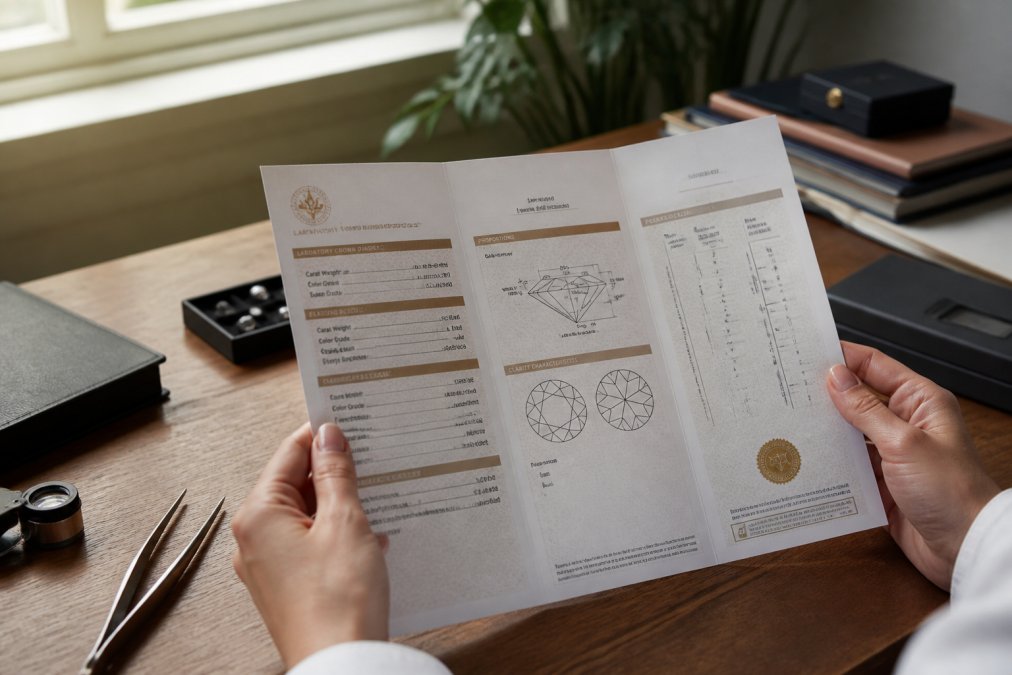
Most reports include a plot diagram showing where inclusions sit within the stone, helping you understand why a diamond received its particular clarity grade. This diagram is specific to your stone, no two diamonds have identical inclusion patterns.
Understanding each grade in practical terms is essential. A colour grade of H means the stone has slight colour visible to the naked eye under normal lighting. A clarity grade of VS1 means very slight inclusions invisible without magnification. These distinctions affect both appearance and value.
The 4Cs on Your Certificate
Carat weight appears as a decimal figure, typically ranging from 0.50 to 5.00 carats. This measures mass, not size. Two diamonds of identical carat weight can appear different sizes depending on cut and depth percentage.
Colour grade runs from D (colourless) through Z (light colour). The difference between D and E is invisible to the naked eye, but the price difference is significant. Grades below K show visible colour to most observers.
Clarity grade documents internal and surface imperfections on a scale from FL (flawless) through I3 (included 3). Anything graded VS2 or higher appears clean to the naked eye. The jump in price between VS1 and SI1 is often minimal despite the grade difference, because both appear identical without magnification.
Cut grade describes how well the diamond's facets interact with light. A well-cut diamond of lower colour or clarity often appears more brilliant than a poorly cut stone of higher grades. Cut is the only 4C that depends on human skill rather than geological chance.
Additional Report Details
Polish and symmetry grades document how precisely the diamond was cut. These grades rarely affect appearance to the naked eye but influence resale value and long-term durability.
Fluorescence indicates whether the diamond glows under ultraviolet light. Most diamonds show no fluorescence. Strong fluorescence is rare and can occasionally affect appearance in direct sunlight.
Table percentage and depth percentage describe the stone's proportions and directly affect brilliance. A table percentage between 54-57% and depth percentage between 58-62% represents optimal proportions for most diamonds.
Reputable Diamond Grading Labs in the UK
The laboratory that grades your diamond carries enormous weight. A certificate from a reputable lab is trustworthy; a certificate from an unknown lab is essentially worthless.
The Gemological Institute of America (GIA) set the standard for diamond grading and operates the most rigorous assessment process. GIA certificates are accepted globally and command premium prices because buyers trust grading consistency. Their reports include detailed diagrams and security features that make forgery extremely difficult.
The American Gem Society (AGS) uses a similar grading scale and maintains comparable standards. AGS certificates are highly respected, though slightly less common in UK jewellery.
The International Gemological Institute (IGI) provides grading services widely used by jewellers and online retailers. IGI certificates are generally reliable, though some buyers view them as marginally less rigorous than GIA or AGS.
For UK buyers, GIA-certified diamonds are a strong choice. The grading is universally recognised, and security features are most difficult to replicate.
Steps to Verify Your Diamond Certificate Online
Verifying your diamond certificate online takes fewer than five minutes and eliminates uncertainty about authenticity. Each major laboratory maintains a searchable database where you can confirm that your certificate number corresponds to the exact stone you received.
Step 1: Locate Your Certificate Number
Your certificate number appears in the top right corner of the physical report. It's a unique identifier assigned by the laboratory. Write this number down or photograph it before verification.
The number typically follows a format specific to the laboratory. GIA numbers are usually 10 digits. The format itself tells you which laboratory issued the certificate, your first verification checkpoint.
Check that the certificate number on your physical document matches any digital copies you received. If they differ, contact the retailer immediately.
Step 2: Visit the Laboratory's Verification Tool
Navigate to the official website of the laboratory that issued your certificate. GIA's verification tool is located at their main website under "Verify a Report." AGS and IGI maintain similar tools on their respective sites.
Do not use a link provided by the seller. Type the laboratory's website address directly into your browser to prevent accessing counterfeit verification sites designed to deceive you.
Step 3: Enter Your Report Details
Enter your certificate number into the search field. Most laboratories also ask for the carat weight as a secondary verification step. Enter the carat weight exactly as it appears on your certificate. If your certificate states 1.50 carats, enter 1.50, not 1.5.
Some laboratories ask for additional information such as the diamond's shape or colour grade. Provide these details as they appear on your certificate.
Step 4: Confirm the Certificate Information
Once you submit your information, the laboratory's database will return the certificate details. Compare every field on the screen against your physical certificate. The 4Cs must match exactly. The measurements must match. The report number must match.
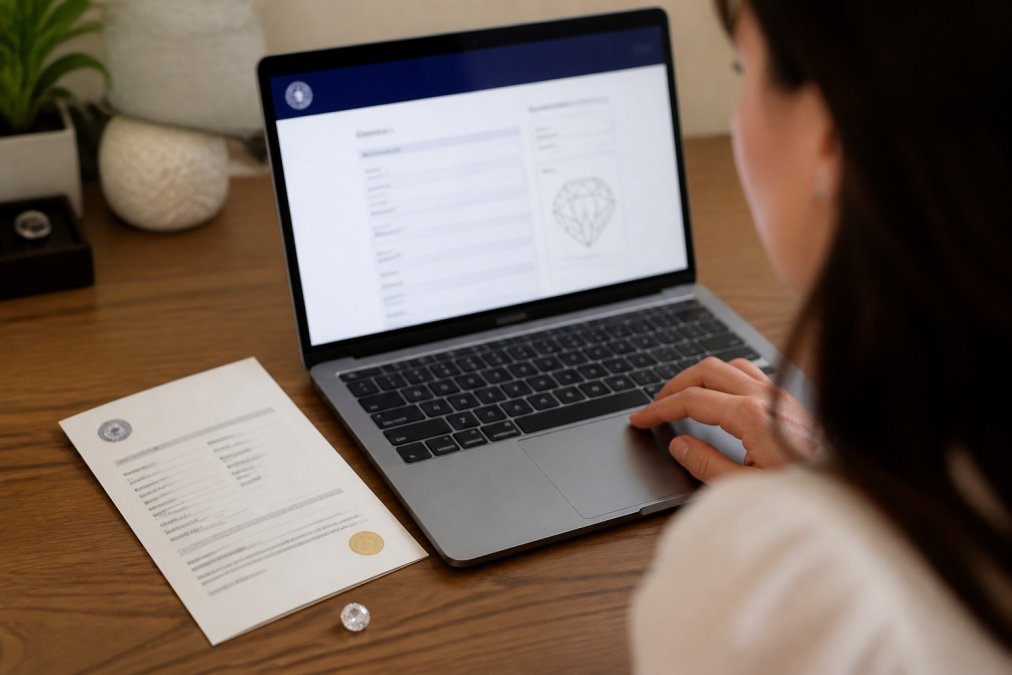
If any detail differs, even by a single digit, you have a problem. Contact the retailer and the laboratory immediately. If everything matches, screenshot or print this confirmation page for your records.
What Is a Laser Inscription on a Diamond
A laser inscription is a microscopic identifier etched onto the diamond's girdle, the thin edge between the top and bottom facets. The inscription typically contains the laboratory's name and certificate number, making it impossible to separate the diamond from its documentation.
Laser inscriptions are invisible to the naked eye and require magnification to see. They don't affect the diamond's appearance, durability, or light performance. The inscription is permanent and cannot be removed without damaging the stone.
The inscription serves as a physical security feature. If someone attempts to substitute your diamond with a lower-quality stone, the inscription will either be absent or show a different certificate number. When you verify your certificate online, you can confirm that the certificate number on the stone matches the number in the laboratory's database.
To verify a laser inscription, you'll need a jeweller's loupe or microscope capable of 10x magnification. Position the diamond so light hits the girdle at an angle. You should see the inscription as tiny characters. If your diamond is supposed to be inscribed but you cannot see any marking, consult a professional gemologist.
How to Spot Counterfeit Reports and Verify Authenticity
Counterfeit certificates exist and are becoming more sophisticated. Learning to identify red flags protects you from overpaying for a lower-quality stone or purchasing a lab-grown diamond misrepresented as natural.
Security Features to Check
Legitimate certificates include multiple security features designed to prevent forgery. Physical certificates use specialised paper with a watermark visible when held to light. The text is printed with precision that standard printers cannot match.
The certificate includes a hologram or security foil that shifts colour when viewed at different angles. If you hold the certificate at an angle and the hologram doesn't shift smoothly or appears flat, you're likely looking at a fake.
The report number is printed with a specific font and formatting that varies by laboratory. The signature or seal of the laboratory appears on every legitimate certificate, often embossed or printed with metallic ink. Run your finger across the seal, you should feel a slight raised texture if it's embossed.
Red Flags in Fake Certificates
Spelling errors or grammatical mistakes indicate forgery. Legitimate laboratories maintain rigorous quality control and would never release a report with errors.
Blurry or pixelated text suggests the certificate was photocopied or scanned and reprinted. Legitimate certificates have sharp, crisp text.
Inconsistent formatting, different fonts, misaligned text, or spacing issues indicate a document assembled in software rather than professionally printed.
A certificate number that doesn't match the laboratory's standard format is a major red flag. Verify it against the laboratory's website before accepting the certificate.
Prices that seem too good to be true often accompany counterfeit certificates. If a seller offers a GIA-certified diamond at significantly below-market pricing, ask to verify the certificate yourself before proceeding.
Common Mistakes When Checking Diamond Certification
The most common mistake is failing to verify the certificate at all. Verification takes minutes and eliminates the risk of accepting a counterfeit.
Another frequent error is verifying the certificate but not examining the physical diamond for a laser inscription. If the certificate says the stone is inscribed but you cannot see the inscription under magnification, something is wrong.
Buyers sometimes accept certificates from laboratories they've never heard of. Grading standards vary significantly between laboratories. Sticking with GIA, AGS, or IGI eliminates this confusion.
Confusing a certificate with an appraisal is another common mistake. An appraisal estimates monetary value. A certificate documents physical characteristics. You need both, but they serve different purposes.
Finally, buyers often fail to keep their certificate in a safe place. Store it in a safe deposit box or home safe. If you lose it, you've lost your proof of ownership and verification of authenticity.
Conclusion
Verifying your diamond's certification transforms a purchase from an act of faith into a documented transaction. You move from trusting a seller's word to confirming facts in an independent database.
When you check diamond certification, you're protecting your investment, establishing resale value, and ensuring that what you own matches what you paid for. It's the single most important step in the diamond-buying process.
At Diamonds by Daisy, we make this process effortless. Every piece comes with certified documentation you can verify independently, backed by our 30-day satisfaction guarantee. We've handpicked each gemstone with the same rigour we'd apply to our own collection, because we believe your diamond should be as beautiful and authentic as the person wearing it. Explore our collection and experience the confidence that comes from verified quality.
Frequently Asked Questions
How can I verify the authenticity of a diamond using its certificate?
Verify authenticity by checking the certificate number on the grading laboratory's official online database. Cross-reference the diamond's carat weight, colour grade, clarity grade, and cut grade against the physical stone. Examine security features like holograms and micro-print on the physical certificate. Match the laser inscription on the diamond to the certificate number to confirm it's the same stone. If any details don't align, contact the laboratory directly for confirmation.
What should I look for when checking a diamond grading report?
Focus on the 4Cs: carat weight, colour grade, clarity grade, and cut grade. Verify the certificate number matches the laser inscription on the diamond. Check the girdle inscription to ensure it corresponds to the report. Review additional metrics like table percentage, depth percentage, symmetry, and polish. Confirm the laboratory's name and the report date. Ensure the physical certificate has security features intact, including holograms and micro-printing. These elements collectively confirm the report's legitimacy and accuracy.
What is a laser inscription on a diamond and why does it matter for certification?
A laser inscription is a unique identifier etched onto the diamond's girdle (the widest edge) by the grading laboratory. It typically displays the certificate number, making it a permanent link between the physical stone and its grading report. This inscription prevents diamond switching and provides a simple way to verify that the diamond you own matches its certification. When checking your diamond, use magnification to read the inscription and confirm it matches the certificate number on your report.
How do I know if a diamond grading laboratory is reputable?
Reputable laboratories maintain publicly searchable online databases for certificate verification. They employ certified gemologists and follow standardised grading protocols. Look for laboratories that are recognised by industry bodies and have established track records spanning decades. Verify that the laboratory's name matches official records and check their security features on physical certificates. Be cautious of unfamiliar or newly established labs without verifiable credentials. Contact the laboratory directly if you have doubts about a report's authenticity.
This article was written using GrandRanker