

Diamond Ring Alternatives: A Complete Guide
Table of Contents
- What Are Diamond Ring Alternatives?
- Lab-Grown vs Natural Diamond Engagement Rings
- Popular Diamond Alternatives Compared
- Durability and the Mohs Hardness Scale
- Resale Value and Long-Term Investment
- Best Places to Buy Engagement Rings Online
- Diamond Ring Buying Guide: How to Choose
- Insurance and Certification Considerations
Last Updated: August 20, 2026
What Are Diamond Ring Alternatives?
Not every engagement ring needs a traditional diamond. Diamond ring alternatives, lab-grown diamonds, moissanite, white sapphire, cubic zirconia, and coloured gemstones, have become increasingly popular among couples seeking distinctive, sustainable, or budget-conscious options without compromising elegance or durability.
The choice often comes down to three factors: appearance, longevity, and personal values. Some alternatives offer superior brilliance and fire, while others prioritise ethical sourcing or investment value. Understanding what each stone offers helps you make a decision aligned with your priorities.
At Diamonds by daisy, we recognise that the perfect engagement ring reflects your individual story. Whether you're drawn to the eco-conscious appeal of lab-grown diamonds, the optical properties of moissanite, or the distinctive colour of a sapphire, the right choice depends on what matters most to you.
Lab-Grown vs Natural Diamond Engagement Rings
Lab-grown diamonds and natural diamonds are chemically identical but differ fundamentally in origin, cost, and environmental impact. Lab-grown diamonds are created in controlled laboratory environments using High Pressure High Temperature (HPHT) or Chemical Vapour Deposition (CVD) processes. Natural diamonds take billions of years to form underground before being mined.
Lab-grown diamonds are ready in weeks and eliminate the environmental disruption of traditional mining. They're typically 30-40% less expensive than comparable natural diamonds, making them attractive for couples seeking value without sacrificing quality.
Optically and physically, lab-grown and natural diamonds perform identically. Both rank 10 on the Mohs hardness scale, ensuring equal durability for everyday wear. Gemological laboratories can distinguish between them using advanced equipment, but this matters only if resale value is a primary concern, natural diamonds currently retain stronger resale markets, though this landscape is shifting.
Lab-grown diamonds eliminate uncertainty about mining practices entirely, offering peace of mind alongside affordability for those prioritising conscious consumption.
Popular Diamond Alternatives Compared
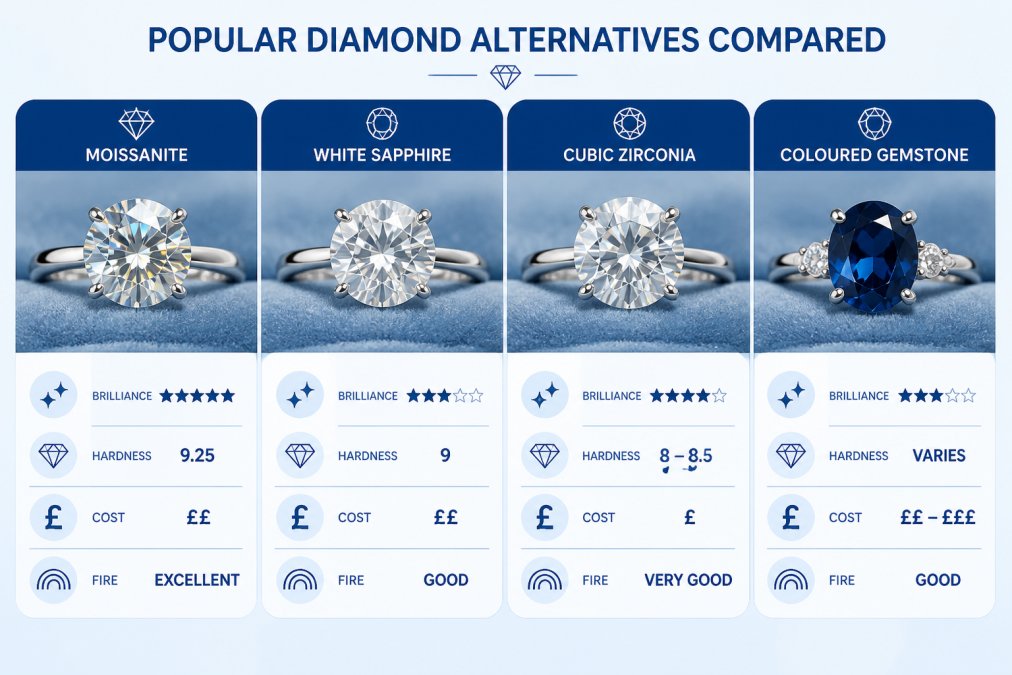
Each diamond alternative brings distinct optical properties, durability characteristics, and aesthetic qualities. The right choice depends on whether brilliance, longevity, colour options, or budget takes precedence.
Moissanite: Brilliance and Durability
Moissanite ranks as one of the most popular diamond alternatives, prized for exceptional brilliance and fire. Created from silicon carbide, moissanite scores 9.25 on the Mohs hardness scale, second only to diamond, making it exceptionally durable for daily wear. It will not scratch, cloud, or fade over decades.
Moissanite displays more fire and sparkle than diamond, creating rainbow flashes when light hits the stone. Modern premium cuts minimise the "rainbow effect," offering a more diamond-like appearance whilst maintaining superior brilliance. The refractive index of moissanite (2.65) exceeds diamond's (2.42), explaining its distinctive optical signature, a feature, not a flaw.
Moissanite rings typically cost 80-90% less than comparable diamond rings, delivering exceptional value for those who love dramatic sparkle and want a stone that maintains its appearance indefinitely.
White Sapphire: Elegance and Strength
White sapphire offers a subtle alternative to moissanite, delivering elegance without excessive sparkle. Sapphires rank 9 on the Mohs hardness scale, matching moissanite in durability and suitability for lifelong wear. White sapphires often display a slight milky or cloudy appearance, appealing to those seeking a vintage or heirloom aesthetic.
The understated brilliance suits engagement rings with intricate metalwork or paired with coloured accent stones. White sapphires can cloud over time with daily wear, particularly if exposed to harsh cleaning methods. Regular professional cleaning preserves their clarity. For those prioritising durability and preferring a softer aesthetic, white sapphire represents an elegant, distinctive choice.
Cubic Zirconia: Budget-Friendly Option
Cubic zirconia offers the most affordable entry point into diamond-like rings, ideal for testing a design before committing to a precious stone or working within tight budgets. This lab-created gemstone displays comparable brilliance and fire to diamond at a fraction of the cost.
The trade-off is longevity. Cubic zirconia ranks 8-8.5 on the Mohs hardness scale, making it susceptible to scratching and clouding. Most cubic zirconia stones show visible wear within 1-3 years of regular use, developing a frosted appearance as microscopic scratches accumulate. It's better suited for occasional wear or as a temporary ring rather than a lifelong piece.
For budget-conscious couples or those testing designs before investing in durable stones, cubic zirconia serves a practical purpose at 90% less cost than diamond.
Coloured Gemstones for Engagement Rings
Coloured gemstones open creative possibilities beyond traditional colourless stones, allowing personal expression through sapphires, emeralds, rubies, or other precious stones. Sapphires and rubies rank 9 on the Mohs hardness scale, matching white sapphire durability. Emeralds rank only 7.5-8 and are more brittle, requiring careful handling and professional cleaning.
Coloured gemstones offer distinctiveness and personal meaning whilst often hiding inclusions better than colourless stones, sometimes providing better value for larger carat weights.
Durability and the Mohs Hardness Scale
The Mohs hardness scale measures gemstone resistance to scratching, ranging from 1 (softest) to 10 (hardest). For daily-wear engagement rings, hardness directly correlates to longevity and maintenance requirements.
Diamond and lab-grown diamonds rank 10. Moissanite ranks 9.25, and sapphires rank 9. These three options resist scratching effectively and maintain appearance through decades of daily wear with minimal maintenance beyond regular cleaning.
Cubic zirconia ranks 8-8.5, making it significantly softer. Emeralds and softer gemstones rank 7.5-8, requiring deliberate care and are best reserved for occasional wear.
For practical engagement rings, prioritising stones rated 9 or higher ensures your ring maintains its appearance throughout your life.
Resale Value and Long-Term Investment
Resale value remains important for many couples, particularly those viewing an engagement ring as a financial investment. Natural diamonds maintain the strongest resale market, typically recovering 25-35% of original retail price. Lab-grown diamonds currently command lower resale values, often 15-25%, though this gap may narrow as acceptance increases.
Moissanite, white sapphire, and cubic zirconia have minimal resale markets, rarely recovering more than 5-10% of original price. Coloured gemstones vary widely depending on rarity and quality.
If long-term investment value matters significantly, natural or lab-grown diamonds are more defensible. If resale value is secondary to personal satisfaction, the lower resale value of alternatives becomes less relevant.
Best Places to Buy Engagement Rings Online
Purchasing an engagement ring online requires balancing convenience with confidence in authenticity and quality. Reputable online retailers offer competitive pricing, broader selections, and transparent grading information rivalling traditional jewellers.
Established online jewellers provide detailed product descriptions, high-resolution imagery, certification documentation, and customer reviews. Many offer virtual consultations, live video showings, and flexible return policies. Look for retailers offering independent gemological certification (GIA, AGS, or equivalent), clear return windows of at least 30 days, and secure payment methods.
At Diamonds by daisy, our curated collection combines online accessibility with craftsmanship traditionally associated with bespoke jewellers. Each piece features meticulously handpicked gemstones and precious metals, with our 30-day satisfaction guarantee ensuring confident purchasing. When shopping online, verify that retailers provide certification for precious stones, offer detailed specifications (carat weight, clarity grade, colour grade, cut quality), include high-quality photography from multiple angles, and respond promptly to questions. Avoid retailers unwilling to provide certifications or detailed specifications.
Diamond Ring Buying Guide: How to Choose
Selecting the right engagement ring requires understanding your priorities and how different stones align with your lifestyle, values, and aesthetic preferences.
Step 1: Define Your Priorities
Begin by identifying what matters most. Are you prioritising durability, ethical sourcing, visual sparkle, budget, colour options, or investment value? Recognising which take precedence narrows choices significantly.
If daily durability matters most, focus on stones rated 9 or higher on the Mohs hardness scale. If ethical sourcing drives your decision, lab-grown diamonds eliminate mining concerns. If budget is primary, cubic zirconia or moissanite offer dramatic savings. If you want a distinctive appearance, coloured gemstones create a unique aesthetic.
Step 2: Understand the Four Cs (or relevant grading criteria)
For diamonds and lab-grown diamonds, the Four Cs, carat weight, clarity, colour, and cut, determine quality and price. Prioritise cut quality above other factors; a well-cut stone with slight compromises outperforms a poorly cut stone with perfect grades.
For moissanite and sapphires, evaluate cut quality, visible inclusions, and colour uniformity. Request certification confirming the stone's properties rather than relying on vague descriptions.
Step 3: Consider Metal and Setting
Precious metal (platinum, white gold, yellow gold, or rose gold) influences both aesthetics and durability. Platinum is most durable but most expensive. White gold requires periodic rhodium plating. Yellow and rose gold offer warmth and are increasingly popular.
The setting style, solitaire, halo, trilogy, eternity, or custom design, affects how the centre stone appears and its protection. A protective setting shields softer centre stones from impact.
Step 4: Request Certification and Detailed Specifications
Never purchase a precious stone without independent gemological certification. Reputable laboratories (GIA, AGS, or equivalent) provide objective grading and protect against misrepresentation. Demand detailed specifications including stone type, dimensions, weight, clarity grade, colour grade, and any treatments applied.
For alternatives like moissanite or sapphire, request documentation confirming the stone's properties and origin.
Step 5: Evaluate Return and Satisfaction Policies
A generous return window (ideally 30+ days) allows you to wear the ring in daily life before committing. Many people discover that how a ring looks in photographs differs from how it appears on their hand in natural light.
At Diamonds by daisy, our 30-day satisfaction guarantee reflects our confidence in quality and commitment to customer satisfaction. If a piece doesn't align with your expectations, you can return it without hassle.
Insurance and Certification Considerations
Protecting your investment requires understanding insurance requirements and maintaining proper documentation. Engagement rings represent significant financial commitments, and insuring them provides peace of mind against loss, theft, or damage.
Most homeowners or renters insurance policies include limited coverage for jewellery, typically £1,000-£2,500 per item. Rings exceeding this threshold require a separate jewellery insurance policy or rider. Insurers typically require independent gemological certification and professional appraisal establishing the ring's value.
Certification from reputable gemological laboratories (GIA, AGS, or equivalent) is essential, documenting the stone's specifications, any treatments applied, and quality assessment. A certified stone is easier to insure, resell, and provides objective proof of quality.
For alternatives like moissanite or sapphire, certification is equally important. Reputable retailers provide documentation confirming the stone's origin, treatment history, and properties.
Professional appraisals establish the ring's monetary value for insurance purposes. Many insurance companies require appraisals for coverage above basic limits. Update appraisals every 3-5 years to reflect market fluctuations and ensure adequate coverage.
Choosing an engagement ring is deeply personal, reflecting your values, lifestyle, and vision for your future. Whether you select a traditional diamond, a lab-grown alternative, moissanite's brilliant sparkle, or a distinctive coloured gemstone, the right choice is one you'll love wearing every day. Diamonds by daisy offers a carefully curated collection of fine jewellery, each piece meticulously crafted with handpicked gemstones and precious metals. Our 30-day satisfaction guarantee ensures you purchase with confidence, knowing your ring reflects your unique style and meets the highest standards of quality and craftsmanship.
Frequently Asked Questions
What should I look for when buying a diamond ring alternative?
Focus on the Mohs hardness scale rating (aim for 8 or above for daily wear), brilliance and fire characteristics, colour grade, and clarity. Consider your lifestyle and maintenance requirements. Lab-grown diamonds and moissanite score highest for durability. Request gemological certification from a reputable laboratory to verify quality. Check the precious metal setting and ensure it suits your aesthetic preferences and budget.
Are lab-grown diamonds a good alternative to natural diamonds?
Lab-grown diamonds offer excellent value and identical chemical composition to natural diamonds, making them a strong alternative for engagement rings. They score 10 on the Mohs hardness scale, ensuring durability for daily wear. The main trade-off is resale value, which tends to be lower than natural diamonds. Lab-grown options are ethically sourced and sustainable, appealing to conscious consumers. They cost considerably less than comparable natural diamonds whilst maintaining the same brilliance and fire.
How do I ensure the quality of a diamond ring alternative online?
Always request gemological certification from recognised laboratories before purchase. Look for detailed product descriptions including carat weight, clarity grade, colour grade, and Mohs hardness rating. Reputable retailers offer high-resolution photography and video demonstrations. Check for a satisfaction guarantee (like Diamonds by Daisy's 30-day promise) allowing you to inspect the piece in person before committing. Ask about the precious metal composition and setting durability. Verify the retailer's return policy and customer reviews.
What is the resale value of diamond ring alternatives compared to natural diamonds?
Natural diamonds typically retain 50-70% of their original value on resale, whilst lab-grown diamonds retain 30-50% due to market perception and lower demand in the secondary market. Moissanite and sapphire rings generally hold 20-40% of purchase price on resale, as these stones have smaller secondary markets. Cubic zirconia has minimal resale value as it degrades over time. If resale value is a priority, natural diamonds remain the strongest investment. For sentimental pieces kept long-term, the resale value matters less than durability and personal satisfaction.
Do diamond ring alternatives require different maintenance than natural diamonds?
Most alternatives require similar care to natural diamonds, though specifics vary by stone. Moissanite and sapphire are extremely durable and resist scratching. All gemstones benefit from gentle cleaning with lukewarm water and mild soap; avoid ultrasonic cleaners for softer stones like cubic zirconia. Lab-grown diamonds need identical care to natural diamonds. Coloured gemstones may require special handling to preserve colour intensity. Have your piece professionally inspected annually, regardless of stone type, to ensure the setting remains secure and the precious metal hasn't worn.
This article was written using GrandRanker