

Is Buying Fine Jewelry Online Safe? A Complete Guide
Table of Contents
- Is Buying Fine Jewelry Online Safe? The Honest Answer
- How to Spot Fake Jewellery Websites and Verify Seller Authenticity
- Understanding Gemstone Certifications and Grading Reports
- Secure Payment Methods and Transaction Security for Online Jewelry
- Return Policies and Consumer Rights Act 2015 Jewellery Protections
- Hallmarking Requirements UK and What They Mean for Online Buyers
- Product Photography vs. Reality: Measuring Size and Visualising Scale
- Post-Purchase Verification and Ethical Sourcing Transparency
Is Buying Fine Jewelry Online Safe? A Complete Guide
Last Updated: August 4, 2026
Is Buying Fine Jewelry Online Safe? The Honest Answer
Yes, but only if you know what to look for. At Diamonds by daisy, we've learned that safety comes down to three critical factors: verifying seller authenticity, understanding gemstone certifications, and knowing your consumer rights.
E-commerce has made luxury goods accessible from home, yet real risks remain: counterfeit jewelry, misrepresented gemstones, and untrustworthy retailers. The challenge isn't whether online purchasing is inherently unsafe, it's whether you're equipped to spot red flags and take proper precautions.
Below, we'll walk you through the exact framework thousands of customers use to buy fine jewelry online with confidence. We'll cover how to identify fake websites, what certifications matter, how to verify seller legitimacy, and what legal protections the Consumer Rights Act 2015 affords you.
How to Spot Fake Jewellery Websites and Verify Seller Authenticity
Red Flags That Signal an Untrustworthy Online Retailer
Professional-looking design doesn't equal trustworthiness; many scam sites invest heavily in polished aesthetics precisely because they know this.
Examine the website's domain structure. Legitimate fine jewelry retailers use straightforward, branded domains (e.g., diamondsbydasiy.com, not diamondsbydasiy-store.co.uk). Check the URL bar for an SSL certificate (the padlock icon), which encrypts your data during transactions.
Poor grammar and spelling throughout product descriptions signal an untrustworthy seller. Similarly, low-quality product photography or images copied from other websites indicate fraud. Legitimate retailers invest in professional photography because presentation directly impacts sales.
Payment options reveal seller legitimacy. Trustworthy retailers accept major credit cards, PayPal, and established payment gateways. If a site demands wire transfer, cryptocurrency, or unusual payment channels, walk away immediately, these offer zero buyer protection.
Check the "About Us" and contact pages. Legitimate retailers provide physical addresses, phone numbers, and verifiable business registration information. Vague pages or missing details are serious red flags.
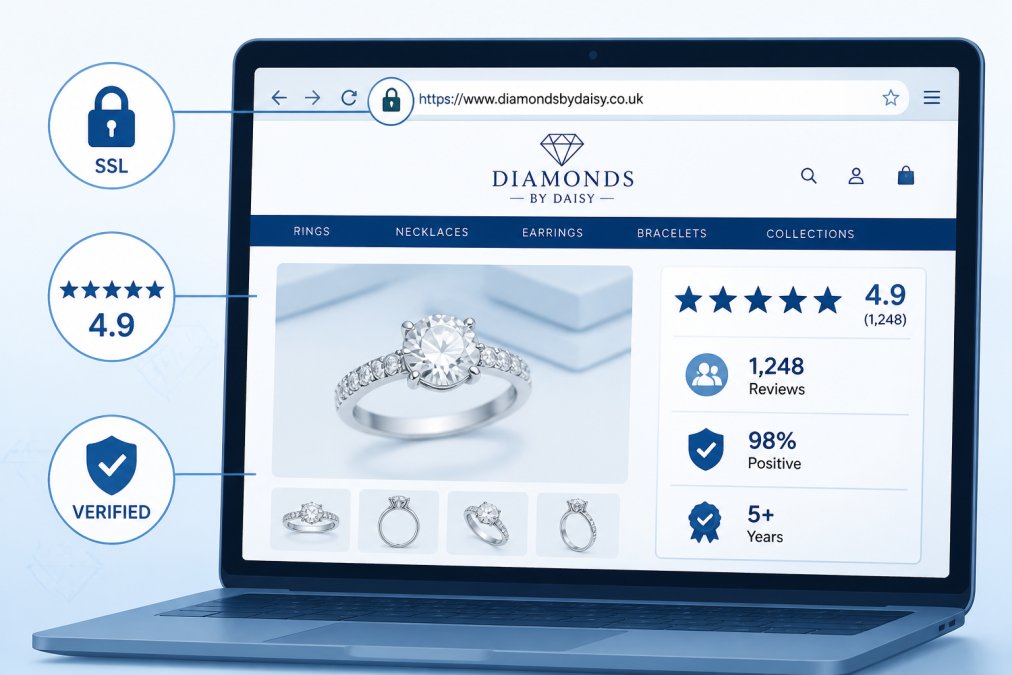
How to Verify a Fine Jewelry Retailer's Legitimacy
Search the retailer's name alongside "scam," "reviews," or "complaints." Read independent reviews on Trustpilot or Google Reviews; legitimate retailers accumulate genuine customer feedback over time. Zero reviews or only five-star reviews warrant suspicion.
Verify the retailer's business registration. In the UK, search Companies House (companieshouse.gov.uk) to confirm the business exists and is properly registered. This takes five minutes and eliminates fraudulent operators.
Contact the retailer directly before purchasing. Call their phone number or email their customer service address. Legitimate businesses answer queries promptly and knowledgeably.
Check whether the retailer is a member of industry bodies. In the UK, membership in the British Jewellers' Association, the Assay Office network, or similar professional organizations signals legitimacy.
Look for third-party verification badges from security companies like Norton or McAfee, or from payment processors like Verified by Visa. These badges link to verification pages where you can confirm the retailer's legitimacy directly with the issuing organization.
Understanding Gemstone Certifications and Grading Reports
A gemstone certification is your insurance policy. It's a document issued by an independent gemological laboratory describing a gemstone's characteristics, quality, and authenticity. The most respected certifications come from the Gemological Institute of America (GIA), the American Gemological Society (AGS), or in the UK, the Assay Office network and independent certified gemmologists.
The certification should include the gemstone's weight (in carats), colour grade, clarity grade, cut grade (for diamonds), treatments applied, and a unique identification number. This number allows you to verify the certificate's authenticity directly with the issuing laboratory.
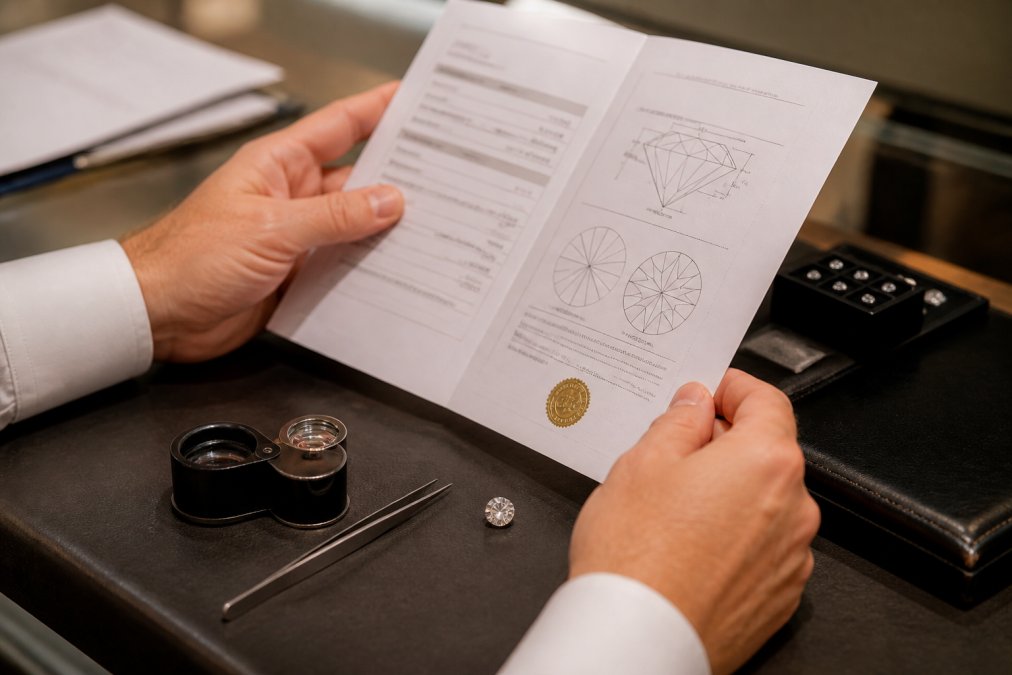
Not all certifications carry equal weight. A certificate from a reputable laboratory (GIA, AGS, Assay Office) is significantly more valuable than one from an unknown organization. Some retailers issue their own "certificates," which are marketing documents without third-party credibility.
When you receive fine jewelry online, verify the certificate's authenticity immediately. Visit the issuing laboratory's website and use their verification tool to confirm that the certificate number, gemstone details, and issue date match the document you received. Two diamonds of identical weight can differ dramatically in value based on colour, clarity, and cut. A certification quantifies these differences and protects you from overpaying.
Secure Payment Methods and Transaction Security for Online Jewelry
Credit cards offer the strongest buyer protection under UK law. If you dispute a transaction or goods don't arrive as described, your credit card company can reverse the charge and investigate. This protection is backed by the Consumer Rights Act 2015.
Debit cards offer less protection. PayPal and similar services add an extra layer of protection through dispute resolution systems.
Always use a secure, encrypted connection when entering payment details. Check for the padlock icon in your browser's address bar and ensure the URL begins with "https://" (not "http://"). Never save your payment details on a retailer's website unless you've verified the site's security credentials thoroughly.
Two-factor authentication adds another security layer. If the retailer offers it, enable it. This requires you to verify your identity through a second method (usually a code sent to your phone) before purchase completes.
Avoid paying via wire transfer, bank transfer, or cryptocurrency for fine jewelry. These payment methods are irreversible. Once the money leaves your account, there's no mechanism to recover it if the seller disappears or sends counterfeit goods.
Return Policies and Consumer Rights Act 2015 Jewellery Protections
The Consumer Rights Act 2015 guarantees that goods must be of satisfactory quality, fit for purpose, and match their description. If fine jewelry arrives damaged, doesn't match product photos, or fails to meet the retailer's claims, you have legal recourse.
Retailers must provide a clear return policy before you complete your purchase. This policy should specify the return window (typically 14-30 days), the condition in which items must be returned, and whether the retailer covers return shipping.
The Consumer Contracts Regulations give you a 14-day cooling-off period for distance purchases. During this window, you can return items without providing a reason, though the retailer can charge for return postage if you simply change your mind. If the item is faulty or doesn't match its description, you're entitled to return it at no cost.
Diamonds by daisy offers a 30-day satisfaction guarantee, which exceeds the legal minimum. This extended window gives you time to receive the piece, have it professionally appraised if desired, and confirm it meets your expectations.
Document everything when you receive fine jewelry. Take clear photos of the piece, packaging, and certificates. If you need to return it, this documentation protects you by providing evidence of the item's condition upon arrival.
| Protection Element | Consumer Rights Act 2015 | Retailer's 30-Day Guarantee | Your Action |
|---|---|---|---|
| Return window | 14 days minimum (cooling-off) | Often 30+ days | Check policy before buying |
| Faulty goods | Full refund, no cost to you | Full refund or replacement | Document condition upon arrival |
| Mismatched description | Return at no cost | Return at no cost | Compare photos to received item |
| Restocking fees | Must be disclosed upfront | Varies by retailer | Ask before purchasing |
| Return shipping | Buyer pays if change of mind | Often covered | Confirm policy in writing |
Hallmarking Requirements UK and What They Mean for Online Buyers
UK hallmarking is a legally mandated quality assurance system for precious metals. Any item sold as gold, silver, platinum, or palladium in the UK must bear a hallmark, a tiny stamped mark certifying the metal's purity. This requirement protects consumers from buying items that don't contain the precious metal they're paying for.
A UK hallmark contains four components: the sponsor's mark (the jeweller's identifier), the assay office mark (which office certified it), the fineness mark (the metal's purity), and the date letter (the year it was hallmarked).
For gold, common marks are 375 (9 carat), 585 (14 carat), 750 (18 carat), and 916 (22 carat). For silver, common marks are 800, 925 (sterling silver), and 950. These numbers represent the proportion of pure precious metal in the alloy.
When buying fine jewelry online, examine the hallmark before completing your purchase. Legitimate retailers provide clear close-up photos of hallmarks or describe them in detail. If a seller cannot or will not show you the hallmark, that's a serious red flag.
You can verify a UK hallmark's legitimacy by contacting the relevant Assay Office. The UK has four: London, Birmingham, Sheffield, and Edinburgh. Each maintains records of hallmarks issued, and you can confirm that a specific piece was officially marked. This verification process is free and takes minutes.
Be cautious of jewelry claiming to be fine but lacking a hallmark. Items under 1 gram are exempt from hallmarking requirements, but anything heavier must be marked. If a seller claims an item is fine jewelry but shows no hallmark and weighs more than 1 gram, the item is either not fine jewelry or the seller is being deceptive.
Product Photography vs. Reality: Measuring Size and Visualising Scale
One of the biggest frustrations with buying fine jewelry online is the disconnect between how pieces look in photos and how they appear in person. Professional product photography uses lighting, angles, and editing techniques that can make jewelry appear larger or more brilliant than reality.
Request additional photos from different angles and in different lighting conditions. Ask specifically for photos showing the piece next to a common object for scale reference, a hand, coin, or ruler. This contextualizes size in a way that isolated product shots cannot.
Many online retailers provide detailed dimensions: ring width in millimetres, pendant dimensions, bracelet length. Use these measurements to your advantage. Cross-reference these dimensions with similar pieces you own or have seen in person to build intuition about scale.
Video content is invaluable for understanding how fine jewelry actually looks. Some retailers provide short videos showing the piece from multiple angles, how it catches light, and how it sits on the hand or body.
Ask the retailer about sizing specifics before purchasing. For rings, confirm the band width and whether sizing will affect appearance. For necklaces, ask about pendant dimensions and how it hangs on different body types.
Post-Purchase Verification and Ethical Sourcing Transparency
Your responsibility doesn't end when the package arrives. Post-purchase verification confirms that what you received matches what was promised.
Inspect the piece immediately upon arrival. Check that the metal hallmark matches what was promised. Examine the gemstones for visible damage or inclusions that weren't disclosed. Compare the piece to the product photos, does it match in appearance?
If the piece includes a gemstone certificate, verify it immediately. Visit the issuing laboratory's website and use their verification tool to confirm the certificate's authenticity. Have the piece professionally appraised by an independent gemmologist if you have any concerns about its authenticity or quality. An appraisal costs between £50 and £150 but provides definitive confirmation of the piece's value and specifications.
Ethical sourcing has become increasingly important to fine jewelry buyers. Ask retailers about their sourcing practices before purchasing. Reputable retailers should be able to explain where their gemstones come from, whether they're lab-grown or mined, and whether they've been certified as conflict-free.
Lab-grown diamonds are chemically identical to mined diamonds but carry a lower environmental footprint and avoid association with conflict diamonds. If ethical sourcing matters to you, ask whether the retailer offers lab-grown options.
Ask for documentation of any sustainability certifications or ethical sourcing claims. If a retailer claims stones are "ethically sourced" but cannot provide documentation, that's a marketing claim without substance.
Buying fine jewelry online doesn't have to be risky. When you verify seller authenticity, understand certifications, confirm hallmarks, and use secure payment methods, you're making a safer purchase than many in-store transactions. Diamonds by daisy eliminates guesswork through professional product photography, detailed certifications, and a 30-day satisfaction guarantee, giving you the confidence to invest in pieces that will be treasured for decades. Start your search with verified retailers, demand transparency at every step, and you'll find that online fine jewelry shopping offers convenience without compromise.
Frequently Asked Questions
Is it safe to buy expensive fine jewelry online?
Yes, buying fine jewelry online is safe when you take proper precautions. Choose established retailers with secure payment gateways, verified SSL certificates, and clear return policies. Look for third-party certifications of authenticity, customer reviews from trusted sources, and sellers who provide gemological reports. Reputable online jewelers offer buyer protection through secure checkout systems and satisfaction guarantees, making high-value purchases as secure as in-store shopping when you verify the seller first.
How can I verify a jewellery website is legitimate before buying?
Check for these verification signals: a secure HTTPS connection (padlock icon in your browser), clear company contact information and physical address, professional product photography with multiple angles, customer reviews on independent platforms, and transparent return policies. Look for hallmarking information on precious metals and gemstone certifications from recognised bodies. Verify the retailer's business registration and check whether they display trust badges or industry memberships. Legitimate sellers are transparent about their sourcing practices and happy to answer questions about provenance and ethical sourcing.
What does the Consumer Rights Act 2015 say about jewellery returns?
Under the Consumer Rights Act 2015, you have the right to return online jewelry purchases within 14 days if the item doesn't match the description or photos. The seller must have informed you of this right at checkout. However, you may lose this right if you've damaged the item beyond inspection purposes. Some retailers offer extended return windows (such as 30-day satisfaction guarantees) which exceed the legal minimum. Always check the specific return policy before purchasing, as it should clearly state the timeframe, condition requirements, and refund process.
What certifications should I look for when buying diamonds or gemstones online?
Look for gemological reports from recognised certification bodies. In the UK market, reputable certifications include those from established gemological institutes. A proper certification should detail the stone's characteristics: carat weight, colour grade, clarity grade, and cut quality. Legitimate online jewelers provide these reports before purchase or offer them as part of your purchase. Request certification details in writing before committing to a purchase. Be cautious of sellers who cannot provide certification or who claim stones are certified without documentation. Third-party verification adds significant assurance to your online purchase.
This article was written using GrandRanker