

3 Best Diamond Shapes for Small Fingers: A 2026 Guide
Table of Contents
- Why Diamond Shape Matters for Petite Hands
- The 3 Best Diamond Shapes for Small Fingers
- Diamond Shapes to Avoid for Small Fingers
- Engagement Ring Styles for Petite Hands
- Diamond Carat Size for Small Fingers: Finding the Right Proportion
- Conclusion: Choose the Shape That Feels Right
- Frequently Asked Questions
The Best Diamond Shapes for Small Fingers: A Complete Guide
Last Updated: September 9, 2026
Choosing the right diamond shapes for small fingers comes down to one principle: elongation. The most flattering cuts create a continuous vertical line that draws the eye along the finger, making it appear longer and more slender. This guide from Diamonds by daisy breaks down the three best shapes, the styles that work against you, and how to balance carat weight with proportion.
Quick Picks:
- Best Overall: Oval Cut, round-diamond sparkle with a slimming silhouette
- Most Lengthening: Marquise Cut, maximum length per carat, vintage appeal
- Most Unique: Pear Cut, graceful asymmetry that flatters petite hands
Why Diamond Shape Matters for Petite Hands
Diamond shape is the single strongest tool for controlling visual balance on the hand. Elongated shapes (oval, pear, marquise, emerald) reflect light and direct the eye vertically, creating an illusion of length that shorter, wider cuts cannot match.
A slender finger has limited surface area, so the diamond's outline becomes the dominant visual element. When that outline is long and narrow, it harmonises with the finger; when wide and blocky, it creates a visual disconnect that makes the hand look shorter and the finger wider.
Most guides stop at listing three shapes, but the setting and band do half the work. A delicate tapered band with a raised profile amplifies the lengthening effect, while a thick band can cancel it out entirely.
The 3 Best Diamond Shapes for Small Fingers
Diamond shapes for small fingers that flatter most are the oval, pear, and marquise cuts. Each delivers elongation through a different silhouette, so the right choice depends on your personal style and how much sparkle you want.
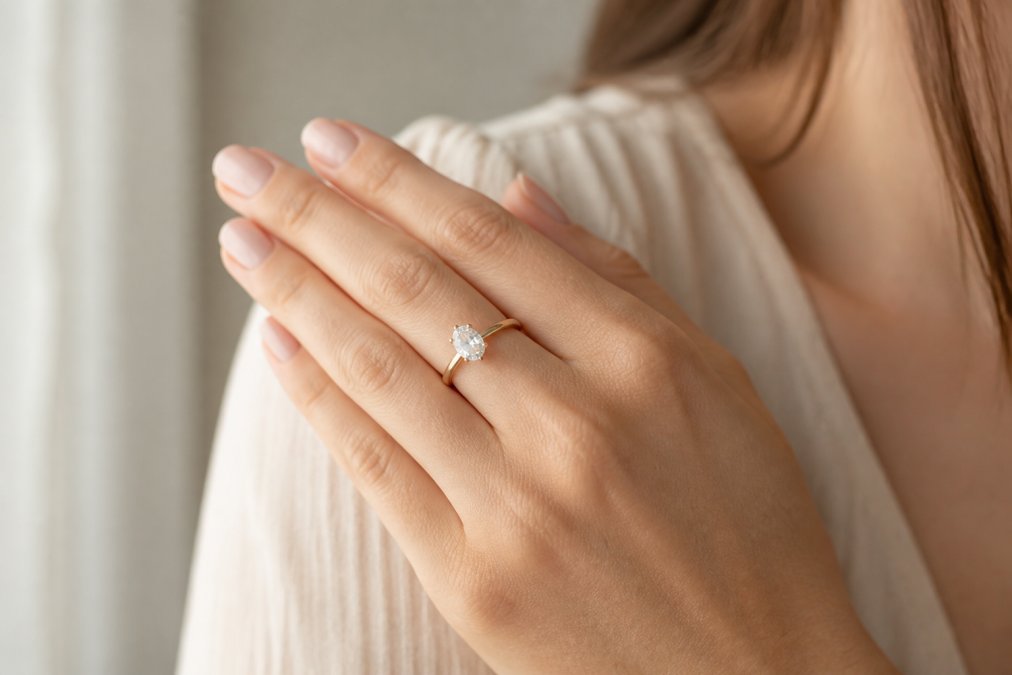
1. Oval Cut: Brilliance with a Slimming Silhouette
The oval cut is the safest and most versatile pick for petite hands. It delivers the brilliance and fire of a round brilliant cut, but its elongated outline creates a slimming effect that rounds cannot offer.
Because the oval is symmetrical, it reads as classic rather than trendy. The main thing to check is cut precision: a poorly proportioned oval can show a dark "bow-tie" effect across the centre, though a well-cut stone minimises this.
2. Pear Cut: Elegant Asymmetry That Lengthens
The pear cut combines the rounded end of an oval with the pointed tip of a marquise, creating a teardrop silhouette that is both graceful and distinctive. Worn with the point facing toward the fingertip, it directs the eye outward and adds measurable length to the finger.
This shape has genuine personality, delivering a feminine, romantic look that photographs beautifully. The trade-off is practical: the pointed tip is delicate and needs a protective setting, typically a V-shaped prong, to guard against chipping.
3. Marquise Cut: Maximum Length, Maximum Impact
The marquise cut is the most effective shape for creating a lengthening effect on small fingers. Its pointed, boat-like outline provides the largest visual footprint per carat of any diamond shape, making the stone appear considerably larger than its actual carat weight.
This shape also carries a vintage, Hollywood-glamour heritage. As with the pear, the pointed ends require a setting that shields them, so a bezel setting or protective prongs are worth considering for daily wear.
Diamond Shapes to Avoid for Small Fingers
Shapes that are wide relative to their length tend to overwhelm petite hands. The round brilliant, princess cut, and asscher cut are beautiful stones, but their proportions work against the finger-lengthening effect you are trying to achieve.
The round brilliant, despite being the most popular shape, offers no vertical line to guide the eye and can visually shorten a short finger further. The princess and asscher cuts, being square, have the same issue: they emphasise width where you most need length.
This does not mean these shapes are off-limits. It means they demand a compensating setting, such as a very thin band and a raised profile, to create some vertical interest.
Engagement Ring Styles for Petite Hands
Engagement ring styles for petite hands should prioritise a slim shank and a raised setting. The band width matters as much as the diamond shape: a tapered band that narrows toward the centre stone creates a continuous vertical line, while a wide, flat band visually cuts the finger in two.
A solitaire setting on a delicate band is the cleanest approach. It lets the elongated diamond do all the work without competing elements. Halo settings can also flatter small hands, provided the halo is shaped to follow the diamond's elongated outline rather than adding a round frame around it.
Pavé bands, set with small diamonds along the shank, add sparkle and can enhance the illusion of length when the stones trail toward the knuckle. The key is restraint: the band should support the centre stone, not compete with it.
Band Width and Setting Height
The "overpowering factor" is the most common mistake with petite hands. A diamond that looks elegant alone can look heavy when paired with a thick band or a low, squat setting. The goal is visual balance between the stone and the finger, and the setting controls that balance.
A raised profile lifts the diamond off the finger, allowing light to pass beneath it and creating a sense of lightness. North-south orientation, where an elongated stone is set vertically along the finger, reinforces the lengthening effect. A lower setting, while practical, can make the stone appear to sit into the finger and shorten its visual impact.
What most guides fail to explain is the mechanics of setting height. There are three primary profile types, each with distinct visual and practical trade-offs:
1. Low-Profile Settings (Cathedral, Flush, or Bezel)
A low-profile setting sits close to the finger, typically with the diamond's culet resting just 2-3mm above the skin (gia.edu). It is the most practical choice for active lifestyles, as it snags less on clothing. However, on a petite finger, it can visually 'ground' the stone, making it appear wider and heavier, and the lack of light passing beneath reduces the airiness that elongated cuts thrive on.
2. Mid-Profile Settings (Standard Prong Solitaire)
This is the most common setting, with the diamond raised approximately 5-6mm above the finger. It offers a balanced approach: enough height for light to pass beneath, but not so much that the ring feels precarious. For petite hands, a mid-profile with a tapered, knife-edge band is the gold standard, as the band narrows to a fine point, creating a continuous vertical line that complements the elongated diamond.
3. High-Profile Settings (Raised Basket or Tension)
A high-profile setting lifts the diamond 7mm or more above the finger, maximising light performance and creating the strongest sense of 'floating' elegance. On a petite finger, this can be stunning, as it visually separates the stone from the hand. The trade-off is significant: high-profile settings are more prone to catching, require a secure head design, and add perceived height that may feel unbalanced if the finger is very short.
The 'Overpowering' Factor: Visual Weight vs. Carat Weight
Beyond physical dimensions, there is a psychological component to how a ring reads on a small hand. The 'overpowering factor' is about visual clutter: a petite finger has limited surface area, and every element competes for attention. A diamond covering more than two-thirds of the finger's width, combined with a pavé band and halo, creates busyness that can make the hand look cluttered rather than elegant.
The most flattering approach for petite hands is subtraction. Choose one focal point, the elongated centre stone, and let everything else recede. A plain, polished band in a contrasting metal provides a clean backdrop. If you desire additional sparkle, a single row of pavé stones that tapers toward the knuckle is more effective than a full pavé band, as it draws the eye along the finger's length rather than encircling it.
Finally, consider the comfort of the setting profile in daily wear. A high-profile setting on a size 4.5 finger can feel top-heavy and may spin more easily. If you prefer a high profile, ask your jeweller about adding sizing beads or a euro shank to prevent twisting, ensuring the ring feels secure and comfortable throughout the day.
Diamond Carat Size for Small Fingers: Finding the Right Proportion
Diamond carat size for small fingers is less about a specific number and more about the finger-to-diamond ratio. A 2-carat marquise can look elegant on a slender finger because its length is distributed vertically, while a 1-carat round can look heavy because its width dominates the finger.
Most articles rely on generic stock photos that fail to show scale, a critical omission since a diamond photographed on a size 7 finger looks dramatically different on a size 4.5 finger. To bridge this gap, a scale-accurate infographic showing the actual outline of specific carat weights (0.5ct, 1ct, 1.5ct, and 2ct) superimposed over a standard size 4.5 finger silhouette can help you see precisely how much of the finger's width the stone will cover before you visit a jeweller.
A practical guideline is to choose a stone whose length does not exceed roughly two-thirds of the finger's width at the knuckle. For a size 4.5 finger, which typically measures about 15.7mm in circumference (roughly 5mm in width), this translates to a maximum diamond length of approximately 8-9mm (gem-a.com). Here is how that plays out in practice:
- 0.5 carat oval (approx. 6.5mm x 4.5mm): Covers about 90% of the finger's width. This is a delicate, understated look that prioritises the band and the hand itself.
- 1 carat oval (approx. 8mm x 5.5mm): Reaches the two-thirds guideline. This is the sweet spot for most petite hands, offering a noticeable presence without overwhelming the finger.
- 1.5 carat oval (approx. 9mm x 6mm): Exceeds the two-thirds guideline. This begins to enter the 'overpowering' territory, where the stone, not the hand, becomes the dominant visual element.
- 2 carat marquise (approx. 12mm x 6mm): While long, the marquise's narrow width means it can still look proportionate, as the visual weight is distributed along the length rather than across the width.
This visual approach also reveals a budget-friendly advantage. Because elongated cuts are generally more affordable per carat than round brilliants, you can often achieve a larger visual presence for the same budget. A 1.5-carat oval will often cost less than a 1-carat round brilliant of similar quality, yet it will appear significantly larger on a petite finger. The 'small finger' aesthetic is not just flattering; it is a smart financial choice that maximises visual impact without inflating your budget.
Conclusion: Choose the Shape That Feels Right
The three best diamond shapes for small fingers, the oval, pear, and marquise, share one quality: they lengthen rather than widen. Start with these, then refine your choice by considering the band width, setting height, and how the ring feels on your hand.
At Diamonds by daisy, every piece is meticulously crafted with handpicked gemstones and precious metals, and each purchase is backed by a 30-day satisfaction guarantee. That means you can see the ring on your own hand, in your own light, before you commit. Gemological Institute of America's diamond shape guidance confirms that cut and proportion are the primary drivers of a diamond's beauty, so trust your eye as much as the specs.
Get started with Diamonds by daisy and find the shape that makes your hand feel exactly right.
Frequently Asked Questions
What shape diamond looks best on small hands?
Elongated shapes like oval, pear, and marquise are the most flattering for small hands. Their longer silhouette draws the eye vertically, creating an illusion of length and making fingers appear slimmer. Round and princess cuts, while beautiful, can make short fingers look wider because they don't offer that lengthening effect.
What is the best diamond carat size for small fingers?
A diamond between 0.5 and 1.5 carats typically suits petite hands best. The key is the ratio of the diamond's surface area to your finger width. An elongated 1-carat oval can look larger and more proportionate than a 1.5-carat round on a narrow finger. Try on different sizes to see what feels balanced.
Do oval diamonds make fingers look thinner?
Yes, oval diamonds are an excellent choice for creating a slimming effect. The elongated shape covers more of the finger's length rather than its width, which visually stretches the hand. This makes oval diamonds one of the best diamond shapes for small fingers, offering a flattering, elegant look.
What ring setting is best for petite hands?
A tapered band paired with a raised setting works beautifully for petite hands. A tapered band is thinner at the front and wider at the back, which makes the finger look longer. A delicate setting, like a simple prong or bezel, keeps the focus on the diamond without overwhelming your hand.