

Measure These Jewelry Lengths for Petite Women with Diamonds by Daisy
The most flattering jewelry for petite women is delicate, proportionate: collarbone-length necklaces that sit right at or just below the collarbone, small studs or huggies, thin stacking rings, and lightweight bracelets. These pieces sit close to the body and echo its scale instead of competing with it. Get the lengths and weights right, and everything else in your jewelry box starts making sense.
TL;DR:
- Jewelry for petite women should be proportionate, with collarbone-length necklaces, delicate earrings, and slim rings to complement smaller frames.
- Necklaces between 16 and 18 inches are most flattering, as they sit at the collarbone, while longer pendants can visually cut the torso in half.
- Small studs, huggies, and vertical drop earrings flatter petite faces, and large hoops or statement earrings should be worn sparingly as focal points.
- Thin bands, lightweight bracelets, and scaled-down gemstones enhance small hands and wrists without overwhelming their proportions.
- Proper measurement before purchase and focusing on proportionate pieces, rather than just size, ensures jewelry complements rather than competes with petite body features.
Table of Contents
- Why Proportion Matters More Than Size Alone for Petite Frames
- Necklaces: Best Lengths, Shapes, and Layering Rules for Petites
- Earrings: Sizes and Styles That Flatter a Smaller Face
- Rings & Hands: Stacking, Proportions, and Sizing Tips
- Bracelets & Wrists: What to Wear and When to Skip Chunky Cuffs
- How to Layer and Balance Jewelry Across a Full Outfit
- Styling Dos and Don’ts: Quick Rules to Remember
- Selecting Pendant Sizes Appropriate for Petite Necklines
- Advice on Matching Jewelry With Different Necklines on Petite Frames
- Considerations for Metal Thickness and Weight in Jewelry for Petites
- Incorporating Color and Gemstone Size to Complement Petite Proportions
- Why “Go Smaller” Isn’t Actually the Whole Story
- Shop Petite-Friendly Jewelry Without the Guesswork
- Sources
Why Proportion Matters More Than Size Alone for Petite Frames
Jewelry works the same way a picture frame works on a small wall. Too much frame and the room feels smaller. Every bracelet, chain, and earring you put on either extends your frame or crowds it, and on a smaller build, that effect shows up faster than it would on someone taller.
A two-inch pendant on a 5-foot-8 woman reads as a nice accent. On a woman who’s 5 foot 2, that same pendant can visually cut the torso in half and make the neck look shorter. It’s not about avoiding size entirely. Stylists agree that petite dressing works best when accessories stay in proportion to bone structure and torso length, not just height, which is why two women who are both petite might need slightly different scales.
A few quick proportion anchors to keep in mind while shopping:
- Collarbone width: guides where a necklace should actually rest, not just its stated length.
- Face width: determines whether an earring elongates or widens.
- Wrist and hand size: dictates how thick a bracelet or ring band can go before it looks borrowed from someone else’s jewelry box.
Necklaces: Best Lengths, Shapes, and Layering Rules for Petites
Sixteen to eighteen inches is the sweet spot for most petite frames. That length lands right at or just below the collarbone, which is exactly where the eye naturally lands anyway. Necklaces in this range are consistently the most flattering choice for smaller frames, according to styling guides focused specifically on dainty jewelry.
Length changes the whole effect, though, and it pays to understand the trade-offs:
- Chokers that sit quite close to the neck: Great for open necklines and can visually widen a short neck if worn alone, but skip them under crewnecks or high collars.
- Collarbone length (16 to 18 inches): The default. Works with nearly every neckline and flatters the widest range of body types.
- Pendant styles (18 to 20 inches): Fine in small doses, but a long pendant on a short torso can slice you visually in half.
If you’re layering, keep every chain thin, stick to two pieces maximum, and stagger the lengths by an inch or two so each one stays visible. Mixing textures, like a bead chain with a slim cable chain, adds depth without adding bulk, a technique Diamondsbydaisy’s guide to layering necklaces breaks down in more detail.
Pro Tip: Grab a soft tape measure or an old necklace whose length you already know, wrap it around your neck at the length you’re considering, and look in a mirror before you buy anything online. Model photos on product pages routinely mislead petite shoppers because those models are rarely under 5 foot 5.
Earrings: Sizes and Styles That Flatter a Smaller Face
Small studs, huggies, tiny hoops, and vertical drop earrings are styles that consistently flatter a smaller face. Vertical drops in particular create a subtle elongating line, which is useful if your face reads as round or wide rather than long.
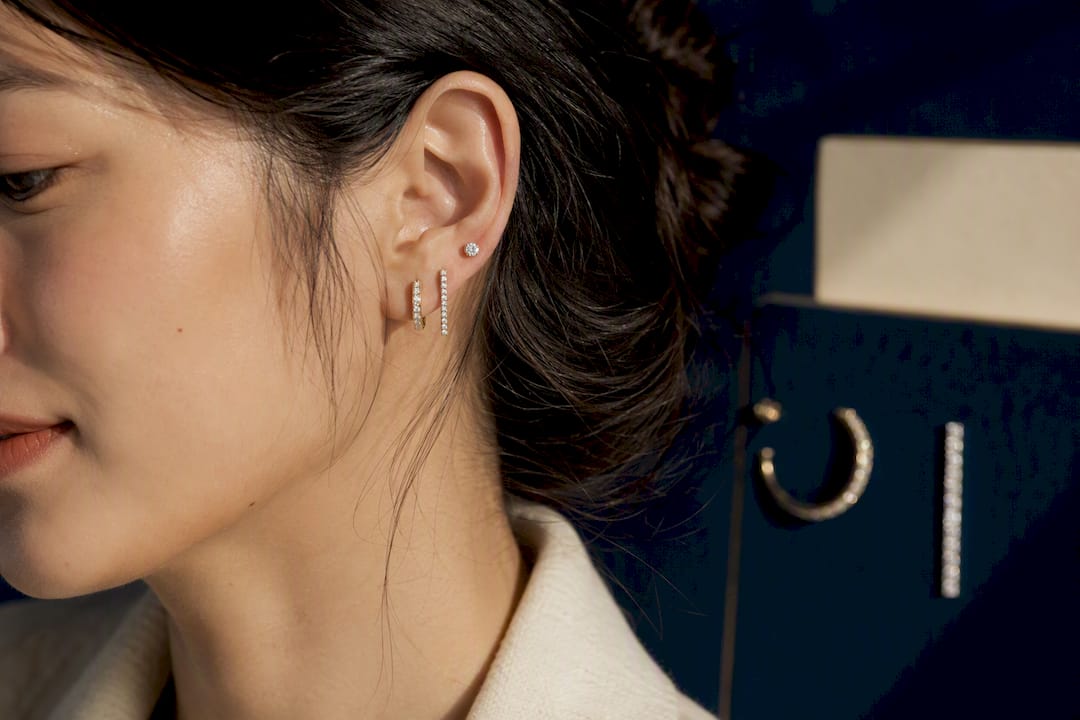
Diameter and projection both matter more than most people realize. A hoop that sits far off the earlobe adds visual width fast, while one that hugs close to the ear barely registers as a hoop at all, which is exactly why huggie styles have become such a go to for smaller frames.
A short list of what actually works on a petite face:
- Small studs suitable for daily wear, especially with glasses or a scarf.
- Huggie hoops for a bit more presence without added width.
- Vertical drop earrings when you want length without volume.
- One statement earring style, worn with everything else minimal, when you want real impact for an event.
That last point matters. When petites go bold with earrings, it works best as a single focal point, not stacked alongside a busy necklace and a loaded wrist.
Rings & Hands: Stacking, Proportions, and Sizing Tips
Thin bands read as elegant on small hands. Chunky rings, even a single one, can make fingers look shorter by comparison. Start with one anchor ring you like, then build a stack around it rather than reaching for five rings at once and hoping they work together.
Quick rules that keep a ring stack looking put together instead of cluttered:
- Mix two or three slim bands max on one finger, leaving a sliver of skin between some of them.
- Vary texture slightly (one twisted band, one smooth) rather than metal color.
- Save large center stones for one ring only, worn alone on an adjacent finger.
- Avoid wide statement bands on the same hand as your stack; pick one focal point.
Large stones aren’t off limits, but they photograph and wear differently on small hands than on a size 8 hand. A one-carat stone that looks moderate on one person can dominate a petite finger, so try rings on in person whenever that option exists.
Bracelets & Wrists: What to Wear and When to Skip Chunky Cuffs
Delicate chains, slim bangles, and small charm bracelets are the safest bet for a narrow wrist. They sit close to the bone and don’t slide around or overwhelm the space between wrist and hand.
Stacking two or three thin bracelets together usually looks better than wearing one thicker piece, and worn slightly loose (not tight against the wrist bone) it gives a bit of natural movement. A few placement notes worth remembering:
- Layer a chain bracelet with a slim bangle for texture, not two bangles that clank.
- Keep charms small; oversized charms drag a delicate chain down visually.
- A single thin cuff can work as a standalone accent piece for a minimalist look.
- Skip wide, heavy cuffs unless you’re removing every other bracelet to let it stand alone.
How to Layer and Balance Jewelry Across a Full Outfit
A simple 2:1:1 rule adapts well for petites: one main piece, one supporting piece, one subtle accent. That might mean a collarbone necklace as the star, a pair of small studs as support, and a slim ring as the quiet extra. Three points of interest read as intentional. Six read as cluttered.
Neckline and occasion should drive the specific choices:
- T-shirt and jeans: One delicate necklace at collarbone length, studs, one thin ring. Nothing else needed.
- Blouse with an open collar: Small pendant necklace, huggie hoops, and a slim bracelet stack. Skip a second necklace here; the collar is already doing visual work.
- Little black dress for evening: Either a statement earring with a bare neck, or a delicate necklace with studs, never both loud pieces at once.
Coordinate metal tones where possible, and match jewelry weight to fabric weight. Chunky knits can handle slightly more presence; silky or sheer fabrics get overwhelmed fast by anything heavy.
Styling Dos and Don’ts: Quick Rules to Remember
Getting this right comes down to a handful of habits repeated across nearly every petite styling guide, not some secret formula.
Do:
- Measure before you buy, and try pieces on your own frame rather than trusting a product photo.
- Pick one hero piece per outfit and let everything else support it.
- Default to delicate metals and thin bands for daily wear.
Don’t:
- Wear more than one oversized piece at a time (a giant hoop and a chunky cuff is one too many).
- Choose long pendants that visually cut a short torso in half.
- Pair delicate jewelry with an oversized bag; the mismatch in scale undercuts the whole look. Structured, medium-sized bags tend to balance a petite frame better than either micro or oversized styles.
Pro Tip: Keep a small tape measure in your bag or purse when shopping in person. Thirty seconds of measuring saves a return shipment and a disappointing unboxing later.
Selecting Pendant Sizes Appropriate for Petite Necklines
Pendant size is where a lot of petite shoppers get tripped up, because a pendant that looks delicate on a hanger can look enormous once it’s actually resting against a smaller chest and shorter neck. A good working range for most petite frames is a pendant between a quarter inch and three quarters of an inch in diameter or length. Anything larger starts to compete with the neckline instead of complementing it.
Shape matters as much as size. A narrow vertical pendant, like a bar or a slim gemstone drop, tends to elongate the neck. A wide, round, or geometric pendant does the opposite, adding horizontal weight exactly where you don’t want it. If you love a bigger pendant, the fix isn’t to avoid it entirely; it’s to simplify everything else around it. Wear it alone on a fine chain, skip the earrings beyond a small stud, and let the pendant be the only story your jewelry is telling that day.
Chain thickness also affects how the pendant reads. A hefty pendant on a fine chain looks intentional and a little editorial. The same pendant on a chunky chain just adds bulk on top of bulk. If you’re shopping online and can’t try before you buy, look for a stated pendant measurement in the product description rather than guessing from a photo, since scale is notoriously hard to judge on a screen.
Advice on Matching Jewelry With Different Necklines on Petite Frames
Necklines set the rules for what jewelry actually gets to be seen, and petite frames make that even more true because there’s less real estate to work with.
A crew neck or high collar leaves almost no room for a necklace to show, so this is where earrings and a ring stack should do the heavy lifting instead. A scoop neck or V-neck is the easiest to dress, since it naturally frames a collarbone length necklace without any competition. A boat neck or off-the-shoulder top calls for something slightly shorter, closer to 14 to 16 inches, so the necklace doesn’t disappear into the wide neckline.
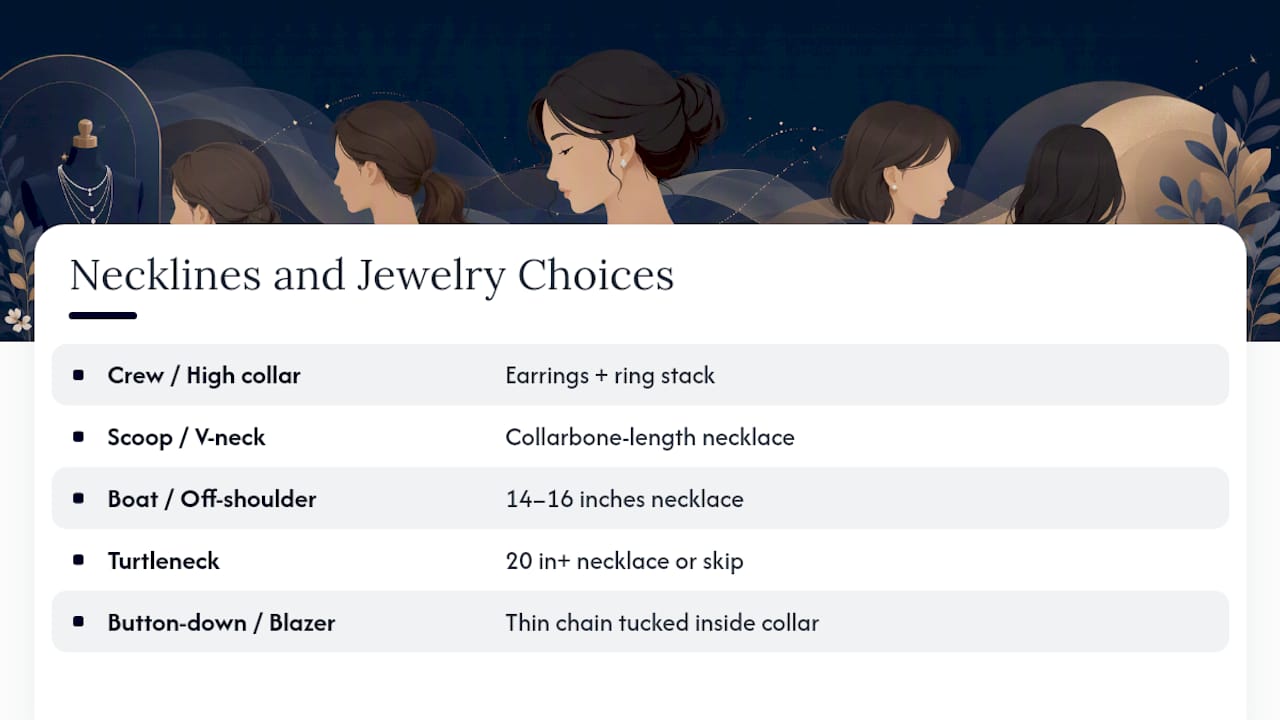
Turtlenecks are trickier than they look. A necklace worn over a turtleneck needs enough length to sit below the fabric’s edge, usually 20 inches or longer, or it should be skipped in favor of statement earrings instead. Button down shirts and blazers work well with a single thin chain tucked just inside the collar, peeking out rather than displayed in full.
The general principle holds across all of these cases: the more fabric covering your neck and chest, the less necklace you need, and the more the job shifts to earrings, rings, or a bracelet stack to carry the look.
Considerations for Metal Thickness and Weight in Jewelry for Petites
Weight is the detail most shoppers skip, and it’s often the one that makes a piece feel wrong the moment it’s on. A necklace can be the perfect length and still feel heavy or look thick if the chain gauge is wrong for a small frame.
Thin chain gauges, generally the finer end of what a jewelry brand offers, drape closer to the skin and move naturally with the body instead of sitting stiffly. Thicker chains, the kind marketed as bold or statement pieces, tend to sit more rigidly and can look disproportionate against a smaller collarbone or a slimmer wrist.
The same logic applies to rings and bracelets. A wide, heavy band can genuinely make fingers look shorter, while a slim band lets the hand’s natural proportions show through. Bangles follow the same pattern: a chunky metal cuff can overwhelm a narrow wrist, while a slim bangle or a few stacked thin ones look considered rather than borrowed.
Weight also affects comfort in a way that matters for everyday wear. Lightweight pieces sit more securely and move less throughout the day, which is part of why dainty styles have become the default recommendation across most petite styling advice rather than a passing trend.
Incorporating Color and Gemstone Size to Complement Petite Proportions
Color and stone size work on the same visual logic as metal weight: smaller and more concentrated tends to flatter, while large and sprawling tends to overwhelm.
A single small colored stone, whether it’s a birthstone pendant or a colored stud, adds personality without adding visual bulk. Clustered or pavé settings, where many tiny stones sit close together, often read as more delicate than one large center stone of the same total size, because the eye perceives texture rather than one dominant shape.
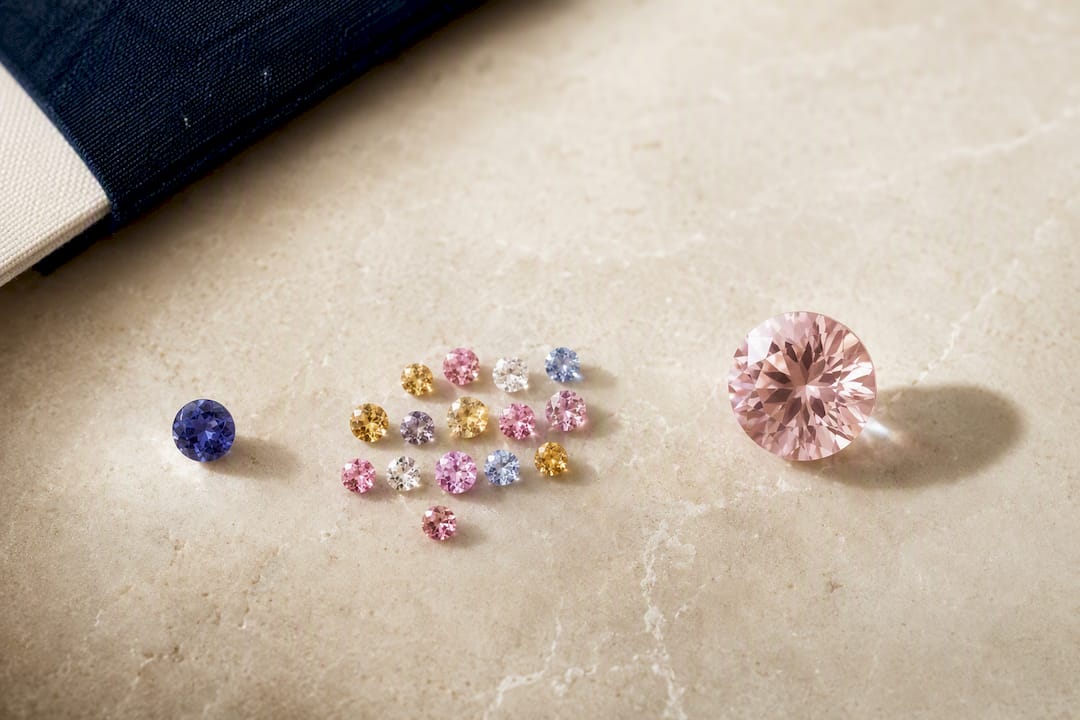
Larger gemstones aren’t automatically off the table, but they need support from everything else being pared back. A statement colored ring or a larger pendant works best as the only bold color note in the outfit, paired with neutral metals and simple shapes elsewhere. Mixing several large colored stones across a necklace, ring, and earrings at once tends to fragment the eye’s attention rather than create one clear focal point, and on a smaller frame that fragmentation reads faster and looks busier than it would on someone taller.
Warm gold tones and cooler silver or platinum both work fine on petite frames; the deciding factor is contrast against skin tone, not scale. Where scale does matter is stone cut. Rounder, softer cuts (oval, cushion, pear) tend to look more proportionate on a smaller hand than sharp, angular cuts that draw more attention to size over shape.
Why “Go Smaller” Isn’t Actually the Whole Story
Most petite styling advice boils down to one lazy sentence: buy smaller jewelry. That advice isn’t wrong, but it’s incomplete, and it’s why so many petite shoppers still end up with a jewelry box full of pieces that technically fit the “dainty” label yet still look off.
The real skill is proportional thinking, not miniature thinking. A woman who’s 5 foot 1 with narrow shoulders and a small bone structure needs a genuinely different scale than a woman who’s 5 foot 4 with a fuller bust and broader collarbone, even though both get filed under “petite” by most sizing charts. Bone width and torso length do more work than height alone, which is exactly what experienced stylists have been saying for years while most advice columns keep repeating the same generic tip.
The other thing people underestimate is how much a single wrong-scale piece can undo three right-scale ones. Wear a perfectly proportioned necklace, ideal studs, and a delicate ring stack, then throw on one oversized cuff, and the cuff wins. Not because it’s the biggest piece by volume, but because contrast draws the eye faster than repetition does. Curating for petite frames isn’t about restriction. It’s about understanding that every piece is in conversation with every other piece you’re wearing that day, and the loudest voice in the room usually wins the argument, whether you meant it to or not.
— Georgia
Shop Petite-Friendly Jewelry Without the Guesswork
The everyday collections are built around proportions that include fine chains, small stud and huggie earrings, thin stacking rings, and slim bracelets that sit close to the wrist instead of overtaking it. Rather than sorting through jewelry sized for average height models, you can shop pieces designed with delicate frames in mind.
The Everyday Gold Jewellery collection is the best starting point if you’re rebuilding a petite-proportioned jewelry box from scratch: lightweight gold necklaces, studs, and bracelets designed to layer without adding bulk. If you want a pendant necklace that won’t overwhelm a smaller neckline, the crystal and celestial jewelry collection has small pendant styles built for exactly that placement. And for the anchor bracelet mentioned earlier in this guide, the Gold Circle Stacking Bracelet is a genuinely good example of a delicate, minimalist piece that works solo or stacked.
Use an adjustable chain when your torso length falls between standard sizes, measure your own collarbone placement before ordering a necklace online, and check the return policy so a length that doesn’t sit right isn’t a wasted purchase. Start browsing the full collection to find pieces sized for your actual frame, not just the “petite” label.
Sources
The styling rules in this guide draw on PoorLittleItGirl’s petite dainty jewelry guide, InStyle’s petite style tips, and SAS for Short’s petite accessories guide, three sources that consistently point petite shoppers toward proportion over pure size. For layering technique specifically, Diamondsbydaisy’s necklace layering guide and minimalist jewelry styles guide go deeper into chain pairing and everyday minimalism. For bracelet stacking specifically, the bracelet stacking guide walks through wrist placement in more detail than covered here.