

Round Brilliant vs Princess Cut Diamonds: The 2026 Guide
Table of Contents
- Round Brilliant vs Princess Cut: Key Differences at a Glance
- How Diamond Cut Quality Explained Affects Your Choice
- Brilliance and Fire: Which Shape Sparkles More?
- Princess Cut Diamond Durability and Everyday Wear
- Price Per Carat and Visual Size: Getting More for Your Budget
- Your Engagement Ring Shape Guide: Matching the Cut to Your Hand
- Long-Term Wear and Resale Value: What to Expect
- The Verdict: Choosing Between Round Brilliant and Princess Cut
- Frequently Asked Questions
Last Updated: September 6, 2026
Choosing between a round brilliant vs princess cut diamonds often comes down to a single question: do you prioritise maximum sparkle or modern geometry? The round brilliant is the classic 58-facet cut engineered for unmatched brilliance, while the princess cut is a square modified brilliant prized for its contemporary silhouette. At Diamonds by daisy, we specialise in helping buyers understand these nuances, ensuring your choice reflects both your style and practical needs.
Below, we break down the optical, financial, and durability differences so you can decide with confidence. A round brilliant cut diamond is the traditional choice for engagement rings, offering the highest level of light performance of any standard shape. The princess cut, by contrast, delivers comparable sparkle with a sharper, more modern aesthetic, often at a more accessible price per carat.
Round Brilliant vs Princess Cut: Key Differences at a Glance
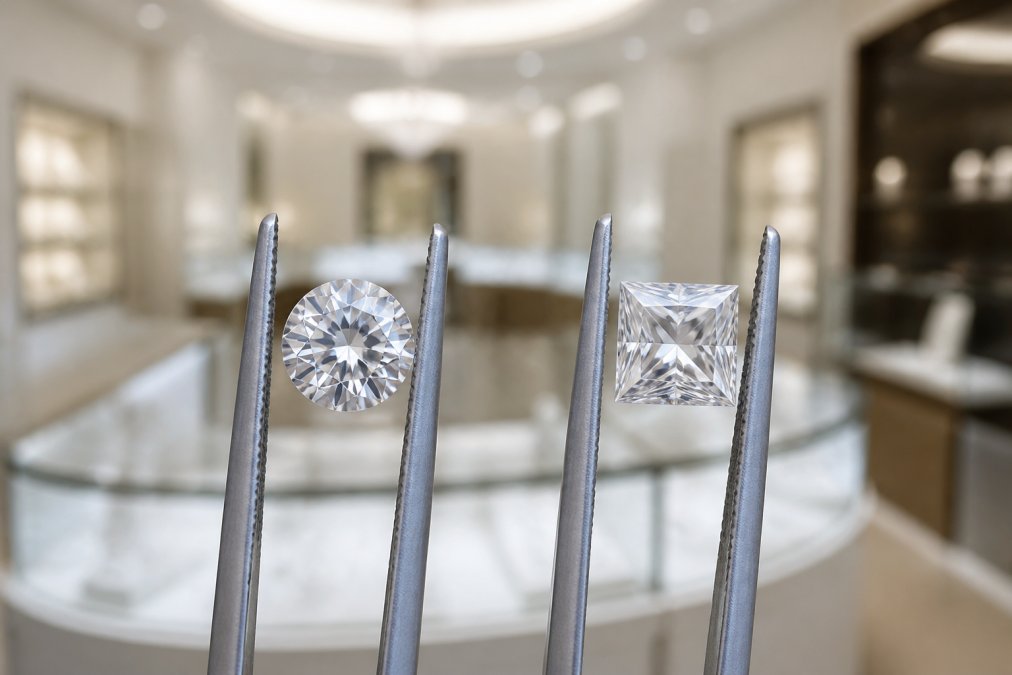
The core difference between these two cuts lies in their geometry and how they interact with light. A round brilliant diamond features a circular outline with 58 facets designed to maximise brilliance, fire, and scintillation. The princess cut is a square or rectangular fancy shape with a modified brilliant facet pattern, which also produces high sparkle but with a distinctly different visual character.
| Feature | Round Brilliant | Princess Cut |
|---|---|---|
| Shape | Circular, classic | Square, modern |
| Facet Count | 58 standard | Varies, modified brilliant |
| Brilliance | Maximum light return | High, comparable |
| Price per Carat | Higher | Typically 20-40% lower |
| Durability | Excellent | Good, corners need care |
| Best For | Traditional elegance | Contemporary style |
How Diamond Cut Quality Explained Affects Your Choice
Cut quality is the single most important factor determining a diamond's beauty, regardless of shape. Diamond cut quality explained simply: it refers to how well a diamond's proportions, symmetry, and polish allow light to enter, reflect, and return to the eye. A poorly cut stone, even with a high clarity grade and colour grade, will appear dull and lifeless.
For round brilliants, the cut grade is strictly evaluated by the table percentage, depth percentage, crown angle, and pavilion depth. Princess cuts also rely on these proportions, but their shape makes evaluation slightly more complex. When comparing the two, always prioritise an excellent cut grade. A well-cut princess can rival a round's sparkle, while a poorly cut round will underwhelm.
Brilliance and Fire: Which Shape Sparkles More?
The round brilliant is the undisputed champion of brilliance and fire. Its circular symmetry and precise facet arrangement are optimised for maximum light performance, creating intense white flashes and colourful dispersion. Princess cuts are modified brilliants, meaning they share a similar facet structure, but their square geometry and step-like corners alter how light refracts.
In practice, a high-quality princess cut shows excellent brilliance, though its fire, the dispersion of light into spectral colours, is often slightly less pronounced than a round's. The princess's sparkle has a more linear, geometric pattern, which many find appealing. If your priority is the absolute maximum sparkle from every angle, the round brilliant wins. If you prefer a modern aesthetic with strong, but slightly different, light performance, the princess is a compelling option.
Princess Cut Diamond Durability and Everyday Wear
The princess cut's four sharp corners are its defining feature and its primary vulnerability. While diamond hardness is uniform across all shapes, the princess cut's geometry creates points where the crystal structure is more exposed to impact. A direct knock on an unprotected corner can cause a chip or fracture that runs along a cleavage plane, potentially requiring a recut that reduces carat weight and compromises the stone's proportions.
Most jewellers agree that the setting is the first line of defence. A standard four-prong setting, where prongs grip the girdle at the cardinal points, leaves the corners exposed. For a princess cut, you need a setting that physically shields those corners.
Here is a practical guide to protective settings:
-
V-Shaped Prongs: This is the most common protective solution. Each corner is cradled by a prong that is notched into a 'V' shape, wrapping around the point. This offers good protection while keeping the stone's profile visible.
-
Bezel Setting: This is the gold standard for durability. A thin rim of metal completely encircles the diamond, covering all four corners and the entire girdle. This offers the highest level of protection against chips and snagging. The trade-off is that a full bezel can make the stone appear slightly smaller and reduces the amount of light entering from the sides, which can subtly affect brilliance. A partial bezel, which covers just the four corners, is a popular compromise that protects the vulnerable points while leaving the crown and pavilion exposed.
-
Channel Setting: Often used in wedding bands or three-stone rings, this setting nests the diamonds between two metal walls. This is an excellent choice for protecting the sides of a princess cut, but the corners at the top and bottom of the stone may still be exposed, so it is not a complete solution on its own.
Beyond the setting, consider your lifestyle. For someone who works with their hands, plays contact sports, or frequently does manual tasks, a round brilliant is the safer choice. The continuous, unbroken circular girdle distributes impact forces far more effectively than the princess's sharp corners. For a princess cut, a bezel setting is not just an aesthetic option; it is a functional necessity for an active lifestyle.
A final note on maintenance: the sharp corners of a princess cut are also prone to catching on knitwear, pockets, or hair. Regularly check the prongs for snags or bending. A loose prong on a princess cut is a far more urgent problem than on a round brilliant, as the stone is more likely to shift and the exposed corner is then at immediate risk.
Price Per Carat and Visual Size: Getting More for Your Budget
Price per carat is where the princess cut holds a significant advantage. Because the princess cut's square shape utilises the rough diamond crystal more efficiently, there is less material waste during cutting (gia.edu). This efficiency typically makes princess cut diamonds 20% to 40% more affordable than equivalent round brilliants, according to industry analysis from Brillianteers' diamond shape guide.
This price difference can allow you to purchase a larger carat weight within the same budget. Additionally, the princess cut often appears larger than a round brilliant of the same carat weight when viewed from above, due to its square surface area. For buyers prioritising visual size and value, the princess cut is the clear winner. However, the round brilliant's higher cost reflects its enduring popularity and the significant rough material lost in its cutting process, as noted by Tiffany & Co.'s diamond education resources.
Your Engagement Ring Shape Guide: Matching the Cut to Your Hand
An engagement ring shape guide should consider how the diamond complements the wearer's hand. Round brilliants are universally flattering, their circular form softening the fingers and suiting virtually any hand shape. They pair beautifully with solitaire settings, which let the stone take centre stage, and halo settings, which add extra brilliance.
Princess cuts offer a more structured, elongating effect. The square outline can make shorter fingers appear longer and slimmer, particularly when set in a solitaire or a three-stone setting. Its sharp lines suit modern, minimalist bands and geometric halo designs. Trying on different shapes is the most reliable way to judge, as personal proportions and style preferences play a major role in what feels right.
Long-Term Wear and Resale Value: What to Expect
Long-term wear and resale value are practical considerations that many guides overlook, yet they are central to the financial reality of your purchase. The two shapes behave very differently in the second-hand market, and the rise of lab-grown diamonds has fundamentally altered the value equation.
Resale Liquidity: Round vs. Princess
The round brilliant is the most liquid diamond shape in the world. Its universal demand means that when you sell, you are competing in a deep, active market of buyers. Trade-in programmes and buy-back schemes from major jewellers consistently favour round brilliants. You can typically expect to recoup a higher percentage of your original purchase price on a natural round brilliant than on any other shape.
The princess cut, while popular, is a fashion-driven shape. Its demand has fluctuated over the past decade, with a noticeable shift toward oval and emerald cuts among contemporary buyers. This reduced liquidity means that selling a princess cut can take longer, and you may need to accept a lower offer to move the stone. It is not that a princess cut has no resale value, but that its market is thinner and more price-sensitive.
The Lab-Grown Price Delta
This is where the conversation changes entirely. The price gap between natural and lab-grown diamonds is stark, and it shifts the calculus for both shapes.
- Natural Diamonds: A natural 1-carat round brilliant with good cut, colour, and clarity typically retails at a certain price point. A comparable natural princess cut might be 20-30% less.
- Lab-Grown Diamonds: The same 1-carat lab-grown round brilliant can be found for a certain price. A lab-grown princess cut is often even cheaper.
This price delta is not just an upfront saving; it is a fundamental shift in the asset's nature. A lab-grown diamond, regardless of shape, has virtually no resale value. The secondary market for lab-grown stones is almost non-existent, with trade-in offers often being a tiny fraction of the original price. If you buy lab-grown, you should consider it a pure consumer expense, like a piece of fine electronics, not an investment.
What This Means for Your Choice
If you are buying a natural diamond and care about long-term value retention, the round brilliant is the safer financial choice. Its timeless appeal and strong demand provide a more stable floor under your investment. The princess cut's lower upfront cost is attractive, but you are accepting higher depreciation risk if you ever decide to sell.
If you are buying a lab-grown diamond, the resale argument is moot. The only financial question is the upfront price. Here, the princess cut's efficiency in using rough crystal means you get a larger-looking stone for your money, making it a compelling value proposition for budget-conscious buyers who prioritise aesthetics over future liquidity.
A common pattern is that buyers who choose a natural princess cut often do so knowing they will likely keep the ring for decades, treating it as a personal heirloom rather than a liquid asset. If that is your intention, the resale concern is less relevant, and the princess cut's beauty and value can be enjoyed without reservation.
The Verdict: Choosing Between Round Brilliant and Princess Cut
The round brilliant is the best choice for those who want the ultimate in brilliance, durability, and timeless tradition. It is a safe, universally admired investment that performs exceptionally in any setting. The princess cut is ideal for those drawn to a modern, geometric aesthetic who want a larger-looking stone and greater value for their budget, provided they select a protective setting.
Ultimately, the right choice reflects your personal style and how you plan to wear the piece. Whichever you select, prioritise excellent cut quality above all else. At Diamonds by daisy, our curated collection features meticulously handpicked gemstones and precious metals, ensuring a high standard of quality in every piece. We invite you to explore our engagement rings, backed by our 30-day satisfaction guarantee, and find the shape that captures your unique inner brilliance.
Choosing between these two exceptional cuts is a personal journey, but understanding the trade-offs in sparkle, durability, and budget makes the decision clearer. If you value maximum brilliance and a classic profile, the round brilliant is your match. If a contemporary look and greater visual size appeal to you, the princess cut delivers outstanding value. Explore the handpicked selection at Diamonds by daisy, where each piece is crafted with luxurious, timeless designs to elevate your personal style, and shop with confidence knowing your purchase is protected by our 30-day satisfaction guarantee.
Frequently Asked Questions
Which is better, a princess cut or a round diamond?
Neither is objectively better; the right choice depends on your priorities. Round brilliants offer the maximum brilliance and a timeless look, making them the most popular choice. Princess cuts provide a modern, square silhouette with excellent sparkle, often at a lower price per carat. If maximum fire and traditional elegance are your goals, choose a round brilliant. If you prefer a contemporary, sharp aesthetic and value for money, the princess cut is a strong contender.
Does a princess cut diamond look smaller than a round brilliant?
Yes, a princess cut diamond typically looks smaller than a round brilliant of the same carat weight. This is because the princess cut has a deeper pavilion, meaning more of its weight is concentrated below the girdle rather than across the table. When viewed from above, the round brilliant's wider, flatter face appears larger. To get a similar visual size to a 1-carat round, you may need a princess cut closer to 1.25 carats.
Is a round brilliant diamond more expensive than a princess cut?
Yes, round brilliant diamonds are generally more expensive than princess cuts of comparable quality. This price difference is due to two factors. First, the round brilliant's cutting process wastes more of the original rough diamond, and second, its extreme popularity drives up demand. A princess cut's efficient use of rough stone material makes it a more budget-friendly option for buyers seeking a larger stone.
Are princess cut diamonds more prone to chipping?
Princess cut diamonds are more susceptible to chipping at their four sharp corners than round brilliants. This is a key consideration for princess cut diamond durability. However, the risk is manageable with the right setting. A protective setting, such as a four-prong 'claw' or a V-shaped prong that covers the corners, or a bezel setting that encircles the entire stone, will effectively shield the vulnerable points from everyday knocks and impacts.