

Why Artisan Jewelry Costs More: A Full Breakdown
Table of Contents
- The Real Cost Difference Between Artisan and High-Street Jewelry
- 1. Skilled Labour and Production Time Are Priced Into Every Piece
- 2. Raw Materials: Quality, Sourcing, and Ethical Standards
- 3. Small-Batch Production vs. Economies of Scale
- 4. Technique-Specific Cost Drivers: Hand-Forging and Lost-Wax Casting
- 5. The Environmental and Ethical Cost of Mass Production
- The Benefits of Handmade Jewellery: Durability and Heirloom Quality
- Understanding the Value of Bespoke Jewellery and One-of-a-Kind Designs
- Frequently Asked Questions
Last Updated: September 8, 2026
The Real Cost Difference Between Artisan and High-Street Jewelry
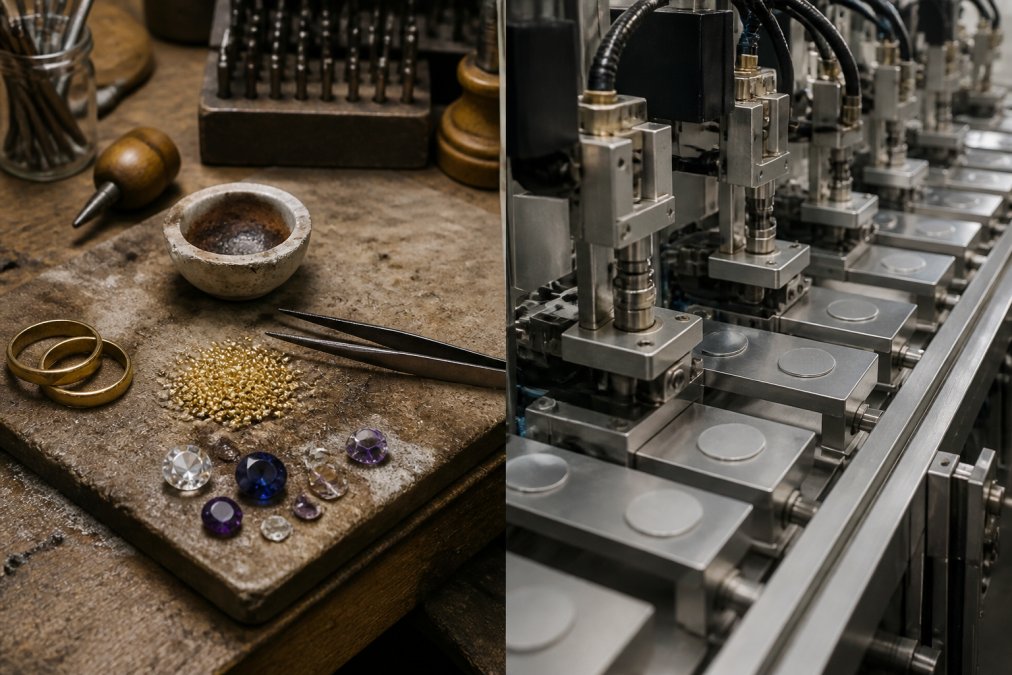
Walk into any high-street jeweller and you will see racks of near-identical rings, each priced to move quickly and produced by the thousands. The artisan jewelry you find in a studio workshop follows a completely different economic logic, one built on skilled labour, precious materials, and production runs measured in single digits rather than thousands. This guide explains why artisan jewelry costs more, breaking down the pricing formula piece by piece so you understand precisely what your money buys.
The gap between a mass-produced pendant and a handcrafted one is not merely about markup. It reflects a fundamental difference in how each item is made, by whom, and with what intent. Where high-street retail optimises for volume, the artisan workshop optimises for quality, durability, and design integrity. Below, we examine the five cost drivers that separate a machine-made piece from a bespoke commission, and why the latter often proves the better long-term investment.
1. Skilled Labour and Production Time Are Priced Into Every Piece
The single largest factor in why artisan jewelry costs more is the hours of skilled labour embedded in each piece. A hand-forged ring can require anywhere from eight to twenty hours of bench time, depending on complexity (ganoksin.com). That time includes sawing, filing, soldering, setting, and polishing, each step performed by a trained goldsmith whose craft took years to develop.
Mass production compresses this labour into seconds. A machine can stamp out hundreds of identical settings per hour, which is why high-street prices stay low. The artisan pays their maker a living wage for genuine skill, not piecework rates. When you purchase handmade jewellery, you are compensating a craftsperson fairly for their expertise, not funding a factory's overhead.
2. Raw Materials: Quality, Sourcing, and Ethical Standards
Another core reason why artisan jewelry costs more lies in material selection, but the difference is more than just a vague notion of 'higher quality'. It is a tangible arithmetic of weight, purity, and provenance that directly impacts the final price.
The Metal Premium
A high-street ring might be made from 9ct gold, which is 37.5% pure gold alloyed with other metals (gov.uk). An artisan maker in the UK will often work with 18ct gold (75% pure) or platinum, which are significantly more expensive per gram (gov.uk). For a single ring weighing 5 grams, the raw material cost difference between 9ct and 18ct gold can be substantial, before any labour is added. This is not a markup; it is the intrinsic cost of the higher-grade material itself.
The Stone Selection Process
Artisan jewellers do not buy gemstones in bulk lots. They select individual stones, often from specialist dealers, paying a premium for specific characteristics. A single, well-cut, eye-clean emerald might cost three to five times more per carat than a commercial-grade stone of the same size that is included (has internal flaws) or poorly proportioned. The artisan absorbs the cost of rejecting stones that do not meet their standard, a cost that never appears in a factory's supply chain.
The Provenance Surcharge
Ethical sourcing is not a marketing buzzword; it is a line item. Many independent UK makers are accredited by the Responsible Jewellery Council (RJC) or choose to use only certified recycled metals. Using 100% recycled gold and silver costs more than virgin material because the refining process is more complex. Similarly, traceable gemstones from sources like Gemfields or fair-trade cooperatives carry a premium that covers the cost of certification and community development. This is the 'provenance surcharge', a direct payment for a supply chain that does not rely on unregulated mining.
A Transparent Pricing Formula
To demystify the math, consider a simplified cost-plus model. An artisan's price is not arbitrary; it follows a clear structure:
- Materials Cost: The actual cost of the metal and stones used, including a small allowance for waste (typically 10-15% for lost-wax casting).
- Labour Cost: The maker's hourly rate multiplied by the hours of bench time.
- Overhead: A percentage to cover studio rent, tools, insurance, and business administration.
- Profit Margin: A modest margin (often 20-30%) that sustains the business.
For a simple 18ct gold band, the formula might look like this (pricing depends on quantity, dates, and delivery):
| Component | Cost (GBP) |
|---|---|
| 18ct Gold (6g) | £420 |
| Labour (4 hours @ £45/hr) | £180 |
| Overhead (30% of labour) | £54 |
| Subtotal | £654 |
| Profit Margin (25%) | £163.50 |
| Final Price (ex VAT) | £817.50 |
This breakdown shows that the material cost is not the primary driver of the premium; it is the honest accounting of labour and overhead that mass production eliminates. When you see a mass-produced ring, you are not seeing a bargain; you are seeing a product where the cost of a living wage, ethical sourcing, and quality control have been removed from the equation.
3. Small-Batch Production vs. Economies of Scale
Economies of scale explain much of the price chasm between artisan and mass-produced jewellery. A factory producing ten thousand identical rings spreads its tooling costs, marketing budget, and distribution overhead across every unit. The marginal cost of one more ring is tiny, allowing retail prices that undercut any studio.
An artisan workshop operates in reverse. Each small-batch or one-of-a-kind piece carries the full cost of its own production: design time, material waste, and the maker's hours. There is no volume discount to absorb mistakes or inefficiencies. This is the honest arithmetic behind why artisan jewelry costs more, and it is also why the pieces hold value better than their mass-produced counterparts.
4. Technique-Specific Cost Drivers: Hand-Forging and Lost-Wax Casting
Different making techniques carry very different cost profiles. Hand-forging, where a goldsmith shapes metal with hammer and anvil, is intensely labour-intensive and produces a dense, durable structure. Lost-wax casting, used for intricate and sculptural designs, requires a wax model, investment mould, and careful finishing of every cast piece.
Each technique demands specialised equipment and consumables, from rolling mills to casting flasks, and each produces some material waste that the maker absorbs. Technique choice directly influences production time and final price. A hand-forged band will always cost more than a cast equivalent because the hours and skill required are simply greater. Understanding these process-driven costs clarifies why artisan jewelry costs more when comparing similar-looking designs.
5. The Environmental and Ethical Cost of Mass Production
The true price of cheap jewellery is often paid elsewhere. Mass production of fashion jewellery drives demand for newly mined metals and stones, frequently under conditions that disregard both environmental standards and worker welfare. The fast-fashion model encourages disposability, with pieces worn briefly and discarded, creating a cycle of waste that carries a heavy ecological toll.
Artisan production offers a counter-model. Small-batch making uses fewer resources per piece, supports fair wages, and creates objects designed for decades of wear rather than a single season. When you choose handmade jewellery, you are voting for a slower, more responsible system of production. This ethical dimension is part of why artisan jewelry costs more, and for many buyers, it justifies the premium.
The Benefits of Handmade Jewellery: Durability and Heirloom Quality
The benefits of handmade jewellery extend far beyond aesthetics, but the most compelling argument is financial: it is an investment, not an expense. To understand this, you must look beyond the initial price tag and consider the total cost of ownership and the mechanics of value retention.
The Structural Advantage
A hand-forged piece is not just 'sturdier'; it has a different molecular structure. The hammering process compresses the metal, increasing its density and hardness compared to a cast or stamped equivalent. This means a hand-forged ring is measurably more resistant to bending, scratching, and the daily micro-abrasions that cause a cast ring to lose its shape and polish over time. Stones are set in individually cut seats with the metal burnished over the girdle, a technique that physically locks the stone in place, unlike the mass-market approach of relying on thin, pre-formed prongs that can snag and bend.
The Cost-Per-Wear Calculation
Let's apply a simple cost-per-wear model. A well-made artisan ring, while a higher initial investment, offers superior durability. If a high-street ring lasts only a short period before needing replacement, the 'cheaper' option can cost significantly more over the long term.
The Resale and Heirloom Market
Mass-produced designs flood the market, and their resale value collapses to the scrap metal price. A handcrafted piece, particularly one with a known maker, quality hallmarks, and ethical provenance, retains a different kind of value. The second-hand market for fine artisan jewellery is robust, with collectors and buyers actively seeking pieces from recognised makers. While you should not buy jewellery purely as a financial speculation, a well-made piece from a reputable studio will hold a far higher percentage of its value than a machine-made item, which is often worthless the moment it leaves the shop.
The Heirloom Mechanism
Heirloom quality is not a romantic ideal; it is a function of repairability. A mass-produced ring with a broken clasp or a lost stone is often cheaper to replace than to repair. An artisan piece is designed to be serviced. A goldsmith can re-tip a prong, re-polish a band, or re-size a shank, because the structure allows for it. This repairability is the true mechanism of longevity. It is the difference between an object that is disposable and one that is maintainable across generations.
Understanding the Value of Bespoke Jewellery and One-of-a-Kind Designs
The value of bespoke jewellery lies in its singularity. A one-of-a-kind design carries a story and a personal connection that no mass-produced item can replicate. Whether it is a commission built around a family heirloom stone or a piece designed to mark a milestone, bespoke work offers a level of emotional resonance that factory lines cannot match.
This uniqueness also protects your investment. Mass-produced designs flood the market, depressing resale values. A rare, handcrafted piece, particularly one made with quality materials and ethical provenance, retains worth far better. At Diamonds by daisy, we curate pieces with meticulously handpicked gemstones and precious metals, ensuring each item meets a high standard of quality and refined aesthetic. Our 30-day satisfaction guarantee provides peace of mind, and the timeless designs in our collection are crafted to elevate your personal style for years to come.
Frequently Asked Questions
What are the benefits of buying artisan jewellery?
Artisan jewellery offers several advantages over mass-produced pieces. Each item is crafted individually, so you get a unique, one-of-a-kind design rather than a copy from a batch. The materials are typically higher grade, and the construction is more durable because a single maker controls the entire process. You also support skilled labor and ethical practices. For many buyers, the deeper connection to the piece, knowing its provenance, adds sentimental value that a high-street purchase cannot match.
Is artisan jewellery made with real gold and precious metals?
Yes, artisan jewellery is usually made with genuine precious metals like 9ct or 18ct gold, sterling silver, and platinum. The difference from high-street pieces lies in the quality and weight of the metal used. Artisan makers often use thicker castings and heavier findings, which adds to the cost but improves durability. Always check the hallmark on the piece; it legally guarantees the metal's purity. Reputable sellers will also provide details about their gemstone sourcing and any grading reports.
Does artisan jewellery tarnish more than mass-produced pieces?
Generally, artisan jewellery tarnishes less than cheaper, mass-produced alternatives. Tarnishing occurs when base metals in an alloy react with air and moisture. High-street jewellery often uses a higher proportion of base metals like copper to cut costs. In contrast, artisan makers typically use higher-purity precious metals, which are far more resistant to tarnishing. A solid 18ct gold piece will not tarnish, while a plated item will eventually wear through. Proper care will keep artisan pieces looking brilliant for decades.
Why does ethical sourcing impact the cost of handcrafted jewellery?
Ethical sourcing means the maker can trace where their gold and gemstones came from, and confirm the miners received fair wages and worked in safe conditions. This process is more expensive than buying from anonymous, unregulated suppliers who may source from conflict zones or use environmentally destructive methods. The higher price reflects the cost of certification, audits, and building long-term relationships with trusted suppliers. For conscious buyers, this premium ensures their purchase does not contribute to human suffering or environmental damage.
The decision to invest in artisan jewelry is a decision to value quality over quantity, provenance over anonymity, and longevity over disposability. When you understand the labour, materials, and ethics behind each piece, why artisan jewelry costs more becomes clear. Explore the Diamonds by daisy collection to find a piece that captures your unique brilliance, backed by our satisfaction guarantee for a confident purchase.