

14k vs 18k Gold: Which Is Better for Your Jewellery?
Table of Contents
- 14k vs 18k Gold: What Is the Real Difference?
- Quick Comparison: 14k vs 18k Gold at a Glance
- Durability of 14k vs 18k Gold for Daily Wear
- Colour Differences: Saturation and Skin Tone
- Does 14k or 18k Gold Tarnish? Allergies and Skin Chemistry
- Understanding Hallmarking Gold Jewellery UK Standards
- How to Care for Fine Gold Jewellery and Resizing Tips
- Which Karat Should You Choose? A Practical Guide
- Frequently Asked Questions
Last Updated: September 7, 2026
Choosing between 14k and 18k gold jewellery comes down to a trade-off between durability and purity. The difference between 14k and 18k gold jewelry is straightforward: 14k gold contains 58.3% pure gold alloyed with stronger metals, while 18k gold contains 75% pure gold (federalregister.gov).
Most buyers assume higher karat always means better, but that ignores daily wear, where the harder 14k alloy often outperforms its purer cousin. The real difference between 14k and 18k gold jewelry comes down to structural integrity versus colour richness.
14k vs 18k Gold: What Is the Real Difference?
14k gold is an alloy containing 58.3% pure gold mixed with harder metals like copper, silver, and zinc. 18k gold is an alloy containing 75% pure gold, making it softer but more valuable per gram. The karat system measures gold purity in parts per twenty-four, so 14k means fourteen parts gold and ten parts alloy, while 18k means eighteen parts gold and six parts alloy.
The extra alloy in 14k gold gives it a structural advantage. Those base metals add hardness and scratch resistance, which is why 14k is the standard choice for engagement rings and wedding bands worn every day. The higher gold content in 18k produces a more saturated yellow tone and commands a higher retail price because it contains more precious metal.
Quick Comparison: 14k vs 18k Gold at a Glance
The table below summarises the key differences you need to weigh before purchasing.
| Feature | 14k Gold | 18k Gold |
|---|---|---|
| Pure gold content | 58.3% (585 parts per thousand) | 75% (750 parts per thousand) |
| Hardness | Harder, more scratch resistant | Softer, prone to wear and tear |
| Colour | Slightly lighter yellow | Deeper, richer yellow saturation |
| Hypoallergenic | Good, but contains more base metals | Excellent, fewer reactive metals |
| Best for | Daily wear, engagement rings | Occasion pieces, luxury jewellery |
| Price | More affordable | Higher retail price |
Durability of 14k vs 18k Gold for Daily Wear
For daily wear, 14k gold is the more durable choice because its higher alloy content makes it significantly harder and more resistant to scratching. The durability of 14k vs 18k gold is the single most important factor for pieces that stay on your hand or wrist through washing, typing, and household tasks.
18k gold's softness has real consequences. Prongs holding a diamond can bend over time, risking the stone, and the band itself may develop scratches and dents from normal contact. A common mistake is choosing 18k for an engagement ring and discovering within a year that the metal shows visible wear.
The durability of 14k vs 18k gold also affects resizing. Jewellers can resize both, but 14k's hardness means it holds its shape better during the process, reducing the risk of warping on intricate settings.
Colour Differences: Saturation and Skin Tone
The colour gap between 14k and 18k gold is real. Pure gold reflects a warm, saturated yellow, while the alloying metals in 14k, typically copper, silver, and zinc, dilute that reflection. Copper pulls the tone towards a faint rose or orange hint, while silver and zinc introduce a slightly greenish or grey cast. Because 18k contains 75% pure gold versus 58.3% in 14k, less alloy is present to distort the colour, so the yellow appears deeper and richer.
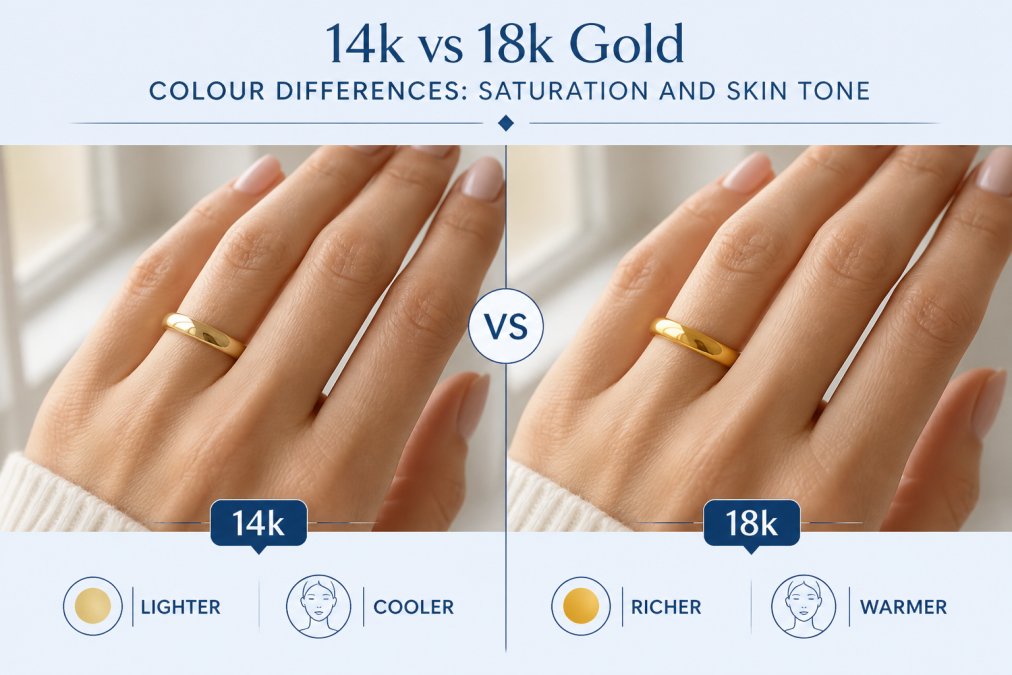
The exact shade of 14k varies significantly between jewellers. There is no single '14k yellow', the proportion of copper to silver in the remaining 41.7% alloy determines whether your ring leans warm (more copper) or cool (more silver). Some manufacturers use a 14k alloy nearly indistinguishable from 18k in low light, while others produce a visibly paler metal. Ask your jeweller for the specific alloy breakdown, not just the karat stamp.
Skin tone matters less than most style guides suggest, but it is not irrelevant. The richer yellow of 18k can look striking against deep or olive undertones, while very fair or cool-toned skin sometimes shows a slight contrast that makes 18k appear almost brassy. The lighter 14k shade tends to blend more seamlessly with cooler complexions. However, lighting dominates the perception, a piece viewed under warm boutique lighting will look different in daylight or office fluorescents.
A practical test: hold the two rings side by side against your inner wrist in natural window light. If you cannot name the difference within ten seconds, the colour gap will not matter to you in daily wear. For most buyers, the aesthetic distinction is a luxury consideration, not a decisive factor, durability and skin chemistry will affect your satisfaction far more.
Does 14k or 18k Gold Tarnish? Allergies and Skin Chemistry
Neither 14k nor 18k gold tarnishes under normal wear, but skin chemistry can affect how each alloy reacts with your body. Pure gold does not oxidise, which means tarnish and oxidation are non-issues for the gold content itself. The base metals in the alloy, particularly copper, can react with acidic skin or harsh chemicals.
Hypoallergenic concerns usually trace to nickel, which appears in some alloy mixes. Because 18k contains a higher proportion of pure gold and fewer base metals, it carries a lower risk of triggering reactions. If you have sensitive skin or a known nickel allergy, 18k is the safer bet, though many 14k alloys are formulated nickel-free.
Skin acidity varies from person to person. Some wearers find their sweat dulls even high-karat gold over time, but this is a cleaning issue, not a metallurgy failure. Regular gentle cleaning restores the shine regardless of karat.
Understanding Hallmarking Gold Jewellery UK Standards
In the UK, hallmarking is a legal requirement for gold jewellery, not an optional extra. The hallmarking gold jewellery UK standards are enforced by assay offices, and any piece over one gram must carry an official hallmark verifying its purity.
The hallmark shows a fineness mark: 585 for 14k gold and 750 for 18k gold, indicating parts per thousand of pure gold. This stamp is your legal guarantee of what you are buying, and it protects you from misrepresented alloys. When purchasing fine jewellery, always confirm the piece carries a valid hallmark from an assay office.
The UK Assay Office guidance on hallmarking requirements explains the full legal framework, including the compulsory nature of hallmarks for precious metals. Buying hallmarked pieces ensures you receive exactly the gold content you pay for, which matters for both quality and future resale value.
How to Care for Fine Gold Jewellery and Resizing Tips
Caring for fine gold jewellery is straightforward, but the long-term cost of ownership differs meaningfully between 14k and 18k, and that difference shows up most clearly at the jeweller's bench.
Cleaning basics: For both karats, a soft lint-free cloth and warm water with a drop of mild dish soap removes everyday oils and dust. Avoid ultrasonic cleaners for 18k pieces with delicate settings, the vibration can loosen prongs on softer metal. For 14k, ultrasonic cleaning is generally safe but still risky for pieces with glued or tension-set stones. Store pieces individually in soft pouches or compartmentalised boxes; gold scratches gold.
The resizing economics: This is where the karat choice affects your wallet years after purchase. On 14k, the harder alloy holds its shape during the process, so a skilled jeweller can typically resize a plain band up or down by two full sizes without structural compromise. On 18k, the softer metal is more prone to warping at the solder joint, and the higher gold content requires a higher melting point during repair, increasing the risk of distortion on intricate settings. Many bench jewellers will quote 20-30% more for an 18k resize compared with the same work in 14k.
Resizing 18k more than once or twice in the same area can thin the metal permanently. A ring sized up, then down, then up again may develop weak spots that eventually crack. For 14k, the same sequence is far less likely to cause structural failure. If you anticipate size fluctuations, pregnancy, weight changes, or knuckle arthritis, 14k offers materially more flexibility over a lifetime.
Repairability beyond resizing: Bent prongs, stretched shanks, and worn claw tips are the most common repairs on gold rings. On 14k, a jeweller can often re-tip a worn prong without compromising the surrounding metal. On 18k, the softer surface wears faster at contact points, and re-tipping requires matching the exact alloy colour, which varies by manufacturer, or the repair will show a visible seam.
What to avoid for both karats: Chlorinated pools and hot tubs are the single worst environment for gold jewellery. Chlorine attacks the alloy metals in both 14k and 18k, and prolonged exposure can cause surface pitting that no polish will fully remove. Remove rings before swimming, heavy cleaning with abrasive chemicals, or gardening. Perfume, hairspray, and lotion accelerate residue buildup, apply these first, then put on your jewellery.
The long-term cost picture: A 14k ring that needs professional cleaning once a year and a resize every decade will cost less to maintain than an 18k ring requiring the same services, purely because the labour is simpler and the metal is more forgiving. For occasional pieces, pendants, earrings, dress rings worn a few times a month, the maintenance gap narrows considerably, and 18k's colour richness becomes the dominant consideration.
Which Karat Should You Choose? A Practical Guide
Choose 14k gold for engagement rings, wedding bands, and any piece worn daily. Choose 18k gold for special-occasion jewellery where colour richness and higher purity take priority over durability.
The decision framework below helps you match the metal to your lifestyle:
- Daily wear, high-contact pieces: 14k, because the durability of 14k vs 18k gold favours the harder alloy for rings and bracelets
- Occasional luxury pieces: 18k, where the deeper colour and premium feel justify the softer metal
- Sensitive skin: 18k, for its lower base metal content and reduced allergy risk
- Budget-conscious buyers: 14k, which delivers excellent value without sacrificing beauty
- Investment-minded buyers: 18k, as its higher gold content tracks more closely with melt value
A common mistake is treating karat as a status symbol rather than a functional choice. The best jeweller will ask about your habits before recommending a metal, because the durability of 14k vs 18k gold directly affects how a piece ages.
The World Gold Council's guide to gold purity and karatage provides further detail on how alloy composition affects both value and wearability. Understanding these fundamentals ensures your purchase serves you for decades, not just the first season.
For most buyers, the practical answer is 14k for rings and 18k for statement pieces. At Diamonds by daisy, our curated collection of fine jewellery uses meticulously handpicked precious metals, and every piece meets high standards of quality with a 30-day satisfaction guarantee for peace of mind.
Choosing between 14k and 18k gold need not be complicated once you understand the trade-off between hardness and purity. The right metal depends on how often you will wear the piece, your skin chemistry, and whether colour or durability matters more to you. At Diamonds by daisy, we craft luxurious, timeless designs with handpicked gemstones and precious metals, ensuring a high standard of quality that elevates your personal style.
Frequently Asked Questions
Is it better to buy 14k or 18k gold for daily wear?
For daily wear, 14k gold is the stronger choice. Its higher proportion of alloyed metals like copper and silver makes it more resistant to scratches and bending. An engagement ring or wedding band worn every day will face knocks and friction, so 14k gold holds its shape better over time. 18k gold, while more luxurious, is softer and more prone to showing wear. If you are buying a piece for occasional wear or special occasions, 18k offers a richer colour and higher purity.
Can you visually tell the difference between 14k and 18k gold?
Yes, but the difference is subtle. 18k gold contains 75% pure gold, giving it a deeper, more saturated yellow tone. 14k gold, at 58.3% purity, appears slightly paler because of the higher proportion of alloyed metals. Side by side, 18k looks warmer and richer, while 14k can look a touch lighter. The difference is most noticeable in yellow gold and less obvious in white or rose gold, where the alloy metals influence the final colour more significantly.
Does 14k gold tarnish faster than 18k gold?
14k gold can tarnish slightly faster than 18k because it contains a higher percentage of alloyed metals like copper, which react to environmental factors. However, tarnishing is rarely a problem for either karat in normal wear. Gold itself does not oxidise, so the discolouration you might see comes from the base metals. Regular cleaning and avoiding exposure to harsh chemicals like chlorine will keep both 14k and 18k pieces looking bright. For most people, the difference in tarnishing is minimal.
What do the hallmarks on gold jewellery mean in the UK?
In the UK, the hallmark is your legal guarantee of purity, applied by one of the four Assay Offices. You will see a stamp reading 585 for 14k gold, meaning 585 parts per thousand of pure gold. For 18k gold, the stamp reads 750, indicating 750 parts per thousand. The hallmark also includes a sponsor's mark identifying the maker and a fineness mark. Always look for these marks when buying gold jewellery in the UK, as they confirm the metal's authenticity and purity.