

Why Handcrafted Jewellery Costs More: The Full Breakdown
Table of Contents
- Why Handcrafted Jewellery Costs More: Understanding the Price Premium
- The Labour Hours Behind Every Handmade Piece
- Material Sourcing and the True Cost of Precious Metals
- Handmade vs Mass Produced Jewellery Quality: What You're Actually Paying For
- Factors Affecting Handmade Jewellery Price: The Hidden Costs
- The Value of Handmade Jewellery UK: Investment Potential and Cost-Per-Wear
- How Independent Jewelers Price Their Work: Profit Margin Reality
- Why High-Street Stores Are Cheaper: The Scale Advantage
Last Updated: July 26, 2026
Understanding why handcrafted jewelry costs more requires looking beyond the price tag into the genuine work, materials, and expertise that go into each piece. At Diamonds by daisy, we've spent years analysing why our meticulously handpicked gemstones and precious metals command a premium compared to mass-produced alternatives. The answer isn't simply about materials, it's about the entire ecosystem of skilled labour, ethical sourcing, overhead costs, and the durability that defines true luxury jewellery.
The Transparency Gap Between High-Street and Bespoke
Most consumers don't realise how dramatically different the economics are between a high-street jeweller and an independent craftsperson. When you walk into Beaverbrooks or The Diamond Store, you're buying a product marked up significantly from its wholesale cost. High-street retailers operate on volume, buying in bulk and relying on rapid inventory turnover. A handmade jeweller creates bespoke pieces in limited quantities, with no economy of scale and no warehouse of identical stock. Instead, a craftsperson invests hours into a single piece.
The Labour Hours Behind Every Handmade Piece
A single handmade ring can take 20 to 40 hours of skilled work from start to finish, including design consultations and revisions. For a high-street piece, labour is compressed into factory processes where a worker might spend 15 minutes assembling pre-made components.
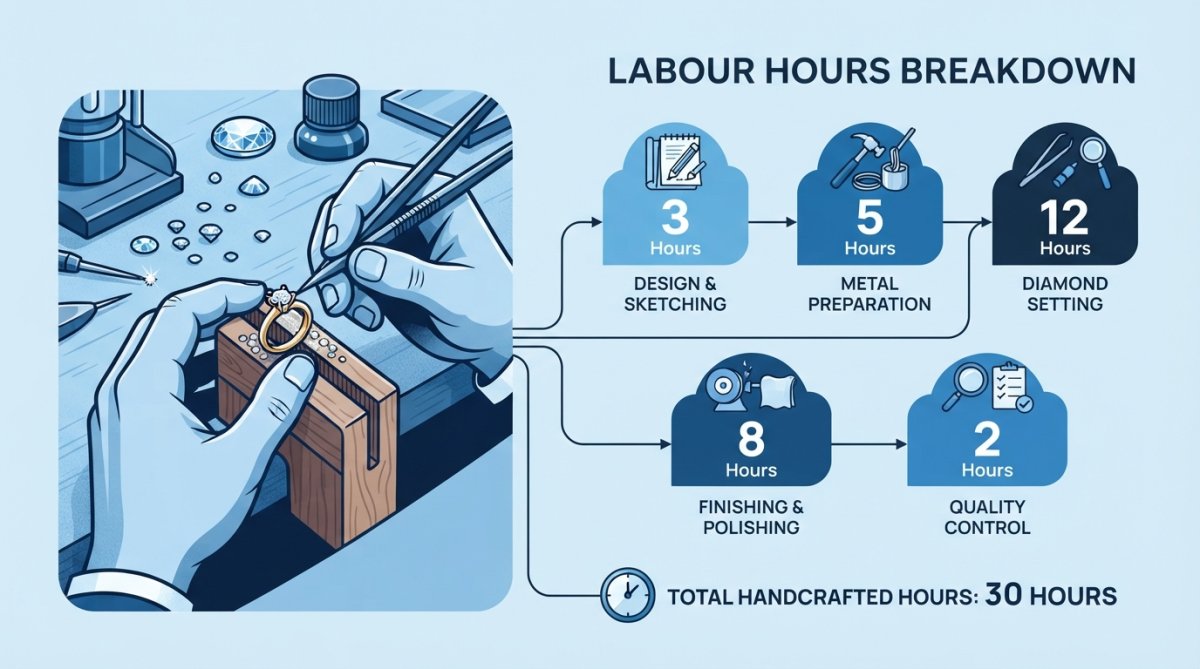
A skilled jeweller charges between £40 and £100+ per hour, depending on experience and location. For a 30-hour ring, that's £1,200 to £3,000 in labour alone, before materials. Mass-produced pieces use automation and lower-wage labour to compress this cost to mere pounds.
The design process involves multiple consultations, sketches, and revisions to translate your vision into technical drawings. Hand-finished details, individually set stones, hand-engraved patterns, bespoke metalwork, cannot be replicated by machine at the same price point. Quality control in handmade jewellery is obsessive, with the craftsperson inspecting every angle, joint, and surface finish for both function and beauty.
| Stage | Handmade Time | Mass-Produced Time | Impact |
|---|---|---|---|
| Design & consultation | 4-8 hours | 0 (pre-designed) | Custom vs. stock |
| Material preparation | 2-3 hours | Automated | Precision vs. speed |
| Hand-finishing | 8-15 hours | 20-30 minutes | Detail vs. volume |
| Quality control | 2-4 hours | Visual inspection only | Durability vs. acceptable loss |
| Total | 20-40 hours | 1-2 hours | Cost multiplier: 10-40x |
Material Sourcing and the True Cost of Precious Metals
Ethical sourcing adds a premium to precious metals. Recycled gold requires certification and traceability; conflict-free diamonds require documentation. At Diamonds by daisy, we prioritise ethical sourcing and supply chain transparency because it ensures your piece wasn't produced at the expense of workers, communities, or the environment.
A handmade jeweller uses solid precious metals and genuine gemstones, while high-street retailers might use gold-plated brass or synthetics to hit lower price points. A solid gold ring weighs more, lasts longer, and can be resized or repaired indefinitely. A gold-plated piece will eventually wear through and become worthless.
Handmade vs Mass Produced Jewellery Quality: What You're Actually Paying For
A well-made handmade piece can last generations and be resized, repaired, and restored. A mass-produced piece often becomes unwearable after a few years of regular use. A handmade jeweller selects gemstones individually, assessing colour, clarity, cut, and carat weight for each piece. Mass-produced pieces use standardised, often synthetic or lower-grade stones selected purely for cost and consistency.
Genuine gemstones formed over millions of years are harder, more lustrous, and more valuable than lab-created alternatives. They also appreciate over time, whereas synthetic stones depreciate. Hand-soldered joints are stronger than machine-welded ones, and hand-polishing produces a deeper, more lustrous finish than automated buffing. These differences compound over years of wear.
Factors Affecting Handmade Jewellery Price: The Hidden Costs
Beyond labour and materials, several hidden costs drive up handcrafted piece prices. Overhead is significant: a jeweller needs workshop space, rent, utilities, insurance, tools, and equipment. A quality jeweller's torch costs £200 to £500; a jeweller's loupe costs £100+. Workspace rent runs £500 to £2,000+ per month, and these costs spread across fewer pieces than a factory produces.
Many independent jewellers rent bench space in shared studios at £100 to £400 per month. For a jeweller producing five to ten pieces monthly, that's £10 to £80 in overhead per piece, before labour. A handmade jeweller must price pieces to afford staying in business, accounting for slow months, materials waste, tools replacement, and the fact that not every piece sells immediately.
Packaging and presentation add cost that consumers often overlook. A handmade piece comes in a branded box with a certificate of authenticity, care instructions, and a satisfaction guarantee. Diamonds by daisy includes a 30-day satisfaction guarantee with every purchase, which adds insurance and administrative costs.
Marketing and trade fair expenses are real costs for independent jewellers. A booth at a major trade fair costs £500 to £2,000+, and these costs must be recovered through sales.
The Value of Handmade Jewellery UK: Investment Potential and Cost-Per-Wear Analysis
Handmade jewellery offers long-term value through timelessness and personal connection. A handmade piece doesn't lose value the moment you buy it because there's no artificial retail markup to depreciate. A handmade engagement ring costing £3,000 to create might resell for £2,000 to £2,500 five years later, a loss of only 15 to 30 percent. A high-street ring costing £3,000 might fetch £500 to £800, a loss of 70 to 85 percent.
Cost-per-wear analysis is compelling. A £2,000 handmade piece worn daily for ten years (3,650 wears) costs 55 pence per wear. A £300 mass-produced piece breaking after two years (730 wears) costs 41 pence per wear, but you'll need to replace it. Buy three over ten years, and you've spent £900 for the same wears, generating three times the waste and environmental impact.
When you factor in emotional value, the knowledge that your piece was made by a real person, that it can be repaired indefinitely, and that it might become an heirloom, the value proposition of handmade jewellery becomes clear. You're investing in durability, sustainability, and a story.
How Independent Jewelers Price Their Work: Profit Margin Reality
Most independent jewellers use a formula based on COGS (cost of goods sold) plus labour, plus overhead, plus a profit margin:
- Materials cost: 30-40% of final price
- Labour: 40-50% of final price
- Overhead and business expenses: 10-15% of final price
- Profit margin: 5-15% of final price
A £2,000 bespoke ring breaks down as: gold and gemstone (£600-800), labour at 30 hours (£1,500), overhead allocation (£200-300), and profit (£100-200). A high-street retailer buys that same ring wholesale for £400 and marks it up 400-600%, selling for £1,600 to £2,400 with a 75-80% profit margin. They rely on volume; a handmade jeweller's smaller margin is sustainable because they're not producing thousands of pieces.
Why High-Street Stores Are Cheaper: The Scale Advantage
High-street stores are cheaper because they benefit from economies of scale that independent jewellers cannot match. A factory producing 10,000 identical rings per year negotiates better material prices, automates labour, and spreads fixed costs across massive volume. Per-unit cost is dramatically lower, but lower cost doesn't mean better value.
Mass production also means standardisation, you get the same design as thousands of others, with no customisation or personal touch. High-street retailers also charge for brand recognition, physical locations, and advertising, costs built into the price. An independent jeweller has lower overhead and relies on word-of-mouth and online presence, which is cheaper to maintain.
When evaluating why handcrafted jewelry costs more, remember that you're investing in quality, durability, and ethical practices. Diamonds by daisy specialises in meticulously handpicked gemstones and precious metals, each piece crafted with intention and backed by a 30-day satisfaction guarantee. Our commitment to ethical sourcing and hand-finished details means every piece is designed to become an heirloom, not a disposable item. Explore our collection and discover why investing in handmade jewellery is an investment in timeless elegance and lasting value.
Frequently Asked Questions
What makes handmade jewellery more expensive than mass-produced pieces?
Handcrafted jewellery costs more due to several interconnected factors: skilled labour hours are significantly higher, materials are often ethically sourced at premium prices, and independent jewelers must cover overhead costs like bench fees, packaging, and marketing. Mass-produced jewellery uses automated processes and economies of scale that handmade artisans cannot match. Additionally, bespoke pieces involve custom design work and hand-finished details that add substantial value.
Is handmade jewellery a good investment in the UK?
Handcrafted jewellery can be a sound investment if purchased from reputable independent jewelers with transparent sourcing and quality certifications. Unlike mass-produced high-street pieces, well-made artisan jewellery maintains durability and aesthetic appeal over decades. However, resale value depends on the piece's design, materials, and condition, not all handmade jewellery appreciates equally. Consider cost-per-wear: a cherished piece worn regularly over 20 years offers better value than cheaper alternatives replaced frequently.
How do I know if handmade jewellery is actually higher quality than mass-produced?
Quality differences are visible in hand-finished details, gemstone grading reports, and material sourcing transparency. Handmade pieces typically feature superior craftsmanship, genuine precious metals (karat gold, sterling silver), and genuine gemstones rather than synthetics. Reputable artisans provide certification and detailed information about their design process and material sourcing. Mass-produced jewellery often uses lower-quality materials, synthetic stones, and minimal hand-finishing to keep costs down.
What are the hidden costs that make independent jewelers' prices higher?
Beyond materials and labour, independent jewelers must cover bench fees for workspace, specialised equipment maintenance, quality control processes, packaging materials, insurance, and marketing expenses. Trade fair fees, website hosting, and business sustainability costs also factor into pricing. These overhead expenses are spread across fewer pieces than mass production, so each item carries a proportionally higher cost allocation. High-street retailers distribute these costs across thousands of mass-produced items, making individual pieces appear cheaper.
This article was written using GrandRanker