

4 Stylist Rules for Mixing Metals in Jewelry You Already Own
Yes, mixing metals in jewelry is not just acceptable, it’s the current default among stylists and editors. The trick is intention: pick one anchor piece that touches both gold and silver, then repeat that second tone at least once more. Everything after that is just balance and scale. The rest of this guide covers exactly how to pull it off, piece by piece.
TL;DR:
- Repetition of each metal tone at least twice creates a deliberate look rather than accidental mixing.
- Start with a two-tone anchor piece to simplify choosing complementary jewelry items.
- Aim for near-equal distribution of gold and silver, roughly a 50/50 ratio, to convey intentionality.
- Mix chunky and delicate pieces to add contrast in scale, not just in color, for a more balanced effect.
- Use non-metal materials like leather or beads to break up metallic stacks and prevent visual clutter.
Table of Contents
- Why Mixing Metals Jewelry Actually Works
- Core Principles: Anchor, Balance, Scale, Finish
- How to Build a Mixed-Metal Look Step by Step
- Mixing Metals by Piece: Necklaces, Rings, Earrings, and More
- Layering and Stacking Formulas That Actually Look Good
- Common Mixed-Metal Mistakes and Quick Fixes
- Why Diamonds by Daisy Recommends This Approach
- Matching Mixed Metals to Your Outfit and Skin Tone, Day vs. Night
- Caring for Mixed-Metal Jewelry So It Lasts
- Combining Mixed Metals With Leather, Beads, and Fabric
- Current Trends in Mixing Metals for 2026
- The Real Reason Mixed Metals Work (And Where Most Advice Falls Short)
- Where to Start Shopping the Mixed-Metal Look
- Sources
Why Mixing Metals Jewelry Actually Works
The two-tone look isn’t a rebellion against the old “match your metals” rule so much as an update to it. Who What Wear’s coverage of the trend frames it as both a style shift and a practical one: instead of buying an entire matching set, you work with what’s already in your jewelry box and sprinkle in the opposite tone where it makes sense. That’s a meaningful change from a decade of “pick your metal and stick with it” advice.
Cohesion comes from repetition, not coincidence. When a metal tone shows up in two or three places, your eye reads it as a choice. When it shows up once and disappears, your eye reads it as a mistake.
Mixing metals is not an accident of what’s in your jewelry box. It’s a decision, and it reads that way when you repeat the accent tone more than once.
Stylists interviewed by The Cut point to the same fix again and again: start with one anchor piece, like a two-tone watch or necklace, and let it give you permission to layer in more.
Core Principles: Anchor, Balance, Scale, Finish
Four rules cover almost every mixed-metal outfit that works, and none of them require buying anything new.
Start with an anchor piece. A watch, belt buckle, or necklace clasp that already blends gold and silver gives your whole look a reason for the mix. Stylists specifically recommend this as the entry point for beginners, because it removes the guesswork.
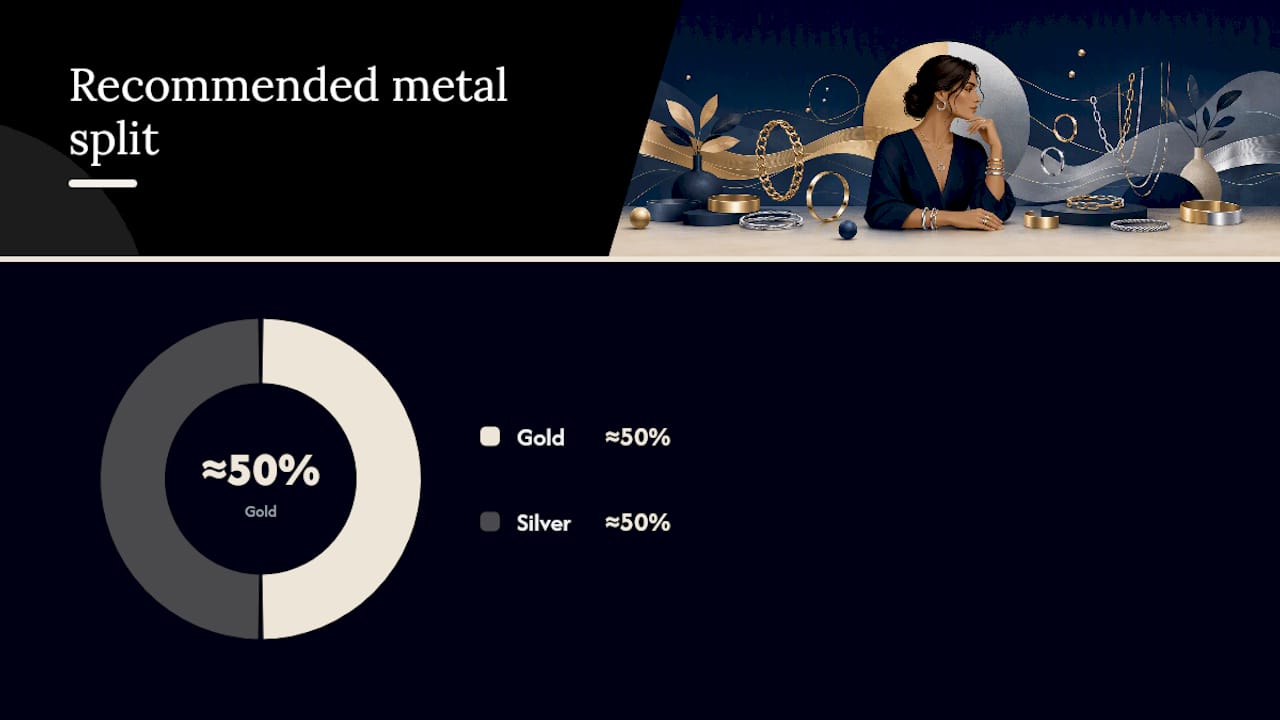
Aim for near-even balance. A look with roughly half gold and half silver reads as deliberate. A single tiny silver ring buried in an otherwise all-gold outfit tends to read as an oversight instead of a style choice, since a lone accent rarely carries enough visual weight to look intentional.
Play with scale, not just color. Pair a chunky gold cuff with a delicate silver chain rather than two pieces of matching heft. Contrast in weight does more work than contrast in tone alone.
Check for repeat touchpoints. Before you leave the mirror, ask whether each metal shows up more than once. If gold appears only on one earring and nowhere else, redistribute it.
- Pick one two-tone anchor piece before adding anything else
- Keep the ratio close to 50/50 rather than a single small accent
- Mix chunky with delicate, not delicate with delicate
- Confirm each metal repeats at least twice across the outfit
Roughly half and half is the number worth remembering: an even split of gold and silver reads as intentional far more consistently than a heavy dose of one metal with a single stray piece of the other.
How to Build a Mixed-Metal Look Step by Step
You don’t need new jewelry to try this tonight. Work with what’s already in your drawer.
- Choose your anchor. Grab a two-tone watch, bangle, or necklace, or the piece in your collection that already has both gold and silver in it. This becomes your excuse to mix everything else.
- Add the opposite tone with scale in mind. If your anchor is delicate, add one bolder piece in the other metal. If it’s bold, add something finer.
- Spread the metals across your top half and your hands. A gold necklace paired only with gold earrings, with silver rings on your fingers and nothing else silver anywhere, looks split rather than mixed. Move one silver element up to your ears or neckline.
- Do a mirror and daylight check. Step back, or better, walk to a window. If one metal disappears entirely from a section of your outfit, add a small piece there or simplify until the mix looks even.
Pro Tip: Keep one “bridge” piece on you at all times, a bracelet or ring that combines both metals in a single design. It’s the fastest way to make any last-minute combination look planned.
For daytime, this might mean a gold hoop, a silver pendant, and a two-tone bracelet holding it together. For evening, swap in a chunkier gold cuff against a fine silver chain necklace, letting the size contrast do the heavy lifting instead of adding more pieces.
Mixing Metals by Piece: Necklaces, Rings, Earrings, and More
Each jewelry category has its own version of the anchor-and-balance rule.
- Necklaces: Layer a gold chain at one length with a silver pendant at another, and let a two-tone chain do double duty as your anchor. Varying the lengths keeps the metals from competing for the same visual space.
- Rings: Stack a silver band on one finger and a gold band on the adjacent one, then mix widths, thin with thick, so the eye reads texture instead of a color clash. A two-tone ring on your dominant hand ties the rest together.
- Earrings: Pair a gold stud in a second piercing with a silver hoop in your primary lobe. If you only have one piercing per ear, alternate: gold in the left, silver in the right, or choose a two-tone earring outright.
- Bracelets and watches: A gold watch reads as intentional next to a silver bangle if you keep the stack to three or four pieces total. Pairing etiquette here matters more than anywhere else, since your wrist is where most people notice the mix first.
When in doubt, a genuine two-tone piece, whether it’s a ring, cuff, or necklace, is the lowest-risk way to wear both metals without thinking too hard about ratios.
Layering and Stacking Formulas That Actually Look Good
Bracelet and necklace stacking has its own shorthand, and it translates directly to mixed metals. A common formula is one bold piece paired with two delicate pieces in the opposite tone, which keeps the eye anchored on a single focal point instead of scanning a cluttered wrist.
- Stack one statement cuff in gold with two thin silver bangles for contrast without competition
- Space necklace lengths at least an inch apart so pendants don’t overlap and blur the metal lines
- Break up back-to-back metal pieces with a bead, leather cord, or fabric bracelet to give the eye a rest
Non-metal elements aren’t filler, they’re doing real work. A stackable bracelet guide notes that wood, leather, or beaded pieces slotted between metal bangles make the whole combination look curated rather than accidental, since the break gives each metal its own moment instead of one long metallic blur.
Common Mixed-Metal Mistakes and Quick Fixes
The most common error is isolating each metal to a different body part, gold on your ears, silver on your hands, with no overlap. Fix it by moving one piece so both metals appear together somewhere.
A single tiny accent, one small silver charm on an otherwise all-gold necklace, rarely reads as a choice. Either add a second silver piece elsewhere or swap in a two-tone anchor instead.
Overstacking is the third trap: five rings, four bracelets, and two necklaces all at once. Pick one focal point per area and simplify the rest.
Why Diamonds by Daisy Recommends This Approach
Diamonds by Daisy curates jewelry and accessories built for everyday wear and gifting, with an emphasis on craftsmanship that holds up whether you’re mixing metals or keeping things simple. The collections are designed with pairing in mind from the start, not as an afterthought.
- Pieces are selected for versatility, so a gold piece from one collection is built to sit comfortably next to a silver piece from another
- Educational guides like the bracelet stacking walkthrough break down formulas you can apply the same day you read them
- The necklace layering guide covers length combinations that work specifically for two-tone chains
- Craftsmanship and quality materials mean mixed pieces wear evenly over time instead of one metal outshining or outlasting the other
The goal isn’t to sell you a matching set. It’s to make sure whatever you already own, or add next, mixes well.
Matching Mixed Metals to Your Outfit and Skin Tone, Day vs. Night
Skin undertone plays a real role here, but it’s a preference filter, not a rulebook. Warmer undertones often find gold sits closer to the skin, while cooler undertones tend to favor silver’s brightness. Neither rule should stop you from wearing both. Mixing metals actually solves the old undertone dilemma altogether: you’re not choosing one metal to flatter your skin, you’re wearing both and letting the anchor piece do the flattering work.
Daytime and workwear call for a quieter ratio, maybe one two-tone watch plus a single delicate necklace in the contrasting metal. Keep the stack low-profile and let the outfit, not the jewelry, carry the look.
Evening and dressier settings can support a bolder mix: a chunky gold cuff against a fine silver chain, or stacked rings across both hands in alternating tones. Under evening light, metal contrast actually reads more clearly than in daylight, so this is where scale differences (bold next to delicate) do their best work.
Outfit color matters too. Warm tones like camel, rust, and olive tend to pull gold forward, while cool tones like navy, gray, and true black let silver pop. When your outfit leans one direction, let your anchor piece lean the other way to keep the mix visible rather than washed out. Denim and neutral basics are the easiest testing ground, since they don’t compete with either metal.
Caring for Mixed-Metal Jewelry So It Lasts
Different metals age differently, which means mixed-metal collections need slightly more attention than a single-metal set. Sterling silver tarnishes with air exposure; gold plating and gold-filled pieces wear down with friction and moisture. Treating them identically shortens the life of at least one.
Store pieces separately, ideally in individual pouches or a jewelry box with divided compartments, so silver pieces don’t accelerate tarnish on nearby gold pieces through contact. Anti-tarnish strips in a drawer help more than most people expect.
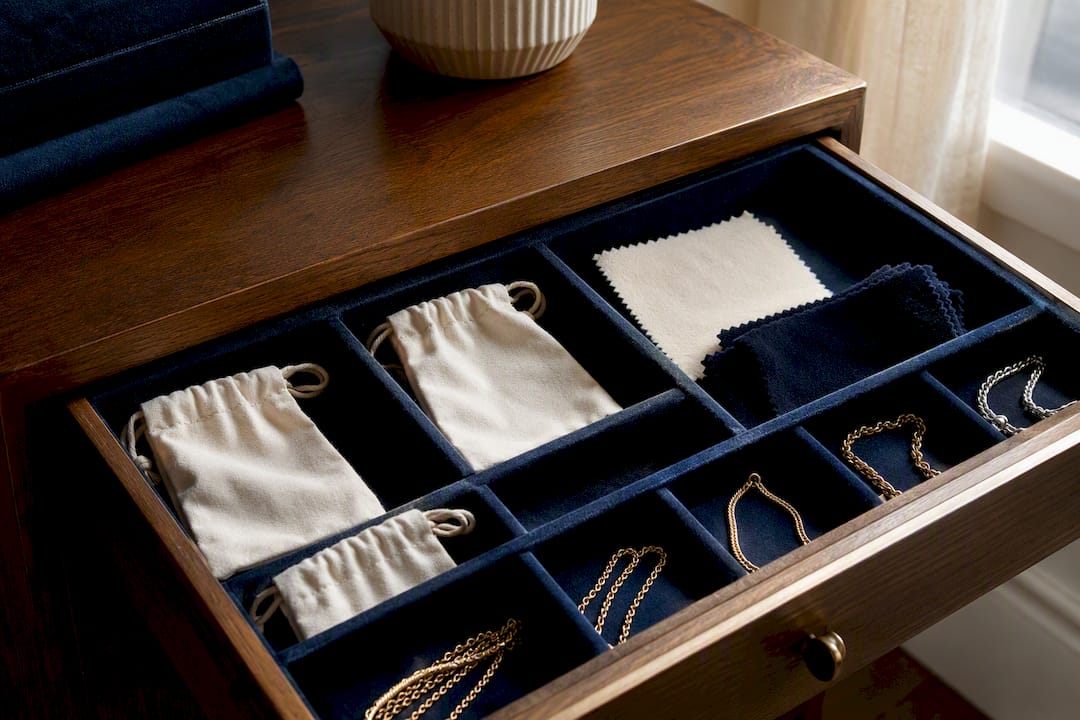
Clean gently and clean often, rather than waiting for buildup. A soft polishing cloth works for both metals, but use separate cloths, since tarnish residue can transfer. Avoid chlorine, chlorinated pools, and household cleaning sprays entirely. Both metals react poorly, and plated pieces especially can lose their finish fast.
Remove mixed stacks before showering, swimming, or applying lotion and perfume. This matters more for layered looks than single pieces, since a five-piece stack means five chances for product buildup between metals.
Check clasps and connectors regularly on layered necklaces and stacked bracelets. The more pieces you’re wearing together, the more friction points exist, and friction is where plating wears thin first. A quick monthly check catches problems before a favorite piece is damaged.
Combining Mixed Metals With Leather, Beads, and Fabric
Metal doesn’t have to compete with metal for every inch of your outfit. Leather cords, beaded bracelets, and fabric-wrapped bangles slotted between gold and silver pieces give the eye somewhere to rest, and they make the whole stack look considered rather than accidental.
A leather cuff paired with one gold bangle and one silver bangle instantly reads as curated instead of cluttered, because the leather acts as a visual buffer between the two metal tones. The same logic works with beaded bracelets: a single strand of wood or stone beads breaks up a metal-heavy wrist stack without diluting the mixed-metal effect.
Fabric chokers and cord necklaces work similarly at the neckline. Layer a fabric choker above a two-tone chain and a silver pendant below it, and the fabric piece keeps the metals from blurring together visually, especially when the chain lengths are close.
This approach also solves a common problem: too much shine in one place. A stack of five metal pieces can look busy under bright light. Swap one or two for leather or beads, and the remaining metal pieces suddenly have room to actually be seen.
Current Trends in Mixing Metals for 2026
The biggest shift this year isn’t a new metal combination, it’s permission. Fashion coverage of the trend notes that the old rule of matching every metal in an outfit is being actively abandoned by people who used to follow it strictly, in favor of working with whatever’s already in their collection.
Two-tone pieces, single items that combine gold and silver in one design, remain the most popular entry point for people trying the trend for the first time, since they eliminate the guesswork around ratio and repetition.
Tri-metal pieces, adding rose gold as a third tone alongside yellow gold and silver, are showing up more in stacked rings and layered bracelets, giving an extra dimension without abandoning the anchor-and-repeat formula. The rule doesn’t change with a third metal, it just means your repeat touchpoints need to cover three tones instead of two.
Layered, mismatched stacks also continue to dominate over matched sets, particularly in bracelets and rings, reinforcing that the trend is fundamentally about personal curation rather than buying a coordinated collection all at once.
The Real Reason Mixed Metals Work (And Where Most Advice Falls Short)
Most articles on this topic treat mixing metals like a checklist: buy an anchor piece, hit a ratio, done. That’s incomplete. The rule that actually matters most is repetition, not ratio. A near-perfect 50/50 split with each metal appearing only once will still look scattered, while an uneven 60/40 mix with each tone repeated three times reads as deliberate every time.
Where conventional advice oversells itself is skin tone matching. Treating undertone as a hard rule (“gold for warm, silver for cool”) ignores that the entire point of mixing metals is sidestepping that binary. You’re not choosing a side anymore.
If you’re starting from zero, prioritize one thing above all else: buy or borrow a single two-tone anchor piece before anything else. Everything in this guide, the ratio, the scale contrast, the touchpoint rule, becomes dramatically easier once you have one piece that’s already doing the mixing for you. Diamonds by Daisy’s gold and silver collections are built with exactly this kind of pairing in mind, which makes the anchor piece a lot easier to find than most people expect.
— Georgia
Where to Start Shopping the Mixed-Metal Look
Diamonds by Daisy makes this easier than digging through your jewelry box hoping something matches. The Everyday Gold collection is built specifically to pair with silver pieces you already own, and the Sterling Silver & Diamond and Crystal & Celestial collections round out the mix with accent pieces designed to sit comfortably alongside warmer tones.

If you’re not sure where to begin, look for a two-tone piece first, a ring, bracelet, or pendant that already blends gold and silver, and build outward from there. That single item does the anchoring work this whole guide has been describing. Browse the Everyday Gold collection for pairing-friendly pieces you can start layering today.
Sources
- How to Mix Metal Jewelry, According to Pros
- The Coolest People I Know Are Breaking This Dated Jewelry Rule in 2026 | Who What Wear