

Work-Appropriate Jewelry: A Professional's Style Guide
Work-appropriate jewelry means pieces that stay small, finish quietly, and don’t compete with the person wearing them. The rule most style guides agree on is the rule of three: wear no more than three pieces at once, keep each one understated, and make sure nothing makes noise when you move.
Quick dos and don’ts:
- Do wear stud earrings, thin chain necklaces, and a simple watch
- Do follow the 2-1-1 variant: two small pieces (studs + ring) and one focal piece (watch or pendant)
- Do choose pieces with secure closures that won’t shift during a long day
- Don’t wear bangles or charm bracelets that clank against a desk or keyboard
- Don’t stack more than two rings per hand in a conservative office
- Don’t choose anything with a large logo, oversized stones, or dangling length past the collarbone
Key Takeaways
Work-appropriate jewelry comes down to three constraints applied consistently: keep pieces small, keep them quiet, and limit yourself to three at once.
| Point | Details |
|---|---|
| Follow the rule of three | Wear no more than three pieces at once; the 2-1-1 formula (two small, one focal) works well. |
| Prioritize comfort and closures | Huggies, screw-back studs, and lobster clasps stay secure through a full workday. |
| Choose hypoallergenic metals | 14K gold, sterling silver, stainless steel, and titanium hold up best for daily wear. |
| Know what to leave home | Noisy bangles, long dangly earrings, and oversized stones distract colleagues and undermine polish. |
| Diamondsbydaisy for daily wear | Curated everyday gold and sterling silver pieces sized and finished to meet the professional checklist. |
Table of Contents
- Why your jewelry choices shape workplace impressions
- The core pieces every professional wardrobe needs
- How to layer and pair jewelry with office outfits
- What makes jewelry comfortable and durable for a full workday
- What to leave at home
- How to build a capsule work jewelry collection
- How to evaluate whether a piece is actually work-friendly
- The case for choosing fewer, better pieces
- Polished pieces for every workday, curated by Diamondsbydaisy
- Sources
Why your jewelry choices shape workplace impressions
Jewelry communicates attention to detail before you say a word. A polished, well-chosen piece signals that you think about how you present yourself. A distracting one signals the opposite, regardless of how strong your work is.
Industry context matters enormously. A law firm or financial institution expects minimal pieces: small studs, a thin chain, a clean watch. A design studio or marketing agency gives you room for a sculptural cuff or a layered necklace. Neither standard is wrong; they just reflect different audience expectations. Recruiters and hiring managers notice accessories, and understated choices consistently read as more professional during interviews, regardless of industry.
Pro Tip: Run two quick tests before you leave the house. First, shake your wrists: if you can hear your jewelry, so can your colleagues. Second, hold your arm out and look at your earrings in a mirror from three feet away. If they read as large from that distance, they’ll read as large across a conference table.
The core pieces every professional wardrobe needs
The goal is a small set of pieces that work across every office context, from a Monday team meeting to a Friday client lunch.
Stud earrings are the foundation. A small diameter that covers most professional settings. Diamond studs and pearl studs are widely cited as the safest choices for conservative workplaces, but a simple gold or silver ball stud in the same size range works just as well.
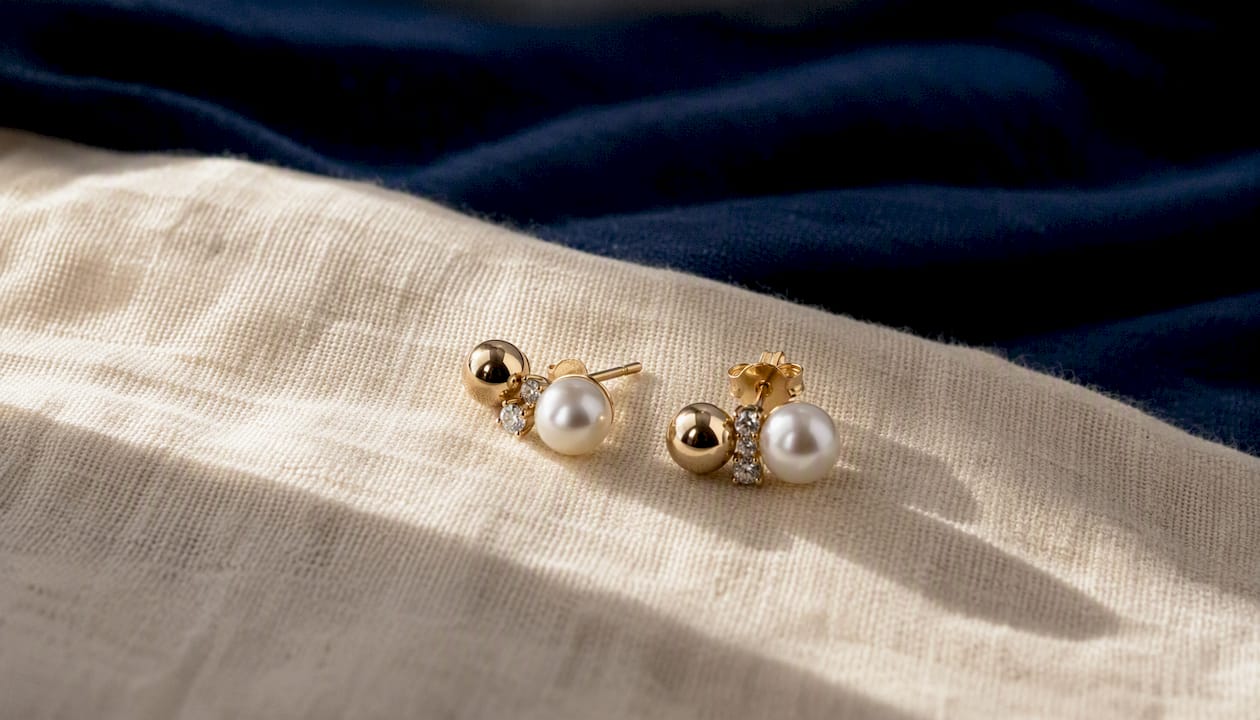
Huggies and small hoops (under 20mm diameter) are the next step up. They sit close to the ear, don’t swing during phone calls, and read as polished rather than casual. Hoops with diameters above a certain point start to feel more weekend than boardroom.
Pendant necklaces at 16–18 inches sit at or just above the collarbone, which is the sweet spot for most necklines. A simple geometric shape, a small stone, or a delicate celestial pendant keeps the look personal without being distracting. Avoid anything that falls below the bust.
Thin chain bracelets or a single cuff add a quiet finishing touch. A chain under 4mm wide or a low-profile cuff in gold or silver reads as intentional without adding bulk or noise.
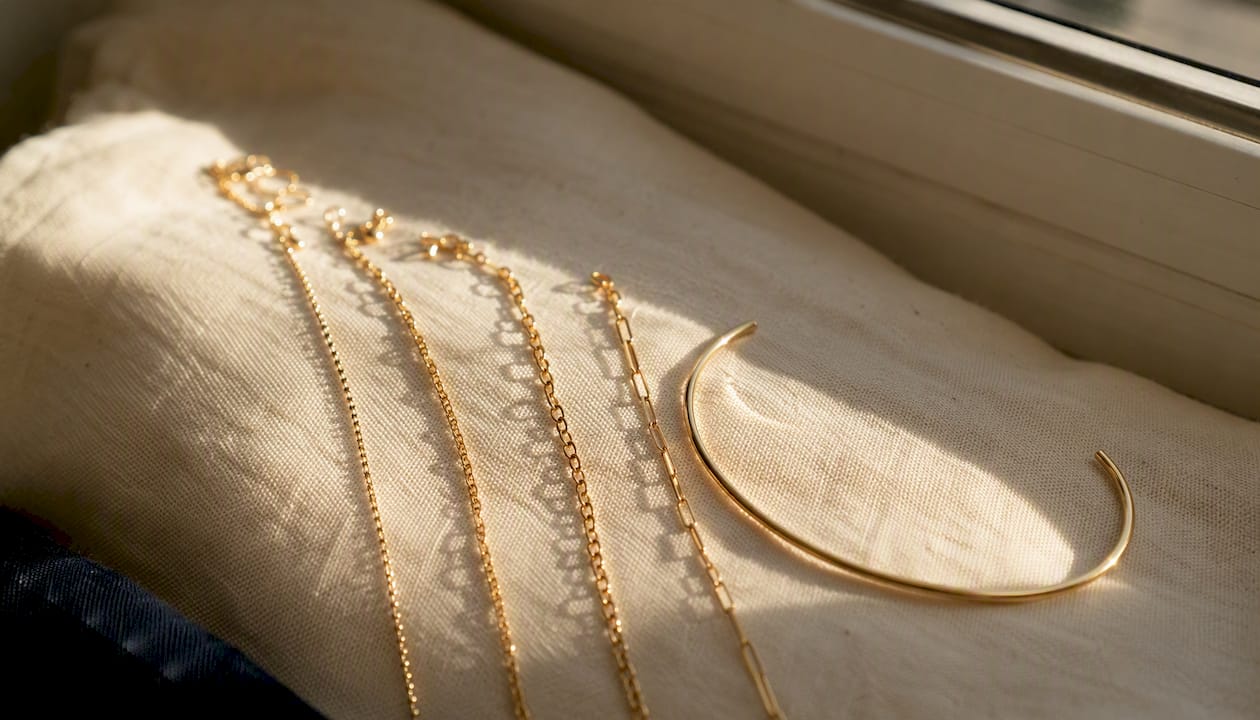
Low-profile rings — a simple band, a thin stacking ring, or a small solitaire — work in almost every setting. Limit yourself to a small number of rings per hand in a conservative office; slightly more is acceptable in a creative one.
A watch does double duty as both jewelry and a practical tool. A leather or metal strap in a neutral tone anchors the wrist without competing with other pieces.
- Stud diameter: 4–8mm for most offices, up to 10mm in creative settings
- Hoop diameter: under 20mm for conservative, up to 25mm for business-casual
- Pendant drop: 16–18 inches; avoid anything below the bust
- Chain bracelet width: under 4mm; single cuff preferred over stacked bangles
Pro Tip: Pick one “anchor” piece for high-stakes moments like presentations or interviews. A quality watch or a pair of diamond studs draws the eye without demanding attention. Everything else that day should be quieter than that one piece.
How to layer and pair jewelry with office outfits
Layering works when there’s a clear focal point and everything else supports it. If your earrings are the statement, keep your necklace short and simple. If you’re wearing a longer pendant, go with studs. Two focal points cancel each other out and read as cluttered.
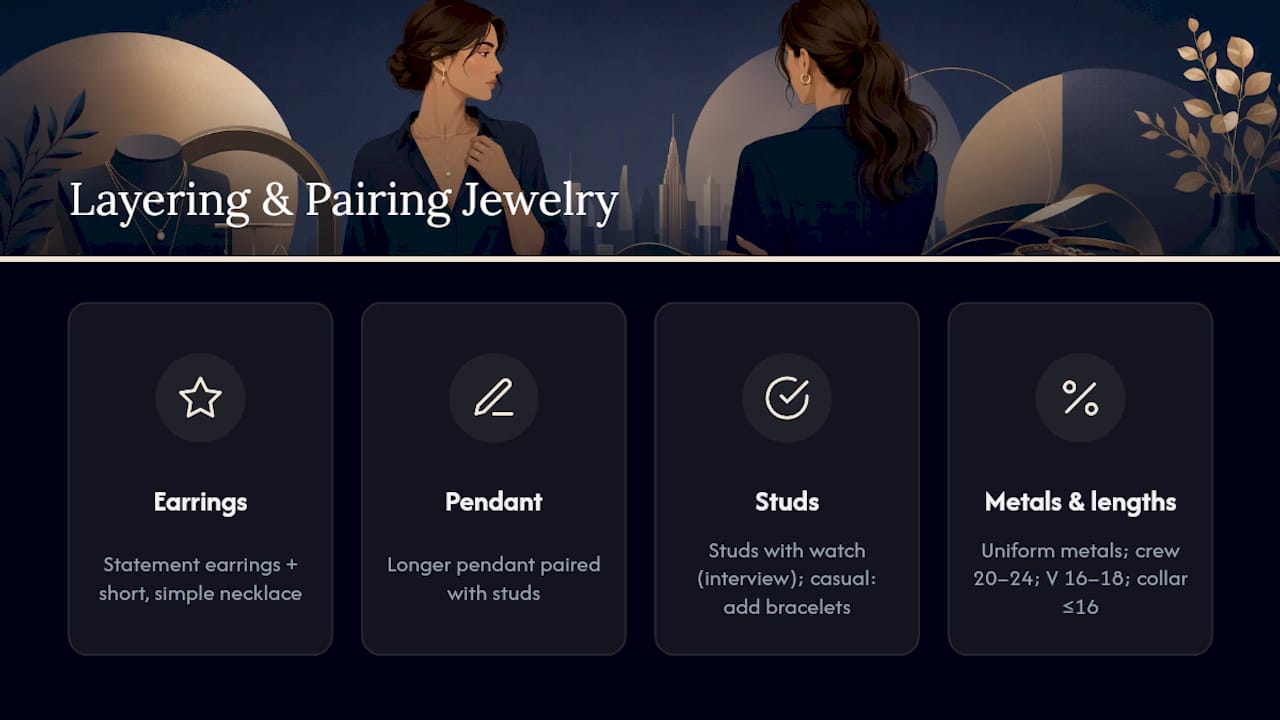
Business-casual jewelry guidelines favor simplicity and neutral metals, which makes metal mixing easier than most people expect. Gold and silver together work when the proportions are similar: a gold watch with silver studs reads as intentional. Where it falls apart is when the metals are different weights — a chunky gold cuff against a delicate silver chain looks accidental rather than curated. When in doubt, keep metals uniform for the day.
Necklace length changes everything depending on your neckline. A crew neck or turtleneck calls for a longer chain (20–24 inches) to create visual space. A V-neck or open collar works best with a shorter pendant (16–18 inches) that echoes the neckline’s shape. A collared shirt or blazer lapel competes with anything longer than a 16-inch chain, so either go shorter or skip the necklace entirely and let the earrings carry the look.
For an interview, the clearest formula is studs plus a watch, nothing else. For a client meeting, you can add a pendant or a thin bracelet. On a casual office day, that’s where stackable rings or a second bracelet layer fits naturally without feeling overdressed.
What makes jewelry comfortable and durable for a full workday
Materials determine both how a piece feels at 8 AM and how it looks at 5 PM. For all-day wear, 14K gold, sterling silver, stainless steel, and titanium are the most reliable choices. They’re durable, widely available in hypoallergenic options, and hold their finish through a full day of desk work.
Gold-plated and vermeil pieces can work well, but the plating thickness matters. Vermeil (sterling silver base with gold plating) holds up longer than brass-base plating. Avoid plated pieces in areas of high friction — rings and bracelets wear fastest. For those, solid metal or at least a thick plating (2.5 microns or more) is worth the extra cost.
Closure type is underrated. Push-back butterfly closures are fine for light studs, but screw-back closures are more secure for anything heavier or more valuable. For necklaces, a lobster claw clasp beats a spring ring for everyday reliability. Huggie earrings with a snap closure stay put through phone calls, headphone use, and everything else a workday throws at you.
Weight and balance matter more than most people realize. Huggie earrings and lightweight studs are less likely to snag on scarves or headphones, and they don’t pull the earlobe during long calls. A heavy chandelier earring that felt fine at 9 AM is uncomfortable by noon.
A simple care habit extends the life of any piece: wipe it with a soft cloth before storing it, keep it away from perfume and hand lotion, and store each piece separately to prevent scratching. A small zip pouch in your desk drawer handles the midday touch-up.
What to leave at home
Some pieces simply don’t belong in a professional setting, regardless of how much you like them.
- Noisy bangles and charm bracelets: the sound carries in quiet offices and on calls
- Long dangly earrings: anything that swings past the jaw risks snagging and reads as evening wear
- Oversized cocktail rings: a stone larger than your fingernail draws attention away from your work
- Logo-heavy pieces: visible brand logos read as casual or promotional, not polished
- Anything with sharp edges or open settings: snag risk on fabric, files, and equipment
- Layered necklaces past the bust: too much movement, too much visual noise
- Multiple stacked bangles: even silent ones add bulk that interferes with typing
Role-specific rules apply in some fields. Food handlers in most jurisdictions are restricted to a plain wedding band with no stones or raised settings; all other jewelry is typically prohibited for safety and hygiene reasons.
How to build a capsule work jewelry collection
A capsule collection doesn’t need to be large. Seven pieces, chosen well, cover every professional situation.
Priority order for building your collection:
- Stud earrings (pair 1): Start here. A pair of diamond studs or pearl studs in 4–6mm works in every setting from a job interview to a board meeting. Invest here.
- A watch: The single most versatile workwear accessory. A clean leather or metal strap in a neutral tone. Buy the best you can reasonably afford.
- A thin chain necklace (16–18 inches): Gold or silver, no pendant. Wear it alone or layer a pendant over it later. This is your foundation chain.
- Stud earrings (pair 2): A second pair in a different metal or a small colored stone gives you variety without adding complexity. Save here; mid-range is fine.
- A simple band or solitaire ring: One ring, worn alone. This is not the place for a statement piece.
- A thin chain bracelet or single cuff: Adds a finishing touch without noise or bulk. Save here.
- A small pendant: Something personal but subtle. A geometric shape, a small stone, or a delicate charm. This is where you can express a little personality.
Budget guidance: Invest in pieces that touch your skin most (earrings, rings) because those wear fastest and affect comfort most. A quality pair of studs in solid gold or sterling silver outlasts three pairs of plated alternatives. Versatile, high-quality basics in gold or silver deliver better long-term value than rotating trendy pieces.
Three-month build plan:
- Month 1: Studs and watch
- Month 2: Foundation chain and first ring
- Month 3: Bracelet and pendant
Keep a small zip pouch in your desk with a polishing cloth, a spare earring back, and a small jewelry bag for travel. Rotate pieces weekly so nothing gets overworked, and store each piece separately at night.
How to evaluate whether a piece is actually work-friendly
Before adding anything to your rotation, run it through this checklist:
- Scale: Does it read as small from three feet away?
- Shine: Is the finish matte, brushed, or subtly polished rather than highly reflective?
- Noise: Does it make any sound when you move your wrist or shake your head?
- Weight: Does it feel comfortable after 30 minutes, not just when you first put it on?
- Closure security: Will the clasp or back stay secure through a full day of movement?
- Material: Is it hypoallergenic, or do you know your skin tolerates it?
- Versatility: Can you wear it with at least three different outfits in your current wardrobe?
For a one-day wear test, put the piece on at the start of your workday and check in at four points: after two hours of desk work (comfort, movement), after a phone call (snag risk, distraction), after lunch (stability, shine), and at the end of the day (skin reaction, closure integrity). A piece that passes all four checks belongs in the rotation.
Quality flags worth looking for: soldered links rather than open jump rings, a hallmark stamp (925 for sterling silver, 585 or 750 for 14K or 18K gold), and a finish that looks consistent under close inspection rather than patchy or thin.
The case for choosing fewer, better pieces
Most professionals own too much jewelry and wear the same two pieces every day. The real problem isn’t having too little; it’s having a collection that doesn’t work together.
The conventional advice is to “build a collection over time,” which usually means accumulating pieces without a plan. What actually works is the opposite: start with one anchor piece you’d wear to an interview, then add only pieces that work alongside it. Every addition should make the existing collection more versatile, not just larger.
There’s also a comfort argument that gets overlooked. A piece you forget you’re wearing is doing its job. A piece you’re adjusting every hour, worrying about losing, or taking off by noon is costing you focus. The best jewelry for work is the kind that disappears into your day and reappears in a photo where you think, “I looked good that day.”
Convertible and versatile pieces — stackable rings, short pendants, small hoops — make this easier because they adapt across contexts without requiring a full outfit change. That flexibility is worth more than novelty.
Polished pieces for every workday, curated by Diamondsbydaisy
Finding jewelry that genuinely meets the professional checklist — small scale, secure closures, hypoallergenic options, finishes that hold up — is harder than it sounds when you’re shopping without guidance.
Diamondsbydaisy curates pieces built for exactly this: everyday gold hoops, necklaces, and bracelets sized and finished for daily wear, alongside sterling silver and natural diamond pieces that cover everything from Monday studs to Friday client lunches. Each collection is selected for scale, finish quality, and versatility across office contexts. Browse the full curated collection to find the pieces that fit your workplace and your style.
Sources
- How to Build a Tasteful Jewelry Collection for Work
- What Jewelry Can Food Handlers Wear Safely? (Keeping safety stylish in the kitchen)
- The Best Business Casual Jewelry to Help You Shine in 2025