

How to Master Bracelet Stacking, One Wrist at a Time
Start with one bracelet that carries the look, then build outward with two or three pieces that vary in width, texture, or metal so the eye has somewhere to travel. That’s bracelet stacking in a nutshell: an anchor piece, a couple of contrasting layers, and a smaller detail that pulls it all together. Skip the matching sets and let a little tension between pieces do the work.
Here’s a recipe you can build in the next five minutes with whatever is already in your jewelry box:
- Anchor: one bracelet with real presence (a cuff, a tennis bracelet, a chunky bead strand)
- Contrast piece 1: something thinner or in a different texture (a fine chain, a bangle)
- Contrast piece 2: a second layer that adds either color or a touch more metal
- Tying piece: a slim chain or delicate bangle that keeps the whole thing from feeling like three separate ideas
The rule of thumb worth remembering: a good stack should look like it happened on purpose but not like it took an hour. If you’re still adjusting it after the fifth try, you’ve probably added one bracelet too many.
Key Takeaways
A great bracelet stack always starts with one anchor piece, then adds contrast in width, texture, or metal until the layers feel balanced rather than crowded.
| Point | Details |
|---|---|
| Start with an anchor | Choose one dominant piece, like a cuff or tennis bracelet, before adding anything else. |
| Vary texture and width | Pair smooth metal with beads or chains to avoid a flat, matchy stack. |
| Keep the count reasonable | Two to four pieces for daily wear; four to seven for a maximalist evening look. |
| Mind the fit | Thin chains need less slack than a single cuff; adjustable sliders make fine-tuning easy. |
| Choose curated starter pieces | Diamondsbydaisy’s Gold Circle Stacking Bracelet works as a ready-made anchor for building your first stack. |
Table of Contents
- What Bracelet Stacking Actually Means
- What Are the Core Rules for Stacking Bracelets?
- How Do You Choose the Right Anchor Bracelet?
- Mixing Shapes and Textures Without Creating Clutter
- When Should You Match Metals and When Should You Mix Them?
- How Many Bracelets Should You Actually Wear?
- Getting the Fit Right When You Stack
- Build Your Stack: A Step-by-Step Checklist
- Five Copyable Stacks for Every Occasion
- Keeping a Stacked Bracelet Collection Looking New
- A Stylist’s Case for Simplicity Over More Pieces
- Start Your Stack With Three Pieces That Already Work Together
- Frequently Asked Questions
- Sources
What Bracelet Stacking Actually Means
Bracelet stacking is the practice of wearing several bracelets together on one wrist, layered and combined so they read as a single, coordinated look rather than a pile of accessories. The concept borrows directly from ring stacking, where GIA recommends building outward from a focal anchor piece and adding contrast through width and texture. The same logic applies at the wrist, just with more surface area to play with.
A few common outcomes show what this looks like in practice. A minimal everyday stack might pair one slim gold bangle with a delicate chain bracelet, nothing louder than a whisper. A layered boho stack leans into beaded strands, leather cord, and a few charms in warm, earthy tones. A mixed-metal editorial stack goes bolder still, combining a silver cuff with a gold chain and a rose gold slider, betting that the contrast itself becomes the style statement.
Stacking works visually for the same reason a good outfit works: contrast creates interest, repetition creates rhythm, and one clear focal point keeps the whole thing from turning into noise. Without an anchor, your eye doesn’t know where to land. Without variation, the stack reads flat and forgettable.
What Are the Core Rules for Stacking Bracelets?
Most stacking mistakes come down to ignoring one of four basics. Get these right and almost any combination of pieces will look intentional.
- Pick one anchor piece. Everything else supports it. Don’t let two bold pieces compete for attention.
- Balance visual weight. A heavy cuff pairs better with something delicate than with another heavy piece.
- Vary texture, not just color. Smooth metal next to a beaded or braided piece adds depth that a stack of identical chains never achieves.
- Include one tying detail. A slim chain, a repeated bead color, or a shared metal tone gives the stack a sense of cohesion.
Where people go wrong is usually predictable:
- Don’t stack three chains of nearly the same width and finish. It reads as clutter, not layering.
- Do mix a wide bangle with a fine chain and a beaded piece for instant contrast.
- Don’t ignore your watch. If you wear one daily, decide whether the stack sits above it or gets tucked partially underneath a cuff.
- Do let a chunky cuff sit closest to the hand and let thinner pieces layer above it toward the wrist.
If you already wear a watch most days, treat it as part of the stack rather than something separate. A thin bangle or two above the watch face usually looks more deliberate than piling bracelets on the opposite, watch-free wrist out of habit.
How Do You Choose the Right Anchor Bracelet?
Your anchor sets the tone for everything else, so pick it before you touch anything else in your jewelry box. It’s the piece with enough presence to hold the stack together: a statement cuff, a tennis bracelet, a chunky bead strand, or even a sentimental charm bracelet that means more to you than it costs.
The right anchor changes with the occasion. For daily wear, something like the Gold Circle Stacking Bracelet works well because it’s substantial enough to lead a stack without overwhelming a work outfit. For evening, a bolder option like a dual cuff set gives you the drama that low light and a dressier outfit call for.
- Everyday anchor: a medium-width bangle or a simple circle bracelet
- Evening anchor: a cuff, a tennis bracelet, or anything with visible sparkle
- Sentimental anchor: a charm bracelet or piece tied to a specific memory, worn as the emotional center of the stack even if it’s not the boldest visually
Pro Tip: If your outfit changes throughout the day, choose an anchor that works with a watch already on your wrist rather than fighting it. A slim anchor piece sits comfortably next to a watch band, while a wide cuff often needs the opposite wrist entirely.
Mixing Shapes and Textures Without Creating Clutter
The most reliable pairings share one thing: contrast in shape or texture, not identical proportions. A bangle next to a chain works because a rigid, unbroken circle sits against something fluid and jointed. A cuff paired with a fine chain works for the same reason, one closed and structured, one loose and delicate. Beaded strands next to a tennis bracelet play with contrast, too, matte texture against faceted stones.
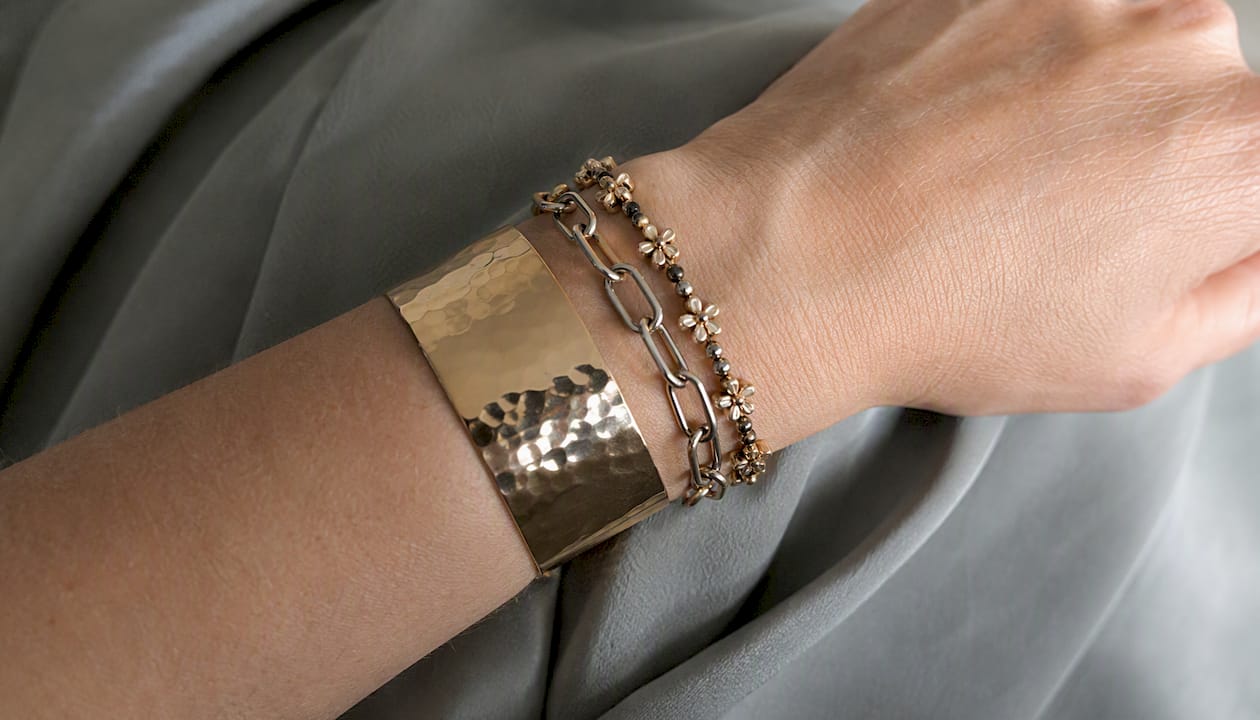
Independent designers lean on this constantly. Mixed hammered and smooth metal finishes across pieces, as seen in designer stacking ring sets, create balance without needing identical materials, and the same principle carries over to bracelets.
| Pairing | Why It Works | Best For |
|---|---|---|
| Bangle + chain | Structured shape against fluid movement | Everyday minimal stacks |
| Cuff + fine chain | Bold anchor with a delicate counterweight | Work-to-evening transitions |
| Beaded + tennis bracelet | Matte texture against faceted sparkle | Evening or dressed-up looks |
| Leather cord + metal chain | Warm, organic material against cool metal | Boho or casual weekend stacks |
The general flow rule: build outward from your anchor by alternating texture with each new piece rather than repeating the same finish twice in a row. Repeat a motif, like a small circle or bead shape, once for cohesion, but introduce something different for the next layer so the stack doesn’t flatten into a single note.
When Should You Match Metals and When Should You Mix Them?
Pick one dominant metal, then add a single accent metal for contrast. That’s the safest, most reliably good-looking approach if you’re not sure where to start. A stack built mostly in gold with one silver piece reads as intentional. A stack split evenly three ways between gold, silver, and rose gold can work too, but it needs a tying color or texture to keep it from looking accidental, something like a shared gemstone tone or a repeated bead color across the mixed metals.
A workable shortcut: keep two to three repeated undertones running through the stack, warm or cool, so even mixed metals feel coordinated rather than random. That’s the same logic Madewell applies to its mixed-metal stacking sets, where a curated trio of tones is sold together specifically because they were chosen to work as a set.
- Do anchor a mixed-metal stack with one piece that touches both tones, like a two-tone chain, to bridge the gap visually.
- Don’t combine three different metals with three unrelated colors and expect it to read as curated. That combination usually just reads as busy.
- Do use enamel details, gemstone tones, or a leather accent as the color thread that ties otherwise mismatched metals together.
How Many Bracelets Should You Actually Wear?
For most people, two to four bracelets on one wrist for daily wear hits the sweet spot: enough to look styled, not so many that your arm feels like it’s working out. Push toward four to seven pieces for a maximalist evening look, where more layers read as intentional drama rather than clutter, provided you’re still following the anchor-plus-contrast approach.
- Two bracelets: the safest daily minimum, an anchor plus one contrast piece
- Three to four bracelets: the standard “well-styled” range for work or casual outings
- Five to seven bracelets: the maximalist or “rich girl” stack, reserved for evenings or when jewelry is the outfit’s focal point
The “rich girl” stack gets its name from a specific look: several tennis bracelets layered together, often in the same metal, sometimes paired with one or two sleek bangles for structure. It’s less about mixing wild contrast and more about repetition done well, the same sparkle repeated in slightly different widths, all in coordinated tones. It works because consistency itself becomes the statement.
Two real risks come with going heavier. First, comfort. More pieces means more contact points, and mixed metals with different hardness levels can accelerate wear between pieces, so a stack of seven bracelets worn daily will show scuffs faster than a stack of three. Second, visual clutter. Past a certain point, extra pieces stop adding rhythm and start competing for attention, especially if none of them share a tying color or metal.
For active days, consider swapping one rigid piece for something with give. Flexible or silicone-style accent bands are worth adding to a stack specifically because they flex where metal doesn’t, which cuts down on pinching between layers during regular movement.
Getting the Fit Right When You Stack
Stacked bracelets need a different fit than a single piece worn alone. Start by measuring your wrist circumference with a soft tape measure or a strip of paper marked and measured against a ruler. From there, add slack based on what you’re building.
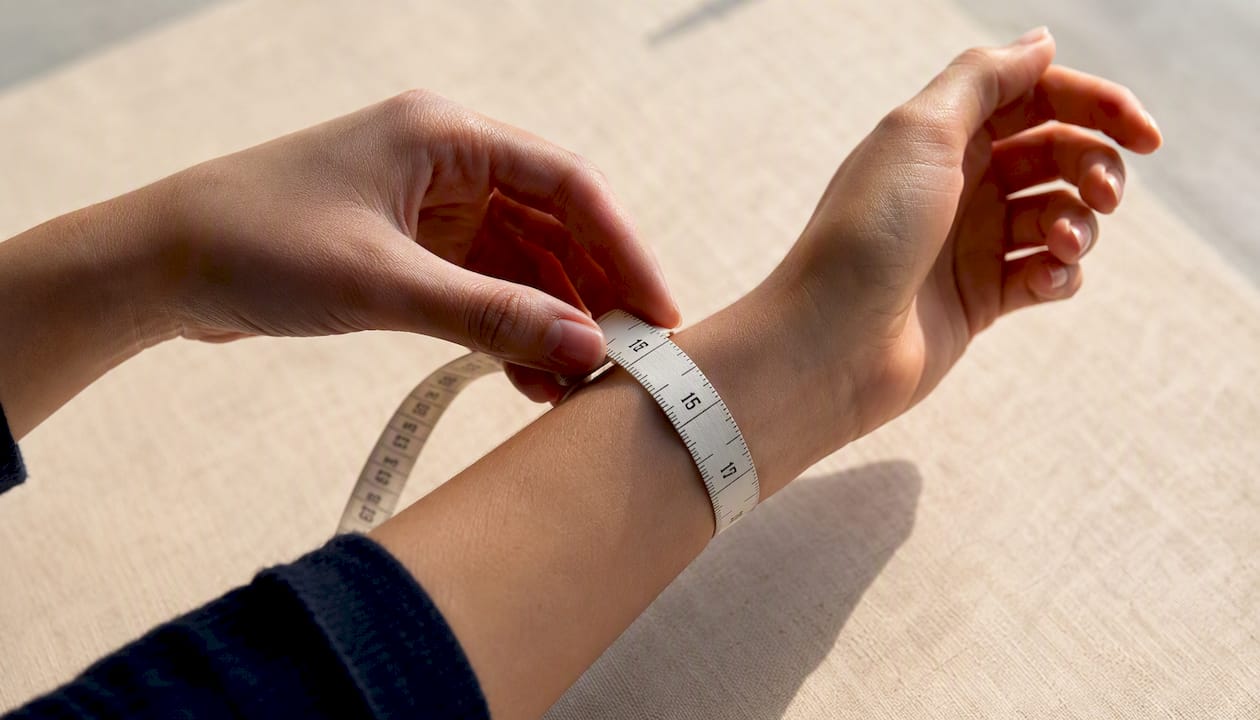
A single cuff or bangle typically needs enough slack to slide over the widest part of your hand, roughly half an inch to an inch of extra room depending on the style. But when you’re stacking multiple thin chains, you actually want less slack per piece; too much room on several thin bracelets means they slide, tangle, and bunch instead of sitting in a clean, layered line.
Clasp choice matters more once you’re stacking than it does for a single piece. Lobster clasps are secure but slow to fasten one-handed, which becomes tedious with three or four pieces. Adjustable slider closures, like those found on a rose gold slider bracelet, solve this neatly because they let you fine-tune fit without a clasp at all, useful when you’re adding or removing pieces from the stack throughout the week.
Rigid pieces like cuffs don’t move with the rest of the stack, so they need slightly looser sizing than chains to avoid pinching the layers beneath them. A stack that includes both should have the cuff sit loosest, with tighter, thinner pieces layered inside it.
Build Your Stack: A Step-by-Step Checklist
- Choose your anchor. Pick the one piece with the most presence, cuff, tennis bracelet, or a sentimental favorite.
- Select two contrast pieces. Look for different widths, textures, or shapes than your anchor.
- Add one tying piece. A slim chain or a repeated bead color that connects the other pieces visually.
- Check the balance. Lay the stack flat on a table before wearing it. Does one piece dominate too much? Adjust before you put it on.
- Test it on your wrist. Move your hand as you normally would, typing, carrying a bag, driving, and see if anything catches or slides awkwardly.
- Photograph it. A quick photo often reveals visual imbalance your eye misses in the mirror. Look for gaps, overlap, or one piece pulling focus away from the anchor.
If the stack tips visually toward one side or feels heavier than it looks, swap out one piece for something thinner. If two pieces are scratching against each other, either separate the metals with a chain buffer between them or remove one and wear it on the opposite wrist instead.
Five Copyable Stacks for Every Occasion
These five combinations cover most situations you’ll actually dress for, from a Tuesday at your desk to a wedding you’re attending as a guest.
| Occasion | Stack Components | Why It Works |
|---|---|---|
| Casual daytime | Slim gold circle bracelet + fine chain + one bead strand | Light enough for all-day wear, still layered |
| Work | Gold circle bracelet (anchor) + thin white gold chain + delicate bangle | Polished without competing with a blazer sleeve |
| Evening | Dual cuff set + tennis bracelet + one fine chain | Structured drama that reads well under low light |
| Minimalist | Two slim bangles, same metal, slightly different widths | Repetition and restraint, no anchor needed |
| Maximalist (“rich girl”) | Two to three tennis bracelets + one sleek bangle, same metal family | Sparkle repeated in coordinated tones |
If you wear a watch daily, the casual and work stacks both sit comfortably above it without crowding the face. For the evening stack, tuck the fine chain slightly beneath the cuff so it peeks out rather than competing with the cuff’s width.
Rotating stacks seasonally is easier than buying new pieces every few months. Swap a leather cord bracelet in for a metal chain during warmer months, or add a beaded strand in seasonal colors, an approach that lines up with trend guidance favoring mixed materials and seasonal rotation rather than constant new purchases. A gemstone bead bracelet can do the same job, adding natural texture and warmth to an otherwise all-metal stack without replacing anything you already own.
Keeping a Stacked Bracelet Collection Looking New
Different materials in your stack need different care, and stacking accelerates wear on all of them since pieces rub against each other throughout the day.
- Gold vermeil: clean gently with a soft cloth and mild soap, and expect to polish it occasionally as tarnish builds; vermeil pieces like an 18K Gold Vermeil CZ Bracelet hold up well with regular light care.
- Sterling silver: a polishing cloth handles most tarnish; avoid letting silver sit directly against rougher-textured pieces for long stretches.
- Plated brass or base metals: these wear fastest in a stack, so keep them away from harder metals when possible and remove before swimming or heavy activity.
- Beaded pieces: wipe with a dry cloth; avoid soaking, which can loosen stringing over time.
Storage matters as much as cleaning. Store bracelets separately, or on a soft roll rather than piled in one drawer, to prevent plated finishes from scratching and fine chains from tangling into knots that take ten minutes to undo. Remove your full stack before swimming, heavy lifting, or anything involving repeated hand-to-surface contact, and set sentimental pieces aside in their own pouch rather than letting them knock against everyday bracelets day after day.
A Stylist’s Case for Simplicity Over More Pieces
Most people over-stack before they ever under-stack. The instinct when you own several nice bracelets is to wear all of them at once, and the result usually looks like indecision rather than style. The anchor-first approach works precisely because it forces a decision: one piece leads, everything else supports it. That discipline is what separates a stack that looks curated from one that looks like a jewelry box emptied onto a wrist.
Repeated metals do more work than people give them credit for. A stack in mostly one metal tone, with a single accent piece breaking the pattern, reads as considered even when the individual pieces are simple. That’s part of why a piece like the Gold Circle Stacking Bracelet works so well as a starting anchor. It’s understated enough to support contrast pieces without fighting them for attention, which is exactly the job an anchor is supposed to do.
Start Your Stack With Three Pieces That Already Work Together
Building a good stack from scratch is easier when you’re not guessing whether your pieces will actually pair well. Diamondsbydaisy solves that by curating each piece with stacking in mind from the start, rather than leaving you to test mismatched metals and widths against each other.

Three pieces cover the full recipe outlined above. The Gold Circle Stacking Bracelet works as your anchor, substantial enough to lead a daily stack without overwhelming it. The 18K Gold Vermeil CZ Bracelet adds contrast and a touch of sparkle as your second layer. The rose gold slider bracelet closes the stack as your tying piece, with an adjustable fit that lets you fine-tune slack once all three pieces are on your wrist together.
Each piece is built for daily wear and doubles as a thoughtful gift, whether you’re building the stack for yourself or putting one together for someone else. Browse the full bracelet collection to see which combination fits your style, or start with the circle bracelet as your anchor and build outward from there.
Frequently Asked Questions
What is bracelet stacking? Bracelet stacking means wearing multiple bracelets together on one wrist, layered by width, texture, and metal so they read as one coordinated look instead of a random pile of jewelry.
How many bracelets should I stack at once? Two to four bracelets works well for daily wear. Four to seven pieces suits a maximalist evening look, especially the layered “rich girl” style built around repeated tennis bracelets in one metal tone.
Can I mix silver and gold bracelets in one stack? Yes. Pick one dominant metal and add a single accent metal, or mix all three metals deliberately if you have a repeated color or texture tying the pieces together.
Do stacked bracelets scratch each other? They can, especially when metals of different hardness sit against each other for hours. Separating harder and softer metals, or adding a buffer piece between them, reduces the wear.
Should I wear a watch with a bracelet stack? Yes, treat it as part of the stack rather than something separate. Thin bangles or a fine chain layered above the watch face usually look more intentional than crowding the opposite wrist alone.
Sources
- Ring Stacking Guide: How to Style and Stack Your Rings | GIA 4Cs
- 10 Best Stacking Rings Ideas for 2026 | Casual Carats