

Six Rules to Match Jewelry to Every Neckline, from Stylist Georgia
Match the jewelry’s line to the neckline’s line, then choose a length that sits clearly above the fabric edge or clearly below it, never straddling it. A V-neck wants a V-shaped pendant or Y-lariat; a scoop wants a rounded chain that echoes its curve. When a neckline is already busy with ruffles, beading, or embroidery, skip the necklace and let earrings or a bracelet carry the look instead, as advised in this guide to treat rose gold watches as precision tools for care and preservation. Our everyday and bridal pieces are designed with shape and length considerations in mind.
TL;DR:
- The necklace should echo the shape of the neckline, with specific suggestions for V-necks, scoop, crew, and strapless styles; avoid crossing fabric edges.
- Longer chains (24 inches or more) suit high necklines like turtlenecks, while shorter lengths (14-16 inches) complement boatnecks and off-the-shoulder styles.
- When neckline embellishments are present, such as beading or ruffles, it is better to skip necklaces and use earrings or bracelets to avoid visual clutter.
- Metal choice depends on outfit tones, with cool colors pairing with silver and warm tones with gold, limited to two metals per outfit for cohesive styling.
- For bridal, asymmetrical, or menswear-inspired looks, opt for delicate, scaled-down jewelry that emphasizes simplicity and proportion, avoiding clash with embellishments or hardware.
Table of Contents
- How Do You Match Jewelry to Different Necklines?
- What Are the Mirror, Depth, and Busy Rules?
- What Necklace Length Works for Each Neckline?
- How Do You Match Metal Color to Your Outfit?
- How Do You Handle Bridal, Asymmetrical, and Menswear-Inspired Necklines?
- Does Body Shape Change Which Jewelry Works Best?
- How Should Occasion Affect Your Jewelry Choices?
- Should You Skip the Necklace and Focus on Earrings or Bracelets Instead?
- Georgia’s Six-Point Jewelry Checklist
- Shop the Diamonds by Daisy Collections Built for These Rules
- Sources
- FAQ
How Do You Match Jewelry to Different Necklines?
Every neckline has a shape, and every necklace has a shape. The fastest way to get dressing right is pairing the two so they echo each other instead of fighting. Here’s how that plays out across the necklines you actually own.
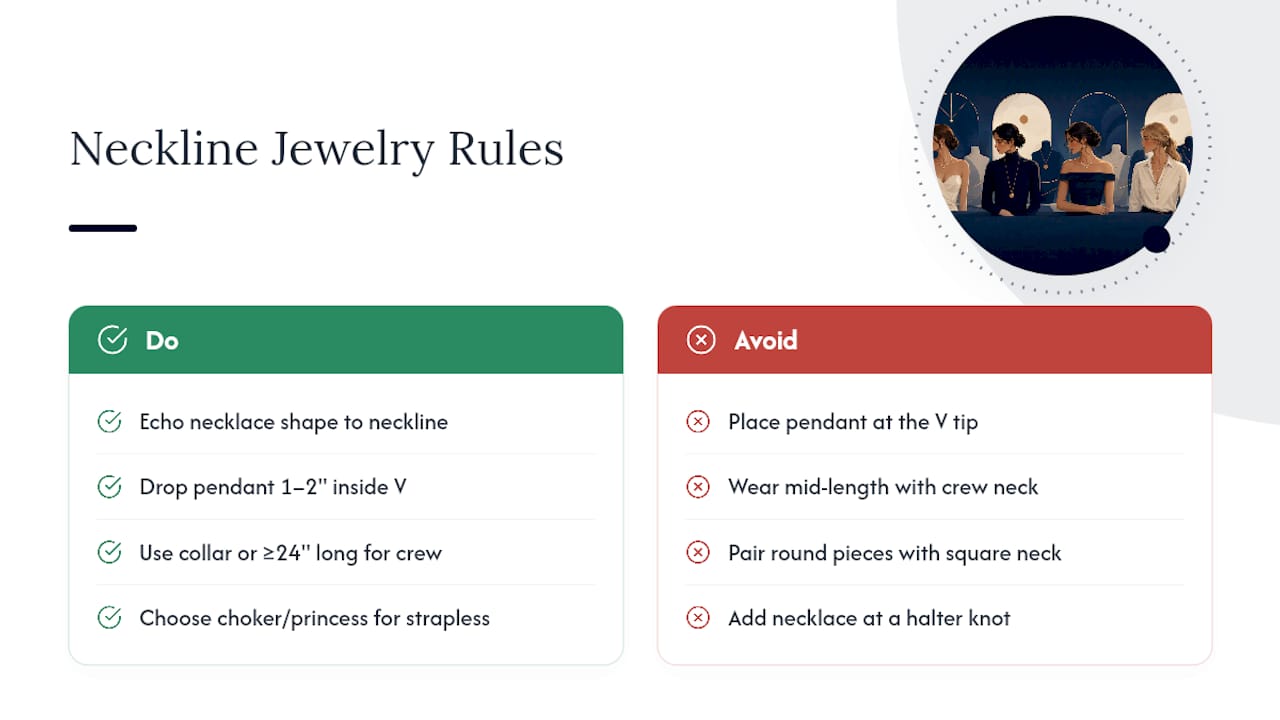
V-neck. A V-neck wants a pendant that continues its angle downward: a Y-lariat, a drop pendant, or a simple V-shaped chain. Length matters more than style here. The pendant should land an inch or two inside the point of the V, never right at the tip where it competes with the fabric edge. An 18-inch matinee length usually hits that sweet spot on most torsos.
Scoop neck. The soft curve of a scoop calls for rounded shapes rather than sharp points. A single 16 to 18-inch chain that follows the collarbone works, or you can layer a 16-inch piece with a 20-inch piece so the longer strand falls just below the curve rather than crossing it. Each neckline calls for a specific necklace shape and length, and scoop necks specifically suit rounded or multi-strand pieces over anything angular.
Crew or round neck. This is the trickiest neckline because a mid-length pendant tends to land exactly on the collar seam, which reads as an accident rather than a choice. Two options work better: a short collar-style piece that sits above the neckline entirely, or a long pendant, 24 inches or more, that drops well below it. Anything in between just gets lost in the seam.
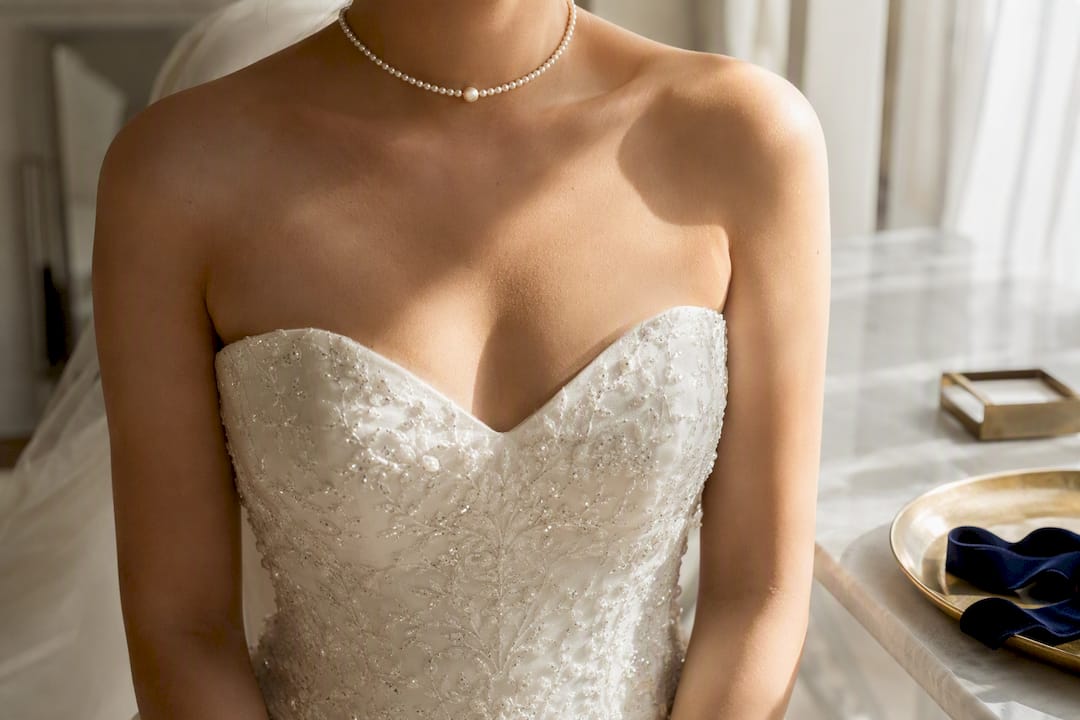
Strapless and sweetheart. These necklines expose the collarbone and chest, so a choker or princess-length necklace (14 to 18 inches) fills that space without competing with the dress. For formal events, a bib-style statement necklace can work beautifully since there’s no fabric line to interrupt it. Bridal and event styling guides consistently point to chokers or princess lengths for strapless and sweetheart cuts.
Square neck. The straight horizontal edge pairs well with geometric pendants or short, structured collar necklaces that mirror its clean lines. Avoid anything too round or flowing here. It’ll look mismatched against the neckline’s architecture.
Boatneck. The wide, horizontal boatneck usually looks best with no necklace at all, or with a long, narrow chain (24 inches or longer) that runs vertically and breaks up the width. Long station necklaces or opera-length chains work particularly well since they create a counterbalancing vertical line.
Halter. Halters already occupy the neck and upper chest with fabric and hardware, so a necklace often just adds clutter and clasp interference. Statement earrings or a single slim vertical pendant that hangs below the halter’s knot are safer bets.
Turtleneck or high neck. These closed necklines are made for long chains worn over the fabric. A 28 to 36-inch opera-length necklace or a sautoir with tassel detail adds drama without touching the skin, which is exactly the effect you want here.
Off-the-shoulder. This neckline creates a strong horizontal line across both shoulders. A choker or short layered set (14 to 16 inches) balances that width by adding a contrasting vertical or clustered element at the throat.
Collared shirts. You have two real approaches. “Under” means a delicate pendant tucked inside an open collar. “Over” means a bolder statement necklace worn over a closed collar, buttoned to the top. Mixing the two, a chunky piece half tucked into a gaping collar, is the one combination that consistently looks unintentional.
What Are the Mirror, Depth, and Busy Rules?
Three simple principles cover almost every neckline you’ll ever encounter, including the odd ones that don’t fit a tidy category.
The mirror rule is the foundation: jewelry that repeats the neckline’s line reads as deliberate styling rather than an afterthought. A curved neckline wants a curved necklace. An angular neckline wants an angular pendant. This single habit is what separates an outfit that looks put together from one that looks randomly accessorized, according to styling guidance from Zevira.
The depth rule governs scale: the more skin a neckline reveals, the bolder your jewelry can go. A deep V or plunging neckline has room for a statement pendant or layered chains. A closed neckline like a turtleneck needs the opposite treatment, either something long enough to sit over the fabric or something small and delicate near the collarbone.
The busy rule tells you when to put the necklace away entirely. If a neckline already has embellishment (beading, ruffles, embroidery, structured collars), adding a necklace usually creates visual competition rather than harmony. When a garment’s neckline is already ornate, the better move is to skip the necklace and let earrings or a bracelet do the work.
One more diagnostic worth memorizing: a necklace should never sit half on, half off the fabric edge. That in-between placement reads as trapped or accidental rather than styled. If a chain keeps landing right on a hem or seam, size up or down until it clears the edge by at least an inch.
- Curved neckline → curved necklace shape.
- Deep neckline → bolder, larger pieces.
- Closed neckline → long chains over fabric or small pieces near the throat.
- Ornate neckline → no necklace, shift focus to earrings or a bracelet.
Pro Tip: Stand six feet from a mirror before you walk out the door. If the necklace disappears at that distance, it’s too delicate for the neckline you’re wearing, and you’ll want to size up.
What Necklace Length Works for Each Neckline?
Necklace length is measured in inches, and each standard length lands in a specific spot on the body. Knowing these numbers turns guesswork into a quick mental checklist.
- 14 to 16 inches (choker): sits at or just below the throat. Best for boatnecks, off-the-shoulder tops, and strapless dresses.
- 17 to 19 inches (princess/matinee): falls at or just below the collarbone. The most versatile length, and the default for V-necks, crew necks, and collared shirts.
- 20 to 24 inches (matinee to opera): lands between the collarbone and the bust. Works well for layering and scoop necks.
- 24 to 36 inches (opera to rope): hangs at or below the bust. Ideal for turtlenecks and high necklines where the chain needs to sit over the fabric.
Standard length categories map directly onto these use cases, and knowing them means you can shop by number instead of guessing from a photo. To measure yourself, wrap a piece of string around your neck at the spot you want the necklace to sit, mark it, then measure the string flat against a ruler. Most chains today come with a two to three inch extender, so a “16 inch” necklace often adjusts up to 19 inches without a jeweler.
When layering, start with your shortest piece closest to the throat and work downward. Keep at least 2 to 3 inches between each layer to prevent tangling and to keep each piece visually distinct rather than blurring into one cluttered chain. A dainty layering chain in the 16 to 18-inch range is a natural starting layer for scoop or crew necks. For guidance on building a full stack, see this beginner’s guide to layering necklaces.
For chokers specifically, comfort comes down to a simple physical test: the Two-Finger Rule. You should be able to slide two fingers between the choker and your throat. If you can’t, size up before you buy, because a choker that fits at the counter but tightens after an hour of wear is one of the most common return reasons in the category.
How Do You Match Metal Color to Your Outfit?
Metal choice follows skin undertone and clothing color more than personal preference alone. Cool clothing tones like blues, greens, and grays tend to look sharper against silver or white gold, while warm tones like reds, browns, and oranges pair naturally with yellow or rose gold. Neutrals such as black, white, and beige work with either.
Mixing metals is fine, but it works best with structure rather than randomness. Georgia’s approach follows three simple rules: limit yourself to two metals at most in one outfit, anchor the look with one dominant metal that appears the most, and repeat that dominant metal in at least two places, say, earrings and a bracelet, so the mix looks intentional rather than mismatched. The full breakdown on mixing metals walks through specific combinations if you want to experiment further.
- Cool tones (blue, green, gray) → silver or white gold.
- Warm tones (red, brown, rust) → yellow or rose gold.
- Neutrals (black, white, camel) → either metal works.
- Two metals maximum, with one dominant and repeated.
Occasion shifts the calculation too. Office settings usually call for smaller, quieter pieces regardless of metal. Evening events can support bolder statement pieces in either tone. Bridal looks tend to favor a single consistent metal throughout for cohesion in photos.
Pro Tip: If a neckline is already busy, ornate, or halter-style, shift your jewelry budget toward earrings or a bracelet instead of a necklace. Your face and hands do more visual work in photos than your throat does.
How Do You Handle Bridal, Asymmetrical, and Menswear-Inspired Necklines?
Bridal and heavily embellished gowns deserve a lighter touch than everyday outfits. When a dress already carries beading, lace, or a structured bodice, event stylists generally recommend keeping jewelry simple, or skipping the necklace entirely and letting the dress lead. Pearls and delicate chokers are safe, timeless choices for strapless bridal gowns because they add polish without adding visual noise.
Asymmetrical necklines, where one shoulder is bare and the other covered, respond well to imbalance rather than symmetry. A single statement earring on the exposed side, or a pendant offset toward that same shoulder, plays with the asymmetry instead of fighting it with a perfectly centered piece.
Halter necklines create a practical problem beyond styling: the tie or hardware at the back of the neck often interferes with a clasp. If you love a necklace with a halter top, choose a slip-on style with no clasp, or move the jewelry moment to earrings and bracelets instead.
For menswear-inspired or androgynous styling, the same shape logic applies, just scaled down. Minimal chains, smaller pendants, and a single anchor piece read as intentional rather than an attempt to soften a masculine cut. Proportion still rules everything.
- Bridal/embellished gowns: simplify or skip the necklace, favor pearls or a delicate choker.
- Asymmetrical cuts: offset the jewelry to match the exposed shoulder.
- Halters: choose slip-on necklaces or skip the necklace to avoid clasp conflicts.
- Menswear-inspired looks: scale down, one anchor piece, minimal layering.
Does Body Shape Change Which Jewelry Works Best?
Neckline shape matters more than body shape when it comes to jewelry, but proportion still plays a role. Longer necklaces, 24 inches and up, tend to elongate the torso, which flatters shorter frames or anyone wanting to lengthen their upper body visually. Shorter lengths like chokers draw the eye upward toward the face and collarbone, a strong choice if you want attention on your neckline and shoulders rather than lower on the torso.
Fuller busts often look more balanced with a slightly longer necklace, 18 to 20 inches, that falls below the bust line rather than resting directly on it, which can make a shorter chain look like it’s cutting the body in half. Smaller frames can wear chokers and shorter princess lengths without the same concern.
Shoulder width interacts with jewelry too. Broader shoulders paired with a boatneck or off-the-shoulder top benefit from a vertical element, a longer pendant or drop earrings, to break up the horizontal width. Narrower shoulders can wear wider, more horizontal jewelry, like a collar necklace or statement choker, without it overwhelming the frame.
None of this overrides the mirror and depth rules from earlier. Body shape adjusts length and scale at the margins; neckline shape still decides the necklace shape itself. If you’re unsure, default to the neckline-first approach and treat body proportion as a secondary tiebreaker when two options seem equally valid.
How Should Occasion Affect Your Jewelry Choices?
Formality changes the volume of your jewelry more than it changes the underlying rules. Office and daytime settings call for smaller, quieter pieces: a delicate pendant, small studs, or a thin bracelet that won’t catch on a keyboard or a phone. A guide to work-appropriate jewelry covers this in more detail if your wardrobe leans professional.
Evening and formal events give you room to go bigger. Deeper necklines common in eveningwear pair well with statement pendants or layered chains, following the depth rule directly. This is also where bib necklaces and opera-length chains get their moment, since the dressier fabric and lower lighting can carry more visual weight without looking excessive.
Bridal and ceremony jewelry tends to sit in its own category, favoring cohesion over statement. Matching metals across the bridal party, keeping pieces simple against embellished gowns, and choosing pearls or diamonds that photograph well under flash all take priority over trend or boldness.
Casual, everyday wear is where the mirror rule gets the most daily use. A simple V-neck tee with a Y-lariat, or a crew neck with a longer layered chain, takes ten seconds to put together once the shape logic is second nature. The occasion doesn’t change which necklace shape fits the neckline. It just changes how much of that shape you’re allowed to show.
Should You Skip the Necklace and Focus on Earrings or Bracelets Instead?
Plenty of necklines simply don’t need a necklace, and knowing when to redirect your jewelry budget saves you from a cluttered look. Halters, high necklines already carrying texture or embellishment, and anything with a busy collar are the clearest candidates for skipping the necklace entirely.
When you go without a necklace, earrings become the primary jewelry decision. Deep or plunging necklines can handle drop or chandelier earrings since there’s already visual space at the neck and chest. Closed or high necklines, like turtlenecks without a chain, look best with earrings that sit close to the ear, studs or small huggies, so they don’t compete with the fabric bunched near the jaw.
Bracelets step in as a secondary focal point when both the necklace and earrings are minimal, or as the main accent when sleeves are short or absent. A single statement bracelet or a stacked set on one wrist draws the eye down and out, which works particularly well with boatnecks and off-the-shoulder tops where you want to counterbalance a wide horizontal line with movement somewhere else on the body.
The same shape logic still applies even without a necklace in the mix: rounded earrings for curved necklines, geometric studs for square or angular cuts, and bolder pieces reserved for the necklines with the most visual room to hold them.
Georgia’s Six-Point Jewelry Checklist
Before you leave the mirror, run through six checks: shape (does it echo the neckline?), length (does it clear the fabric edge?), metal (does it match your outfit’s undertone?), balance (have you limited yourself to one focal point?), comfort (does the Two-Finger Rule pass?), and occasion (does the scale fit the setting?).
For a fast fitting-room test, take a photo from six feet away rather than trusting a close-up mirror check. A necklace that reads clearly in that photo will read just as clearly across a room. If you want more detail on building layered looks or current styling directions, the 2026 jewelry trends guide is a solid next stop.
— Georgia
Shop the Diamonds by Daisy Collections Built for These Rules
Every recommendation above points toward a specific length or shape, and our collections are designed around those categories rather than a generic assortment. The Everyday Gold Jewellery collection is stocked with princess-length pieces in the 16 to 18-inch range that work for V-necks, crew necks, and collared shirts without extra sizing guesswork.
If you’re planning for a wedding or a formal event, the Bridal & Wedding Jewellery collection leans into the simple-pearl-and-choker approach that works with strapless and sweetheart necklines. Pieces in both collections use finishes designed for sensitive skin, making choker lengths a comfortable option. Product pages provide chain length and metal tone details to help you select pieces that suit your neckline. Start browsing the full Diamonds by Daisy collection and filter by length to find the piece that fits the neckline you’re dressing for tonight.
Sources
- What Necklace To Wear With What Neckline? – Jewelers Mutual
- What Necklace To Wear With What Neckline? The Ultimate 2026 Guide – DG Jewelry
- Neckline & jewelry combos — David’s Bridal
- What jewelry to wear with a ruffle neckline — Aureus Boutique
FAQ
What jewelry goes with what neckline?
Match the necklace’s shape to the neckline’s shape: V-shaped pendants for V-necks, rounded chains for scoop necks, long chains over the fabric for turtlenecks, and chokers or princess lengths for strapless dresses.
What is the rule of three in jewelry wearing?
The rule of three suggests limiting visible jewelry to three focal points at once, such as earrings, a necklace, and a bracelet, so no single outfit looks overloaded with competing pieces.
How do you match a necklace to a neckline?
Pick a necklace shape that echoes the neckline’s line, then choose a length that clearly sits above or below the fabric edge rather than crossing it, following the mirror and depth rules.
What is the 2:1:1 rule in jewelry?
Definitions of this rule vary across styling sources, and there’s no single agreed-upon standard, so it’s more reliable to lean on the mirror rule, depth rule, and busy rule covered above when building a look.
When should I skip a necklace entirely?
Skip the necklace when the neckline already has embellishment like beading or ruffles, or when wearing a halter top, and shift the jewelry focus to earrings or a bracelet instead.