

Hoop Earring Sizes: Choose the Right Diameter for You
Hoop earring sizes are measured by diameter, the straight-line distance across the widest point of the hoop, and listed in either millimeters (mm) or inches. Common sizes run from small huggies measuring around 8 mm up to much larger oversized statement hoops. Three conversions worth bookmarking: 25 mm = 1 inch, 30 mm ≈ 1.18 inches, and 45 mm ≈ 1.77 inches.
The four standard size names you’ll see across most retailers:
- Huggie/tiny: small hoops that sit snug against the lobe
- Small: subtle everyday hoops
- Medium: versatile range that suits most face shapes
- Large/statement: larger hoops suitable for dramatic looks
Millimeters are the more precise unit for online shopping. Inches rounding can mask small but visible differences, which is why most product pages list mm first, per guidance from the earring stud size chart at sizechart.net.
Key Takeaways
Hoop diameter, measured in millimeters across the interior of the hoop, is the single most important number to know before buying or gifting a pair of earrings.
| Point | Details |
|---|---|
| Measure by interior diameter | Always measure across the widest interior point in mm; divide by 25.4 to convert to inches. |
| Medium sizes are the safest gift default | When you can’t confirm measurements, 20–30 mm suits most adult face shapes and lobe lengths. |
| Profile thickness changes perceived size | A tubular 25 mm hoop looks as bold as a thin-wire 35 mm hoop; check cross-section, not just diameter. |
| Use coin comparators to preview scale | A US quarter (24.26 mm) previews a 25 mm hoop; a half-dollar (30.6 mm) previews a 30 mm hoop. |
| Diamondsbydaisy lists full specs | Every hoop in the collection shows diameter, profile, and closure type so you can apply this guide at checkout. |
Table of Contents
- What does the hoop earring size chart look like?
- How do you measure hoop size and your ear for the right fit?
- What hoop styles come in which size ranges?
- How do you pick hoop diameter by face shape and lobe length?
- How do wire thickness and material change comfort and perceived size?
- How do you choose hoop sizes when buying for someone else?
- How can you visualize hoop sizes before buying?
- What materials and care routines keep hoops looking their best?
- What Diamondsbydaisy has learned about sizing and style
- Diamondsbydaisy hoops: find your size in the collection
- Sources
What does the hoop earring size chart look like?
The table below maps diameter to inches, common size names, and a household object you can hold up for instant scale reference. Retail diameters cluster into four bands, and knowing which band you’re shopping in makes the difference between a hoop that grazes your jaw and one that barely clears your lobe.
According to Blue Nile’s hoop earring size guide, huggies sit close to the lobe, while medium hoops offer wide styling flexibility across face shapes and occasions.
A few practical notes on which rows to reach for:
- 8–25 mm works best for everyday wear, office settings, and stacking multiple piercings
- 28–40 mm transitions well from day to evening and suits most adult lobe lengths
- 45 mm and above reads as a statement piece; reserve for occasions where the earring is meant to be noticed
For cross-referencing, stud earring sizes typically run 2–10 mm, so a 10 mm huggie is roughly the same visual footprint as a large stud.
How do you measure hoop size and your ear for the right fit?
Getting the measurement right before you buy saves a return trip. Here’s the exact process:
- Measure an existing hoop. Lay the hoop flat on a ruler or use a digital caliper. Measure across the widest interior point, not the outer edge. That interior measurement is the diameter. Record it in mm first, then divide by 25.4 to convert to inches.
- Measure your lobe length. Use a soft measuring tape or a ruler held vertically from the base of your earlobe to the piercing hole. Most adult lobes measure moderate lengths, so a hoop size equal to the lobe length will just clear it, while smaller hoops will sit above the lobe tip.
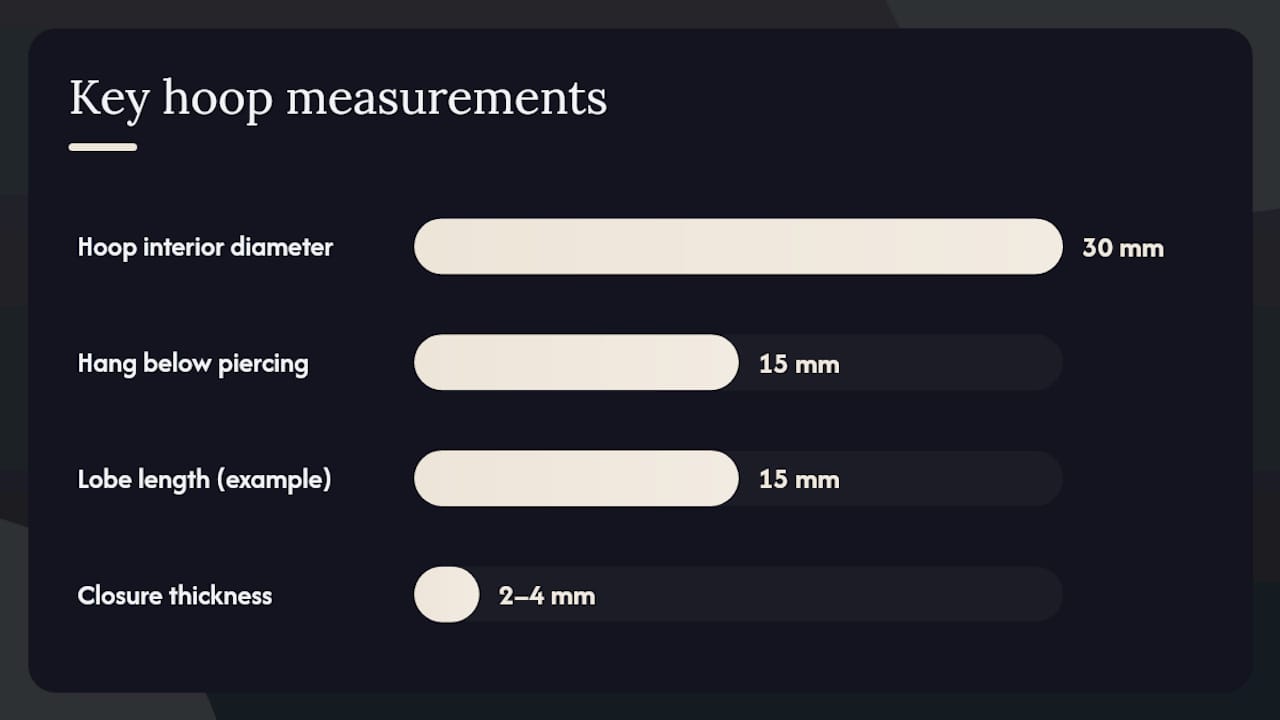
- Mark the piercing point. Hold the ruler at your piercing hole and note how far the hoop will hang below it. A 30 mm hoop hangs roughly 15 mm below the piercing point (half the diameter), so it will clear a 15 mm lobe with a few mm to spare.
- Check closure clearance. Open the clasp and measure the total depth the closure adds. Hinged and latch closures on larger hoops can add 2–4 mm of thickness at the ear, which changes how the hoop sits against the lobe.
- Record both diameter and profile thickness. A 30 mm thin-wire hoop and a 30 mm tubular hoop have the same diameter but look noticeably different in scale because the tube adds visual mass.
It takes 30 seconds and eliminates most sizing surprises.*
A useful diagram would show: the hoop in profile with an arrow spanning the interior diameter, a second arrow showing the hang distance below the piercing point, and a callout for the closure thickness at the top.
What hoop styles come in which size ranges?
Hoop construction and category labels are closely tied to size, and understanding the connection helps you shop by feel, not just by number.
- Huggies (8–12 mm): Designed to hug the lobe with minimal gap. They typically use a tiny hinge or snap closure that keeps the hoop flush. Because they sit so close, even a 2 mm difference in diameter is noticeable. The Annette 18K Gold Vermeil Huggie Earrings from Diamondsbydaisy are a good example of how this profile stacks cleanly with a second or third piercing.
- Small thin-wire hoops (12–25 mm): The most popular everyday style. A thin wire (under 1.5 mm gauge) keeps weight minimal and lets the hoop move freely. These read as understated and work across casual and professional settings.
- Medium tubular/chunky hoops (25–40 mm): A thicker cross-section, often 2–4 mm, adds visual weight even when the diameter stays the same. The Gold & Silver Thick Hoop Earrings at Diamondsbydaisy show how a tubular profile at medium diameter reads as a statement piece without the length of a large hoop.
- Large and statement hoops (40 mm+): These rely on diameter for impact; for example, the Sacred Rose Cross Hoops illustrate how motifs on hoops change perceived visual scale. Closure type matters here: hinged and latch closures are standard because a continuous wire at this scale is harder to insert and less secure. A 45 mm large hoop labeled “Large” in 14K gold fill is a practical example of how the size category maps to real product dimensions.
Thin-wire profiles at any diameter tend to look lighter and more delicate. Tubular or chunky profiles at the same diameter look bolder and heavier, even before you account for actual weight. That distinction matters most when you’re choosing between a 30 mm thin-wire and a 30 mm tube: they share a number but not a look.
How do you pick hoop diameter by face shape and lobe length?
Face shape is a useful starting point, not a rigid rule. Think of it as narrowing the range, not locking you into one size.
- Round face: Longer hoops (35 mm and above) add vertical length and create the illusion of a slimmer face. Avoid very small huggies, which emphasize width.
- Oval face: The most forgiving shape. Medium hoops (20–35 mm) are the sweet spot, but oval faces carry most sizes well, from huggies to statement hoops.
- Square face: Larger, rounder hoops (30–50 mm) soften angular jawlines. Avoid geometric or angular hoop shapes, which echo the jaw’s sharpness.
- Heart face: Medium hoops (20–30 mm) balance a wider forehead against a narrower chin. Very large hoops can overwhelm the lower face.
- Long/narrow face: Smaller to medium hoops (14–25 mm) work best. Oversized hoops can elongate the face further, which isn’t always flattering.
Lobe length adds a second variable. If your piercing sits near the top of a short lobe (under 15 mm), a 20 mm hoop will clear the lobe cleanly and hang just below it. A 40 mm hoop on the same lobe will extend well past the jaw. For a center-pierced lobe of 20 mm, a 30 mm hoop hangs about 15 mm below the lobe tip, which is a comfortable, visible drop without reaching the shoulder.
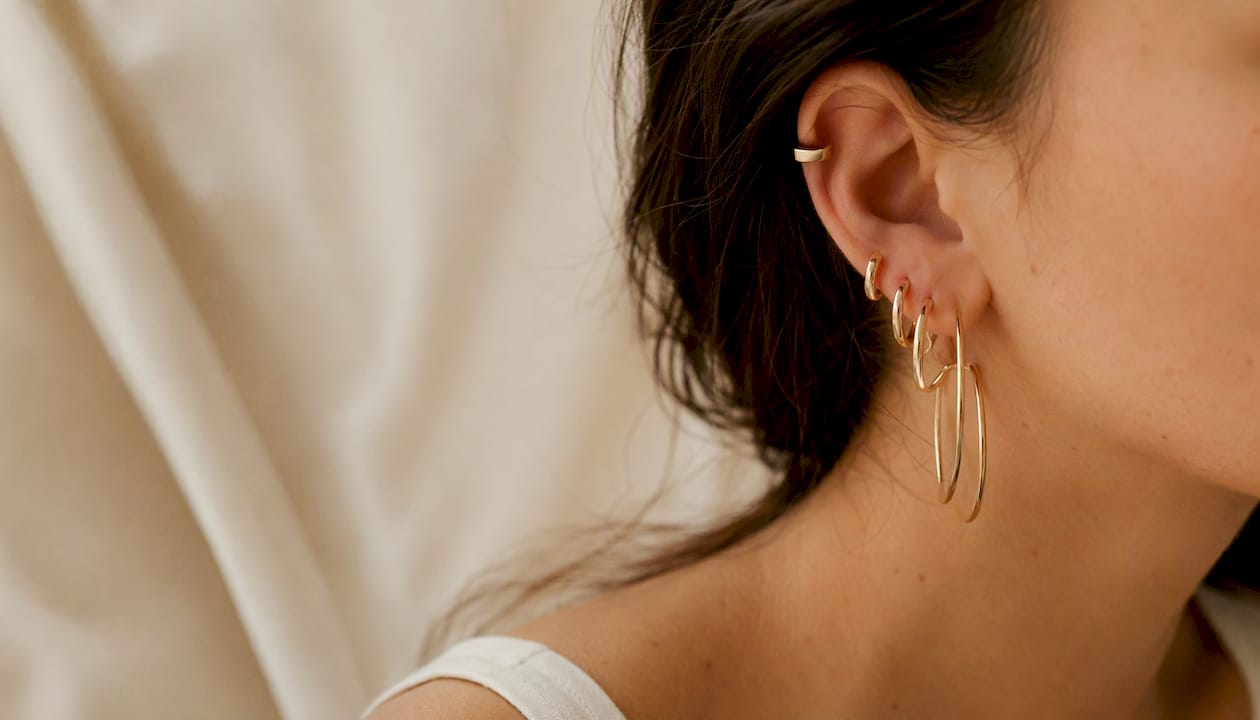
For stacked looks with a second or third hole, keep the upper piercing at 8–14 mm and step up 6–10 mm per hole. A common stack: 10 mm huggie at the top, 20 mm thin-wire in the center, 30 mm hoop at the lobe.
How do wire thickness and material change comfort and perceived size?
Two hoops with the same diameter can feel completely different in the hand and on the ear. The cross-section is the main culprit.
- Thin wire (under 1.5 mm gauge): Lightweight, minimal drag on the piercing, and easy to wear all day. The hoop looks delicate and the diameter reads as the dominant visual.
- Tubular/chunky (2–5 mm cross-section): Adds significant visual mass and weight. A 25 mm tubular hoop can look as bold as a 35 mm thin-wire hoop because the eye reads the overall volume, not just the diameter.
Material density plays a role in long-wear comfort. Gold vermeil (sterling silver base with gold plating) and sterling silver are lighter than solid 14K or 18K gold at the same profile, which matters for hoops above 35 mm. Plated base metals can be heavier and may cause discomfort after a few hours, particularly with tubular profiles. For anyone planning to wear hoops for a full workday or an event, thin-wire styles in gold vermeil or sterling silver are the practical choice.
Closure type adds one more layer. Hinged closures on larger hoops add a small amount of bulk at the top of the ear, which can press against the lobe if the hoop is very heavy. Continuous wire hoops (no clasp) distribute weight evenly but can be harder to insert. Latch-back closures are the most secure for everyday wear in medium-to-large sizes.
Pro Tip: If a hoop feels heavy after an hour, the issue is usually the cross-section, not the diameter. Try the same diameter in a thinner wire gauge before sizing down.
How do you choose hoop sizes when buying for someone else?
When you can’t ask directly, medium diameters in the 20–30 mm range are the safest default for most adults. They’re flattering across face shapes, appropriate for most occasions, and easy to wear daily.
A quick checklist before you buy:
- Check their existing jewelry photos. Social media or phone photos often show earrings clearly enough to estimate size against the earlobe.
- Look at what they already wear. Minimalists tend to stay under 20 mm; everyday wearers usually land in the 20–30 mm range; statement dressers go 40 mm and above.
- Measure a hoop they already own if you can access their jewelry box. Lay it flat and measure the interior diameter.
- Default to thin-wire profiles. They’re lighter, more universally comfortable, and less likely to feel too bold for someone with a conservative style.
- Choose hypoallergenic metals when uncertain. Sterling silver or 14K gold avoids most sensitivity issues.
- Confirm the return or exchange policy before purchasing. Even a well-chosen size can miss by a few millimeters.
For recipients without piercings, a piercing-free ear cuff is a thoughtful alternative that sidesteps the sizing question entirely. The Gifts for Her collection at Diamondsbydaisy includes curated options across size categories, which makes it easier to narrow down by style rather than starting from a blank search.
How can you visualize hoop sizes before buying?
Seeing a number on a screen and knowing how it will look on your ear are two different things. These methods close that gap.
- Print a scale template. Search for a printable hoop size template, open it in a PDF viewer, and confirm the print settings are set to 100% (not “fit to page” or “shrink to fit”). Cut out the circle for the diameter you’re considering and hold it at your piercing point in front of a mirror. This is the most accurate at-home method.
- Use coin equivalents. A US quarter measures 24.26 mm across, which makes it a near-perfect stand-in for a 25 mm hoop. A half-dollar coin is about 30.6 mm. Hold the coin at your piercing point to preview the hang. For larger sizes, a ping-pong ball is roughly 40 mm in diameter.
- Phone-camera trick. Place a ruler vertically at your piercing point and take a photo. Open the photo and use a drawing app to overlay a circle at the diameter you’re considering, scaled against the ruler. It’s not as precise as a printed template, but it works in a pinch.
Per Pinterest’s hoop size reference, printable templates aligned to the piercing point are among the most reliable ways to preview hang length before committing to a purchase.
- Coin comparators work for sizes up to about 35 mm; above that, household objects (ping-pong ball, golf ball) are more useful.
- Virtual try-on tools built into some retailer apps can approximate scale, but lighting and phone angle affect accuracy. Use them as a starting point, not a final answer.
What materials and care routines keep hoops looking their best?
The metal you choose affects both sensitivity and how long the earring holds up.
- Sterling silver (.925): Hypoallergenic for most wearers, affordable, and widely available. Tarnishes with exposure to moisture and sulfur compounds; store in an airtight pouch and polish with a soft cloth.
- 14K or 18K gold: The most skin-friendly option for sensitive ears. Denser than silver, so heavier at the same profile. The sterling silver and diamond collection at Diamondsbydaisy covers both solid silver and gold-plated options.
- Gold vermeil: Sterling silver base with a thick gold plating (at least 2.5 microns). More durable than standard gold-plated pieces, but the plating will eventually wear at contact points. Avoid submerging in water.
- Surgical steel: Nickel-free grades (ASTM F138) are safe for fresh piercings and sensitive lobes. Less common in fashion hoops but worth seeking out if you have a known nickel allergy.
- Plated base metals: Least expensive, but the base metal (often brass or copper) can cause reactions once the plating wears through. Fine for occasional wear; not ideal for daily use.
Simple care rules: remove hoops before swimming, showering, or applying hairspray and perfume. Store flat or hanging to prevent the wire from bending out of round. Clean with a soft, damp cloth and dry thoroughly. Thin-wire hoops are more prone to bending than tubular profiles, so handle them by the body of the hoop rather than the closure.
What Diamondsbydaisy has learned about sizing and style
The most common mistake shoppers make is buying by aesthetic alone and ignoring diameter. A hoop that photographs beautifully at 50 mm on a model with a long face and high cheekbones can look overwhelming on a shorter lobe or a rounder face shape. The guidance in this article reflects what consistently works across different face shapes and wearing occasions: medium diameters (20–35 mm) in thin-wire or light tubular profiles are the most universally flattering starting point, and they’re the sizes that generate the fewest returns.
What’s worth pushing back on is the idea that bigger always reads as more elegant. Some of the most striking earrings in Diamondsbydaisy’s curation are in the 20–30 mm range, where the design detail, finish, and material do the work rather than sheer size. A well-made 25 mm hoop in 18K gold vermeil outperforms a 50 mm hoop in plated brass on every axis: comfort, longevity, and the kind of quiet confidence that doesn’t need to announce itself across the room.
Diamondsbydaisy hoops: find your size in the collection
Choosing the right diameter is easier when the product page tells you exactly what you’re getting. Every hoop in the Diamondsbydaisy collection lists diameter in millimeters, profile thickness, and closure type, so you can apply this guide directly at checkout without guessing.
The Everyday Gold Jewellery collection covers the 14–35 mm range that works for daily wear, with thin-wire and light tubular profiles in gold vermeil and sterling silver. For larger statement pieces, the Large Gold Textured Hoop Earrings and the Rectangle Hoop Earrings show how shape and texture change the visual impact of a larger diameter. If you’re buying as a gift, the Gifts for Her collection is organized by occasion and style, which makes it straightforward to match a size category to a recipient’s taste. All orders include an easy exchange option if the size isn’t quite right.
Sources
Recommended
- Rectangle Hoop Earrings – Diamonds by daisy
- Large Gold Textured Hoop Earrings – Statement Bead Hoops | Diamonds by Daisy – Diamonds by daisy
- Gold & Silver Thick Hoop Earrings – Statement Hoops | Diamonds by Daisy – Diamonds by daisy
- Square Crystal Drop Earrings – Gold & Silver Geometric Earrings | Diamonds by Daisy – Diamonds by daisy