

How to Read Diamond Grading Reports: A Step-by-Step Guide
Table of Contents
- What Is a Diamond Grading Report and Why It Matters
- Understanding the 4Cs on Your Diamond Grading Report
- GIA Diamond Grading Scale Explained
- Reading the Diamond Plot and Measurements
- How to Verify a Diamond Certificate Online
- Additional Details: Fluorescence, Polish, and Symmetry
- Common Mistakes When Reading Diamond Grading Reports
- Frequently Asked Questions
Last Updated: October 3, 2026
What Is a Diamond Grading Report and Why It Matters
A diamond grading report is an official document that describes a diamond's quality, authenticity, and characteristics using standardised assessment criteria. This certificate provides independent verification of what you're buying, which matters enormously when making a significant investment in fine jewellery.
A diamond grading report is your diamond's passport, third-party confirmation of exactly what you own, protecting you from misrepresentation.
A proper diamond grading report removes guesswork from your purchase decision, telling you precisely what you're paying for and whether it matches the seller's claims.
The report documents the 4Cs, carat weight, colour grade, clarity grade, and cut grade, plus additional details like fluorescence, polish, and symmetry. These measurements create a complete profile of your diamond's quality and characteristics.
Understanding the 4Cs on Your Diamond Grading Report
The 4Cs form the foundation of diamond grading. Understanding how to read these four measurements on your report is essential to knowing whether you're getting genuine value for your investment.
Carat Weight: Reading the Weight Section
Carat weight measures how heavy your diamond is (one carat equals 200 milligrams). However, weight alone doesn't determine value, a one-carat diamond with poor colour and clarity costs far less than one with excellent grades in both areas.
A smaller diamond with superior colour, clarity, and cut often appears more brilliant and valuable than a larger stone with mediocre grades.
Colour Grade: Using the D-Z Colour Scale
Diamond colour is graded on a scale from D to Z. D represents completely colourless, while Z indicates a light colour tint. The scale works like this:
- D to F: Colourless (the finest grades)
- G to J: Near-colourless (excellent value)
- K to M: Faint colour (noticeably tinted)
- N to Z: Light colour (visible tint to the naked eye)
Most people cannot detect the difference between D and F grades without professional training. G to J grades offer exceptional value, these diamonds appear colourless to most observers once set in jewellery, yet cost considerably less than D-F stones.
Clarity Grade: Interpreting Inclusions
Clarity grades describe the presence or absence of inclusions, tiny imperfections inside the diamond. The clarity scale runs from FL (flawless) down to I3 (included 3).
The main clarity grades are:
- FL/IF: Flawless or internally flawless (extremely rare and expensive)
- VVS1/VVS2: Very very slightly included (inclusions invisible to naked eye)
- VS1/VS2: Very slightly included (inclusions invisible to naked eye)
- SI1/SI2: Slightly included (inclusions invisible to naked eye, usually)
- I1/I2/I3: Included (inclusions visible to naked eye)
Your report includes a plot diagram showing where inclusions are located. VS1 and SI1 grades offer tremendous value, inclusions at these levels are invisible to the naked eye, yet cost significantly less than VVS grades. Most people never see inclusions in VS or SI diamonds.
Cut Grade: Why Proportions Matter
Cut grade measures how well the diamond has been shaped and faceted. Cut determines three optical properties: brilliance (light reflection), fire (rainbow colours), and scintillation (sparkle effect).
The report includes specific measurements: table percentage, depth percentage, crown and pavilion angles, and polish/symmetry ratings. A well-cut diamond with lower colour or clarity grades often appears more brilliant than a poorly cut diamond with higher grades.
GIA Diamond Grading Scale Explained
The Gemological Institute of America (GIA) is the most widely recognised independent laboratory for diamond grading (gia.edu). Every diamond is evaluated by multiple gemologists under controlled lighting conditions, with the report reflecting consensus grading. The GIA scale is consistent worldwide, making reports traceable and verifiable.
Other laboratories issue diamond grading reports, but GIA reports are most widely accepted and trusted, particularly in the UK market.
Reading the Diamond Plot and Measurements
The plot diagram on your report is one of the most important sections, yet many buyers never examine it carefully. This visual map shows exactly where inclusions are located inside your diamond.
What the Plot Diagram Shows
The plot uses standardised symbols to mark inclusion location and type. An inclusion near the edge matters less than one in the centre, as light travels differently through various parts of the stone. Two SI1 diamonds might have very different inclusion patterns, the plot reveals this difference.
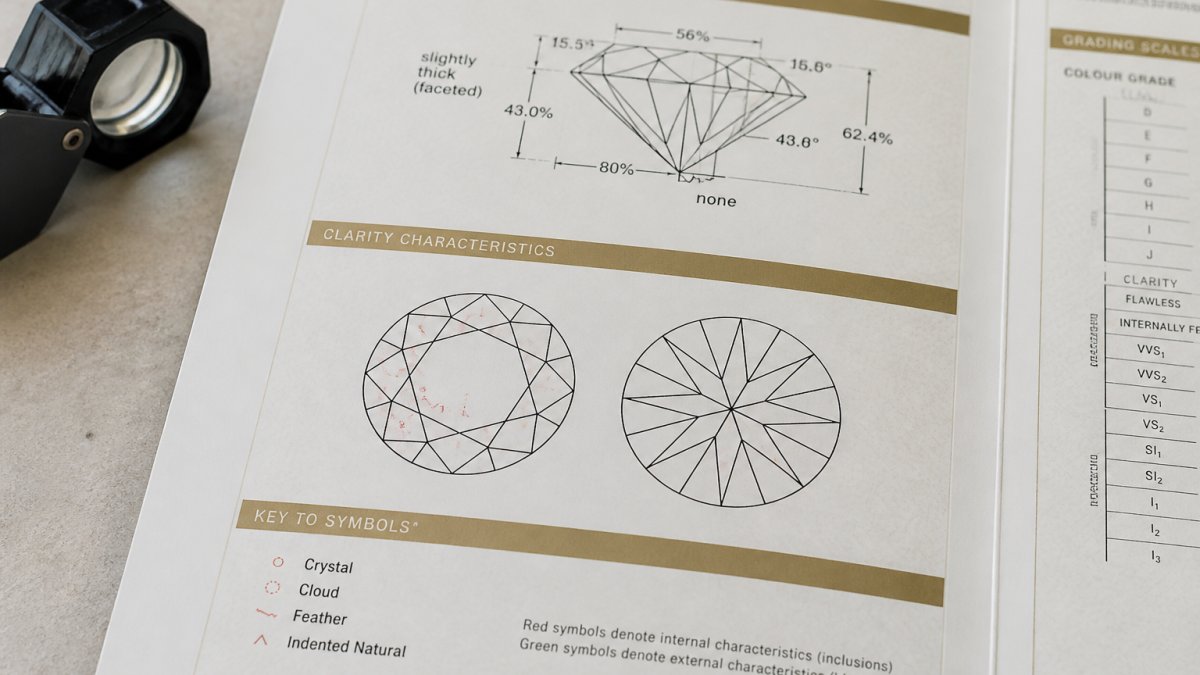
Table Percentage, Depth Percentage, and Girdle Thickness
These measurements describe your diamond's proportions. They directly affect how light behaves inside the stone.
Table percentage measures the width of the flat top surface compared to the diamond's overall width. Ideal table percentages typically range from 52% to 62%. A table that's too wide or too narrow can reduce brilliance.
Depth percentage measures how deep the diamond is from top to bottom. This percentage should typically fall between 58% and 62%. Depth that's too shallow or too deep affects light return.
Girdle thickness describes the thin edge where the top and bottom of the diamond meet. The report describes this as thin, medium, slightly thick, thick, or extremely thick. Girdle thickness affects durability and light performance.
Your report lists all these measurements numerically. If you're comparing two diamonds, these numbers tell you which one has better optical proportions. Better proportions usually mean better brilliance and value.
How to Verify a Diamond Certificate Online
Verifying your diamond grading report ensures it's authentic and hasn't been altered. This verification step is straightforward and takes just a few minutes.
Checking the Report Number and Laser Inscription
Every GIA report includes a unique report number. This number is also laser-inscribed on the diamond's girdle, the thin edge of the stone. The inscription matches the report number exactly.
To verify online:
- Visit the GIA website verification tool
- Enter the report number from your certificate
- The system displays the original grading information
- Compare what appears on screen with your physical report
The laser inscription serves as proof that the diamond in your possession matches the report. If someone claims to have a diamond with a particular report number, the laser inscription on the stone must match. This prevents fraud and ensures you're buying exactly what's documented.
This verification step is part of our commitment to trustworthy, high-quality jewellery.
Spotting Synthetic vs. Natural Notation
Modern grading reports clearly indicate whether a diamond is natural or laboratory-created. This notation appears prominently on the report, usually near the top.
Natural diamonds formed deep in the earth over billions of years. Laboratory-created diamonds (also called lab-grown or synthetic diamonds) are manufactured in a lab in weeks or months. Both are real diamonds chemically, but they have very different origins and value implications.
Your report will state either:
- "Natural Diamond" (formed in the earth)
- "Laboratory Grown Diamond" or "Synthetic Diamond" (created in a lab)
This distinction matters significantly for value and investment potential. Natural diamonds typically command higher prices and better resale value. Laboratory-created diamonds cost less but lack the rarity and investment characteristics of natural stones.
Always check this notation carefully. Reputable laboratories clearly distinguish between natural and laboratory-created stones. If a report is ambiguous about this, it's a red flag.
When shopping with Diamonds by daisy, our curated collection features natural diamonds selected for their quality and authenticity.
Additional Details: Fluorescence, Polish, and Symmetry
Beyond the 4Cs, your report includes three additional factors that affect your diamond's quality and appearance.
Fluorescence describes how the diamond glows under ultraviolet light. The report grades fluorescence as None, Faint, Medium, Strong, or Very Strong. Most diamonds show no fluorescence or faint fluorescence, which doesn't affect appearance under normal light.
Strong fluorescence can occasionally make a diamond appear slightly hazy or milky under certain lighting conditions. However, this is rare and typically only noticeable to trained observers. For most buyers, fluorescence is a minor consideration.
Polish rates how well the diamond's surface was finished after cutting. Grades range from Excellent to Poor. Polish doesn't affect the diamond's internal properties, only the surface quality. Excellent or Very Good polish is standard for quality diamonds.
Symmetry describes how precisely the facets align and match. Excellent symmetry means facets are perfectly aligned. Poor symmetry means facets are misaligned, which can affect light performance slightly. Most quality diamonds receive Very Good or Excellent symmetry grades.
These three factors matter less than the 4Cs, but they contribute to overall quality. When comparing diamonds, check these details alongside the primary grades.
Common Mistakes When Reading Diamond Grading Reports
Understanding what not to do helps you avoid costly errors when interpreting your report.
Mistake 1: Ignoring the plot diagram. Many buyers focus only on the clarity grade without examining where inclusions are located.
Mistake 2: Prioritising carat weight above all else. Larger doesn't automatically mean better.
Mistake 3: Assuming online photos match reality. Photography distorts colour, brilliance, and size significantly. Your report's grading is far more reliable than any image.
Mistake 4: Overlooking cut quality. Cut determines how your diamond looks to the naked eye.
Mistake 5: Not verifying the laser inscription. Always confirm that the laser inscription on the diamond matches the report number.
Mistake 6: Accepting reports from unknown laboratories. Stick with reports from recognised laboratories like GIA or AGS.
Mistake 7: Confusing laboratory-created with natural diamonds. Always check whether your report indicates a natural or laboratory-created diamond. This distinction significantly affects value and investment potential.
Understanding how to read diamond grading reports transforms you from a passive buyer into an informed consumer.
When you're ready to invest in fine jewellery, Diamonds by daisy provides meticulously handpicked gemstones.
Frequently Asked Questions
How do I verify the authenticity of a diamond grading report?
Check the report number against the issuing laboratory's online database, GIA, AGS, and other major labs provide free verification tools on their websites. Confirm the laser inscription on the diamond's girdle matches the report number listed. Verify the report date is recent and matches your purchase timeline. Be cautious of reports with vague language or missing key data like the 4Cs grades, plot diagram, or measurements. Always request the original report directly from the seller rather than relying on photographs.
What is the difference between a diamond grading report and an appraisal?
A diamond grading report (also called a certificate) is an objective, scientific assessment of a diamond's characteristics, the 4Cs, measurements, and plot, issued by an independent laboratory. It does not assign monetary value. An appraisal, by contrast, is a professional valuation that estimates the diamond's market worth, typically for insurance or resale purposes. Appraisals are often performed by jewellers and may be subjective. For purchasing decisions, prioritise the grading report; for insurance or resale, you'll need a separate appraisal.
Why is a GIA report considered the industry standard?
The Gemological Institute of America (GIA) is widely recognised as the most rigorous and consistent diamond grading laboratory globally. Their grading standards are precise, their methodology is transparent, and their reports are universally accepted by jewellers and buyers. GIA uses a consistent D-Z colour scale and detailed clarity grades that allow direct comparison between diamonds. Their laser inscription service adds traceability. While other laboratories like AGS also produce reliable reports, GIA's reputation and consistency make their certificates the benchmark for quality assurance in the diamond industry.
What do the plot diagrams on a diamond report represent?
The plot diagram is a schematic representation of a diamond's internal inclusions and surface features as viewed from above. Each symbol on the plot marks the location, type, and size of an inclusion, such as feathers, clouds, or crystals. Red symbols indicate surface features; black symbols show internal characteristics. The plot helps you understand where imperfections are located and whether they affect the diamond's brilliance or structural integrity. A plot with inclusions clustered near the girdle (edge) may be less visible than one scattered across the table (top surface), which is important when assessing clarity grade and value.