

How to Buy Vintage Jewelry for Beginners: 2026 Guide
Table of Contents
- What Counts as Vintage Jewelry (And What Doesn't)
- How to Identify Vintage Jewelry Hallmarks
- How to Spot Fake Vintage Jewelry Before You Pay
- Understanding the True Costs: Restoration, Resale, and Hidden Fees
- Where to Buy Vintage Jewelry Safely
- Vintage Jewelry Care and Maintenance
- Ethical Sourcing and Digital Authentication Tools
- Conclusion
- Frequently Asked Questions
Last Updated: September 11, 2026
What Counts as Vintage Jewelry (And What Doesn't)
Vintage jewelry is any piece aged 20 to 99 years old, while antique jewelry crosses the 100-year threshold. That distinction matters because it drives price, wearability, and how carefully you need to inspect a piece before committing. This guide walks beginners through hallmarks, fakes, hidden restoration costs, and safe buying routes. Below, we'll show you exactly how to buy vintage jewelry for beginners without overpaying or getting burned.
Vintage vs Antique vs Estate: The Age Brackets That Matter
The age brackets are straightforward once you know them:
- Vintage: 20-99 years old, typically 1920s to early 2000s
- Antique: 100+ years old, generally pre-1920s
- Estate jewelry: previously owned, regardless of age. A 2015 ring sold secondhand is estate, not vintage
The Eras You'll Meet Most Often
Most pieces you'll encounter fall into a handful of recognisable periods. Victorian (1837-1901) pieces favour black enamel, cameos, and sentimental motifs. Edwardian (1901-1915) work is delicate, platinum-heavy, and lace-like. Art Deco (1920s-30s) brings geometric lines and bold colour contrast. Retro (1940s-50s) uses chunky gold and rose tones.
Each era carries its own resale value and wearability. Art Deco and Edwardian pieces tend to hold strong collector interest; Retro pieces are often more wearable day to day.
How to Identify Vintage Jewelry Hallmarks
Learning how to identify vintage jewelry hallmarks is the single most useful skill a beginner can build. A hallmark is an official stamp struck into precious metal to certify its purity, and in the UK it is a legal requirement, not a decorative flourish. The Assay Office hallmarking guidance explains the full system.
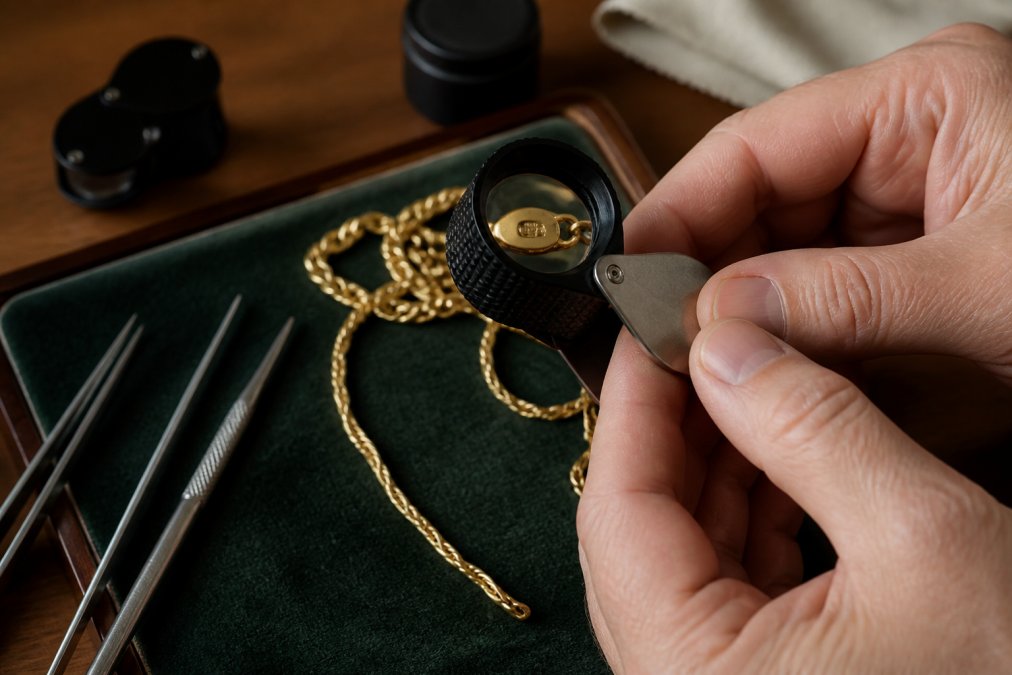
Where to Look on a Piece (And What a Loupe Reveals)
Hallmarks hide in awkward places. Check the inner band of rings, the clasp of necklaces, the pin stem of brooches, and the reverse of pendants. A 10x jeweller's loupe, costing very little, reveals stamps the naked eye misses entirely.
What most guides miss is that a missing hallmark doesn't automatically mean fake. Very old or foreign pieces may be unmarked, and thin metal can wear stamps away. It means you need another verification route.
Reading British Hallmarks: Assay Office, Date Letter, Maker's Mark
A British hallmark carries three core elements: the assay office mark, the date letter, and the maker's mark (often called the sponsor's mark). The assay office tells you where it was tested; the date letter pins the year; the maker's mark identifies who submitted it.
| Mark | What It Tells You | Why It Matters |
|---|---|---|
| Assay office | Where metal was tested | Confirms UK assay |
| Date letter | Exact year of assay | Verifies true age |
| Maker's mark | Who submitted the piece | Traces provenance |
| Purity mark | Metal fineness | Confirms karat or sterling silver |
How to Spot Fake Vintage Jewelry Before You Pay
Spotting fakes is a physical skill, not a vibe check. Work through four stations on every piece, the clasp, the setting, the surface, and the weight, and you will catch most reproductions before money changes hands. A 10x loupe and a small magnet are the only tools you need, and both cost very little.
Station 1: The Clasp and Findings
Clasps are the fastest tell because they are rarely replaced and their technology dates a piece precisely. A lobster claw clasp did not exist before the late 1970s, so a brooch claiming to be Victorian but fitted with one is a contradiction (vam.ac.uk). Look for the era-appropriate mechanism:
- Victorian and Edwardian: barrel, box, or bolt-ring clasps, often hand-finished with slight irregularity
- Art Deco: spring-ring clasps, sometimes with a safety chain
- Retro and mid-century: fish-hook and fold-over clasps
- Modern reproductions: uniform, machine-perfect lobster claws and magnetic clasps
Run a magnet along the clasp and pin stem. Gold, silver, and platinum are non-magnetic; a strong pull usually means a base-metal core under a thin plating.
Station 2: The Setting and Stone
Old fine jewellery holds stones in metal, prongs, bezels, or channel settings, cut and pushed by hand. Under a loupe you should see fine tool marks and slightly uneven prongs. Glue, resin, or perfectly identical prongs on every stone point to a cast reproduction.
Check the stone itself. Glass and paste feel warm quickly against the skin and show no sharp facet edges under magnification; genuine gemstones stay cooler longer and have crisp facet junctions. A stone that is glued rather than set is almost never precious.
Station 3: Surface, Patina, and Wear
Real age produces uneven wear. High points on a ring shank thin out, edges soften, and oxidation settles into recesses rather than sitting on top. Uniform darkening across a whole piece is usually applied artificially with a chemical dip, and it will often rub off on a cloth.
Look for the opposite problem too: a piece with no wear at all but a claimed age of 80 years is suspicious. Genuine vintage shows its history.
Station 4: Weight and Proportion
Solid gold and sterling silver have a density you can feel. A piece that looks chunky but feels light is likely hollow or base metal. Compare a suspect piece against a known solid item of similar size, the difference is usually obvious in the hand.
Common Reproduction Categories to Recognise
Most fakes fall into a handful of recognisable families:
- Costume pieces with added hallmarks. Base metal and glass, stamped to imply precious metal. If the price is far below solid-gold value, distrust the stamp first.
- Modern cast copies of Art Deco designs. Geometric styles are easy to reproduce; check for soft, shallow detail and machine-perfect symmetry.
- Marriage pieces. Genuine old components assembled into a new whole, an old brooch pin on a modern setting. Ask whether the piece is original or assembled.
- Re-plated silver sold as solid. Fresh plating hides base metal; look for wear at high points where the colour differs underneath.
When to Walk Away
Walk away if the seller cannot give a date range, refuses a condition report, or pressures you to decide on the spot. A genuine dealer expects inspection and welcomes questions. If any single station fails and the seller cannot explain it, the piece is not worth the risk for a beginner.
Understanding the True Costs: Restoration, Resale, and Hidden Fees
Restoration is where beginners lose money, because the purchase price is only the entry fee. A piece priced attractively often needs work, and the bill for that work can rival or exceed what you paid. The discipline is simple: price the piece as if it already needs the worst-case repair, then decide whether it is still worth it.
The Restoration Costs to Budget For
Costs vary by piece and by jeweller, so treat these as ranges to plan around rather than quotes. Ask a jeweller for an estimate before you buy, not after.
- Re-plating or re-polishing. Restores shine on gold-plated and rhodium-finished pieces, but polishing removes original patina and can thin delicate metal. On antique pieces, polishing can reduce value rather than add it.
- Stone tightening and re-setting. Loose prongs are common on old pieces and relatively inexpensive to fix; replacing a missing stone is not, because matching an original cut, colour, and size is slow work.
- Clasp and chain replacement. A new clasp is a small cost, but replacing an original clasp with a modern one can hurt authenticity and resale.
- Ring resizing. Many rings can be resized, but some settings, especially those with channel-set or fragile stones, cannot be resized without risk.
- Cleaning. Gentle cleaning is cheap; deep cleaning of fragile or glued settings is not, and ultrasonic cleaning can loosen stones.
- Appraisal fees. Needed for insurance and resale, and usually charged per piece.
When Restoration Adds Value, and When It Destroys It
The rule of thumb is that restoration should preserve, not transform. Tightening a prong, replacing a worn clasp with an era-appropriate one, or a light clean all protect value. Re-plating a piece that was never plated, polishing away patina, or replacing original stones with modern ones usually destroys it.
Ask the jeweller one question before any work: will this repair be reversible? If not, get a second opinion.
The Resale Reality
Vintage jewellery rarely resells at retail. The gap between what a dealer charges and what a private seller receives is wide, and it widens further once restoration costs are counted. Buy because you love wearing the piece, and treat any resale as a bonus rather than a plan. If resale matters to you, prioritise pieces with strong collector demand, signed maker's marks, documented provenance, and intact original components.
A Simple Budget Framework
Before committing, run this check:
- Note the asking price.
- Add the estimated restoration cost from a jeweller.
- Add appraisal and any resizing.
- Compare the total against what a comparable piece in good condition sells for.
- If the total exceeds that figure, the piece is overpriced for you, walk away or negotiate.
Where to Buy Vintage Jewelry Safely
Safe buying comes down to provenance and returns. Reputable dealers provide a written description, condition report, and a clear return window. Auction houses offer authentication but often sell as-is. Consignment shops sit in between.
For beginners, the safest route is a seller who combines authenticated craftsmanship with a satisfaction guarantee. At Diamonds by daisy, every piece is crafted with handpicked gemstones and precious metals, and backed by a 30-day satisfaction guarantee.
Vintage Jewelry Care and Maintenance
Vintage jewelry care and maintenance protects both wearability and value. Store pieces separately in soft pouches to prevent scratches. Clean gently with a soft cloth; avoid ultrasonic cleaners on fragile or glued settings, which can loosen stones.
- Remove jewelry before swimming, showering, or applying perfume
- Have prongs and clasps checked annually by a jeweller
- Keep sterling silver in anti-tarnish pouches to slow oxidation
- Never polish away patina on antique pieces; it is part of the value
Ethical Sourcing and Digital Authentication Tools
Two angles most buying guides skip are ethics and technology. On sourcing, ask dealers where gemstones originate and whether they can document it. The Responsible Jewellery Council standards set out recognised supply-chain expectations for precious materials.
On authentication, digital tools now help. Gem laboratories offer online report verification using report numbers, and some appraisers use spectroscopy to confirm gemstone identity. These tools supplement, never replace, a physical inspection and a trustworthy dealer.
Conclusion
Buying vintage jewelry rewards patience and inspection over impulse. Learn the hallmarks, question the patina, and budget for restoration before you fall for a piece. When you want authenticated craftsmanship with genuine peace of mind, Diamonds by daisy offers meticulously handpicked gemstones, timeless designs, and a 30-day satisfaction guarantee. Add to cart
Frequently Asked Questions
What is the difference between vintage and antique jewelry?
Vintage jewelry is generally 20 to 100 years old, while antique pieces are over 100 years old. A Victorian brooch from the 1890s is antique; a 1970s gold chain is vintage. Estate jewelry simply means a piece was previously owned, regardless of age. Knowing the bracket helps you judge value and expected craftsmanship before you buy.
How can you tell if vintage jewelry is authentic?
Start with hallmarks. British pieces should carry an assay office mark, a date letter, and a maker's mark. Check the clasp style, solder joints, and stone settings under a loupe. Real gemstones feel cool and show sharp facet edges. If a seller cannot explain the marks or refuses a condition report, walk away.
Is vintage jewelry a good investment?
Some pieces hold or grow in value, particularly signed designer work, high-karat gold, and rare gemstones. Most vintage jewelry is a pleasure purchase rather than an investment. Buy what you love, check resale comparables first, and factor in restoration costs. A piece needing a new clasp or stone replacement can wipe out any gain.
How do I clean and care for vintage jewelry?
Use a soft cloth and mild soapy water for most metals, but avoid soaking pearls, opals, or glued settings. Dry thoroughly to prevent oxidation. Store pieces separately in soft pouches to stop scratches. Have prongs and clasps checked annually by a jeweller, since vintage settings loosen with wear.