

Handcrafted vs Mass-Produced Jewellery: Key Differences
Table of Contents
- What Defines Handcrafted Jewellery
- How Mass-Produced Jewellery is Made
- Jewellery Casting vs Hand Fabrication: The Manufacturing Reality
- How to Identify Quality Jewellery: Spotting the Difference
- Benefits of Bespoke Jewellery and Customisation
- Durability, Longevity and Maintenance
- Ethical Sourcing and Sustainability in Fine Jewellery
- Conclusion
- Frequently Asked Questions
Last Updated: September 27, 2026
What Defines Handcrafted Jewellery
Handcrafted jewellery is made by skilled artisans who shape, form, and finish each piece largely by hand, using traditional techniques passed down through generations. Unlike factory production, every handcrafted piece receives individual attention from conception through completion.
This distinction affects durability, aging, and whether a piece becomes an heirloom or disposable fashion. At Diamonds by daisy, we focus on craftsmanship because it's the foundation of pieces that truly endure.
A handcrafted approach means the jeweller makes deliberate choices at every step: selecting specific metals and gemstones for their individual qualities, adjusting proportions based on the materials in front of them, and finishing surfaces by hand to create subtle variations that give each piece character.
Mass-produced jewellery prioritises standardisation: machines cut identical stones, moulds produce identical settings, and quality control focuses on consistency. This makes jewellery affordable and accessible, but the result is uniform, replaceable pieces often designed to last a few seasons rather than a lifetime.
How Mass-Produced Jewellery is Made
The design-to-production pipeline uses CAD software to create a digital 3D model that becomes the template for hundreds or thousands of identical pieces. Once approved, there is no flexibility; every piece must match the approved file.
Casting is the most common method. A master mould produces dozens of castings per day, transforming raw metal into shape in minutes. The advantage is speed; the disadvantage is that cast metal is more brittle than worked metal, and moulds leave seams and imperfections requiring removal in finishing.
Stone setting uses automated equipment to position stones in pre-formed settings. This is fast and consistent but offers no adjustment for irregular stones. Stones are pre-cut to fit standard settings rather than settings being adapted to individual stones.
Finishing and polishing happens on assembly lines. Quality control checks for correct dimensions, secure settings, and proper plating thickness. The standard is acceptable, not exceptional.
Economies of scale drive the process. A factory producing 10,000 identical rings spreads fixed costs across all units, bringing per-unit cost down dramatically. Workers perform repetitive tasks, becoming faster through repetition, whereas a handcrafted jeweller sets stones as part of a broader creative process.
The trade-off is inflexibility and disposability. Mass production is engineered for a specific price point. If a customer wants a modification, the factory cannot accommodate it without creating a new mould, which is economically unfeasible. The piece is designed to be affordable and replaceable, not maintained or repaired.
Many mass-produced pieces use plating rather than solid precious metals. The plating wears away within 2-5 years, exposing base metal underneath. Replating often costs more than replacement, which is why mass-produced jewellery is treated as disposable fashion.
Jewellery Casting vs Hand Fabrication: The Manufacturing Reality
Casting involves pouring molten metal into a mould. In mass production, identical moulds produce uniform results. In artisanal work, the jeweller may create unique moulds or use casting as one step in a more complex process.
Hand fabrication is fundamentally different. The jeweller shapes metal through hammering, bending, soldering, and filing, techniques that require skill, experience, and constant adjustment. A hand-fabricated piece isn't built from a mould; it's built from raw metal, shaped to specification through manual labour.
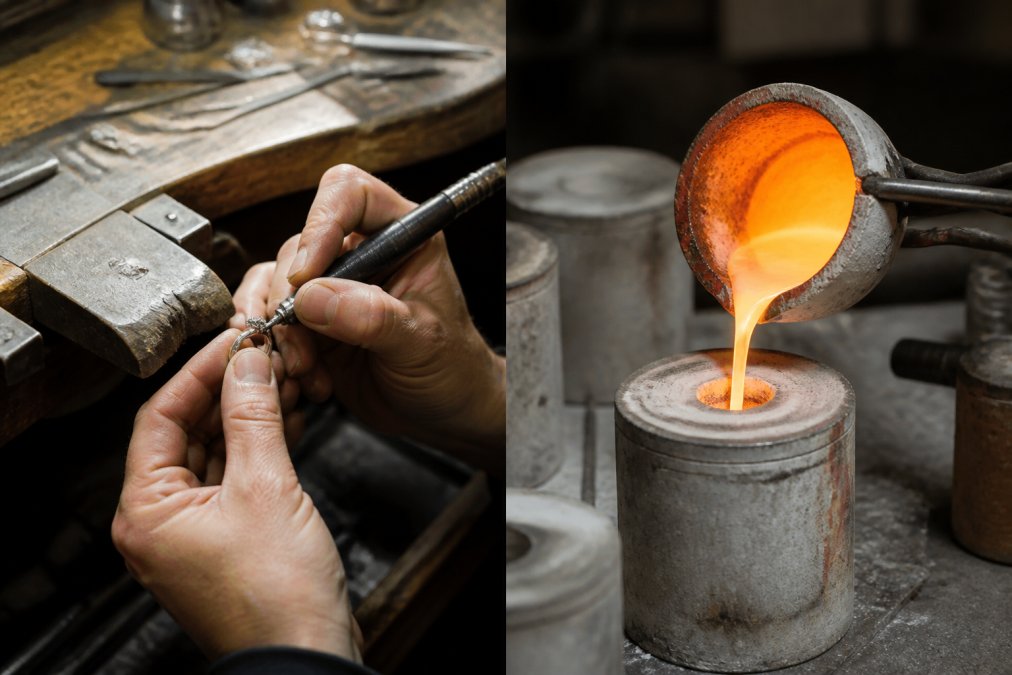
Hand fabrication creates several advantages: the metal is worked and refined, creating internal strength; the jeweller adjusts proportions as they work; and finishing happens by hand, creating surface quality machines often miss.
Many fine pieces are cast, but labour intensity differs sharply: a hand-fabricated ring takes 8-12 hours; a cast ring takes 2-3 hours across multiple workers. This labour difference compounds into durability and longevity.
How to Identify Quality Jewellery: Spotting the Difference
Hallmarks and precious metal stamps are your baseline. Look for stamps indicating purity: 925 for sterling silver, 750 for 18-carat gold, 950 for platinum. Both handcrafted and mass-produced pieces carry these stamps. If there's no hallmark, the metal is likely plated or below standard purity.
Surface finish quality separates craft from cost-cutting. Run your finger along the inside of a ring. Quality pieces feel smooth everywhere, even unseen surfaces. A handcrafted jeweller might spend 1-2 hours polishing a ring's interior; a factory worker might spend 5 minutes. This labour difference creates a tactile difference you can feel immediately.
Rough interiors suggest cost prioritised over craft. Mass-produced pieces often have visible mould seams, indicating less care.
Stone setting precision matters enormously. In quality work, stones sit securely with minimal, uniform gaps. In mass-produced pieces, uneven gaps, rough edges, or crooked stones indicate lower-grade stones or unadjusted settings.
Weight and feel communicate something real. Quality jewellery has substance and density because it uses solid precious metals and genuine gemstones. Mass-produced pieces sometimes feel hollow or lightweight, indicating less metal or plating substituted for solid metal.
Maker's mark or signature is common in handcrafted jewellery, signalling pride and accountability. Mass-produced pieces rarely carry a maker's mark because no single person is responsible for the piece.
Understanding the price difference: why handcrafted costs more
Labour is the largest factor. A handcrafted ring requires 8-12 hours of skilled labour at £40-£80 per hour, adding £320-£960 to cost. A mass-produced ring involves 2-3 hours across multiple workers at lower rates, totalling £30-£60 in labour cost.
Material sourcing differs significantly. Handcrafted jewellers source individual gemstones and often use recycled or ethically sourced metals, costing more than bulk purchasing. A handcrafted ring might use a 1.5-carat ethically sourced diamond; a mass-produced ring might use a 0.8-carat bulk-sourced stone.
Mass-produced jewellery often uses plating instead of solid metal, costing 60-80% less to produce. The savings are enormous at scale but plating wears away within 2-5 years of regular wear.
Overhead and tooling favour mass production at volume. A factory producing 50,000 rings per year spreads facility costs across all units. A handcrafted jeweller has higher per-piece overhead but avoids the massive upfront cost of creating moulds and tooling (£500-£2,000 per design).
Skill premium is real. An experienced handcrafted jeweller with 10+ years of training commands higher rates than a factory worker. This expertise allows them to solve problems, adapt to unusual materials, and create genuinely unique pieces.
Customisation and bespoke work are impossible at mass-production costs. A factory cannot accommodate custom requests without creating a new mould. A handcrafted jeweller can do this as part of their normal workflow, but it requires additional labour and material sourcing.
When examining a piece, ask: does this look like someone spent time on it? A handcrafted piece shows evidence of individual attention: refined surfaces, secure settings, thoughtful proportions, and often a maker's mark. The price difference reflects real labour, better materials, and design for longevity rather than a specific price point.
Benefits of Bespoke Jewellery and Customisation
Bespoke jewellery, pieces made specifically for you, offers something mass production cannot: exact alignment with your vision and values.
The process typically begins with a conversation. You describe what you want: a ring that echoes your grandmother's style but in a modern material, or a pendant that incorporates a stone you already own, or a bracelet that fits your wrist perfectly. The jeweller sketches ideas, discusses proportions, and refines the design with you.
Once you approve the design, the jeweller sources materials, often selecting specific stones and metals rather than using whatever's in stock. They then hand-fabricate the piece, making adjustments as needed. You might visit during the process, seeing how it develops.
The results are pieces that feel personal. You know exactly what went into them. You can explain the design to anyone who asks. You've invested in something that reflects your taste and values, not a mass-market trend.
Durability, Longevity and Maintenance
Handcrafted jewellery, especially pieces made from quality materials, lasts decades or longer. Mass-produced pieces often don't.
Ethical Sourcing and Sustainability in Fine Jewellery
Conscious consumers increasingly ask where their jewellery comes from and how it was made. Handcrafted jewellery, by its nature, offers more transparency.
Conclusion
The choice between handcrafted and mass-produced jewellery isn't simply about price. It's about what you value: uniqueness or uniformity, longevity or convenience, transparency or mystery.
Frequently Asked Questions
What is the difference between handcrafted and handmade jewellery?
Handcrafted jewellery is made by skilled artisans using hand tools and manual techniques, often incorporating elements like hand-fabrication and finishing. Handmade can sometimes refer to pieces that are partially hand-assembled but may use some machine-cut components. True handcrafted pieces show individual character and variations that reflect the maker's skill, whereas mass-produced items are uniform and created primarily through automated machinery. Both terms emphasise human involvement, but handcrafted typically indicates a higher level of artisanal skill and labour-intensive production.
How can you tell if jewellery is genuinely handcrafted rather than mass-produced?
Look for hallmarks and maker's marks that verify the piece's origin and materials. Handcrafted pieces often show subtle variations in symmetry, surface texture, and finishing that indicate manual work. Examine the stone setting closely, hand-set stones may have slightly irregular prongs, whereas mass-produced settings are perfectly uniform. Check for signs of labour-intensive techniques like hand-engraving, custom patina work, or bespoke adjustments. Reputable makers provide transparency about their process and materials used.
Is handcrafted jewellery more durable than mass-produced alternatives?
Handcrafted pieces often demonstrate superior durability because artisans use manual finishing techniques, selective material sourcing, and meticulous quality control at every stage. Hand-fabrication allows jewellers to identify and correct flaws before completion, whereas mass-produced items rely on standardised processes that may miss defects. The use of premium precious metals and ethically sourced gemstones in handcrafted work contributes to longevity. However, durability ultimately depends on the specific maker's standards and the materials used, regardless of production method. Handcrafted pieces typically age gracefully and are easier to repair because they're made using traditional techniques that remain consistent over decades.
Why does handcrafted jewellery cost more than mass-produced pieces?
Handcrafted jewellery requires significant labour investment, skilled artisans spend hours on each piece using hand-fabrication, stone setting, and finishing techniques. Materials are often carefully curated and sourced ethically, increasing costs. Small-batch production means no economy of scale; each piece receives individual attention rather than being one of thousands made identically. Makers invest in training, quality tools, and sustainable practices. The final price reflects not just materials but the artisan's expertise, time, and commitment to quality control. Mass-produced jewellery uses automated machinery and standardised processes, reducing labour costs dramatically, though this often comes at the expense of customisation and individual character.
The real difference between handcrafted and mass-produced jewellery comes down to intention. One is made to last; the other is made to sell. When you understand that distinction, the choice becomes clearer. Choose jewellery that reflects who you are and how you want to be remembered, pieces that tell a story, not just fill a box.