

How to Value Vintage Handcrafted Jewellery Pieces
Table of Contents
- How to Value Vintage Handcrafted Jewellery: A DIY Appraisal Checklist
- Hallmark Identification Guide UK: Reading Maker's Marks and Purity Stamps
- Factors Affecting Vintage Jewellery Value: Rarity, Condition and Craftsmanship
- How to Find a Reputable Jewellery Valuer
- Insurance Value vs Resale Value: What Your Valuation Really Means
- When to Seek a Professional Valuation for Vintage Jewellery
- Frequently Asked Questions
Last Updated: September 16, 2026
How to Value Vintage Handcrafted Jewellery: A DIY Appraisal Checklist
Learning how to value vintage handcrafted jewellery pieces starts with a simple truth: most inherited or secondhand pieces fall into one of three categories, and knowing which one you own saves you from paying for an appraisal you don't need. At Diamonds by daisy, we handle handpicked gemstones and precious metals daily, and the questions we hear most are about identifying what a piece actually is before anyone talks about money.
This guide gives you a practical self-assessment process: read hallmarks, judge condition, separate insurance value from resale value, and decide when a qualified valuer is worth the fee.
Here's the checklist we recommend working through before you spend anything:
- Locate and photograph every stamp, mark or engraving on the piece
- Weigh the item if you can, and note the metal colour and any tarnish pattern
- Examine stones under bright, angled light for chips, abrasions and colour shifts
- Check the clasp, hinges and any solder joints for repair or replacement
- Write down everything you know about where and when it was acquired
- Compare construction methods against known costume jewellery techniques
- Decide whether the piece needs a professional valuation or is best sold as scrap
Work through it in order. Each step tells you whether the next one is worth your time.
Hallmark Identification Guide UK: Reading Maker's Marks and Purity Stamps
A hallmark is an official stamp applied to precious metal items to confirm purity, and it is the fastest way to separate fine jewellery from costume pieces. In the UK, hallmarks are applied by assay offices and typically include a maker's mark, a purity mark, and an assay office mark.
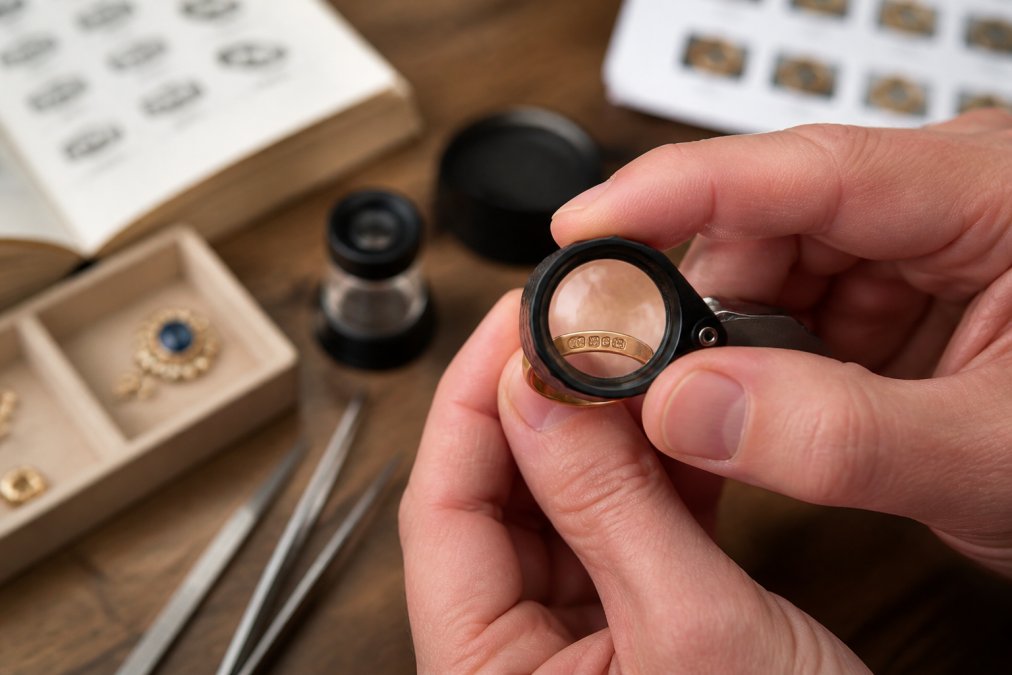
Use a loupe or phone macro lens and look inside the band, on the clasp, or on the reverse of a brooch. Common purity marks include 375 for 9ct gold, 750 for 18ct, and 925 for sterling silver. A piece with no hallmark is not automatically worthless, but it needs closer inspection before you assume it is precious.
Maker's marks matter for a different reason. A recognised workshop name can lift value well above scrap, while an unknown mark tells you little either way. As the Assay Office London guidance on UK hallmarks explains, the combination of marks and their style can also help date a piece.
Factors Affecting Vintage Jewellery Value: Rarity, Condition and Craftsmanship
Value comes down to four things: rarity, condition, craftsmanship and market demand. A rare piece in poor condition can be worth less than a common piece in excellent condition, which is why condition usually decides the outcome. Here is how to score each factor yourself before you pay anyone.
Craftsmanship is where handcrafted pieces separate themselves. Look for hand-set stones with individually cut seats, filigree with consistent wire thickness, and neat rather than blobby solder joints. Hand engraving has a fluid, slightly irregular line; machine engraving looks printed. Patina on silver can signal age, but heavy corrosion around a clasp usually means moisture exposure and a weakened fitting.
To judge hand work versus mass production, count the inconsistencies.
A DIY pre-appraisal scoring framework
Most guides tell you to "assess condition" without saying how. Use this five-factor score before deciding whether a professional valuation is worth the fee. Score each factor from 1 (poor) to 5 (excellent):
| Factor | What raises the score | What lowers the score |
|---|---|---|
| Rarity | Limited production, discontinued maker, documented pattern | Mass-produced designs still in catalogue |
| Condition | Intact stones, original fittings, no repairs | Chips, missing stones, visible solder repairs |
| Craftsmanship | Hand-set, hand-engraved detail, consistent filigree | Cast, machine-finished parts, blobby joins |
| Provenance | Original box, receipts, family history, photographs | No documentation at all |
| Market demand | Maker or style currently collected | Style with no active buyer base |
The insurance-versus-resale trap
One factor that quietly distorts every valuation is which number you are being given. A piece can carry a replacement value for insurance of several hundred pounds and a realistic resale value of a fraction of that, because insurance figures include retail margin while resale figures reflect what a secondhand buyer will actually pay. If you are scoring a piece to decide whether to sell, score it against resale comparables, not insurance figures.
How to Find a Reputable Jewellery Valuer
Choosing the right valuer is the step most people rush, and the one that costs the most when you get it wrong. A valuation is only as good as the person writing it, so check credentials before you hand anything over.
Practical checks before you commit:
- Ask for a sample report so you can see the level of detail
- Confirm whether the fee is flat or a percentage of the valuation
- Check that they will return the piece with the report
- Avoid anyone who offers to buy the item at the same appointment
Insurance Value vs Resale Value: What Your Valuation Really Means
Insurance value and resale value are not the same number, and confusing them leads to disappointment. Replacement value is what it would cost to buy an equivalent piece new from a retailer, and it is always higher. Resale value, or secondary market value, is what a buyer would actually pay for your piece secondhand, and it is typically lower.
Why the gap is so wide
The gap exists because each figure answers a different question from a different cost base:
- Replacement value includes retail margin, the cost of sourcing a comparable piece, and the labour to recreate it. It is what an insurer would have to pay a retailer to replace your item.
- Resale value strips out retail margin entirely. It is what a dealer, auction house or private buyer would pay, knowing they need to resell at a profit.
- Scrap value strips out everything except the recoverable metal. Stones, craftsmanship and provenance contribute nothing.
Which figure to use for which decision
| Your situation | Figure to use | Why |
|---|---|---|
| Insuring a piece you are keeping | Replacement value | A claim must fund a like-for-like retail purchase |
| Selling to a dealer or auction | Resale value | Reflects what a buyer will actually pay |
| Settling an estate or probate | Market value at date of death | The basis required for inheritance tax purposes |
| Deciding whether to melt | Scrap value | The floor below which selling intact makes no sense |
| Dividing inherited items between family | Resale value | The fairest basis for a like-for-like split |
The practical trap
Most people discover the gap the hard way: they insure a piece for a replacement figure, then try to sell it and are offered a fraction of that number. Neither figure is wrong, they answer different questions. The mistake is assuming the insurance figure is what the piece is "worth" in every context.
When to Seek a Professional Valuation for Vintage Jewellery
Seek a professional valuation when the piece is being insured, sold, inherited or disputed, and when your own inspection suggests genuine precious metal or stones. Otherwise, a careful DIY assessment is usually enough.
Bring in a professional if any of these apply:
- The piece carries a hallmark and you intend to insure it
- You are settling an estate or dividing inherited items
- A stone appears valuable and you need a gemological assessment
- You are selling and want a defensible asking price
- The piece has provenance you want documented
Frequently Asked Questions
How can I tell if my vintage jewellery is valuable?
Start by checking for hallmarks, which indicate the metal purity and maker. Examine the condition: intact clasps, secure gemstone settings, and minimal wear add value. Look for signs of handcraftsmanship such as filigree or engraving. Rarity and provenance also matter. If the piece has precious metals or stones, a professional valuation will confirm whether it is worth more than scrap value.
What factors influence the value of handcrafted vintage jewellery?
Key factors include the metal type and purity (karat), gemstone quality and setting, craftsmanship techniques, rarity, age, and condition. Provenance, such as original documentation or a famous maker, can significantly increase value. Market demand for specific styles or eras also plays a role. A piece with historical significance and minimal restoration will typically command a higher price.
Do I need a professional valuation for my vintage jewellery?
If you plan to insure, sell, or donate the piece, a professional valuation is advisable. It provides an accurate replacement value for insurance or a realistic resale figure. For items with unclear hallmarks or potential high value, a valuer can authenticate and assess. For inexpensive costume pieces, a DIY check may suffice.
How does the hallmark affect the value of vintage jewellery?
Hallmarks confirm the metal's purity and origin, which directly impacts value. A clear hallmark from a reputable assay office assures buyers of quality. Rare or early hallmarks can increase collector interest. Conversely, missing or fake hallmarks may indicate lower value or reproduction. Understanding hallmark identification is essential for accurate valuation.