

How to Verify Ethically Sourced Diamonds
Table of Contents
- What Ethically Sourced Diamonds Actually Means
- Kimberley Process Certification: What It Proves and What It Doesn't
- Diamond Origin Tracking: Following a Stone from Mine to Setting
- Documents and Questions That Verify Ethical Sourcing
- Conflict-Free vs Ethically Sourced: Why the Difference Matters
- Environmental Impact and the Limits of Current Certification
- How Blockchain and Digital Ledgers Are Changing Verification
- Verifying Lab-Grown Diamonds and Their Ethical Claims
- Frequently Asked Questions
Last Updated: September 26, 2026
What Ethically Sourced Diamonds Actually Means
Learning how to verify ethically sourced diamonds starts with knowing what the term really covers. Ethically sourced diamonds are stones mined, cut, and traded without funding violence or abusing the people who handle them. The label also speaks to fair labour practices, safe mining conditions, and care for the land around a mine.
That definition is broader than most shoppers expect.
A stone can be conflict-free and still fall short on human rights or environmental impact. This guide from Diamonds by daisy walks through the checks that separate a genuine ethical claim from a marketing line. Below, we show you exactly which documents, questions, and tools to use before you buy.
Kimberley Process Certification: What It Proves and What It Doesn't
Kimberley Process certification is a government-backed scheme that stops rough diamonds from rebel groups entering the legal trade. Over 80 countries take part, and each shipment of rough stones travels with a certificate confirming it is conflict-free. The Kimberley Process official site sets out how the scheme works.
So what does it not prove?
- It covers rough diamonds only, not cutting or polishing
- It does not address labour conditions at the mine
- It says nothing about a stone's environmental footprint
- It does not track an individual diamond after export
Treat it as a minimum baseline. A certificate on its own is a starting point, not the whole story.
Diamond Origin Tracking: Following a Stone from Mine to Setting
Diamond origin tracking follows a stone from the mine through cutting, polishing, and setting. Full traceability is rare. Most diamonds change hands many times, and records thin out at each step.
Some major producers now publish their own traceability data. The Gemological Institute of America on diamond origin explains how labs research a stone's country of origin. A grading report can note a diamond's origin when the lab has enough evidence.
Ask your jeweller one direct question: can you show me where this specific stone came from?
If the answer is vague, that tells you something.
Documents and Questions That Verify Ethical Sourcing
The strongest proof comes from paperwork you can inspect before you pay. Ask to see the full chain of custody, not just a certificate.
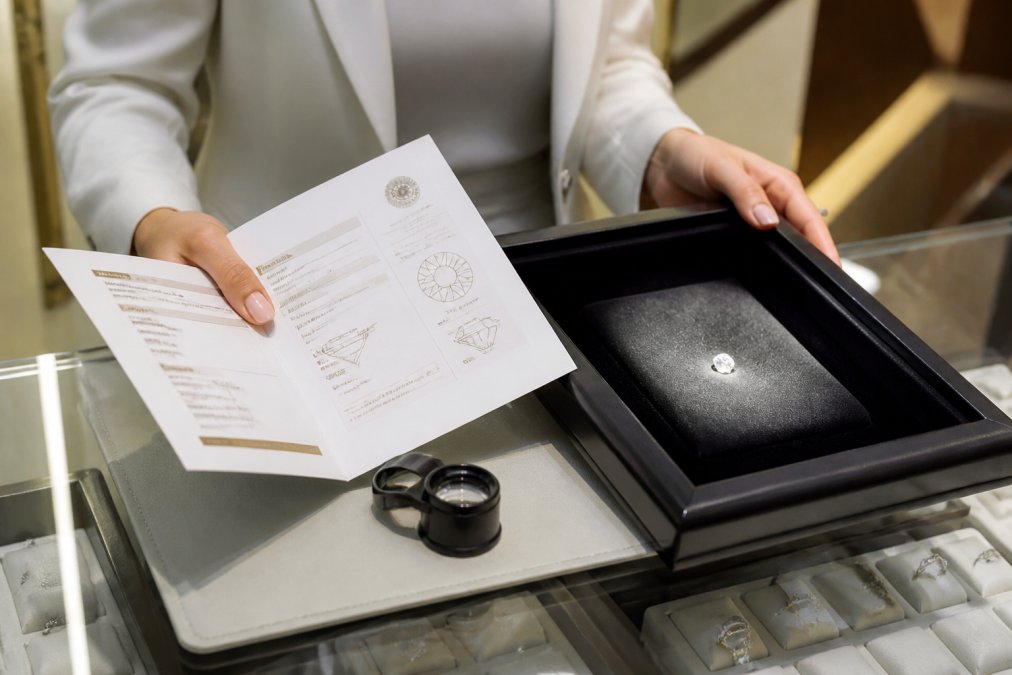
Here is what to request:
| Document | What It Shows | Who Issues It |
|---|---|---|
| Kimberley Process certificate | Stone is conflict-free at export | Government authority |
| Grading report | Quality, and origin where known | Independent lab |
| Supplier declaration | Responsible sourcing policy | The jeweller |
| Provenance record | Country of origin and journey | Miner or cutter |
How to Read a Grading Report
A grading report describes a diamond's quality, not its ethics. Look for the four Cs: cut, colour, clarity, and carat. Check whether the report names a country of origin. Then match the serial number on the report to the inscription on the diamond's girdle. If those two do not line up, walk away.
Questions to Ask Before You Buy
Ask these directly, and expect clear answers:
- Where was this diamond mined?
- Can I see the Kimberley Process certificate?
- Does the grading report list the origin?
- What is your responsible sourcing policy?
- Can you show chain of custody records?
A trustworthy seller answers without hesitation. Diamonds by daisy stands behind every piece with a 30-day satisfaction guarantee, so you can buy with confidence.
Conflict-Free vs Ethically Sourced: Why the Difference Matters
Conflict-free means a diamond did not fund armed conflict. Ethically sourced goes further, covering labour practices, human rights, and environmental standards across the whole supply chain. A stone can be one without being the other.
That gap is where most marketing claims fall apart. A seller may lean on a conflict-free label while saying nothing about how the stone was mined or who cut it. Ethical standards demand more.
Environmental Impact and the Limits of Current Certification
Current certification was built to stop conflict, not to measure environmental harm. That is the single biggest blind spot in the mainstream guidance on how to verify ethically sourced diamonds, and most buying guides skip straight past it.
What does diamond mining actually do to land and water? Open-pit operations move enormous volumes of rock to reach a small yield of rough stones. Alluvial mining, sifting diamonds from riverbed gravel, disturbs waterways and can silt up fishing grounds. Both use significant water, and both can leave scars that outlast the mine itself. A stone can carry a clean Kimberley Process certificate and still come from ground that was never restored.
No mainstream certificate captures that impact. So how do you judge it as a buyer?
Look for a seller who publishes a responsible sourcing policy and names the specific standards they follow. The credible names to look for include:
- The Responsible Jewellery Council (RJC) Code of Practices, a certification covering business ethics, human rights, labour standards and environmental management across the jewellery supply chain (RJC Member Certification • COP • Responsible Jewellery Council). Members are audited against the code.
- The OECD Due Diligence Guidance for Responsible Supply Chains of Minerals from Conflict-Affected and High-Risk Areas, the international framework most serious suppliers build their sourcing policies around.
- The Natural Diamond Council, an industry body that publishes member commitments on environmental and community impact, including land rehabilitation and carbon reduction targets.
Ask whether the seller works with suppliers who restore mined land, monitor water use, or use lower-impact recovery methods.
One honest caveat: even the best certification schemes are self-reported at the mine level in many cases, and independent environmental auditing of diamond mines is not yet universal. Treat environmental credentials as a spectrum, not a pass-or-fail badge, and reward sellers who are specific about where their stones come from and what standards apply.
How Blockchain and Digital Ledgers Are Changing Verification
- Stone-level tracking, not shipment-level. Kimberley certificates cover a parcel of rough stones; a ledger entry can follow one specific diamond.
- A tamper-evident history. Once an entry is written, changing it would require rewriting the whole chain, which is what makes the record credible.
- Cutting and polishing visibility. Kimberley stops at export of rough. A ledger can extend through the stages where most traceability currently breaks down.
Still, the direction of travel is clear. As more producers adopt digital traceability, the gap that paper certificates leave open narrows. When you are comparing sellers, ask whether the diamond comes with a digital traceability record and whether you can access it yourself before you buy. A seller who can hand you a scannable, verifiable history is ahead of one who can only show you a certificate.
Verifying Lab-Grown Diamonds and Their Ethical Claims
Lab-grown diamonds carry their own ethical questions, and they need their own checks. These stones are created in a lab rather than mined, so they avoid many mining harms. But they are not automatically clean.
Verification means asking:
- Does the grading report confirm it is lab-grown?
- Which lab grew the stone, and where?
- What energy source powers that lab?
- Is the stone inscribed and matched to its report?
Frequently Asked Questions
What is the difference between conflict-free and ethically sourced diamonds?
Conflict-free means a diamond has not funded armed conflict, which is the minimum the Kimberley Process certification checks. Ethically sourced diamonds go further: they also account for mining conditions, labor practices, human rights and environmental impact across the supply chain. A stone can be conflict-free and still fall short on fair pay, safe working conditions or land restoration. When verifying ethically sourced diamonds, ask for proof of both, not just a conflict-free label.
How can I verify the authenticity of a diamond before buying?
Ask for a grading report from a recognised laboratory and check that the report number matches the laser inscription on the diamond's girdle, usually visible under magnification. The report confirms the stone's identity and quality, while diamond origin tracking documents where it came from. Reputable sellers will share certification and documentation before purchase. If a seller cannot produce a grading report or explain the stone's provenance, treat that as a warning sign.
Are lab-grown diamonds always more ethical than natural diamonds?
Not automatically. Lab-grown diamonds avoid large-scale mining, which reduces land disturbance and water use, but they still carry energy demands and their own supply chain questions. Verification matters just as much: a lab-grown stone should come with its own grading report and clear documentation of where it was grown and cut. The ethical claim depends on the producer's practices, not simply on whether the diamond was grown in a lab or mined.
What does Kimberley Process certification actually prove?
Kimberley Process certification confirms that a rough diamond shipment has been checked against the scheme's rules and is not a conflict diamond. It applies to rough stones crossing borders and covers a defined set of conflict-related criteria. It does not verify fair wages, safe mining conditions, environmental restoration or cutting and polishing practices. That is why it is best treated as a baseline rather than a complete guarantee of ethical sourcing.
The real challenge is not finding a diamond. It is finding proof you can trust. Diamonds by daisy handpicks the finest gemstones and precious metals for every piece, so each design meets a high standard of quality. Every purchase comes with a 30-day satisfaction guarantee, giving you peace of mind while you choose. Get started with Diamonds by daisy and add a piece you can wear with confidence for years.