

Birthstone Jewelry Guide: Pick the Right Stone for Every Month
Each month has a designated birthstone — here’s the modern list at a glance, with the most common traditional alternatives noted where they differ meaningfully.
Single buying tip: Match the stone’s Mohs hardness to how the piece will be worn. Stones rated 7.5 or above handle daily ring wear well; anything softer belongs in a pendant or earrings where it won’t take daily knocks.
If you’re ready to buy now:
- Confirm the stone is natural or lab-created and that any treatments are disclosed before you purchase.
- Choose a bezel or halo setting for stones rated below 7 on the Mohs scale to protect the edges.
- When in doubt about a recipient’s taste, a pendant or stud earrings in their birth month stone are nearly always a safe, elegant choice.
Key Takeaways
Choosing birthstone jewelry well comes down to three things: knowing the stone’s hardness, understanding whether it’s been treated, and matching the format to how the piece will actually be worn.
| Point | Details |
|---|---|
| Match hardness to wear | Stones rated 7.5 or above suit daily rings; softer stones belong in pendants or earrings. |
| Use protective settings | Bezel or halo settings protect stones rated below 7 from chipping and scratching. |
| Always ask about treatments | Fracture-filling, heat treatment, and irradiation are common and acceptable — but must be disclosed. |
| Both lists are valid | Modern (1912) and traditional birthstone lists are both recognized; choose by color, price, or durability. |
| Diamondsbydaisy curates for durability | Every piece is selected for gem hardness, disclosed treatments, ethical sourcing, and setting protection. |
Table of Contents
- What’s the difference between modern and traditional birthstone lists?
- Where did birthstones actually come from?
- Your month-by-month birthstone reference
- How to choose the right birthstone jewelry as a gift
- How to care for birthstone jewelry
- Quick reference: all 12 birthstones at a glance
- How Diamondsbydaisy evaluates and recommends birthstone jewelry
- Birthstone collections worth exploring at Diamondsbydaisy
- Sources
What’s the difference between modern and traditional birthstone lists?
The short answer: one list was standardized for the American retail market in 1912, and the other reflects centuries of older European and cultural traditions. Both are considered legitimate, and most U.S. buyers draw freely from whichever list gives them the stone they prefer in terms of look, price, or durability.
The modern list was formalized by the National Association of Jewelers (now Jewelers of America) in 1912. It prioritized stones that were widely available, facetable, and commercially practical. The traditional list, which varies by region and source, pulls from older European conventions that often favored stones tied to zodiac signs, biblical symbolism, or local gem availability. The two lists overlap on most months but diverge noticeably on a handful.
The months where the split matters most for buyers:
- March: Aquamarine (modern) vs. bloodstone (traditional). Aquamarine is far more popular today; bloodstone is a dark green chalcedony with red flecks, rarely requested but historically significant.
- June: Pearl (modern) vs. alexandrite or moonstone (traditional). Alexandrite is prized for its color-change effect but can be expensive; moonstone is a softer, more affordable alternative.
- August: Peridot (modern) vs. spinel or sardonyx (traditional). Spinel was added to the modern list in 2016, giving August three recognized options.
- November: Topaz (modern) vs. citrine (traditional). Citrine is often the more affordable pick and shares a warm golden color.
- December: Blue topaz (modern) vs. tanzanite or turquoise (traditional). Tanzanite is rarer and more valuable; turquoise carries strong cultural heritage in the American Southwest.
The International Gem Society notes that the modern list has continued to evolve since 1912, with later additions including spinel (2016), tanzanite, and citrine — reflecting both changing fashion and the gem trade’s expanding supply of facetable stones.
The practical takeaway for gifting: ask the recipient which list they identify with, or simply pick the stone whose color and price point fit the occasion. Either choice is recognized and appropriate.
Where did birthstones actually come from?
The connection between gems and calendar months is ancient, but the tidy twelve-stone-per-twelve-month system we use today is a relatively modern invention. The origins stretch back to the biblical Book of Exodus, which describes the breastplate of Aaron set with twelve gemstones representing the twelve tribes of Israel. Early scholars, including the first-century Jewish historian Josephus, drew a connection between those twelve stones, the twelve months of the year, and the twelve signs of the zodiac.
The Old Farmer’s Almanac notes that birthstones have multiple origin threads — the biblical breastplate, zodiac traditions, and the Julian calendar — and that modern lists reflect retail availability and fashion as much as ancient symbolism.
For most history, the practice was to own all twelve stones and wear the one corresponding to the current month, rotating through the year. The idea of wearing only your birth month’s stone as a personal talisman became popular in 18th-century Poland and gradually spread through Europe. Two historical shifts show how fluid the system has always been:
- Color over species: Medieval and Renaissance gem lists often grouped stones by color rather than mineral species. A red stone was a red stone, whether it was a ruby, garnet, or spinel. This is why some traditional lists include stones that seem interchangeable with the modern picks.
- Availability drove choices: In colonial-era Europe and early America, gem availability varied enormously by region. Local gem trades shaped which stones appeared on which month’s list, which is why Polish, German, and English traditional lists sometimes differ from each other.
The 1912 standardization by the National Association of Jewelers was the first time the U.S. retail industry agreed on a single, commercially consistent list. It replaced a patchwork of regional traditions with stones that jewelers could reliably source and sell. The list has been updated several times since, most recently in 2016 when spinel was added for August.
Your month-by-month birthstone reference
This section covers each month’s primary stone, common alternatives, color, meaning, Mohs hardness, and the jewelry formats that suit it best. Hardness data is drawn from Geology, which rates stones for everyday ring suitability.
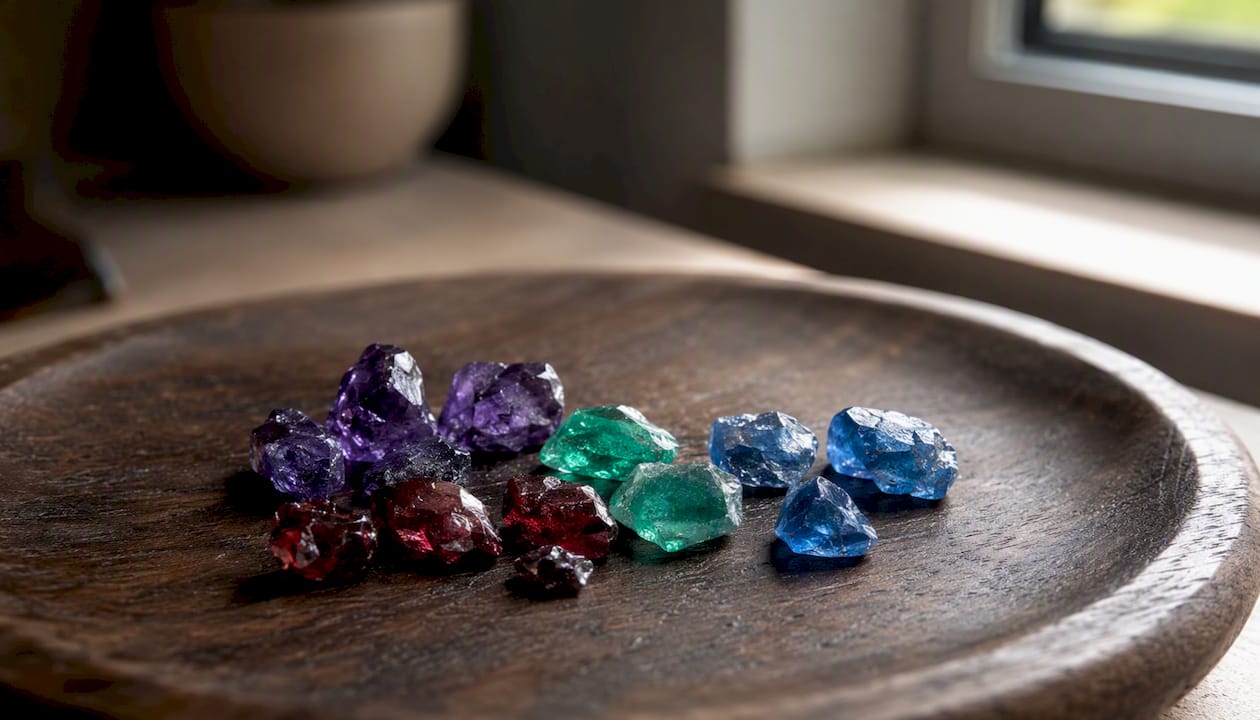
January: Garnet
Color: Deep red (most common), but also green, orange, and yellow varieties exist. Meaning/Folklore: Historically carried by travelers as a protective talisman; associated with safe journeys and friendship. Mohs hardness: 6.5–7.5 Best uses: Rings, pendants, earrings. Red garnet is durable enough for daily wear in a well-protected setting.
February: Amethyst
Color: Purple, ranging from pale lavender to deep violet. Meaning/Folklore: Long associated with sobriety and clarity of mind; ancient Greeks believed it prevented intoxication. Mohs hardness: 7 Best uses: All jewelry formats. Amethyst is affordable, widely available, and holds up well in rings with a protective setting.
March: Aquamarine (modern) / Bloodstone (traditional)
Color: Aquamarine is pale blue to blue-green; bloodstone is dark green with red spots. Meaning/Folklore: Aquamarine was carried by sailors for safe passage across water. Bloodstone was associated with courage and healing. Mohs hardness: Aquamarine 7.5–8; bloodstone 6.5–7 Best uses: Aquamarine suits rings, pendants, and earrings. Bloodstone is better in pendants or brooches given its lower hardness and opaque appearance.
April: Diamond
Color: Colorless (most prized), but also yellow, brown, and fancy colors. Meaning/Folklore: Symbol of eternal love and invincibility; the name derives from the Greek adamas, meaning unconquerable. Mohs hardness: 10 Best uses: Every jewelry format. Diamond is the hardest natural material and the gold standard for daily-wear rings. Lab-created diamonds offer the same properties at lower price points. Browse sterling silver and diamond jewelry for curated April options.
May: Emerald
Color: Vivid green to bluish-green. Meaning/Folklore: Associated with rebirth, fertility, and foresight; Cleopatra famously prized Egyptian emeralds. Mohs hardness: 7.5–8 Best uses: Pendants and earrings are safer choices. Most emeralds on the market are fracture-filled to improve clarity, and ultrasonic or steam cleaning can damage that treatment. A bezel setting protects the stone in a ring.
Pro Tip: Always ask whether an emerald has been fracture-filled before buying. A reputable seller will disclose this upfront, and it affects both cleaning method and long-term value.
June: Pearl (modern) / Alexandrite or Moonstone (traditional)
Color: Pearl is white, cream, pink, or black; alexandrite shifts from green in daylight to red under incandescent light; moonstone is milky white with a blue sheen. Meaning/Folklore: Pearls symbolize purity and wisdom. Alexandrite, discovered in Russia in the 1830s, was named for Tsar Alexander II and is considered a stone of good luck. Mohs hardness: Pearl 2.5–4.5; alexandrite 8.5; moonstone 6–6.5 Best uses: Pearls belong in pendants, earrings, and bracelets — never in a daily-wear ring. Alexandrite is durable enough for rings. Moonstone needs a protective bezel setting.
July: Ruby
Color: Red, from pinkish-red to deep blood red. Meaning/Folklore: Called the “king of gems” in ancient Sanskrit texts; associated with passion, protection, and prosperity. Mohs hardness: 9 Best uses: All formats. Ruby is one of the most durable colored gemstones and handles daily ring wear well. Heat treatment to improve color is standard in the industry and should be disclosed.
August: Peridot (modern) / Spinel or Sardonyx (traditional)
Color: Peridot is lime to olive green; spinel comes in red, pink, blue, and other colors; sardonyx is banded brown and white. Meaning/Folklore: Ancient Egyptians called peridot the “gem of the sun.” Spinel was historically confused with ruby and sapphire in royal gem collections. Mohs hardness: Peridot 6.5–7; spinel 8; sardonyx 6.5–7 Best uses: Peridot is best in pendants and earrings; its lower hardness makes it prone to scratching in rings. Spinel, at 8, is an excellent ring stone and underrated for its brilliance.
September: Sapphire
Color: Blue (most recognized), but also pink, yellow, white, and padparadscha (orange-pink). Meaning/Folklore: Associated with wisdom, loyalty, and nobility; historically worn by clergy and royalty as a symbol of heaven. Mohs hardness: 9 Best uses: All formats. Sapphire is second only to diamond in durability for colored stones and is an excellent choice for engagement-style rings and daily wear.
October: Opal (modern) / Tourmaline (traditional)
Color: Opal displays a play of color across the spectrum; tourmaline spans pink, green, blue, and watermelon (pink-green bicolor). Meaning/Folklore: Romans considered opal the most precious of all gems, symbolizing hope and purity. Tourmaline was believed to inspire creativity. Mohs hardness: Opal 5–6.5; tourmaline 7–7.5 Best uses: Opal is fragile and should be reserved for pendants and earrings, or rings worn only occasionally. Tourmaline is a much more practical ring stone for daily wear.
Pro Tip: Opal can crack if it dries out. Store opal jewelry away from heat sources and avoid ultrasonic cleaners entirely.
November: Topaz (modern) / Citrine (traditional)
Color: Blue topaz is the most common commercial form; imperial topaz is golden-orange. Citrine ranges from pale yellow to deep amber. Meaning/Folklore: Topaz was believed to cool anger and bring strength. Citrine is called the “merchant’s stone” and associated with abundance. Mohs hardness: Topaz 8; citrine 7 Best uses: Both suit rings, pendants, and earrings. Citrine is significantly more affordable than topaz and a popular budget-friendly alternative for November gifts.
December: Blue Topaz (modern) / Tanzanite or Turquoise (traditional)
Color: Blue topaz is sky to Swiss blue; tanzanite is violet-blue; turquoise is opaque blue-green. Meaning/Folklore: Turquoise is one of the oldest known gemstones, used in Native American and ancient Egyptian jewelry for thousands of years. Tanzanite, discovered in Tanzania in 1967, is associated with new beginnings. Mohs hardness: Blue topaz 8; tanzanite 6–7; turquoise 5–6 Best uses: Blue topaz handles daily wear well. Tanzanite and turquoise are better suited to pendants and earrings, or rings worn occasionally. Turquoise should never be cleaned with chemicals.
The GIA’s birthstone resource provides deeper technical data on each stone’s properties for readers who want to go further on any specific gem.
How to choose the right birthstone jewelry as a gift
Start with two questions: how will the piece be worn, and what’s the recipient’s style? Everything else follows from there.
A practical buying checklist:
- Intended wear frequency. Daily ring wear demands a stone rated 7.5 or above on the Mohs scale. For occasional wear or non-ring formats, softer stones are fine.
- Metal match. Warm-toned stones (garnet, citrine, peridot, topaz) pair naturally with yellow gold. Cool-toned stones (aquamarine, sapphire, amethyst) suit white gold, platinum, or sterling silver. Rose gold works across both.
- Natural vs. lab-created. Lab-created stones are chemically identical to natural ones and cost significantly less. They’re a legitimate choice, but the seller must disclose this clearly. Geology that lab-created and simulant stones are widely used in birthstone jewelry, and clear labeling is the industry standard.
- Budget. Emerald, ruby, sapphire, and alexandrite command the highest prices in natural form. Garnet, amethyst, citrine, and peridot offer excellent color at accessible price points.
- Color preference. Some recipients care more about a flattering color than strict birth month adherence. If the modern stone’s color doesn’t suit them, the traditional alternative often does.
Questions to ask any seller before buying:
- Is the stone natural, lab-created, or a simulant? (These are three different things.)
- Has the stone been treated? If so, how — heat, fracture-filling, irradiation?
- Does the piece come with any certification, such as a GIA grading report?
- What is the return policy, and does it cover resizing?
Red flags to watch for:
- A seller who can’t or won’t answer treatment questions.
- Metal stamps that are vague or missing (look for 14K, 18K, 925, or PT950).
- No written return or exchange policy. Diamondsbydaisy’s fine jewelry return guide explains what a solid buyer protection policy should include.
- Prices that seem too low for a natural stone of the described quality.
The International Gem Society’s birthstone chart recommends asking the recipient which list they prefer when gifting, since some people feel strongly about one stone over another for their birth month.
How to care for birthstone jewelry
Mohs hardness is the most practical number to know. It measures scratch resistance on a scale of 1–10. Stones rated 7 and above resist everyday scratching from dust and surfaces; below 7, they need more careful handling.
Everyday wear vs. occasional wear:
A stone rated 8 or above (diamond, sapphire, ruby, alexandrite, topaz) can handle daily ring wear without special precautions beyond routine cleaning. Stones rated 6–7.5 (amethyst, garnet, peridot, tourmaline, moonstone) are fine in rings for moderate wear but benefit from protective settings. Stones below 6 (pearl, opal, turquoise, tanzanite) belong in pendants, earrings, or rings worn for special occasions only.
Cleaning steps for most birthstone jewelry:
- Soak the piece in warm water with a small amount of mild dish soap for 20–30 minutes.
- Use a soft-bristled toothbrush to gently clean around the setting and under the stone.
- Rinse thoroughly with clean water.
- Pat dry with a lint-free cloth and allow to air-dry completely before storing.
What to avoid for specific stones:
- Pearls: Never soak. Wipe with a damp cloth after wearing. Avoid perfume, hairspray, and acids. Store separately so harder stones don’t scratch the surface.
- Opal: No ultrasonic cleaners, no steam, no harsh chemicals. Keep away from heat and prolonged sunlight.
- Turquoise: No chemicals of any kind. Turquoise is porous and absorbs substances easily, which can permanently alter its color.
- Emerald (fracture-filled): No ultrasonic or steam cleaning. The GIA-trained gemologist guidance at jewelry-tips.com specifically flags this: ultrasonic vibrations can dislodge the filling and damage the stone.
- Tanzanite: No ultrasonic cleaners. Tanzanite has perfect cleavage in one direction, making it vulnerable to sharp impacts.
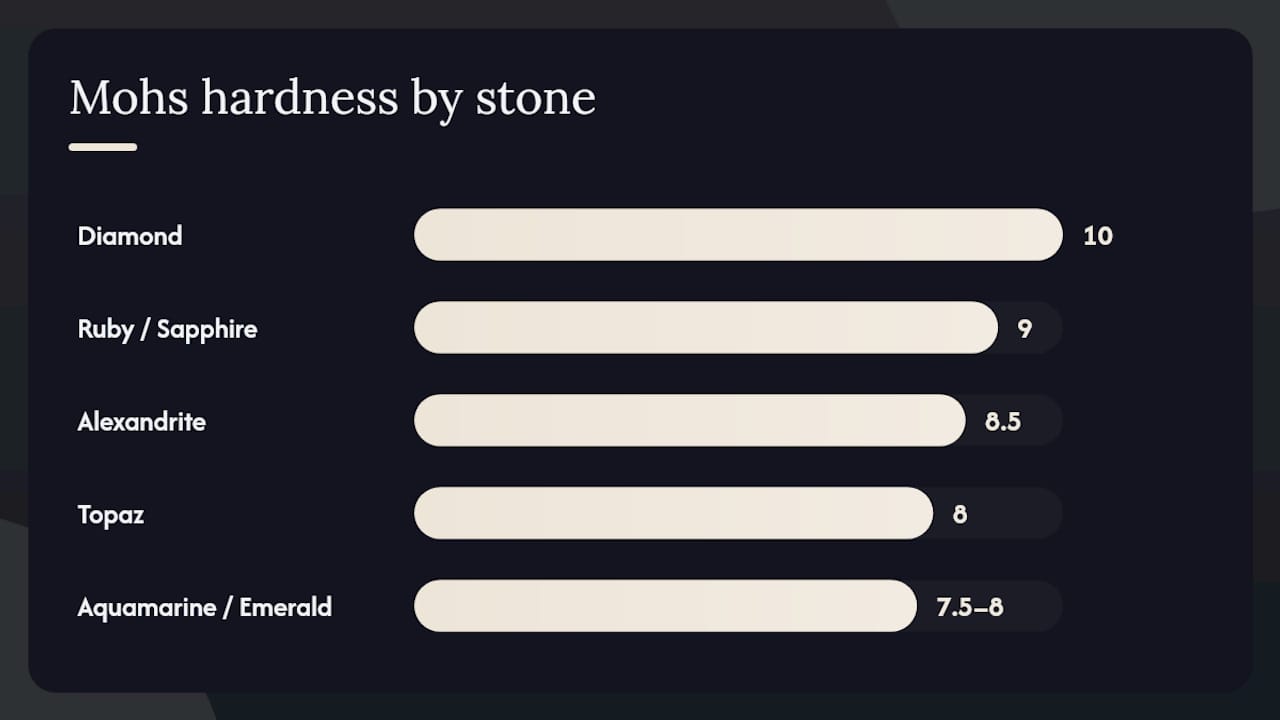
Compact Mohs hardness reference:
| Stone | Mohs Hardness | Daily Ring Wear |
|---|---|---|
| Diamond | 10 | Excellent |
| Ruby / Sapphire | 9 | Excellent |
| Alexandrite | 8.5 | Excellent |
| Topaz | 8 | Very good |
| Aquamarine / Emerald | 7.5–8 | Good (protective setting) |
| Amethyst / Citrine | 7 | Good (moderate wear) |
| Garnet | 6.5–7.5 | Good to fair |
| Peridot / Tanzanite | 6–7 | Fair (occasional wear) |
| Moonstone / Turquoise | 5–6.5 | Poor (pendants/earrings) |
| Opal | 5–6.5 | Poor (pendants/earrings) |
| Pearl | 2.5–4.5 | Poor (pendants/earrings) |
Storage tip: keep each piece in its own soft pouch or compartment. Diamonds and sapphires will scratch softer stones if they share a jewelry box tray.
Quick reference: all 12 birthstones at a glance
Hardness figures are sourced from Geology.com’s birthstone chart and GIA.
How Diamondsbydaisy evaluates and recommends birthstone jewelry
At Diamondsbydaisy, every piece in our curated collections goes through a consistent editorial checklist before it earns a place on the site. The criteria aren’t complicated, but they’re specific enough to filter out the pieces that look good in photos and disappoint in person.
Our selection criteria:
- Gem durability for intended use. A stone rated below 7 on the Mohs scale doesn’t go into a ring recommended for daily wear without a protective setting and an explicit note to the buyer.
- Treatment disclosure. Any treated stone — heat-treated ruby, fracture-filled emerald, irradiated blue topaz — is labeled as such. Buyers deserve to know what they’re getting, and undisclosed treatments are a dealbreaker.
- Ethical sourcing signal. We prioritize suppliers who can speak to their sourcing practices, whether that means conflict-free diamonds, responsibly mined colored stones, or lab-created alternatives with full traceability.
- Setting protection. For softer stones, we favor bezel and halo settings that protect the girdle and reduce the risk of chipping.
- Value for size and color. A well-cut, well-colored stone in a modest size outperforms a large stone with poor saturation or visible inclusions. We select for the former.
Styling by metal and stone tone:
Warm-toned stones like garnet, citrine, and peridot look best in yellow gold settings, where the metal amplifies the stone’s warmth. Cool-toned stones like aquamarine, amethyst, and sapphire read crisper in white gold, platinum, or sterling silver. Our everyday gold jewelry collection is a natural starting point for warm-stone birthstone pieces, and our sterling silver and diamond collection suits April birthdays and cool-stone pairings.
For gift occasions, celestial-themed pendants pair particularly well with birthstones — a moon or star setting with the recipient’s birth month stone makes a layering piece that feels personal without being overly literal. Our crystal and celestial jewelry collection is designed with exactly that kind of layering in mind.
A note on how I approach birthstone gifting
Birthstone jewelry works best when it’s chosen with the recipient’s actual life in mind, not just their birth month. My habit before recommending any piece is to ask one question: will this person wear it, or will it sit in a drawer? That question cuts through most of the noise around stone selection, metal choice, and price. A garnet pendant someone wears every day is a better gift than a sapphire ring that never leaves the box. At Diamondsbydaisy, that philosophy shapes every curation decision we make.
Birthstone collections worth exploring at Diamondsbydaisy
Diamondsbydaisy curates birthstone-friendly jewelry with the same editorial checklist described above: durability for intended use, disclosed treatments, protective settings for softer stones, and designs that hold up as everyday pieces, not just occasion wear.
For everyday birthstone necklaces and studs, the everyday gold jewelry collection is the right starting point. Warm-stone birth months (January, August, November) pair especially well with yellow gold. For April birthdays or anyone drawn to diamond and silver, the sterling silver and diamond collection offers natural diamond pieces at a range of price points. And for a gift that layers a celestial theme with a personal birthstone, the crystal and celestial collection has pendants designed for exactly that pairing. Browse the full shop at Diamondsbydaisy to find the right piece for any birth month.
Sources
These are the primary references used throughout this guide. Each covers a distinct area of birthstone knowledge.
- Birthstone Chart - Modern and Traditional - International Gem Society
- Birthstones - GIA
- Birthstones | Jewelers of America
- Geology
- Birthstones by Month: Colors & Meanings | What’s Your Birthstone? | The Old Farmer’s Almanac