

5 Fast Checks to Tell Sterling Silver from Silver Plated, When to Test
Silver plated jewelry is a thin silver skin over a base metal like brass or copper, worth little once melted. Start by checking the hallmark. If there’s no mark, or you don’t trust it, run a couple of quick, non-destructive tests before you assume anything.
TL;DR:
- Look for clear hallmarks like 925 or STERLING, and check multiple areas of the piece to confirm authenticity, especially if wear is evident.
- Wear patterns typically appear first at stress points such as ring shanks, clasps, and hinge lines, revealing if the piece is plated underneath.
- Basic home tests like magnets, ice cubes, and sound tests can quickly help differentiate sterling silver from base metals or plated items.
- Professional testing methods, including XRF or nitric acid, are recommended for valuable or sentimental pieces to avoid damaging the item.
- Verified sterling silver is worth its melt value based on current silver prices, while plated jewelry mainly derives value from design and condition.
Table of Contents
- Sterling Silver vs Silver Plated: The 5-Step Checklist
- What Do Sterling and Plating Hallmarks Actually Mean?
- Where Does Wear Reveal Plating First?
- Do Home Tests for Silver Actually Work?
- When Should You Get Professional Silver Testing?
- How Does Metal ID Change What Your Silver Is Worth?
- Can Sterling Silver or Silver Plated Jewelry Cause Skin Reactions?
- A Straight Take on Buying Silver Sight Unseen
- Diamonds by Daisy’s Approach to Metal Clarity
- Where to Find Clearly Labeled Sterling Silver
- Sources
Sterling Silver vs Silver Plated: The 5-Step Checklist
Handling an unfamiliar piece for the first time? Work through these five checks in order, and you’ll usually know what you’re holding before you finish the second one.
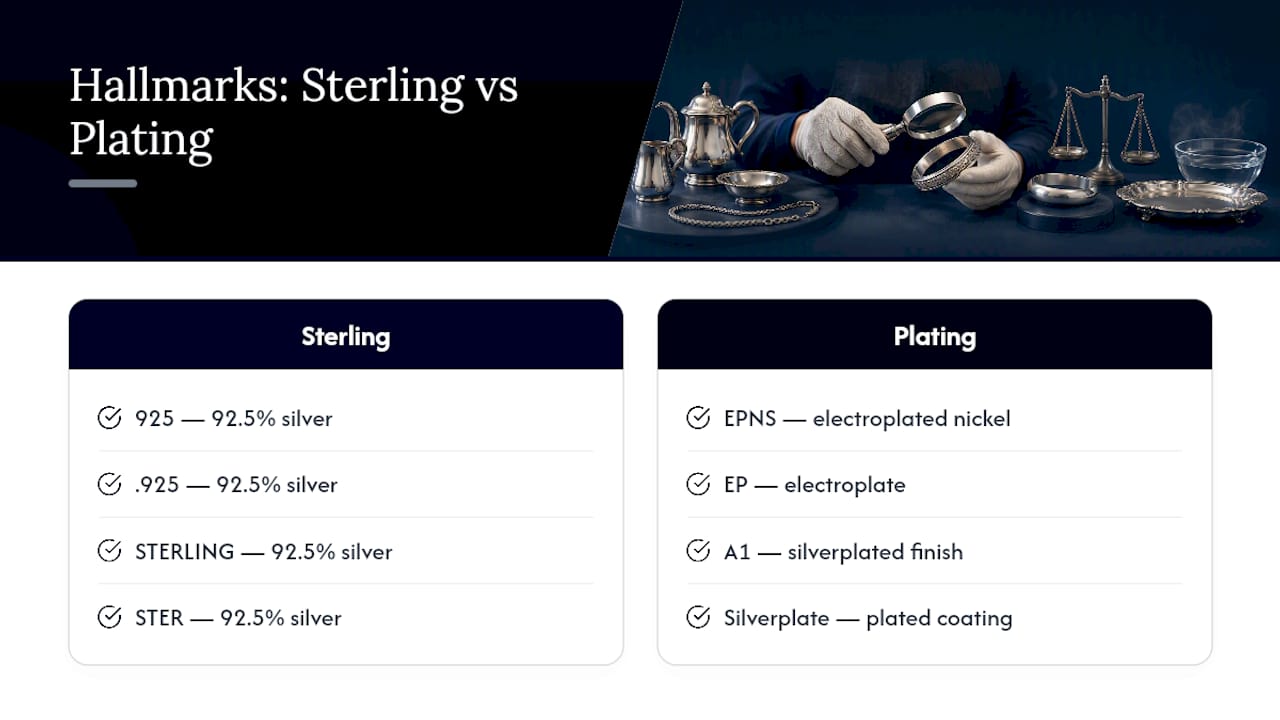
- Scan for hallmarks. Look inside rings, on clasps, and on the back of flatware for 925, .925, or STERLING. Plated pieces often carry EPNS, EP, or Silverplate instead.
- Check the high-wear spots. Edges, seams, and raised details are where plating rubs thin first.
- Run a quick test. A magnet, an ice cube, or a light tap can tell you a lot in under a minute.
- Weigh it in your hand. Sterling has a denser, more substantial feel than most plated pieces of similar size.
- Stop before you cut or scratch anything. If a piece matters, financially or sentimentally, skip DIY acid testing and get it looked at professionally.
That order matters. Appraisers work the same way: marks first, then edges, then wear pattern, then simple tests, and only then anything destructive.
What Do Sterling and Plating Hallmarks Actually Mean?
Sterling silver almost always carries a stamp: 925, .925, STERLING, or occasionally STER. Genuine sterling is defined as an alloy that’s 92.5% silver by weight, with the rest usually copper for strength. Older pieces, especially British or European antiques, may use assay hallmarks (a lion, a crown, a city mark) instead of numbers, so don’t panic if you don’t see “925” on a Victorian teapot.
Plated items carry different language entirely. Watch for EPNS (electroplated nickel silver), EP, A1, Silverplate, or Triple Plate. Any of these tell you the silver is a coating, not the metal itself, no matter how convincing the shine looks.
A few things complicate this. Stamps wear off over decades of polishing. Some manufacturers, mostly in past eras, stamped pieces deceptively to look more valuable than they were. And rhodium is sometimes plated over genuine sterling to resist tarnish, which means a plated-feeling surface doesn’t always mean a plated core.
Pro Tip: Check two or three spots on the same item, not just one. A worn or faked stamp in one place is far less convincing when the rest of the piece backs it up.
If a hallmark’s meaning still confuses you, our guide to what jewelry hallmarks really mean breaks down maker’s marks alongside purity stamps.
Where Does Wear Reveal Plating First?
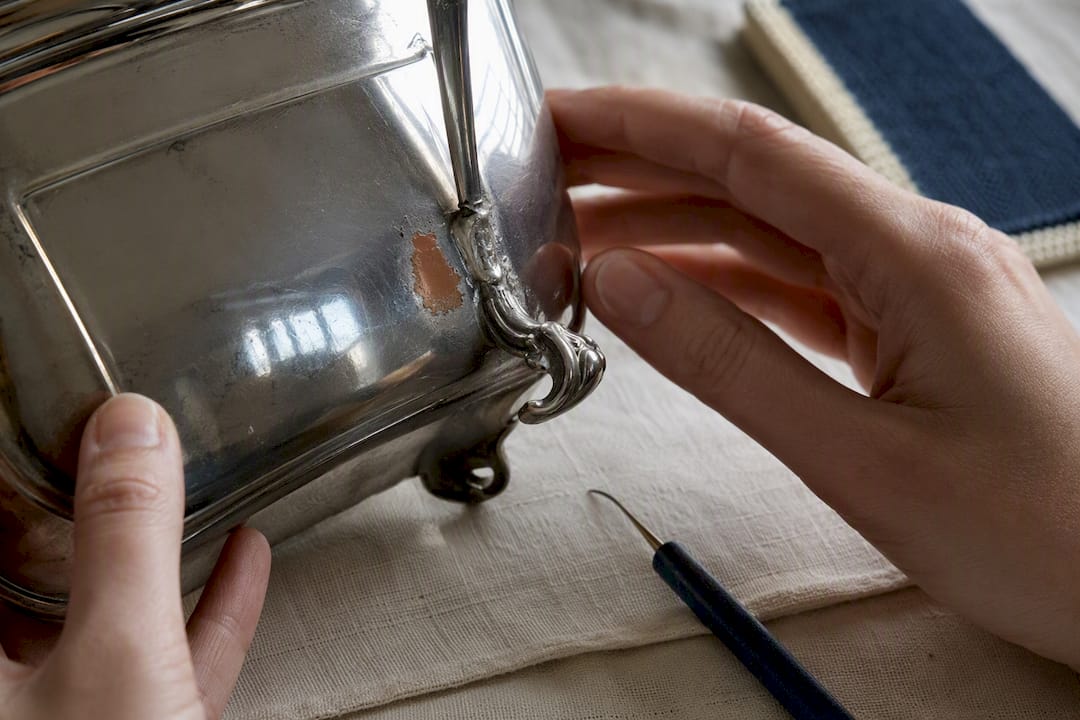
Plating doesn’t fail evenly. It fails exactly where a piece gets touched, gripped, or rubbed, and that’s your best diagnostic tool when a stamp is missing or unreadable.
- Check ring shanks near the bottom, where fingers grip and metal-on-metal contact happens constantly.
- Look at earring posts and clasps, both stress points that see repeated friction.
- Inspect hinge lines on bracelets and lockets, where flexing wears through fastest.
- Turn the piece over. Undersides and backs often show the first signs because they take incidental contact nobody notices.
A yellowish or pinkish tone peeking through a silvery surface is your tell. That’s brass or copper showing through, confirming a plated substrate rather than a flaw in the silver itself. Sterling behaves differently under stress: it tarnishes more uniformly across the whole surface, and a good polish brings the shine back everywhere at once rather than patchily.
One wrinkle worth knowing: a repaired piece, or one with soldered joints, can show mixed signals. Older sterling repaired with a different alloy, or plated over at some point in its life, won’t read cleanly. When wear patterns look inconsistent across one piece, treat that as a reason to test further, not a reason to guess.
Do Home Tests for Silver Actually Work?
Home tests won’t replace a lab, but they’re fast, free, and good enough to rule things out before you buy, sell, or worry.
- The magnet test. Hold a strong magnet near the piece. Strong attraction usually means a plated layer over a ferrous (iron-based) core, since real silver isn’t magnetic. But no attraction doesn’t prove sterling. Plenty of fakes use brass or copper, which aren’t magnetic either. Slide a strong neodymium magnet down a tilted silver surface, and it will noticeably drag, an eddy-current effect that only happens on conductive metal.
- The ice test. Place an ice cube directly on the surface. Silver conducts heat exceptionally well, so a cube melts noticeably faster on real silver than on most base metals.
- The sound test. Gently tap the piece and listen. Sterling tends to ring with a clearer, longer tone; plated base metals often sound duller or shorter, “a difference estate appraisers rely on more than most buyers realize”.
- The rub test. Rub the piece firmly with a clean white cloth. Black residue is silver sulfide, a byproduct of real silver tarnishing, and it’s a good sign. Flaking or a shiny cloth streaked with a different color usually means the plating is separating.
When Should You Get Professional Silver Testing?
Home tests are great for a quick gut check. They’re not enough when real money, a family heirloom, or an insurance claim is on the line.
- XRF and electronic testers analyze metal composition without damaging the piece, and pawn shops and jewelry stores increasingly offer this in minutes. The catch: very thin plating can occasionally confuse a reading if the machine isn’t calibrated for it.
- Nitric acid spot testing is definitive, reacting differently to sterling than to base metal, but it leaves a tiny mark on the piece. Leave this one to a professional who knows where to test discreetly.
- A full appraisal goes further, documenting maker, pattern, condition, and metal content together, which matters if you’re insuring, selling, or settling an estate. Bring any receipts, prior appraisals, or photos of maker’s marks; they speed things up and support your case.
Look for appraisers affiliated with the GIA or ASA, or an independent jewelry lab with a track record in silver specifically, not just diamonds.
Pro Tip: Ask upfront whether a test is destructive before you agree to it. A five-minute XRF scan costs you nothing structurally; a scratch test is permanent.
How Does Metal ID Change What Your Silver Is Worth?
Once you know what you’re holding, the decision gets a lot simpler. Confirmed sterling carries genuine melt value tied to spot silver prices, on top of whatever design or maker premium it commands. Plated pieces generally don’t have that floor. Their worth comes almost entirely from pattern, maker reputation, and condition, which is exactly why a beat-up plated tray can be worthless while a mint-condition one from a known silversmith still sells.
- Confirmed 925 sterling: weigh it, note the maker, and choose a selling channel that pays close to melt value plus any design premium.
- Confirmed plate in strong condition: value it on pattern and maker, not metal content, and consider decorative or collector markets instead.
- Confirmed plate that’s worn through: replating can cost more than a piece is worth. Selling as-is or repurposing is often the smarter move.
Curious how provenance and maker’s marks factor into resale beyond just the metal? Fine jewelry’s investment value goes deeper into what actually moves resale price.
Can Sterling Silver or Silver Plated Jewelry Cause Skin Reactions?
Sterling silver rarely causes skin irritation on its own. Pure silver is one of the least reactive metals people wear, which is part of why it’s a common recommendation for sensitive skin. The usual alloy metals can sometimes cause mild skin discoloration (that greenish tint some people notice) but it’s rarely a true allergic reaction.
Silver plated jewelry carries more risk, and it’s not really about the silver layer itself. It’s what’s underneath. Base metals commonly used in plating, brass, nickel, or nickel-containing alloys, sit directly against skin the moment that thin silver coating wears through. Nickel allergy is one of the more common metal sensitivities people develop, and once plating thins at a ring shank or earring post, that’s exactly where prolonged skin contact happens.
If you’ve noticed itching, redness, or a rash that shows up specifically where a ring or earring touches skin, and it started after the plating visibly wore down, that’s a reasonable sign the base metal is the trigger, not the silver. Switching to solid sterling, rather than a plated equivalent, usually resolves it. If reactions persist even with sterling, a dermatologist can test for nickel or copper sensitivity specifically rather than guessing.
A Straight Take on Buying Silver Sight Unseen
The internet has made this harder, not easier. Photos flatten every visual cue that would normally tip you off. A plated bracelet lit well and shot close can look identical to sterling in a marketplace listing, and sellers aren’t always lying; plenty genuinely don’t know what they’re passing along.
Here’s what the conventional advice gets backwards: it treats the magnet test like a verdict. It’s not. It’s a filter for the worst fakes, nothing more. Skipping the hallmark check and going straight to a magnet is how people convince themselves a piece is sterling just because it didn’t stick. Marks first, always, then wear patterns, then the quick tests as backup, not the other way around.
The other thing people underestimate is how much a worn hallmark still tells you. A half-legible “925” stamped decades ago is still more trustworthy than a crisp, suspiciously perfect stamp on something claiming to be antique. Wear is honest in a way that pristine perfection sometimes isn’t.
— Georgia
Diamonds by Daisy’s Approach to Metal Clarity
Georgia has written extensively for the Diamonds by Daisy blog on identifying genuine 925 silver and caring for rhodium-finished pieces, and one theme keeps surfacing: buyers deserve to know exactly what metal they’re wearing, not guess from a photo. That’s why every product page states metal content plainly, sterling marked as sterling, plated marked as plated, with no ambiguity left for the customer to untangle. If you ever have a question about what’s in a specific piece, customer service will confirm it before you buy, not after.
Where to Find Clearly Labeled Sterling Silver
Buying silver online usually means trusting a listing photo and hoping the description is honest. Diamonds by Daisy skips that guesswork entirely: every piece in the sterling silver and diamond jewelry collection states its metal content plainly on the product page, so you know before checkout whether you’re holding 925 sterling or something else.
That clarity matters more with silver than almost any other material, since the visual difference between good sterling and good plating can be nearly invisible until wear sets in. Pair a labeled piece with proper upkeep and it holds up for years; gentle, non-abrasive cleaning keeps tarnish from building up between wears, whether the piece is sterling or a rhodium-finished plate. If you’re shopping for a gift or restocking your own everyday pieces, browse the sterling silver collection and check the listed metal content on each item before you add it to your cart. Questions about a specific piece’s composition? Reach out to customer service directly and get an answer before you buy, not after.
Sources
- How To Tell If Your Silver Is Real—And What To Look For
- Sterling Silver vs Silver Plate: What Appraisers Check | Appraisily
- Sterling silver vs silver plated: 7 easy ways to tell the difference | AntiqueIdentifier
- How to Tell If Silver Is Real Sterling Silver: 5 Easy Checks | Busby Antiques