

Investing in Independent Jewellery Designer Collections
Table of Contents
- Why Independent Jewellery Designer Collections Are Worth Your Attention
- How to Start a Fine Jewellery Collection with Independent Designers
- Identifying Investment-Grade Gemstones in Designer Pieces
- Authentication and Provenance: What Buyers Must Verify
- Resale Market Dynamics for Independent Jewellery
- Care and Maintenance for Fine Jewellery Collections
- Frequently Asked Questions
Last Updated: September 15, 2026
Why Independent Jewellery Designer Collections Are Worth Your Attention
Investing in independent jewellery designer collections means buying from named, small-scale makers who produce in limited quantities rather than mass-manufactured lines. At Diamonds by daisy, this is where personal style and long-term value meet.
That distinction matters more than most buyers realise. Mass-market luxury sells a name; independent jewellery sells a maker's hand, an original design, and a documented stone. The British Hallmarking Council guidance on hallmarking sets out how precious metals are independently tested and marked, which is one of the few objective quality signals a buyer can verify before purchase.
Below, we break down how to assess craftsmanship, gemstone certification, provenance and resale potential, and where the real risks sit. Pieces that hold value share three traits: a named designer, certified stones, and paperwork that survives the sale.
What Separates Independent Designers from Mass-Market Luxury
The difference is volume and control. An independent goldsmithing studio might produce a handful of a design, choosing each gemstone by hand; a mass-market line produces the same setting in the thousands, often in base metal with thin precious-metal plating.
That control shows up in ways that matter to a collector:
- Original design rather than licensed or copied silhouettes
- Handpicked gemstones with individual character
- Full hallmarking on every precious metal component
- Limited edition or one-off runs that create genuine rarity
Rarity alone does not create value: a rare piece nobody wants is still worth little. Value comes from rarity combined with a designer whose work has a documented track record.
How to Start a Fine Jewellery Collection with Independent Designers
Start with one anchor piece and build outward. A fine jewellery collection is curated, not a shopping spree, and the first piece should be the one you would keep if you sold everything else.
A practical sequence for a first purchase:
- Decide the purpose: daily wear, milestone, or pure investment
- Set a budget and stick to it across the first three pieces
- Choose one designer whose aesthetic you genuinely like
- Buy the best-certified stone you can afford in that budget
- Keep every receipt, certificate and valuation document together
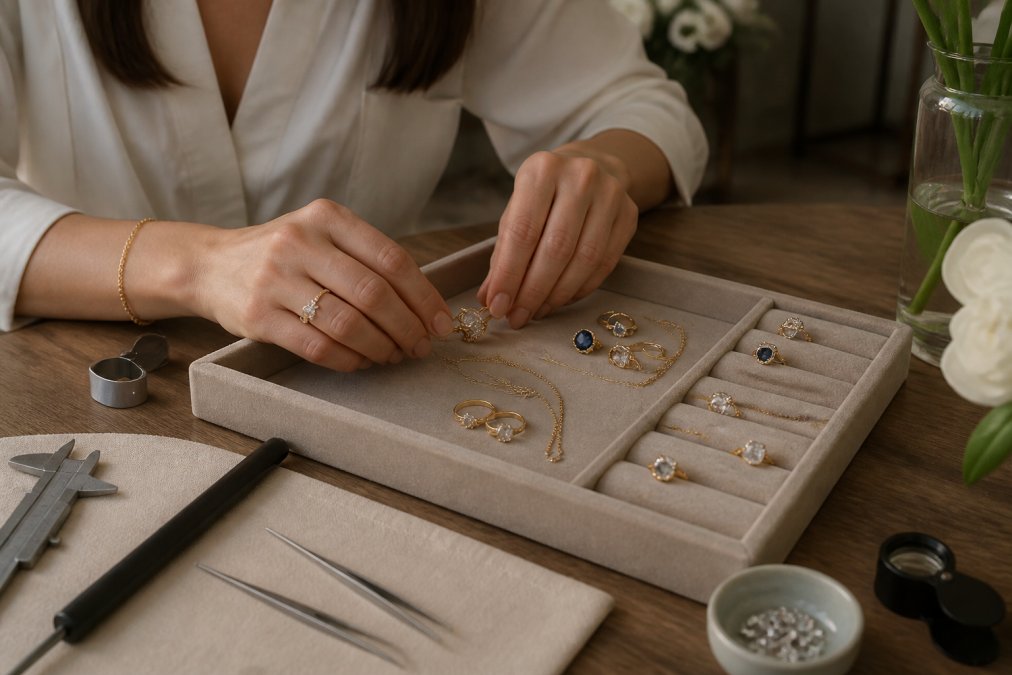
Building a Curated Collection: First Pieces to Consider
The first pieces to consider are a signature ring, a pendant on a fine chain, and a pair of studs or drops. These cover most wearing occasions and resell easiest individually if your taste changes.
A common mistake is buying three similar pieces. Three near-identical rings offer less flexibility than a ring, a pendant and earrings, variety across categories gives you more options and a broader pool of future buyers.
Identifying Investment-Grade Gemstones in Designer Pieces
Investment-grade gemstones combine good colour, clarity, cut and carat weight with independent certification and a market that actually trades them. A large, poorly cut stone with no paperwork is a decorative purchase, not an investment.
The four factors buyers should weigh:
| Factor | What to Check | Why It Matters |
|---|---|---|
| Certification | Independent gemstone certification report | Proves the stone is what the seller claims |
| Hallmarking | Assay office mark on the metal | Confirms precious metal purity |
| Cut quality | Proportions and symmetry | Drives how the stone performs in light |
| Rarity | Natural, untreated where possible | Underpins long-term appreciation |
Certification, Hallmarking, and Documentation
Certification and hallmarking are the two documents that protect a buyer. Certification comes from an independent laboratory that grades the stone; hallmarking from a UK assay office that tests the metal. Together they turn a verbal claim into a verifiable fact.
Without both, you are relying entirely on the seller's word. That is fine for a fashion piece. It is not fine for anything you intend to treat as an asset. The Gemological Institute of America on diamond grading reports explains what a grading report does and does not cover, which is worth reading before you accept any certificate at face value.
Authentication and Provenance: What Buyers Must Verify
Authentication confirms a piece is genuine; provenance confirms where it came from and who owned it. For independent work, provenance is the harder half and separates a collectible from a curiosity. Unlike a branded piece, whose maker is stamped on the item and recorded in a central archive, an independent piece relies on a paper trail the designer controls. If that trail is thin, the piece is hard to authenticate later, and hard to authenticate means hard to sell.
Most guides stop at "keep your receipt". That is not enough. The checklist below is what a serious buyer should demand at the point of sale, the same evidence a future buyer, valuer or auction house will ask for.
The Documentation Checklist for Independent Pieces
Ask for, and keep, all of the following:
- Signed designer's certificate or letter of authenticity on studio letterhead, naming the piece, the materials, the gemstone(s) and the date of making
- Original invoice or receipt showing the designer's trading name, the price paid and the date
- Independent gemstone report from a recognised laboratory, with the report number matching the stone in the piece
- Assay office hallmark on every precious metal component, consistent with the stated metal and, where relevant, the date letter
- Stone map or setting diagram for pieces with multiple stones, so a future valuer can confirm nothing has been swapped
- Provenance note covering the design's origin, was it a one-off commission, a limited run, or part of a named collection?
- Any prior valuation or insurance schedule, if the piece has been owned before
- Photographs of the piece at purchase, ideally including close-ups of the hallmark and the stone
A designer who cannot supply most of this is not necessarily dishonest, many small studios simply have not built the admin habit. But missing paperwork caps what the piece can achieve on resale.
How to Read a Gemstone Report Properly
A gemstone report is not a guarantee of value but a statement of identity and, for some stones, a grade. Read it for four things: species and variety, carat weight, whether the stone is natural or synthetic, and whether it has been treated. Treatment disclosure matters enormously, an untreated sapphire and a heat-treated one of the same colour are not the same asset.
The Gemological Institute of America on diamond grading reports explains what a grading report does and does not cover, which is worth reading before you accept any certificate at face value. For coloured stones, the equivalent reports from recognised laboratories follow similar principles: they describe the stone, they do not price it.
Provenance and the Emerging-Designer Risk Question
Risk assessment of emerging designers belongs here too. A designer with five years of consistent output, a documented client list and a recognisable body of work carries less risk than one who appeared last season. Neither is automatically a bad buy, but the emerging designer should be priced accordingly, and the paperwork should be even more complete, because there is no secondary market history to fall back on.
A practical test: in ten years, could a stranger look at this piece plus its documents and agree on what it is? If yes, you have an authenticatable asset. If no, you have a beautiful object with a ceiling on its resale value.
Resale Market Dynamics for Independent Jewellery
Resale for independent jewellery is thinner than for branded luxury, which cuts both ways.
The Four Channels and What Each Costs You
What Actually Drives Liquidity for an Independent Piece
The Ethical Premium as a Resale Driver
Care and Maintenance for Fine Jewellery Collections
Frequently Asked Questions
What makes independent jewellery a good investment?
Independent jewellery offers investment potential through rarity, original design, and artisanal craftsmanship that mass-market pieces lack. Limited edition collections and bespoke commissions from skilled designers create scarcity. Precious metals and certified gemstones provide intrinsic value, while provenance and hallmarking support authentication and resale. The secondary market increasingly values unique pieces with documented ethical sourcing and design innovation, though liquidity varies by designer reputation and market trends.
How do I verify the quality of independent jewellery designer pieces?
Check for UK hallmarking on precious metals, which confirms metal purity at an assay office. Request gemstone certification from recognised laboratories for significant stones. Examine craftsmanship details: secure settings, smooth finishes, and consistent design execution. Ask for documentation covering materials, origin, and any ethical sourcing claims. A reputable designer provides transparent information and stands behind their work with guarantees.
What should I look for when buying jewellery from independent designers?
Prioritise pieces with clear provenance, proper hallmarking, and gemstone certification where applicable. Assess craftsmanship through setting quality, finish, and weight. Consider the designer's track record and whether their style aligns with lasting appeal rather than fleeting trends. Ethical sourcing documentation adds value. Start with versatile pieces in precious metals that suit regular wear, and confirm the returns policy before committing.
Are independent jewellery collections better than mass-market luxury brands?
Independent collections often offer greater originality, smaller production runs, and direct relationships with makers. Mass-market luxury brands provide consistency and brand recognition. For investment purposes, independent pieces with documented provenance and limited availability can appreciate more than widely produced items. The best choice depends on whether you value uniqueness and artisanal craftsmanship or brand prestige and easier resale through established channels.