

Every Earring Back Type Explained: Your Complete Guide
For most people, the right earring back comes down to four families: friction/push backs (the classic butterfly clutch), screw/locking backs, flat-back labrets, and integrated closures like leverbacks and French hooks. Here is the fastest way to choose:
- Security first? Screw backs or professional locking systems (Guardian, Chrysmela) are your pick.
- Sleeping or cartilage comfort? Flat-back labrets sit flush and remove the protruding post entirely.
- Everyday convenience? Friction/push backs slip on and off in seconds and work with nearly every stud.
- Dangle earrings? Leverbacks and French hooks handle the weight and keep the earring hanging at the right angle.
Every other back type is a variation on these four families. The sections below break down the full catalog, trade-offs, and a step-by-step checklist for buying or gifting.
Key Takeaways
Screw backs and locking systems are the most secure earring backs available, and flat-back labrets are the best choice for cartilage piercings and sleeping comfort.
| Point | Details |
|---|---|
| Security hierarchy | Screw and locking backs lead; friction/push backs degrade over time and suit only lightweight, low-value earrings. |
| Flat-backs for comfort | Flat-back labrets sit flush behind the ear, making them the top pick for cartilage piercings and overnight wear. |
| Post compatibility matters | Locking backs require matching post diameters and, for professional systems, notched posts; always verify before buying. |
| Hypoallergenic metals | Choose platinum, titanium, 14K gold, or surgical steel backs for sensitive ears or when gifting to someone with unknown sensitivities. |
| Diamondsbydaisy | Offers curated sterling silver and diamond earrings with hypoallergenic backs and a Fine Jewelry Return Guarantee for confident gifting. |
Table of Contents
- What are the different earring back types?
- Detailed profiles of each earring back type
- Which earring backs are the most secure?
- What materials are earring backs made from?
- How to choose the right earring back
- How to fit, remove, and replace earring backs safely
- Keeping your earring backs clean and secure
- Diamondsbydaisy’s recommendations for gifting and everyday wear
- The backs that actually matter, and the ones that are overhyped
- Curated earrings with the right backs, ready to gift
- Sources
What are the different earring back types?
The industry uses a mix of formal and informal names, and the same back often appears under two or three labels in product listings. Here is a quick reference:
| Back Type | Also Called | One-Line Function | Best For |
|---|---|---|---|
| Friction/push back | Butterfly, clutch, push back | Slides onto post; tension holds it | Everyday studs, quick changes |
| Screw back | Threaded back | Screws onto threaded post | Secure studs, fine jewelry |
| Flat-back labret | Comfort disc, disc back | Flat disc screws onto internally threaded post | Cartilage, sleeping, sensitive lobes |
| Locking back | Guardian, positive-lock, safety back | Requires trigger press to release | Valuable studs, children, travel |
| Silicone/rubber back | Soft back, clear back | Soft friction grip | Lightweight earrings, sensitive skin |
| Leverback | Lever back | Hinged lever snaps shut behind lobe | Dangle and drop earrings |
| French hook | Fish hook, fishhook | Open wire curves through lobe | Lightweight dangles, chandelier styles |
| Latch/hinge/omega | Hinged hoop, clicker, omega back | Hinged bar or ring snaps closed | Hoops, huggies, thick-gauge styles |
| Huggie clasp | Snap clasp | Integrated hinge on small hoop | Huggies, small hoops |
| Magnetic back | Magnet back | Magnet holds two pieces together | Non-pierced or clip-on styles |
A note on terminology: “Post” refers to the metal pin that goes through the ear. “Clutch” and “butterfly” are the same thing. “Disc back” and “comfort back” both describe flat-back labret-style closures. Knowing these synonyms matters when you are reading product listings or asking a jeweler.
Detailed profiles of each earring back type
Friction/push backs (butterfly clutch)
The most common back in the world. A small metal piece with two wing-like tabs grips the post through spring tension. They fit virtually any standard post, cost almost nothing to replace, and take about one second to put on.
The catch: tension weakens over time. A friction back that felt snug when new may barely grip the post after a year of daily wear. They also offer no active locking mechanism, so a snagged sweater or a bump can pull them free. For a $20 pair of studs, that is fine. For a diamond solitaire, it is a real risk.
Stylistic note: The butterfly wings sit visibly behind the ear. On very small studs, the back can look disproportionately large.
Screw backs
A threaded post pairs with a back that literally screws on. The connection is mechanical and does not rely on spring tension, so it stays put through activity and sleep. Screw backs are the standard for fine jewelry studs, particularly diamond and gemstone settings.
The trade-off is convenience. Screwing a back on with one hand, in dim light, or in a hurry is genuinely annoying. Some people find the threading wears down after years of use, especially if the back is overtightened repeatedly.
Compatibility note: Screw backs only work on threaded posts. You cannot put a screw back on a smooth post.
Flat-back labrets (comfort disc)
A flat disc screws onto an internally threaded post from the front of the ear, leaving a smooth, low-profile surface behind the lobe. There is no protruding back to press into a pillow or catch on clothing. Retail and trade guides consistently recommend flat-back labrets for cartilage piercings and sleeping because they remove the protruding post entirely.

They require internally threaded posts, which are not universal. Replacing the back means unscrewing from the front, which can feel counterintuitive at first.
Locking backs (positive-lock systems)
These are the backs designed specifically to prevent loss. The best-known professional system is the Guardian back, which engages a groove on the post and only releases when both trigger tabs are pressed simultaneously. Guardian positive-lock backs require matching notched posts and a specific post diameter (0.89 mm for the Guardian Original) to function correctly. Using them on a standard smooth post can render the mechanism ineffective or damage it.
Consumer-grade locking backs like the Chrysmela Catch use a different approach: a three-ball micro-bearing primary grip plus a secondary safety catch, designed to fit most straight posts in the 0.6–1.1 mm diameter range without requiring a notched post. Both systems are meaningfully more secure than friction backs, but neither is truly universal.
Troubleshooting: Locking mechanisms can jam if polishing residue or debris gets into the release channel. A soft toothbrush and warm water usually clear it.
Silicone/rubber backs
Soft, clear, and gentle on skin. Silicone backs grip through friction like a butterfly back but with a softer feel. They are popular for children’s earrings and for people with metal sensitivities who want to avoid any metal contact behind the ear.
Security is modest. Silicone compresses and can stretch over time, reducing grip. They are not a good choice for heavy earrings or active wear.
Leverbacks
A hinged lever arm snaps shut behind the lobe, creating a closed loop. The earring cannot fall out unless the lever is deliberately opened. Leverbacks are the standard closure for drop and dangle earrings because they handle weight well and keep the earring hanging at a natural angle.
They are integrated into the earring design, so you cannot swap a leverback onto a different style. The hinge can loosen with heavy use; a jeweler can tighten it.
French hooks (fishhook backs)
An open wire curves through the lobe and hangs freely. No locking mechanism. The earring stays in place through the curve of the wire and gravity, which means it can slip out if the wire straightens or catches on something. French hooks are lightweight, elegant, and the default for chandelier and drop styles, but they are not suitable for active wear or children.
Stylistic note: The open back is part of the design aesthetic. The earring swings freely, which is intentional for dangle styles.
Latch/hinge backs (omega, clicker, hinged hoop)
A hinged bar or ring snaps into a notch or channel to close the earring. Clicker rings are common in cartilage and septum jewelry. Omega backs appear on larger hoop and statement earrings. Security is good once snapped shut, but the hinge mechanism can wear over time.
Huggie clasps
A small integrated hinge on a close-fitting hoop earring. The hoop itself is the earring; the clasp is part of the design. Huggies sit tight against the lobe, which makes them comfortable for all-day wear and reduces snagging risk.
Magnetic backs
Two magnetic discs hold the earring against the lobe without a piercing. Security depends entirely on magnet strength, and strong magnets can be uncomfortable for extended wear. These are not suitable for children due to the choking hazard if the magnets separate.
Comparison at a glance
| Back Type | Security | Ease of Use | Best For | Comfort | Compatibility |
|---|---|---|---|---|---|
| Friction/push | Low–medium | Very easy | Everyday studs | Medium (wings show) | Standard posts |
| Screw back | High | Moderate | Fine jewelry studs | Good | Threaded posts only |
| Flat-back labret | High | Moderate | Cartilage, sleeping | Excellent (flush) | Internally threaded posts |
| Locking back | Very high | Moderate | Valuables, children, travel | Good | Notched or specific-diameter posts |
| Silicone/rubber | Low | Very easy | Lightweight, sensitive skin | Excellent | Standard posts |
| Leverback | High | Easy | Dangle/drop earrings | Good | Integrated only |
| French hook | Low | Very easy | Lightweight dangles | Good | Integrated only |
| Latch/hinge/omega | High | Easy | Hoops, cartilage | Good | Integrated only |
| Huggie clasp | High | Easy | Small hoops | Excellent | Integrated only |
| Magnetic | Low | Very easy | Non-pierced styles | Variable | No piercing needed |
Which earring backs are the most secure?
Security ranking, from highest to lowest:
- Screw backs and professional locking systems (Guardian, Chrysmela): the top tier. Mechanical connection that does not rely on spring tension.
- Threaded flat-backs and clicker/latch backs: strong, but integrated into specific earring styles.
- Leverbacks and hinged omega backs: reliable for dangles; the closed loop prevents accidental loss.
- Friction/push backs: adequate for light everyday use; tension degrades over time.
- Silicone backs: lowest security; suitable only for lightweight earrings in low-risk settings.
The key variable in locking systems is post compatibility. Professional positive-lock backs require matching notched posts; using them on smooth posts is ineffective. Consumer locking backs like Chrysmela are designed for a wider post-diameter range (0.6–1.1 mm) but still have limits. Always verify post diameter before buying a locking back.
Practical scenarios:
- Children’s earrings: Screw backs or locking backs. Avoid French hooks and magnetic backs entirely.
- Travel and active wear: Screw backs or locking backs. Friction backs are a liability in a gym bag or on a plane.
- Expensive studs: Screw backs at minimum; locking backs for anything you cannot afford to lose.
- Cartilage piercings: Flat-back labrets. The flush surface prevents pressure and snagging.
Pro Tip: Before buying a locking back, measure your post diameter with a caliper or ask your jeweler. A Guardian back on the wrong post will not engage properly, and forcing it can score the post surface.
What materials are earring backs made from?
Common materials, from most to least hypoallergenic:
- Platinum: The gold standard for sensitive ears. Naturally hypoallergenic, dense, and durable.
- Titanium (implant-grade): Lightweight, nickel-free, and the preferred material for new piercings and cartilage.
- 14K or 18K gold: Generally safe for most people. Lower karat gold (9K, 10K) contains more alloy metals and a higher nickel risk.
- Surgical stainless steel (316L): Widely used and generally safe, though it contains trace nickel. Most people with mild sensitivities tolerate it; those with severe nickel allergies may not.
- Niobium: Nickel-free and hypoallergenic, less common but a good alternative to titanium.
- Sterling silver: Contains 7.5% copper alloy. Safe for most people but can tarnish and cause reactions in very sensitive ears.
- Gold-filled: A thick layer of gold bonded to a base metal. More durable than plating but the base metal can be exposed if the layer wears through.
- Silicone/rubber: No metal contact behind the ear; good for metal sensitivities but limited to lightweight earrings.
Nickel is the most common contact allergen in jewelry. The American Contact Dermatitis Society identifies nickel as the leading cause of allergic contact dermatitis from jewelry. Surgical steel and titanium are the safest choices for anyone with a known sensitivity.
For gifting: Choose 14K gold, titanium, or surgical steel backs when you are unsure of the recipient’s sensitivities. Plated backs can look identical to solid metal but wear through over months of use, exposing the base metal. If you are giving fine jewelry, confirm the back material matches the post.
Pro Tip: When trying a new back material, wear it for 30 minutes and check for redness or itching before committing to a full day. Reactions usually appear within an hour of contact.
How to choose the right earring back
Work through these questions in order:
- What is the primary concern? Security (valuable piece, active lifestyle, child) → screw or locking back. Comfort (sleeping, cartilage) → flat-back labret. Convenience (daily changes, casual wear) → friction/push back.
- Where is the piercing? Lobe supports most back types. Cartilage strongly favors flat-back labrets. Helix and tragus piercings almost always use flat-backs or clicker rings.
- How heavy is the earring? Heavy drops and chandeliers need leverbacks or latch backs. Lightweight studs work with any back. Heavy studs benefit from screw or locking backs.
- Does the wearer have metal sensitivities? If yes, prioritize platinum, titanium, or implant-grade steel. Avoid unknown plated metals.
- How often will the back be changed? Daily changers want friction backs or French hooks. Set-and-forget wearers can manage screw backs.
- Is this for a child? Avoid French hooks, magnetic backs, and tiny detachable parts. Screw backs or locking backs are the right choice.
- Ask the seller or check the packaging: Post diameter, back material, whether the back is replaceable, and care instructions. A back that cannot be replaced is a liability.
Red flags to avoid: Unknown plated metals for sensitive ears; magnetic backs for children under 12; friction backs on expensive fine jewelry; locking backs without confirming post compatibility first.
How to fit, remove, and replace earring backs safely
Friction/push backs
- Hold the earring post steady with one hand.
- Align the back’s center hole with the post tip.
- Push straight onto the post until you feel resistance. Do not push past the point of firm grip.
- To remove: grip the back between thumb and forefinger and pull straight back while holding the front of the earring.
- Replace when the back slides on with little resistance or wobbles on the post.
Screw backs
- Thread the back onto the post by turning clockwise. Use light pressure.
- Stop when snug. Overtightening strips the threads over time.
- To remove: turn counterclockwise. If stuck, a jeweler can help without damaging the post.
- Inspect threads monthly for wear or grit. A soft brush clears debris.
Flat-back labrets
- Insert the post from the back of the ear (the flat disc sits behind the lobe).
- Screw the decorative front piece onto the post from the front, turning clockwise.
- To remove: hold the flat disc behind the ear and unscrew the front piece.
- Note: the disc and front piece are both small. Work over a tray or soft surface.
Locking backs (Guardian/positive-lock style)
- Confirm the post has the correct groove and diameter before attempting to fit the back. Matching post and clutch is required for the locking mechanism to engage.
- Push the back onto the post until you hear or feel a click.
- Test by gently pulling the back. It should not move without pressing the release tabs.
- To remove: press both trigger tabs simultaneously and pull straight back.
- If the mechanism does not click or release smoothly, do not force it. Take it to a jeweler.
When to see a jeweler: If a screw back is stuck, a locking back will not engage, a leverback hinge is loose, or a post appears bent or scored. Forcing any of these risks permanent damage to the earring.
Pro Tip: After cleaning or replating, always recheck the fit of locking backs. Polishing residue inside the mechanism is a common cause of failure, and a quick check takes ten seconds.
Keeping your earring backs clean and secure
Regular maintenance is the single most overlooked part of earring care. A friction back that loses tension does not announce itself; it just falls off one day.
Daily habits:
- Wipe posts and backs with a soft cloth after each wear to remove skin oils, product residue, and moisture.
- Remove earrings before applying perfume, hairspray, or sunscreen. Chemicals in these products strip plating and can gum up locking mechanisms.
- Store backs separately from loose jewelry to avoid scratching or bending the spring tension in butterfly backs.
Weekly checks:
- Test friction backs by sliding them onto a post and checking resistance. If they slide on with almost no effort, replace them.
- Inspect screw threads for grit or visible wear. A soft toothbrush and warm water clear most debris.
- Verify locking clutch release: press the tabs and confirm smooth action. Stiffness usually means debris in the channel.
Periodic and annual care:
- Replace friction backs every 6–12 months for earrings worn daily. They are inexpensive and the cost of losing a fine earring is not.
- For valued pieces, an annual check with a jeweler covers post condition, thread integrity, and locking mechanism function. Screw and locking systems must be kept free of debris and polishing residue to avoid obstruction of the locking components.
- Silicone backs should be replaced when they show any cracking or loss of elasticity.
Diamondsbydaisy’s recommendations for gifting and everyday wear
At Diamondsbydaisy, the earrings curated for everyday wear and gifting are selected with the back type in mind, not just the front. Here is what that means in practice:
- For everyday studs: Low-profile backs in 14K gold or surgical steel. They sit flat, do not snag on hair, and work for most ear types without a fitting appointment.
- For fine jewelry studs: Screw backs or locking backs, always on matching threaded or notched posts. A diamond stud deserves more than a friction back.
- For gifting: Hypoallergenic metals (titanium, 14K gold, surgical steel) as the default. The recipient’s sensitivities are unknown, and a reaction is a poor first impression of a thoughtful gift.
- For cartilage and second piercings: Flat-back labrets where available, or low-profile screw backs. Comfort matters more than aesthetics when the back is pressed against cartilage all day.
Diamondsbydaisy’s Fine Jewelry Return Guarantee means that if a piece does not fit or the back style is not right for the wearer, there is a clear path to resolution. That matters for gift buyers who cannot try the earring on the recipient before purchase.
Pro Tip: When buying earrings as a gift, note the back type on the gift receipt or include a card. The recipient may not know how to use a screw back or locking system, and a quick note prevents frustration.
The backs that actually matter, and the ones that are overhyped
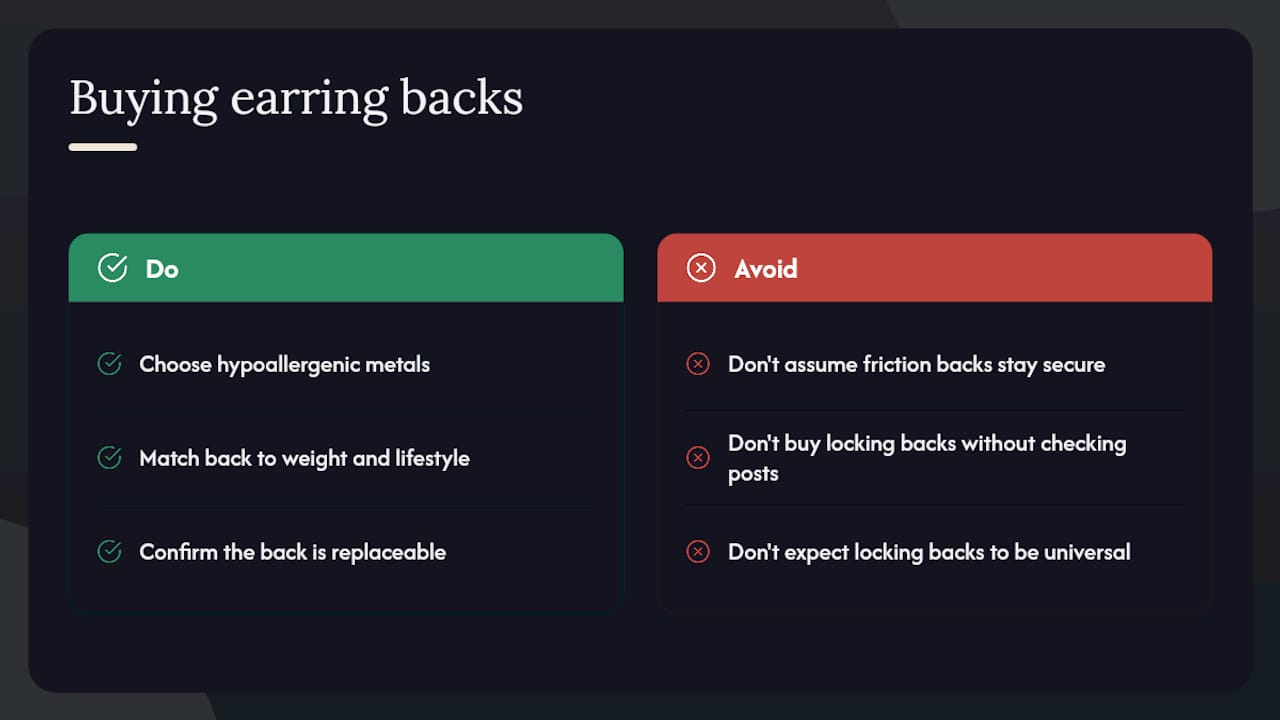
The conventional advice on earring backs tends to either oversimplify (“just use butterfly backs for everything”) or overcomplicate (“you need a professional locking system for any real security”). Neither is quite right.
Friction backs are genuinely fine for lightweight, low-value earrings worn in low-risk settings. The problem is that most people keep using them long past the point where the tension has degraded, without noticing. A friction back that felt secure two years ago may be holding on by habit rather than grip. That is the real risk, not the design itself.
Locking backs are excellent, but they are not magic. The Guardian system requires notched posts; the Chrysmela system works across a wider range but still has post-diameter limits. Buying a locking back without checking post compatibility is a common mistake that leaves people thinking the product failed when the real issue was a mismatch.
The most underrated back in the catalog is the flat-back labret. Most people associate it with body jewelry or cartilage piercings, but it is genuinely the most comfortable option for lobe studs too. No protrusion, no pressure point, no snagging. The only reason it is not universal is that it requires internally threaded posts, which are not standard on most mass-market earrings.
For gift buyers, the practical hierarchy is simple: choose hypoallergenic metals, match the back type to the earring weight and the wearer’s lifestyle, and confirm the back is replaceable. A beautiful earring with a worn-out back is just an earring waiting to be lost.
Curated earrings with the right backs, ready to gift
Choosing the right back is easier when the earring is already paired with one that suits the style and wearer. Diamondsbydaisy curates sterling silver and diamond earrings with hypoallergenic finishes and secure backing options, selected for everyday wear and gifting occasions. Whether you are shopping for a first pair of fine studs or a secure set for an active wearer, the collection covers the back types that matter most.
For occasion gifting, the gifts for her collection includes curated earring sets suited to different ear types and lifestyles. Browse, check the product details for back type and materials, and use the Fine Jewelry Return Guarantee as your safety net if the fit is not right.
Sources
- Types of Earring Backs: Complete Guide to Choosing the Right Closure
- Guardian Positive Locking Earring Backs 6.1mm | Gold & Platinum: Otto Frei
- World’s Most Secure Locking Earring Backs to Lock and Lift Earrings – Chrysmela