

Why Online Jewelry Prices Are Lower
Table of Contents
- Why Online Jewelry Prices Are Lower: The Core Economics
- The Direct-to-Consumer Model and Wholesale Markup
- How to Verify Jewelry Quality Online
- Benefits of Buying Diamond Jewelry Online
- Hidden Costs and Considerations of Online Jewelry Purchases
- Jewelry Return Policies Explained
- Online vs. In-Store: Making the Right Choice
- Frequently Asked Questions
Last Updated: September 21, 2026
Why Online Jewelry Prices Are Lower: The Core Economics
The reason online jewelers can undercut their brick-and-mortar counterparts comes down to a fundamental difference in how they operate. When you buy diamond jewelry online, you're not paying for the same overhead that traditional retailers shoulder.
The difference isn't about cutting corners on quality. Instead, it's about eliminating costs that don't directly improve the gemstones or precious metals in your piece. A physical storefront requires staff, utilities, property taxes, and rent, expenses that can easily run into tens of thousands of pounds annually. Online retailers sidestep most of these costs entirely, passing the savings directly to customers.
This structural advantage compounds across the entire supply chain. Direct-to-consumer models remove middlemen who traditionally took their cut. When you eliminate wholesale markups and distribution layers, the final price reflects a much leaner operation. The result is genuine value, not a marketing illusion.
Overhead costs and retail rent
Brick-and-mortar jewellery stores carry substantial fixed costs simply by existing in physical space. Rent alone represents one of the largest line items in a traditional retailer's budget. A prime location in any town centre commands premium rates, and landlords expect long-term leases. Add to that the cost of utilities, insurance, security systems, and maintenance, and you're looking at significant monthly expenditure before a single piece sells.
Staffing costs amplify this burden. A physical store requires trained jewellery consultants on the floor during business hours. In the UK, this means adhering to minimum wage requirements, providing holiday pay, and managing employment taxes. A team of even three staff members represents substantial payroll overhead. Online retailers, by contrast, can operate with a fraction of this headcount because they don't need to provide in-person service.
These overhead expenses create a pricing floor that online jewellers simply don't face. When you remove the storefront entirely, you remove an entire category of cost. That's why online jewelry prices are lower, not because the diamonds are inferior, but because the business model is fundamentally more efficient.
Inventory turnover and supply chain efficiency
Traditional retailers must stock inventory in advance, hoping it sells before market conditions shift. This creates risk. A jeweller holding £100,000 in stock has capital tied up in pieces that may sit unsold for months. If precious metal prices drop or gemstone values fluctuate, that inventory loses value while sitting in a display case.
Online retailers operate differently. Many use made-to-order or just-in-time inventory models. Rather than stocking thousands of pieces speculatively, they source materials as orders arrive. This approach dramatically reduces holding costs and inventory risk. The business doesn't carry the financial burden of unsold stock.
Supply chain efficiency extends further. Online jewellers often work directly with suppliers and artisans, reducing the number of intermediaries between raw materials and the finished piece. Each middleman in a traditional supply chain adds markup. Wholesalers mark up to retailers, retailers mark up to customers. Online direct-to-consumer models compress these layers, meaning fewer hands, and fewer profit margins, between mine and wrist.
This efficiency also applies to returns and damaged goods. Traditional retailers must absorb losses on pieces that don't sell or become damaged in storage. Online retailers, managing inventory more tightly, experience fewer such losses. These savings accumulate into lower prices across the board.
The Direct-to-Consumer Model and Wholesale Markup
The direct-to-consumer business model fundamentally changes pricing because it eliminates the wholesale layer entirely. Traditionally, diamonds and fine jewellery flow through a complex chain: miner to wholesaler to distributor to retailer to customer. Each transition involves markup. A wholesaler might purchase stones at cost plus 20%, then sell to a retailer who adds another 40-50%, and finally the retailer sells to you with their margin on top.
When a jeweller sells directly to you online, that entire wholesale markup disappears. You're not paying for a middleman's profit. You're paying for the gemstone, the precious metal, the craftsmanship, and the retailer's operating costs. Nothing more. This is why direct-to-consumer jewellery prices are lower, the savings are structural, not promotional.
Diamonds by daisy operates on this principle. By curating our collection directly and selling to customers without intermediaries, we pass those wholesale savings to you. You get access to meticulously handpicked gemstones and precious metals at prices that reflect the actual cost of sourcing and crafting, not inflated markups from distribution chains.
This model works because online platforms reduce the cost of reaching customers. A physical store requires you to visit; a website reaches anyone with internet access. The customer acquisition cost per sale is lower, which allows for lower prices overall. The volume of sales across a broader geographic area compensates for the lower per-unit margin.
How to Verify Jewelry Quality Online
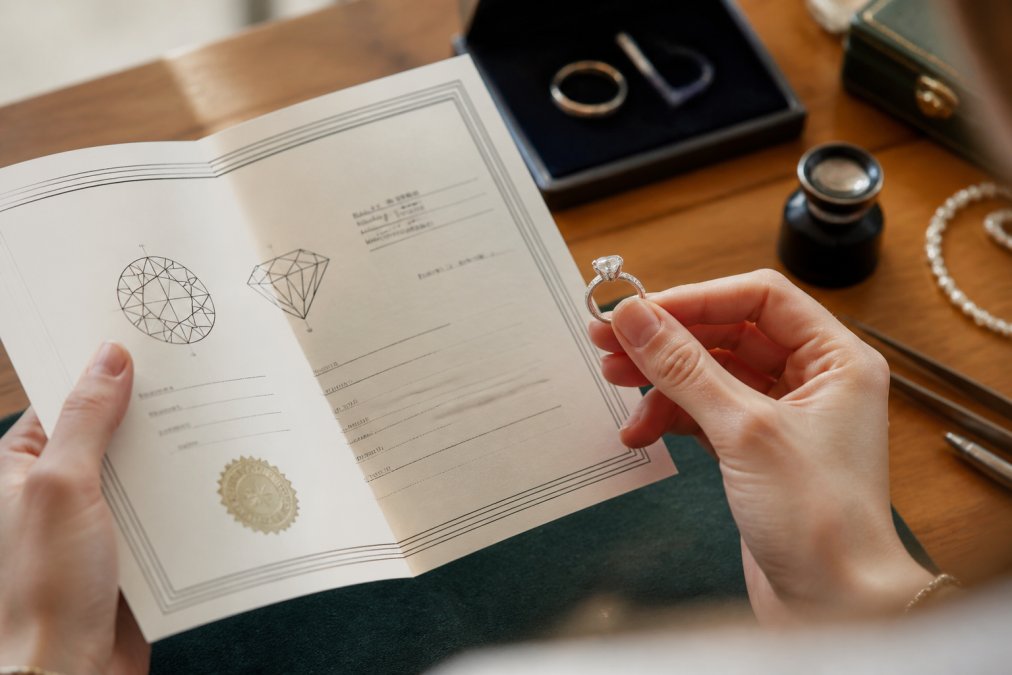
Buying fine jewellery online requires confidence in quality verification. You can't walk into a shop and examine the piece under a loupe, so online retailers must provide documentation that replaces in-person inspection.
Diamond certification and gemstone grading
A certified diamond comes with a grading report from an independent laboratory. The most recognised certifications in the UK come from bodies that assess the Four Cs: carat weight, cut, colour, and clarity. These reports provide objective measurement of a stone's quality, removing guesswork from the purchase.
When you buy online, demand to see the certification before purchase. A reputable jeweller will provide this documentation freely. The report should list specific grades for each of the Four Cs, along with the laboratory's assessment of any inclusions or colour tints. This document is your proof that the stone you're receiving matches the description you saw online.
Gemstone grading for coloured stones follows similar principles, though the assessment is more subjective.
Authentication and provenance documentation
Beyond certification, understanding where a stone comes from matters. Ethical sourcing and conflict-free status are increasingly important to conscious consumers. A reputable online jeweller will provide documentation about the provenance of their gemstones and precious metals.
Benefits of Buying Diamond Jewelry Online
The advantages of buying diamond jewelry online extend beyond price. The model creates genuine benefits for customers who understand how to navigate it properly.
Price transparency and value proposition
Online jewellery retailers typically display prices clearly without hidden charges. You see the cost upfront, understand what you're paying for, and can compare across different options. This transparency is harder to achieve in traditional retail, where negotiations and subjective valuations can obscure the true cost.
Access to curated, bespoke collections
Online platforms allow jewellers to offer broader selections than physical stores can display. Rather than being limited by shelf space, an online retailer can showcase hundreds or thousands of pieces. This variety means you're more likely to find exactly what you're looking for, whether that's a specific gemstone combination or a particular design aesthetic.
Hidden Costs and Considerations of Online Jewelry Purchases
Understanding why online jewelry prices are lower doesn't mean you'll automatically save money. Several hidden costs can emerge once you've made your purchase.
Sizing, shipping, and insurance expenses
When you buy a ring online, you must order the correct size. If it doesn't fit, you'll need to pay for resizing. This cost varies but can range from £30 to £100 or more, depending on the metal and complexity. Some online jewellers offer free resizing within a certain period, but not all do. Factor this into your decision.
Metal market volatility and pricing fluctuations
The price of gold, silver, and platinum fluctuates daily based on global commodity markets. This volatility affects online jewelry prices, sometimes dramatically. A piece you priced at £800 last week might cost £850 this week if gold prices spike. Conversely, prices can drop if metals decline in value.
Jewelry Return Policies Explained
Consumer protection and satisfaction guarantees
A strong return policy is essential when buying jewellery online. You can't inspect the piece in person before committing, so the ability to return it if you're unsatisfied is crucial. Diamonds by daisy offers a 30-day satisfaction guarantee, allowing you to return pieces that don't meet your expectations.
Online vs. In-Store: Making the Right Choice
Shopping for jewellery online offers genuine advantages in price and selection, but it requires a different approach than visiting a physical store. You lose the ability to examine pieces in person, but you gain access to broader selections and lower prices. The question is whether those trade-offs work for your situation.
Frequently Asked Questions
Why are online jewelry prices generally lower than physical stores?
Online retailers eliminate substantial overhead costs associated with brick-and-mortar locations, including retail rent, staffing, and property maintenance. They also reduce wholesale markup by operating direct-to-consumer models, allowing them to pass savings to customers. Additionally, efficient inventory management and lower customer acquisition costs through digital channels contribute to competitive pricing without compromising on quality or craftsmanship.
How can I verify diamond jewelry quality when buying online?
Request certified gemstone grading reports from independent laboratories or similar recognised bodies. Verify diamond certification numbers directly with the issuing laboratory. Ask for detailed photographs and videos showing the stone from multiple angles under different lighting. Check the retailer's authenticity guarantees and ensure they provide documentation of precious metal content and hallmarking. Reputable online jewelers, like those offering a satisfaction guarantee, typically provide comprehensive certification upfront.
What hidden costs should I expect when buying jewelry online?
Beyond the listed price, consider sizing adjustments, which may incur additional fees if the piece doesn't fit perfectly. Shipping costs and insurance for valuable items can add to your total expense. Return shipping may not always be free if you change your mind. Metal market volatility can affect pricing, particularly for precious metals like gold and platinum. Factor in any appraisal fees if you need independent valuation for insurance purposes. Understanding these costs helps you make an informed decision about overall value.
What should I look for in a jewelry return policy when shopping online?
Look for retailers offering at least a 30-day return window, allowing time to inspect the piece in person and ensure satisfaction. Check whether returns are free or if you cover shipping costs. Verify that the retailer accepts returns for change-of-mind reasons, not just defects. Understand any restocking fees or deductions applied to refunds. A satisfaction guarantee demonstrates the retailer's confidence in quality and provides consumer protection. Read the policy carefully to understand conditions around sizing adjustments, custom pieces, and final sale items.