

Ring Size Guide: Measure, Convert, and Verify
Measure an existing ring’s inside diameter in millimeters — that single step gives you the most accurate ring size you can get at home. No ring to measure? An adjustable plastic ring sizer is the next best option. Printable charts work only if your printer is set to exactly 100% scale; even a 2% scaling error shifts the result by a full size, so when in doubt, skip the paper and use a plastic sizer or get sized at a jeweler.
- Best method: measure an existing ring’s inside diameter with a ruler (mm)
- Reliable fallback: adjustable plastic ring sizer
- Last resort: printable chart at exactly 100% scale, verified with a ruler
- International orders: always convert via inner diameter in mm — it’s the universal reference across all seven major sizing systems
Average ring sizes sit near US 6 (≈16.— mm inside diameter) for women and US 9 (≈19.0 mm) for men. Each US size step is roughly 0.— mm in diameter — a gap small enough that a single bad measurement puts you in the wrong size.
Key Takeaways
Measuring an existing ring’s inside diameter in millimeters is the single most reliable step in getting ring size right, and every other method should be verified against it.
| Point | Details |
|---|---|
| Best measurement method | Measure an existing ring’s inside diameter in mm with a ruler for the highest at-home accuracy. |
| Convert via inner diameter | Use mm diameter as the pivot when converting between US, UK, EU, Japan, or any other system. |
| Account for band width | Size up half a size for bands over 6 mm; a full size for bands over 10 mm. |
| Avoid printable pitfalls | Printable charts require exactly 100% print scale; a 2% error shifts the result by a full US size. |
| Diamondsbydaisy | Every product page includes a size chart, with a clear exchange path for surprise gifts. |
Table of Contents
- What does a ring size chart actually tell you?
- How to measure your ring size at home
- How band width and finger shape change the size you need
- Common sizing mistakes and how to avoid them
- What to do after you have a measurement
- The sizing mistake that costs people the most
- Rings that fit perfectly, starting here
- Sources
What does a ring size chart actually tell you?
A US ring size is just a number assigned to a specific inside diameter. The chart below maps the most common US sizes to their inside diameter and circumference in millimeters, which are the two values you need for any international conversion.
ISO 8653:2016 standardizes ring measurement and designation globally, and inner diameter in millimeters is the pivot that makes every system talk to each other. There are seven major ring-size systems worldwide — US, UK/Australia, EU, Japan, India, Brazil, and China — and each uses a different numbering convention.
Three quick conversion examples using inner diameter as the pivot:
- US 7 (17.3 mm) → UK/AU: N, EU: 54, Japan: 14
- US 6 (16.— mm) → UK/AU: L½, EU: 52, Japan: 11
- US 9 (19.0 mm) → UK/AU: S, EU: 60, Japan: 18
One conversion quirk worth knowing: EU sizes use circumference in millimeters, while French and Italian conventions sometimes express size as circumference minus 40. A ring labeled “14” by a French seller means 54 mm circumference, not US 14. Always confirm whether a number represents diameter, circumference, or a regional offset before ordering.
Pro Tip: If your measurement falls between two sizes, always round up. A slightly loose ring is far easier to resize than one that won’t clear your knuckle.
How to measure your ring size at home
Three methods work reliably. Each has a different accuracy ceiling and a different use case.
Method 1: Measure an existing ring (most accurate)
- Find a ring that fits the target finger well.
- Lay it flat and measure the inside diameter — the distance across the interior opening — with a millimeter ruler or digital calipers.
- Match that measurement to the chart above.
Measure across the widest internal span, not the outer edge. This is the most accurate at-home approach because you’re working with a physical object that already fits, not estimating a finger’s circumference.
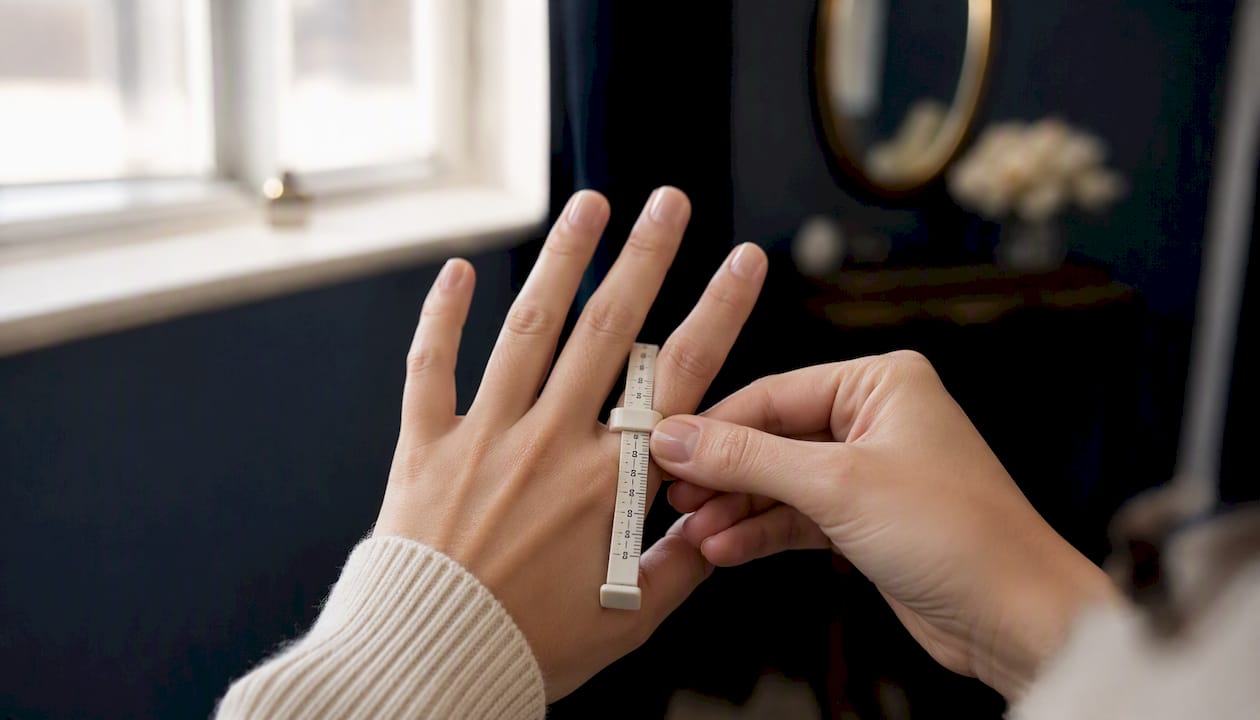
Method 2: Adjustable plastic ring sizer
Slide the sizer onto the target finger, push it snug past the knuckle, and read the size marked on the band. Jewelers recommend this for first-time sizing because it accounts for knuckle width automatically. Sets cost a few dollars online and are reusable.
Method 3: Paper strip or printable chart
Wrap a narrow strip of paper around the base of the finger, mark where it overlaps, and measure the length in millimeters. Divide by 3.14 to get the diameter, then match to the chart. The catch: paper stretches slightly under tension, and string stretches even more. A printable chart must be printed at exactly 100% — never “fit to page.”
Side-by-side comparison:
| Method | Accuracy | Cost | Speed | Best for |
|---|---|---|---|---|
| Existing ring (diameter) | Highest | Free | 2 min | Anyone with a fitting ring |
| Plastic ring sizer | High | ~$— | — min | First-time sizing, no ring available |
| Professional jeweler | Highest | Free–$10 | 15 min | Engagement rings, wide bands |
| Paper strip / printable | Moderate | Free | — min | Rough estimate only |
Visit a professional jeweler when the ring is an engagement ring, a wide band, or a piece with a complex interior profile. The accuracy difference between a plastic sizer and a jeweler’s gauge set is small for standard bands; for anything unusual, it matters.
How band width and finger shape change the size you need
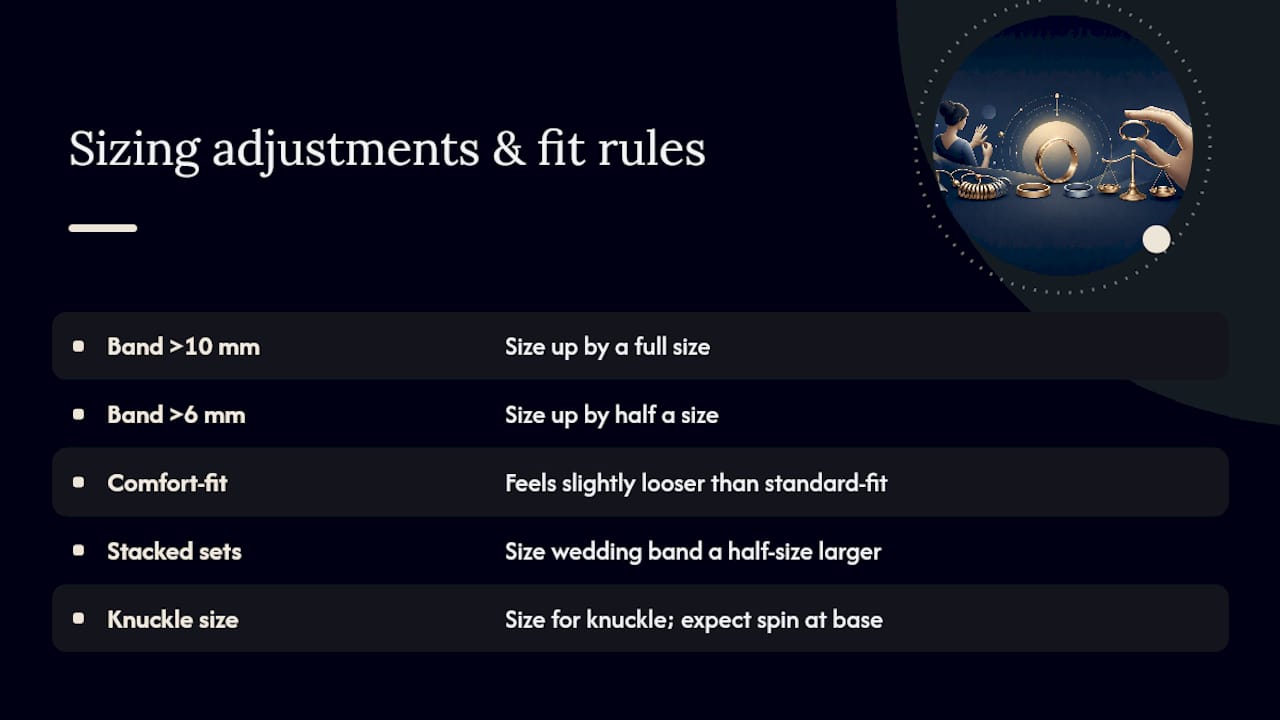
A ring that measures US 7 on a standard narrow band may feel like a US 6.— once you switch to a 10 mm wide band. Wider bands press against more skin, which increases friction and makes the ring feel tighter. The general rule is to size up by half a size for bands wider than 6 mm, and by a full size for bands over 10 mm.
Interior profile matters just as much. A comfort-fit ring has a rounded interior that glides over the knuckle more easily than a flat-interior band of the same nominal size. If you’re choosing between a comfort-fit and a standard-fit ring in the same size, the comfort-fit will feel slightly looser in wear.
Tapered rings, convex exteriors, and stacked bridal sets each change the contact geometry. A bridal ring set worn alongside an engagement ring effectively narrows the finger space available, so many people size the wedding band a half-size larger than the engagement ring to keep both comfortable.
GIA notes that measurement technique must match ring geometry — wide bands, tapered rings, and convex interiors change contact points and can affect how a given numeric size actually fits. A standard chart assumes the ring’s interior is perfectly round; special shapes require adapted interpretation.
Knuckle size is the other variable most people ignore. If your knuckle is noticeably wider than the base of your finger, size for the knuckle and expect the ring to spin slightly at the base. A ring that clears the knuckle but fits the base perfectly is the right call for most people. A ring that fits the base but won’t clear the knuckle is unwearable.
Common sizing mistakes and how to avoid them
The most frequent errors aren’t about technique — they’re about conditions.
- Wrong time of day: fingers swell in heat and shrink in cold. Measure in the afternoon when your hands are at a neutral temperature, not first thing in the morning or after exercise.
- Printer scaling: even a 2% scale error shifts a printable sizer by a full US size. Always print at 100% and verify the scale bar on the page with a ruler before cutting.
- Paper and string stretch: both materials deform under the tension needed to wrap a finger snugly. Use a thin strip of paper (not string) and mark with a pen, not a pinch.
- Wrong finger, wrong hand: ring sizes differ between your dominant and non-dominant hand, sometimes by half a size. Measure the specific finger on the specific hand where the ring will be worn.
- Measuring too high on the finger: the base of the finger is narrower than the area just below the knuckle. Measure at the base for most rings; measure at the widest point if the knuckle is significantly larger.
- Relying on average sizes: average sizes (US 6 for women, US 9 for men) are starting points for surprise gifts only. Individual variation is wide enough that guessing from an average carries real risk.
One-minute pre-order checklist:
- [ ] Measured the correct finger on the correct hand
- [ ] Measured in the afternoon at room temperature
- [ ] Used mm ruler or calipers (not a tape measure alone)
- [ ] Confirmed printer scale at 100% if using a printable chart
- [ ] Accounted for band width (size up for bands over 6 mm)
- [ ] Checked the seller’s size chart uses the same system (diameter vs. circumference)
Remember: each US size is only 0.— mm apart in diameter. That’s the width of a pencil line. Precision isn’t optional.
What to do after you have a measurement
If you’re ordering for yourself:
- Match your inside diameter measurement to the seller’s size chart — confirm whether they list diameter or circumference.
- If you fall between two sizes, choose the larger one. Sizing down is harder and more expensive than sizing up.
- Check the seller’s resizing policy before purchasing. Most standard narrow bands in gold or silver can be resized one to two sizes up or down. Wide bands, eternity rings with stones around the full circumference, and rings with intricate settings are harder to resize and sometimes can’t be altered without damaging the design.
If you’re buying a surprise gift:
- Borrow a ring the recipient already wears on the target finger and measure its inside diameter.
- Check their jewelry box for a ring that fits the right finger — even a few seconds with a ruler is enough.
- If no ring is accessible, ask a close friend or family member who might know their size.
- As a last resort, buy an adjustable open ring as a placeholder gift, then get the recipient sized properly before ordering the final piece.
Resizing typically takes a few days at a local jeweler and costs $20–$60 for a simple band, depending on metal type and how many sizes need to change. Budget more time and cost for platinum or wide-band designs. For certified diamond jewelry, always confirm the retailer’s resizing or exchange policy at checkout.
The sizing mistake that costs people the most
The single most common error in gifting a ring isn’t a bad measurement — it’s skipping the measurement entirely and guessing from an average. Averages exist for a reason, but they mask the reality that women’s ring sizes range from US 4 to US 9 in everyday retail, and men’s from US 7 to US 14. Picking US 6 for a woman because “that’s average” is a coin flip for anyone outside the middle of that range.
What I’d actually recommend: measure an existing ring first, every time. If that’s not possible, use a plastic sizer before ordering. The two minutes it takes to do either one saves the awkward conversation about returns and the wait for a resize. For engagement rings especially, a professional sizing appointment is worth the trip — not because home methods are unreliable, but because the stakes are high enough that the extra confirmation matters.
Rings that fit perfectly, starting here
Knowing your size is only half the equation. Finding a ring worth wearing every day is the other half. Diamondsbydaisy makes that part straightforward: every product page includes a size chart, and the sterling silver and diamond collection covers everything from slim stacking bands to statement pieces with wider profiles. For bridal sets, the bridal and wedding collection includes sizing notes specific to each design.
Surprise gifts are handled, too. Gift receipts and a straightforward exchange path mean the recipient can confirm their size and swap if needed — no awkward conversations required. Browse the full collection at Diamondsbydaisy and use the size chart on any product page to order with confidence.
Sources
- Accurate Determination of Finger and Ring Sizes
- ISO 8653:2016 - Jewellery — Ring-sizes — Definition, measurement and designation
- Ring Size Chart for All Countries 2026 – Complete International Guide
- Ring Size Chart & Guide
- Ring Size Chart & Converter (mm & inches) — Sizepedia
Recommended
- Buy Certified Diamond Jewelry Online: A 2026 Guide – Diamonds by daisy
- 18K Yellow Gold Plated .925 Sterling Silver Diamond Cross Ring with Sa – Diamonds by daisy
- Diamond Bridal Ring Set – Sterling Silver & Natural Diamonds | Diamonds by Daisy – Diamonds by daisy
- Diamond Arrowhead Open Ring – Sterling Silver Natural Diamonds | Diamonds by Daisy – Diamonds by daisy