

Start with 18 Inches: Necklace Lengths That Actually Fit
For most people, an 18-inch princess necklace is the safest, most versatile pick. As a rule, go shorter when your neckline is already busy or high, and go longer when you want a pendant to show or plan to layer. The rest comes down to measuring correctly, which the chart and steps below will walk you through.
TL;DR:
- An 18-inch princess necklace remains the most versatile and commonly used length for daily wear, jewelry gifts, and layered styling.
- Choker and collar lengths suit high or busy necklines, while matinee and opera lengths work best for high collars, buttoned shirts, or formal events.
- Proper measurement includes the clasp and considers pendant weight, with adjustable or extender chains enabling flexible fit across different neck sizes and styles.
- Neckline pairing rules favor shorter lengths for V-necks and crew necks, with longer lengths chosen for turtlenecks or high collars to avoid cramped appearances.
- Most sizing mistakes involve miscalculating length with a pendant or ignoring how heavy pendants pull the chain, making fixing simple and often preferable to returns.
Table of Contents
- Necklace Length Chart: Names, Inches, and Where They Sit
- Standard Lengths Explained: What Fits Your Wardrobe
- How to Measure Necklace Length at Home
- Match Lengths to Necklines and Body Types
- Layering Necklaces: Spacing, Chains, and Anti-Tangle Tricks
- How Pendants Change Where a Necklace Sits
- Common Sizing Mistakes and Easy Fixes
- Author and Brand Authority
- Historical and Cultural Variations in Necklace Length
- Pick a Signature Length, Then Build Around It
- Shop the Lengths This Guide Recommends
- Where This Guide’s Sizing Advice Comes From
- Sources
Necklace Length Chart: Names, Inches, and Where They Sit
Every jewelry retailer uses slightly different marketing names, but the industry has settled on a fairly consistent set of ranges. Knowing these six categories by heart makes shopping online far less of a guessing game, since most product pages list length in inches without a picture of where it actually falls.
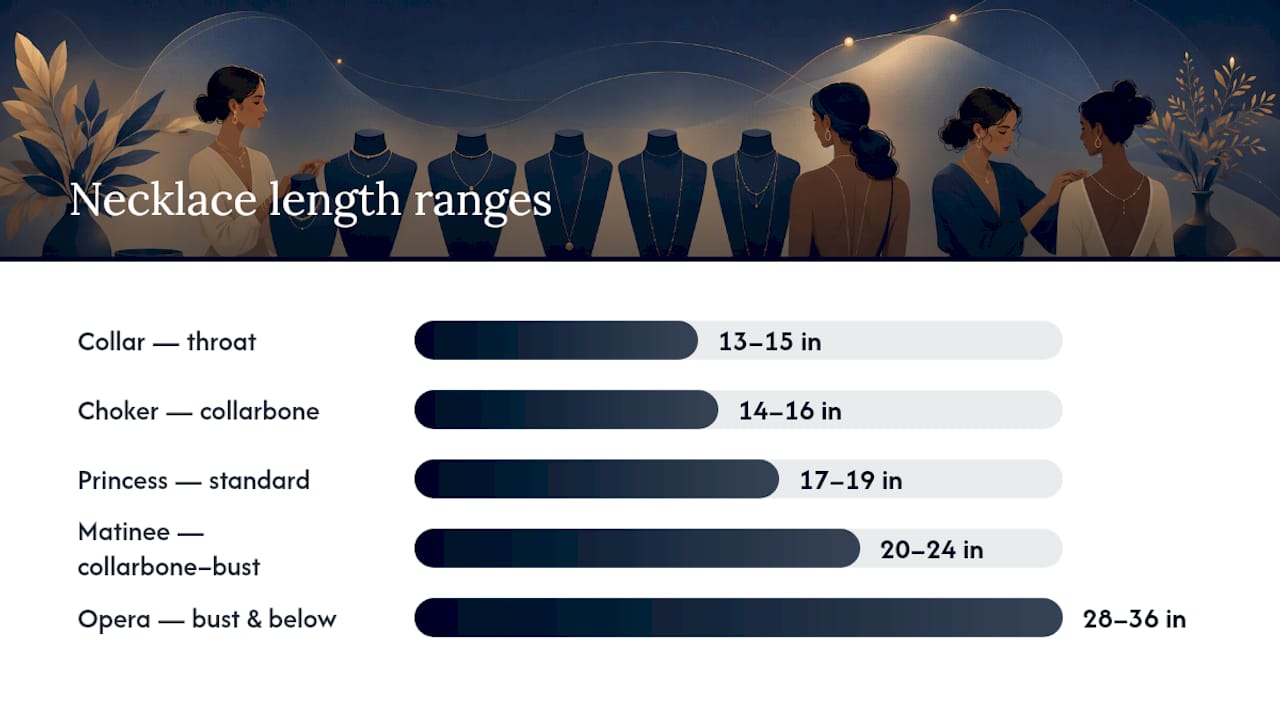
Inches are the standard unit in the U.S. jewelry trade, so that’s the primary measurement here, with centimeters alongside for reference or for shopping from international sites. The standard necklace length ranges below cover collar through rope, the six lengths you’ll see again and again.
| Name | Inches | Centimeters | Typical placement | Best used for |
|---|---|---|---|---|
| Collar | 13–15 in | 33–36 cm | Sits tight around the base of the neck | Statement pieces, layering foundation |
| Choker | 14–16 in | 36–41 cm | Rests at or just above the collarbone | Casual wear, layering, trend pieces |
| Princess | 17–19 in | 43–61 cm | Falls at or just below the collarbone | Everyday wear, work, most necklines |
| Matinee | 20–24 in | 51–61 cm | Sits between the collarbone and bust | Business attire, over collared shirts |
| Opera | 28–36 in | 71–91 cm | Rests at or below the bust line | Formal events, can be doubled for a choker look |
| Rope | 37+ in | 94+ cm | Falls past the bust, often to the waist | Statement layering, can be knotted or wrapped |
Princess is the workhorse length. An 18-inch necklace is the most common everyday size sold by jewelers, which is exactly why it’s the default recommendation for anyone buying their first “good” necklace or shopping for a gift without knowing someone’s exact preference. Matinee and opera lengths get less daily wear but solve a real problem: they let a pendant clear a high neckline or a buttoned collar without looking cramped.
Standard Lengths Explained: What Fits Your Wardrobe
Picturing a length on a hanger tag is one thing. Picturing it on your own collarbone is another. Here’s what each standard length actually does once it’s on your body, not just how it measures on a ruler.
Collar (13–15 in). This sits almost like a tattoo choker, hugging the base of the throat. It works best on longer necks and reads as edgy or vintage depending on the design. Most collar-length pieces use a rigid or semi-rigid band rather than a flexible chain, so sizing runs less forgiving than the others on this list.
Choker (14–16 in). A choker skims the collarbone and pairs naturally with off-the-shoulder tops, crew necks, and low buns. It’s the length that photographs best in close-up shots, which is part of why it resurfaces every few fashion cycles.
Princess (17–19 in). This is the length most brands mean when they say “standard.” A slight variation of an inch or two either way changes little visually, but it matters if you’re layering, since even a half inch of gap keeps chains from bunching. Princess suits nearly every neckline except a high turtleneck.
Matinee (20–24 in). Falling between the collarbone and the bust, matinee lengths are the unsung workhorse for office wear. They sit low enough to clear a buttoned collar but high enough to stay visible under a blazer.
Opera (28–36 in). This is your event length. Opera necklaces can be worn long for a formal gown or doubled over to create an instant layered choker for a cocktail dress, which is the single most useful trick in this entire guide.
Rope (37+ in). Rope lengths are built for drama. They can be knotted, wrapped twice around the neck, or left long over a simple dress.
A few practical notes worth keeping in mind:
- Men’s chains commonly run 20 to 24 inches, since a men’s collar size and chest depth typically sit lower than a woman’s princess length would allow.
- Adjustable chains with a slide clasp or a 2 to 4 inch extender let one necklace cover both choker and princess territory, which is worth paying attention to if you only want to buy one piece.
- Lobster clasps and spring rings add roughly a quarter inch to overall length, a detail that matters when you’re comparing two “18 inch” listings that don’t actually match.
How to Measure Necklace Length at Home
Guessing a length from a photo is how most necklace returns happen. Two methods fix that in under five minutes, and neither requires anything you don’t already own.
Method 1: Measure a necklace you already own.
- Lay the necklace flat on a table, letting the chain relax into its natural curve.
- Measure end to end using a soft tape measure, going along the curve rather than straight across.
- Include the clasp in your measurement. Jewelers measure necklaces end to end including the clasp, so leaving it out will throw off your comparison to a size chart by half an inch or more.
- If the piece has a pendant, measure the chain alone first, then add the pendant’s drop separately.
Method 2: Simulate the length on your body.
- Take a flexible tape measure or a piece of string and a mirror.
- Wrap it around your neck at the height you want the necklace to sit.
- Pinch the point where you want it to fall, then measure that length flat against a ruler.
- Add 1 to 2 inches if you plan to wear the piece over thicker fabric like a sweater or coat collar.
Pro Tip: Measure while standing in the posture you’ll actually wear the necklace in. Slouching or tilting your chin down can shift the resting point by an inch or more, which is enough to turn a choker into an accidental collar.
Match Lengths to Necklines and Body Types
Necklines do most of the work in deciding which length looks intentional versus accidental. A few pairing rules cover the vast majority of outfits:
- V-neck tops: A pendant on a princess or matinee chain follows the V-line and elongates the torso; anything shorter competes visually with the neckline itself.
- Scoop or crew necks: These plain, high necklines want either a short choker sitting above the fabric line or a long opera piece that falls well below it. Anything in between tends to disappear into the shirt.
- Turtlenecks: Skip anything short. A long opera or rope length worn over the fabric is the only combination that reads as styled rather than crowded.
- Button-down collars: Matinee length clears the collar points without getting tangled in buttons.
Body proportions shift these rules slightly. Shorter necks generally look more balanced in matinee or opera lengths, since a choker can visually shrink the space between chin and collarbone. Longer necks can wear collars and chokers comfortably and often look better in them than in a long rope, which can create too much empty vertical space. Petite frames tend to look overwhelmed by very long rope lengths worn alone, while taller frames can carry that same length without it looking oversized.
A few concrete combinations: a princess-length pendant under an open blazer for work, a doubled opera necklace with a strapless dress for a wedding, or a rope length knotted once over a plain white tee for a casual weekend look. Styling advice consistently points to shorter, polished lengths in the 14 to 18 inch range for formal settings, and 30-plus inches for casual or high-fashion statement dressing.
Layering Necklaces: Spacing, Chains, and Anti-Tangle Tricks
Good layering isn’t about owning more necklaces. It’s about spacing them so each one has room to read as its own piece. A reliable starter combo is 16, 18, and 20 inches, which gives roughly two inches between each layer, a gap stylists commonly recommend to keep chains from overlapping and tangling.
- Start with your shortest chain closest to the throat and let each additional length sit lower.
- Vary chain weight and texture, not just length. A delicate bead chain paired with a slightly heavier curb chain looks curated; three identical thin chains tend to blend into one blurry line.
- Keep metal tones consistent, or mix them on purpose. An accidental mismatch reads as sloppy; an intentional gold-and-silver mix reads as fashion-forward.
Pro Tip: Lay your planned combo flat on a table before you put it on. If any two chains cross or overlap in that flat position, they’ll tangle the moment you move. For a longer walkthrough of building a layered look from scratch, Diamonds by Daisy’s necklace layering guide covers combinations by neckline and metal tone.
How Pendants Change Where a Necklace Sits
A pendant doesn’t just hang off the end of a chain. It adds its own length to wherever the chain lands, and a heavy one pulls that resting point even lower than the numbers suggest.
- To predict final placement, add the chain length to the pendant’s total drop, including the bail loop it hangs from.
- An 18-inch chain with a 2-inch pendant behaves more like a 20-inch necklace once it’s on your body, since the pendant’s weight pulls the whole piece down.
- A dense or oversized pendant, like a chunky charm or a large stone, will sit noticeably lower than a lightweight one at the same chain length.
- If you’re buying a substantial pendant piece, size up your chain by an inch or two from what you’d normally choose for a plain chain alone.
Common Sizing Mistakes and Easy Fixes
Most necklace-fit complaints trace back to one of three errors: forgetting to include the clasp when measuring, ignoring how a pendant’s weight shifts placement, or mismeasuring against a curved neck instead of a flat surface.
- Mistake: Buying based on chain length alone when the piece has a heavy pendant. Fix: Recalculate using chain plus pendant drop before ordering.
- Mistake: A necklace that arrives half an inch too short. Fix: An extender chain or jump ring adds length without altering the original piece.
- Mistake: A rope-length necklace that reads as too long or overwhelming. Fix: Loop it twice around the neck instead of returning it.
- Mistake: A gifted necklace that doesn’t fit the recipient’s neck. Fix: A jeweler can shorten most chains permanently, which is often cheaper and faster than a full return.
Alteration usually beats a return whenever the piece itself is right, just sized wrong. If the style, metal, or clasp isn’t what you wanted, that’s when a return makes more sense than a fix.
Author and Brand Authority
This guide draws on standard jewelry-industry sizing conventions and measurement practices used across major retailers, cross-checked against real styling scenarios rather than theory alone. For a deeper walkthrough of building layered combinations from these same length rules, see the layering guide referenced above.
The collection features jewelry selected with an emphasis on craftsmanship and sustainable materials, designed to work for both everyday wear and gifting. Every collection on the site, from everyday gold staples to pendant styles, is chosen with the length and styling principles covered in this guide already in mind.
Historical and Cultural Variations in Necklace Length
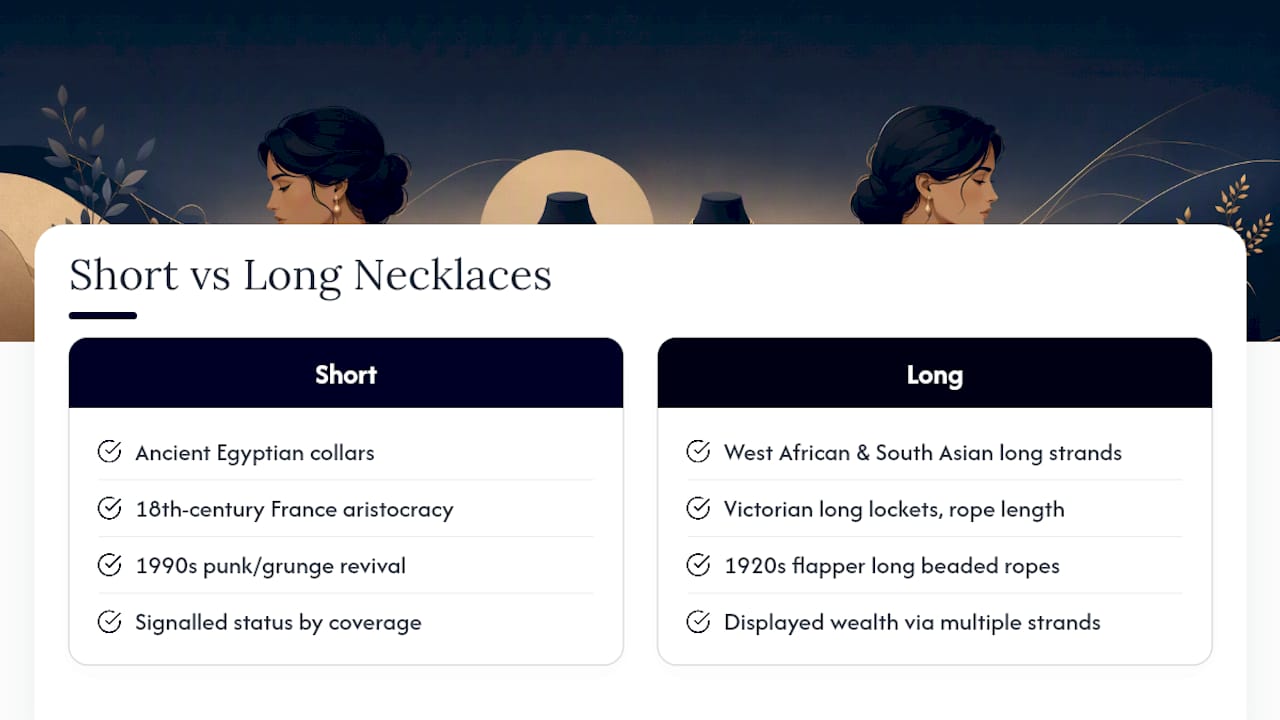
Necklace length has never been just a fashion choice. It’s carried social and cultural meaning for thousands of years. Ancient Egyptian collars, the wide, rigid pieces worn by pharaohs and nobility, sat flat against the collarbone and signaled status through sheer material coverage rather than drop length. Long strands of beads and gold, by contrast, showed up in wealth displays across West African and South Asian traditions, where multiple long strands worn at once demonstrated prosperity in a way a single short piece never could.
Victorian mourning jewelry popularized long lockets and pendant chains in the 1800s, often worn at rope length to hold a keepsake or a woven strand of a deceased loved one’s hair close to the heart. The flapper era of the 1920s flipped the trend toward long, beaded rope necklaces worn loose and swinging, a rebellion against the high, tight collars of the previous decade.
Chokers have swung in and out of fashion in cycles tied to specific moments, worn as a symbol of aristocracy in 18th-century France, then reclaimed as a punk and grunge staple in the 1990s. That same short length carries almost opposite cultural associations depending on the decade, which is a useful reminder that “correct” length has always been shaped by context as much as by measurement.
Pick a Signature Length, Then Build Around It
If you only take one habit from this guide, make it this: buy one great 18-inch chain first, then add a shorter or longer piece once you know how the princess length actually sits on you. Everything else, layering combos, pendant math, occasion swaps, gets easier once you have that one reference point on your own body. Measure before you buy, try the combinations flat on a table first, and trust the inch marks over the marketing names.
— Georgia
Shop the Lengths This Guide Recommends
There are other ways to build a necklace collection: hunting through vintage shops, commissioning a custom piece, or piecing together a wardrobe from whatever’s on sale. All of that takes time most people don’t have. This process can be shortened by choosing necklaces at the typical lengths covered in this guide, allowing shoppers to select from pre-vetted options rather than guessing from product photos.
Start with the everyday gold jewellery collection for princess-length staples built for daily wear, or browse crystal and celestial pendant necklaces if you’re planning a pendant-and-chain combo using the drop math from this guide. Pieces are selected with attention to quality craftsmanship, suitable for personal use or gifting when the exact size is unknown. Browse the full necklace collection and measure first using the steps above, then find the length that matches what you found.
Where This Guide’s Sizing Advice Comes From
The length chart and per-inch ranges here draw on the wikiHow necklace length chart, one of the most widely cited standard references for collar-through-rope naming. Measurement steps follow the method outlined by Brite’s sizing guide, and layering spacing and occasion guidance come from Blue Nile’s sizing and styling guide.
Sources
- Find the Perfect Necklace Length: Chart, Sizing Guide and Quiz — Blue Nile
- How to measure necklace length — Brite (guide)
- Necklace Length Chart — wikiHow