

Lab-Grown Diamond Alternatives: 2026 Guide
Table of Contents
- What Are Lab-Grown Diamonds and Why Consider Alternatives?
- Natural vs. Lab-Grown vs. Simulants: Understanding the Differences
- Moissanite vs Lab-Grown Diamond Durability and Wearability
- White Sapphire Engagement Rings: Pros and Cons
- Lab-Grown Sapphires and Rubies as Diamond Alternatives
- How to Verify Diamond Authenticity and Quality
- Resale Value and Long-Term Investment Considerations
- Frequently Asked Questions
Last Updated: September 18, 2026
What Are Lab-Grown Diamonds and Why Consider Alternatives?
Lab-grown diamond alternatives are real diamonds created in controlled laboratory environments rather than mined from the earth. They possess the same chemical composition, crystal structure, and physical properties as mined diamonds. Yet many shoppers exploring lab-grown diamond alternatives discover that other gemstones offer compelling advantages in durability, appearance, cost, and ethical sourcing.
The choice between lab-grown diamonds and alternatives like moissanite, sapphires, and white sapphires depends on what matters most to you. Some prefer maximum sparkle and fire. Others prioritise durability for everyday wear. Still others seek distinctive colours or lower price points without compromising on quality.
At Diamonds by daisy, we understand that selecting the right centre stone is deeply personal. This guide will help you understand the real differences between your options. We've curated information on durability, optical properties, resale value, and long-term wearability to help you make an informed decision.
Natural vs. Lab-Grown vs. Simulants: Understanding the Differences
The terminology matters more than many realise. Natural diamonds are mined from the earth over billions of years. Lab-grown diamonds are chemically identical but created in months using advanced technology. Simulants, by contrast, are entirely different materials that merely look like diamonds.
Natural diamonds form under extreme pressure and temperature deep underground. They contain the carbon lattice structure that gives diamonds their hardness on the Mohs scale. This geological process creates variations in clarity, colour, and inclusions that contribute to their uniqueness.
Lab-grown diamonds replicate this process in a controlled setting. They're real diamonds, not imitations. The refractive index and optical properties match mined stones perfectly. The key difference is origin and environmental impact, not composition.
Simulants like cubic zirconia are chemically different materials. They mimic a diamond's appearance but lack the durability and longevity. Cubic zirconia scores only 8-8.5 on the Mohs hardness scale, making it prone to scratching with daily wear. Moissanite, however, ranks 9.25 on the Mohs scale, harder than lab-grown diamonds themselves.
The distinction matters for longevity. A simulant engagement ring may cloud or scratch within months. Lab-grown diamonds and quality alternatives like moissanite withstand decades of wear.
Moissanite vs Lab-Grown Diamond Durability and Wearability
Moissanite is a silicon carbide gemstone engineered for extreme durability. At 9.25 on the Mohs hardness scale, it's exceptionally durable. This exceptional hardness makes moissanite ideal for engagement rings and pieces worn daily.
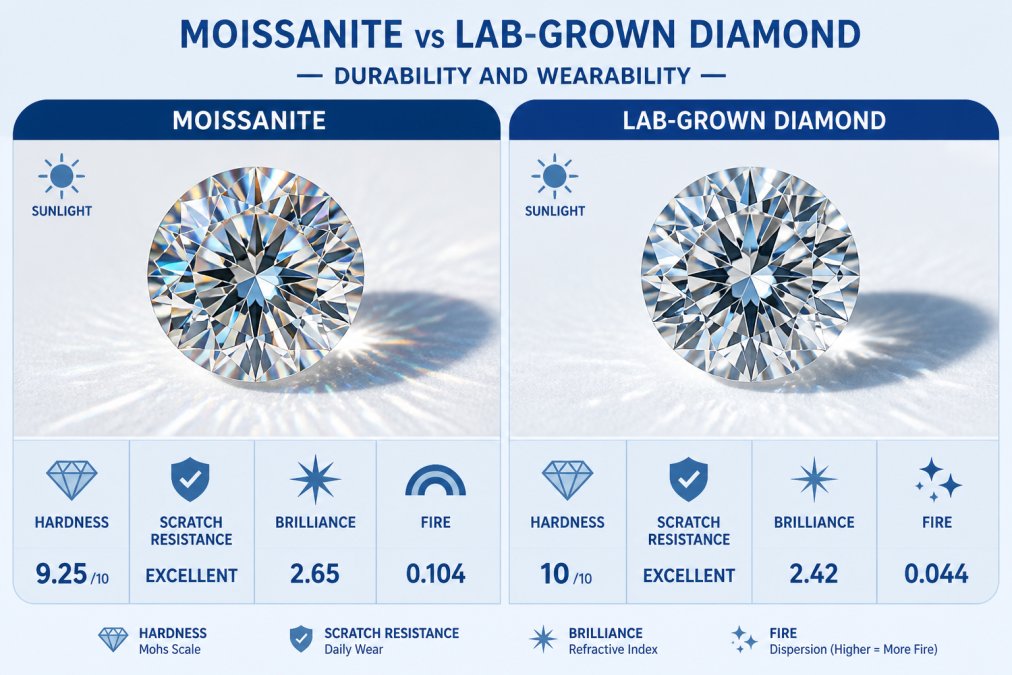
The optical properties differ noticeably. Moissanite displays higher refractive index than diamonds, creating more visible rainbow-coloured light dispersion called "fire." Some find this brilliance stunning. Others prefer the subtler sparkle of diamonds or white sapphires. This is purely aesthetic preference, neither is objectively superior.
Long-Term Wearability: The Five-Year Reality
Durability in theory differs from durability in practice. Over five to ten years of daily wear, both moissanite and lab-grown diamonds maintain their structural integrity, but maintenance demands diverge significantly.
Moissanite's superior hardness (9.25 vs. 10) means it resists scratching better than lab-grown diamonds in everyday contact with skin, clothing, and surfaces. However, moissanite is more prone to oil and dust accumulation on its surface due to its refractive properties. Many long-term moissanite wearers report that their stones require more frequent cleaning, weekly rather than monthly, to maintain the signature sparkle. Without regular cleaning, moissanite can appear dull or hazy within weeks of accumulated wear. However, moissanite is more prone to oil and dust accumulation on its surface due to its refractive properties. Many long-term moissanite wearers report that their stones require more frequent cleaning, weekly rather than monthly, to maintain the signature sparkle. Without regular cleaning, moissanite can appear dull or hazy within weeks of accumulated wear.
White sapphires present a different trade-off. At 9 on the Mohs scale, sapphires scratch more readily than both moissanite and lab-grown diamonds. After five years of daily wear, white sapphires commonly develop a fine network of surface scratches that can cloud the stone's appearance. This cloudiness is cosmetic rather than structural, the stone remains durable, but it affects visual brilliance. Sapphire wearers often require professional re-polishing every 3-5 years to restore clarity, an ongoing cost not typically needed for moissanite or lab-grown diamonds.
Thermal Conductivity and Testing Implications
The thermal conductivity of moissanite differs from diamonds, which matters for diamond testers. Some older diamond testing equipment may misidentify moissanite. Modern gemological testing, however, distinguishes them easily. When purchasing moissanite, request certification from a reputable gemological laboratory.
White Sapphire Engagement Rings: Pros and Cons
White sapphire offers a sophisticated alternative to colourless centre stones. It's chemically identical to blue sapphires but lacks the chromium impurities that create colour. This produces a clear, colourless gemstone with different optical properties than diamonds.
Advantages of white sapphire:
White sapphire ranks 9 on the Mohs hardness scale, making it durable for daily wear. It's significantly less expensive than lab-grown diamonds. The refractive index produces a softer, more subtle sparkle, some prefer this understated elegance over diamond brilliance. For those seeking a refined, less "flashy" appearance, white sapphire delivers exactly that aesthetic.
Disadvantages of white sapphire:
The optical properties create less visible fire and brilliance than diamonds or moissanite. White sapphire can appear slightly milky or cloudy if not meticulously maintained. Regular cleaning is essential to preserve clarity. Some buyers find the reduced sparkle disappointing compared to diamond expectations. The resale market for white sapphire is smaller than for diamonds or moissanite, potentially affecting long-term value.
White sapphire works beautifully for vintage-inspired designs and halo settings where the centre stone is surrounded by smaller diamonds. The supporting stones amplify sparkle while the white sapphire provides a sophisticated focal point.
Lab-Grown Sapphires and Rubies as Diamond Alternatives
Coloured lab-grown gemstones offer bold alternatives for those seeking distinctive engagement rings. Lab-grown sapphires and rubies provide exceptional clarity and colour consistency compared to their natural counterparts.
Lab-grown sapphires come in virtually every colour imaginable. Blue sapphires remain traditional choices, but pink, yellow, peach, and padparadscha sapphires create stunning modern rings. The chemical composition is identical to natural sapphires, corundum with trace elements creating colour. Lab-grown versions simply form without the impurities common in mined stones.
Sapphires score 9 on the Mohs hardness scale, making them suitable for daily wear. The durability matches white sapphire. The advantage lies in colour options and purity. Lab-grown sapphires offer superior clarity compared to natural stones, which often contain visible inclusions.
Lab-grown rubies deliver vibrant red colour with exceptional uniformity. Natural rubies often contain impurities that cloud the stone or create uneven colour. Lab-grown rubies eliminate these issues, producing brilliant, consistent colour throughout.
How to Verify Diamond Authenticity and Quality
Authenticating diamonds and diamond alternatives requires understanding gemological standards. Before purchasing any centre stone, request proper certification and documentation.
Resale Value and Long-Term Investment Considerations
Resale value differs significantly across gemstone types. Understanding these differences matters if you view your purchase as an investment or anticipate future resale.
Lab-Grown Diamonds: Secondary Market Reality
Moissanite: Minimal Secondary Market
Sapphires and Rubies: Colour-Dependent Resale
What Actually Affects Resale Price
Beyond stone type, several factors determine secondary-market value:
- Certification: Stones with gemological reports from recognised laboratories (Gemmological Association of Great Britain, International Gemological Institute) resell for 10-20% more than uncertified stones. Buyers trust documented quality.
- Size: Stones under 0.75 carats are harder to resell; the market for small centre stones is thin. Stones 1.5 carats and above attract more buyers.
- Condition: Scratched, cloudy, or damaged stones resell for 30-50% less than pristine examples. Maintenance history matters.
- Setting: A stone in a generic solitaire setting resells more easily than one in a bespoke or trendy design. Buyers often want to reset stones into their own designs.
- Market timing: Lab-grown diamond prices have fallen 20-30% since 2022 as supply increased. A lab-grown diamond purchased in 2020 may resell for less in 2026 due to market deflation, not just wear.
The Real Value Proposition
Frequently Asked Questions
What is the best natural alternative to a lab-grown diamond?
The best choice depends on your preference for sparkle intensity, colour, and budget. Natural diamonds remain the traditional choice, though lab-grown diamonds offer identical chemical composition at lower cost.
How do moissanite and white sapphire compare to lab-grown diamonds?
Lab-grown diamonds match natural diamonds in optical properties and chemical composition but cost significantly less. Your choice depends on desired sparkle level, aesthetic preference, and budget constraints.
Do lab-grown diamonds hold their value compared to natural stones?
Lab-grown diamonds typically retain less resale value than natural diamonds due to market perception and supply availability. Moissanite and white sapphire similarly face limited secondary markets. However, these alternatives cost substantially less upfront, so the absolute financial loss on resale may be comparable. If investment value is paramount, natural diamonds remain the stronger choice. For engagement rings and personal jewellery, focus on the stone's durability and your satisfaction rather than future resale potential.
How can I verify that a diamond is authentic and high quality?
Request gemological certification from recognised bodies, which grade diamonds on the four Cs: carat weight, clarity, cut grade, and colour. Lab-grown diamonds and simulants should also come with certification stating their composition and origin. Reputable jewellers provide grading reports before purchase. Ask for thermal conductivity testing to distinguish diamonds from simulants like cubic zirconia, which conduct heat differently. Always purchase from established retailers offering certification and authenticity guarantees.
What is a poor man's diamond called?
Cubic zirconia is commonly known as a poor man's diamond due to its low cost and superficial diamond-like appearance. However, it lacks durability, scratching easily and becoming cloudy with wear. Lab-grown diamonds provide chemically identical stones at 30-40% less than natural diamonds. For engagement rings and fine jewellery, lab-grown diamonds outperform cubic zirconia in longevity and aesthetic retention, making them superior budget-conscious choices.