

Conflict-Free Diamonds: What U.S. Buyers Need to Know
A conflict-free diamond is one whose rough origin did not finance armed conflict. Specifically, the Kimberley Process Certification Scheme defines a conflict diamond as a rough stone used by rebel movements or their allies to fund war against a legitimate government. If a diamond clears that bar, it qualifies as conflict-free under the trade’s standard definition.
That’s the bottom line, and it matters to know what it covers and what it doesn’t. The Kimberley Process (KPCS) is a real, functioning international system. What it does not do is certify labor conditions, environmental practices, or community impact. A diamond can be fully KP-compliant and still come from a mine with poor worker safety or significant ecological damage.
Before you buy, ask your retailer three things:
- Does your supplier follow the World Diamond Council’s System of Warranties?
- Can you provide documentation of this diamond’s country of origin?
- Do you carry any third-party certifications beyond KP compliance, such as RJC or SCS-007?
Pro Tip: Ask specifically for the country of origin, not just “conflict-free.” A retailer who can name the mine or region is operating at a higher transparency standard than one who can only offer a blanket assurance.
Key Takeaways
A conflict-free diamond meets the Kimberley Process standard for rough-diamond origin, but that narrow trade claim does not cover labor conditions, environmental impact, or post-cutting chain of custody.
| Point | Details |
|---|---|
| Conflict-free definition | Rough diamond did not finance rebel armed conflict, per the Kimberley Process Certification Scheme. |
| KP market coverage | GIA estimates 99%–99.8% of diamonds in global trade meet the KP conflict-free definition. |
| What KP does not cover | Labor conditions, environmental harm, government abuses, and chain-of-custody after cutting. |
| Broader ethical standards | RJC, IRMA, and SCS-007 certifications require third-party audits and cover labor and environmental performance. |
| Practical alternatives | Lab-grown diamonds, recycled diamonds, and moissanite each eliminate conflict-financing risk and offer varying degrees of traceability. |
Table of Contents
- How the Kimberley Process works and what “conflict-free” certification actually covers
- What the “conflict-free” label does not guarantee
- How “conflict-free” differs from broader ethical sourcing claims
- Alternatives to KP-certified natural diamonds: lab-grown, recycled, and moissanite
- A practical buying checklist for U.S. shoppers
- How conflict-free status affects price and the current market picture
- What’s changed in 2026: policy updates and reliable U.S. resources
- Diamondsbydaisy’s perspective on conflict-free claims and ethical sourcing
- Sources
How the Kimberley Process works and what “conflict-free” certification actually covers
The KPCS launched in 2003 following a UN resolution that recognized rough diamonds as a financing mechanism for some of the most brutal conflicts of the 1990s, particularly in Sierra Leone, Angola, and the Democratic Republic of Congo. The scheme created a government-to-government export and import control system: every shipment of rough diamonds crossing an international border must travel with a government-validated KP certificate.
The KP core document establishes the legal definition and the trade controls. Participating countries, currently more than 80 nations representing the vast majority of global diamond production and trade, agree to issue certificates only for rough diamonds that meet the scheme’s requirements and to refuse imports that arrive without valid documentation.
Here’s where it gets practical for retail buyers: you will not receive a KP certificate when you purchase a finished ring or pendant. The certificate travels with rough diamond shipments between governments and wholesalers. By the time a stone reaches a jewelry store, the paperwork has served its purpose upstream.
What carries the conflict-free assurance to the retail level is the System of Warranties, an industry practice where each sale invoice includes a written declaration that the diamonds were purchased from legitimate, non-conflict sources. The KP FAQ explains that this system, maintained by dealers and retailers, is how KP compliance translates into consumer-facing claims.
A short timeline:
- 1998–2000: Civil wars in Sierra Leone and Angola draw global attention to diamond-funded atrocities
- 2000: The Kimberley Process begins as a series of international meetings
- 2003: KPCS formally implemented; participating countries begin issuing certificates
- 2006: The film Blood Diamond brings public awareness to a mainstream audience
- 2003–present: Over 80 countries participate; the scheme covers rough diamond trade globally
How to verify KP provenance at the retail level:
- Ask the retailer for their System of Warranties statement in writing
- Request the country of origin for the diamond you’re considering
- Ask whether their supplier has been audited for KP compliance
- For high-value purchases, request a GIA grading report, which may include origin information
- Check whether the retailer publishes a sourcing policy on their website
What the “conflict-free” label does not guarantee
The KP’s narrow mandate is both its strength and its most significant limitation. It was designed to solve one specific problem: stopping rebel groups from selling rough diamonds to fund wars. It does that reasonably well. What it was never designed to do is certify anything else.
Independent reporting confirms that the KP was a meaningful advance for peace and security, but that “conflict-free” remains a narrow trade claim. It does not address:
- Labor conditions: Mine workers may face dangerous conditions, inadequate pay, or child labor, none of which the KP tracks
- Environmental harm: Open-pit mining, water contamination, and land degradation fall entirely outside the scheme’s scope
- Government-sponsored abuses: The KP only targets rebel groups; a government that abuses its own mining communities is not in violation
- Chain-of-custody after cutting: Once a rough diamond is cut and polished, the KP certificate’s chain of custody effectively ends; there is no mandatory tracking of the finished stone
- Artisanal and small-scale mining (ASM): Millions of informal miners operate in conditions the KP cannot meaningfully monitor
Statistic: GIA estimates that roughly 99% to 99.8% of diamonds in the global marketplace meet the KP conflict-free definition today. That figure reflects how successfully the scheme has pushed conflict diamonds out of legitimate trade channels, not how broadly ethical the supply chain is.
Red flags that suggest a retailer’s transparency is insufficient:
- No written System of Warranties statement available
- Unable to name the country of origin for any diamond in their inventory
- No sourcing policy published anywhere on their website or in-store
- Resistance to questions about third-party certifications
- Vague assurances (“all our diamonds are ethical”) with no documentation to back them
Pro Tip: Ask a retailer: “Can you tell me where this diamond was mined?” If they can’t answer, that’s not necessarily disqualifying, but it tells you their supply chain visibility stops at the rough-diamond stage. A retailer who can name a specific mine or region has invested in traceability beyond the minimum.
How “conflict-free” differs from broader ethical sourcing claims
Conflict-free and ethical are not synonyms, even though they’re often used interchangeably at the point of sale. Conflict-free is a specific trade claim about one thing: whether a rough diamond financed armed rebellion. Ethical sourcing covers a much wider set of concerns.
The gap matters. A diamond can be fully KP-certified and still come from a mine where workers earn poverty wages, where rivers run with sediment runoff, or where local communities received no benefit from the extraction. Buyers who care about those issues need to look beyond the KP label.
Standards that go further than the Kimberley Process:
| Standard | Scope | Verification method |
|---|---|---|
| Responsible Jewellery Council (RJC) | Labor, human rights, environment, business ethics across the supply chain | Third-party audits of member companies |
| Initiative for Responsible Mining Assurance (IRMA) | Mine-site social and environmental performance | Independent third-party audits at the mine level |
| SCS-007 Sustainably Produced Gemstones | Multi-stakeholder sustainability: social, environmental, and economic criteria for natural and lab-grown gems | Third-party certification against defined benchmarks |
The verification difference is significant. A KP certificate is issued by a government based on export documentation. RJC, IRMA, and SCS-007 certifications require independent auditors to physically assess operations and supply chain practices. That’s a fundamentally different level of scrutiny.
Traceability programs like GemFair go further still, using digital logging to track individual stones from artisanal mining communities through the supply chain, providing documented evidence of provenance and community benefit.
Key distinctions for buyers:
- KP certificate: Covers rough diamonds only; government-issued; confirms no rebel financing
- RJC certification: Covers the full supply chain; company-level; requires third-party audit
- IRMA certification: Mine-site specific; the most rigorous standard for mine-level social and environmental performance
- SCS-007: Applies to both natural and lab-grown gems; covers broader sustainability pillars
Pro Tip: When ethics beyond conflict avoidance matter to you, ask specifically: “Is your supplier RJC-certified?” RJC membership requires periodic audits, so it’s a more meaningful signal than a blanket “ethical” claim with no documentation behind it.
Alternatives to KP-certified natural diamonds: lab-grown, recycled, and moissanite
If the limitations of the KP system concern you, three alternatives are worth understanding clearly. Each addresses the conflict issue differently, and each comes with its own trade-offs.
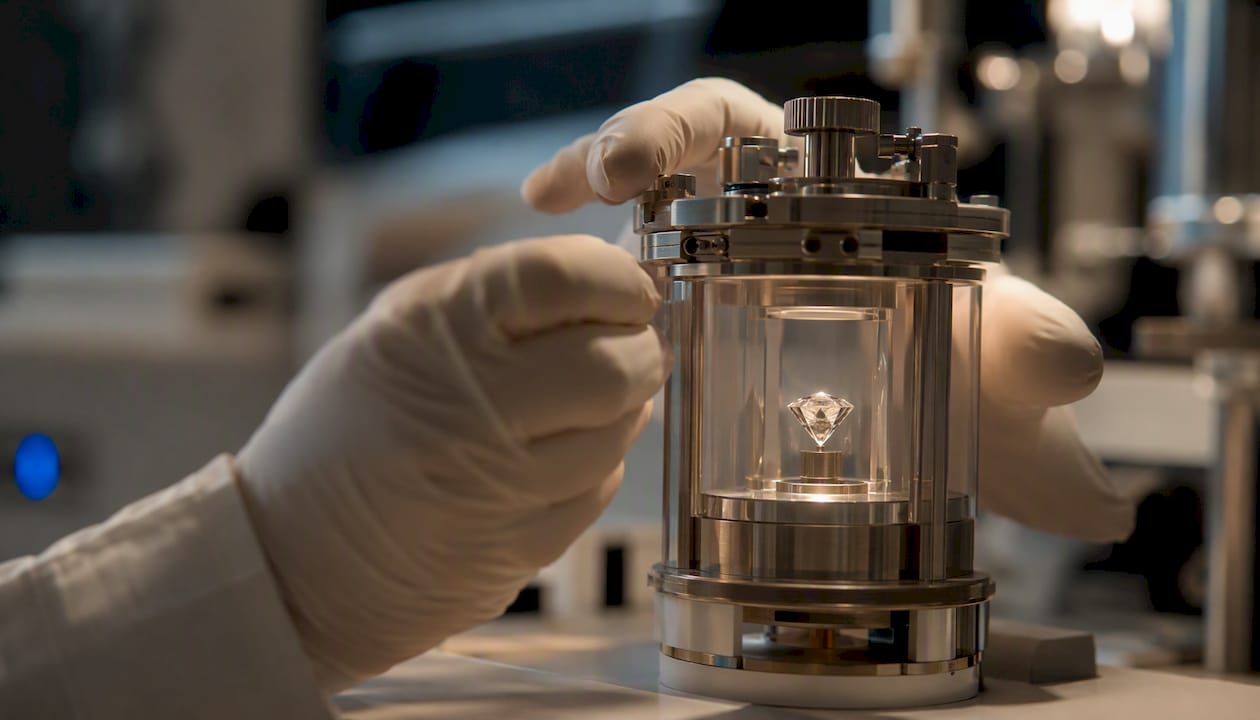
Lab-grown diamonds are chemically and physically identical to mined diamonds. They’re created in controlled facilities using either High Pressure High Temperature (HPHT) or Chemical Vapor Deposition (CVD) processes. Because no mining occurs, the conflict-financing concern is eliminated by definition. They also sidestep most labor and land-use concerns associated with extraction. The trade-off: energy consumption in production can be significant, and the environmental footprint depends heavily on whether the facility uses renewable power. Price-wise, lab-grown diamonds typically cost considerably less than comparable mined stones. Ask for an independent lab report (GIA certifies lab-grown diamonds) to confirm the stone is genuinely lab-created and not a simulant.
Recycled diamonds are previously owned stones re-entering the market through estate sales, buyback programs, or resale. No new mining means no new conflict risk and no new environmental extraction impact. Provenance documentation for the original mining source is usually unavailable, but the stone’s re-use is itself a form of ethical sourcing. Availability is more limited, and finding a specific cut, size, or quality in recycled inventory takes more effort. Services like Watch Repair Station’s gold buying and appraisal illustrate how the secondary precious-materials market operates for buyers and sellers navigating resale and valuation.
Moissanite is a distinct gemstone, silicon carbide rather than carbon, that closely resembles diamond in appearance and brilliance. It’s almost entirely lab-created today, which means zero mining conflict risk and a predictable, auditable production chain. It costs significantly less than diamond. The difference in appearance is subtle to most eyes but detectable by gemologists and some diamond testers. Moissanite is a genuine gemstone, not a fake diamond, but it is a different material.
| Option | Conflict risk | Environmental impact | Price vs. natural diamond | Traceability |
|---|---|---|---|---|
| KP-certified natural diamond | Very low (99%+ compliant) | Varies by mine | Baseline | Limited post-cutting |
| Lab-grown diamond | None | Depends on energy source | Significantly lower | High (facility-based) |
| Recycled diamond | None (no new mining) | Minimal (no extraction) | Varies by market | Original source unknown |
| Moissanite | None | Low (lab-created) | Substantially lower | High (facility-based) |
Pro Tip: For lab-grown diamonds, always request a GIA or IGI grading report that explicitly states “laboratory-grown.” Some retailers use vague language; the report removes all ambiguity about what you’re buying.
A practical buying checklist for U.S. shoppers
Use this sequence whether you’re shopping in a store or online. It takes about ten minutes and covers both conflict-free status and broader ethical credentials.
- Ask for the System of Warranties statement. Request it in writing. Any reputable retailer following KP FAQ guidelines should provide this on the invoice.
- Request the country of origin. A specific country is the minimum; a named mine or region is better.
- Ask for a GIA grading report. The GIA report covers the 4Cs and may include origin information. For lab-grown stones, confirm the report explicitly states “laboratory-grown.”
- Check for RJC, IRMA, or SCS-007 certification. Ask whether the retailer or their supplier holds any of these. If yes, ask to see documentation or a membership number you can verify independently.
- Review the retailer’s published sourcing policy. A transparent retailer publishes this on their website. If you can’t find one, ask where it is.
- Confirm chain-of-custody documentation for high-value purchases. For engagement rings or significant pieces, ask whether the retailer can provide supplier audit reports or provenance statements beyond the KP certificate.
- Check U.S. Customs compliance. The U.S. Customs and Border Protection publishes guidance on conflict-diamond controls relevant to import compliance.
Questions to ask a retailer directly:
- “Do you follow the World Diamond Council’s System of Warranties?”
- “What is the country of origin for this specific stone?”
- “Is your supplier RJC-certified or IRMA-audited?”
- “Can I see your sourcing policy in writing?”
- “For lab-grown stones: can I see the GIA or IGI grading report?”
Red flags to watch for:
- No written sourcing policy anywhere on the website
- Inability to name even a country of origin
- “All our diamonds are ethical” with no certification or audit to back it
- Pressure to skip documentation questions
- No grading report available for a diamond over 0.5 carats
How conflict-free status affects price and the current market picture
Here’s a fact that surprises many buyers: conflict-free status alone almost never increases the retail price of a diamond. The reason is straightforward. Conflict diamonds, by definition, are illicit goods that operate outside legitimate trade channels. A diamond sold in a U.S. jewelry store was never competing with conflict stones on price. The KP system has pushed conflict diamonds to a fraction of a fraction of global supply.
Statistic: GIA estimates that 99% to 99.8% of diamonds in the global marketplace meet the KP conflict-free definition. Conflict stones are not a meaningful presence in U.S. retail.
What does affect price is the additional layer of ethical certification. RJC membership, IRMA audits, and SCS-007 certification all require investment from suppliers and retailers. That cost can flow through to retail pricing, though the premium varies widely by retailer and stone.
Key market points:
- KP compliance is essentially universal in U.S. retail; you are almost certainly buying a conflict-free diamond already
- The meaningful price differentiator is broader ethical certification, not KP status alone
- Lab-grown diamonds typically cost significantly less than comparable mined stones, making them an accessible option for buyers who want both ethical assurance and value
- Recycled diamonds vary in price depending on the secondary market; they don’t carry a predictable premium or discount
What’s changed in 2026: policy updates and reliable U.S. resources
The Kimberley Process continues to operate with its current membership structure. No major structural overhaul to the KPCS framework has been announced as of mid-2026, though ongoing discussions about expanding the definition of “conflict diamonds” to include government-sponsored abuses remain active within the KP’s working groups.
Key resources for U.S. buyers in 2026:
- Kimberley Process official site: Current participating countries, certificate requirements, and policy updates
- GIA conflict-free FAQ: Plain-language explanation of what conflict-free means and the 99%–99.8% market estimate
- U.S. Customs and Border Protection: U.S. government guidance on conflict-diamond import controls
- SCS-007 standard: Full text of the sustainability certification for natural and lab-grown gems
- Gem Society conflict-free explainer: Consumer-facing overview of how the term is used at point of sale
Statistic: GIA’s guidance places the share of KP-compliant diamonds in global trade at 99% to 99.8%, a figure that reflects the scheme’s effectiveness at removing conflict stones from legitimate channels since 2003.
Diamondsbydaisy’s perspective on conflict-free claims and ethical sourcing
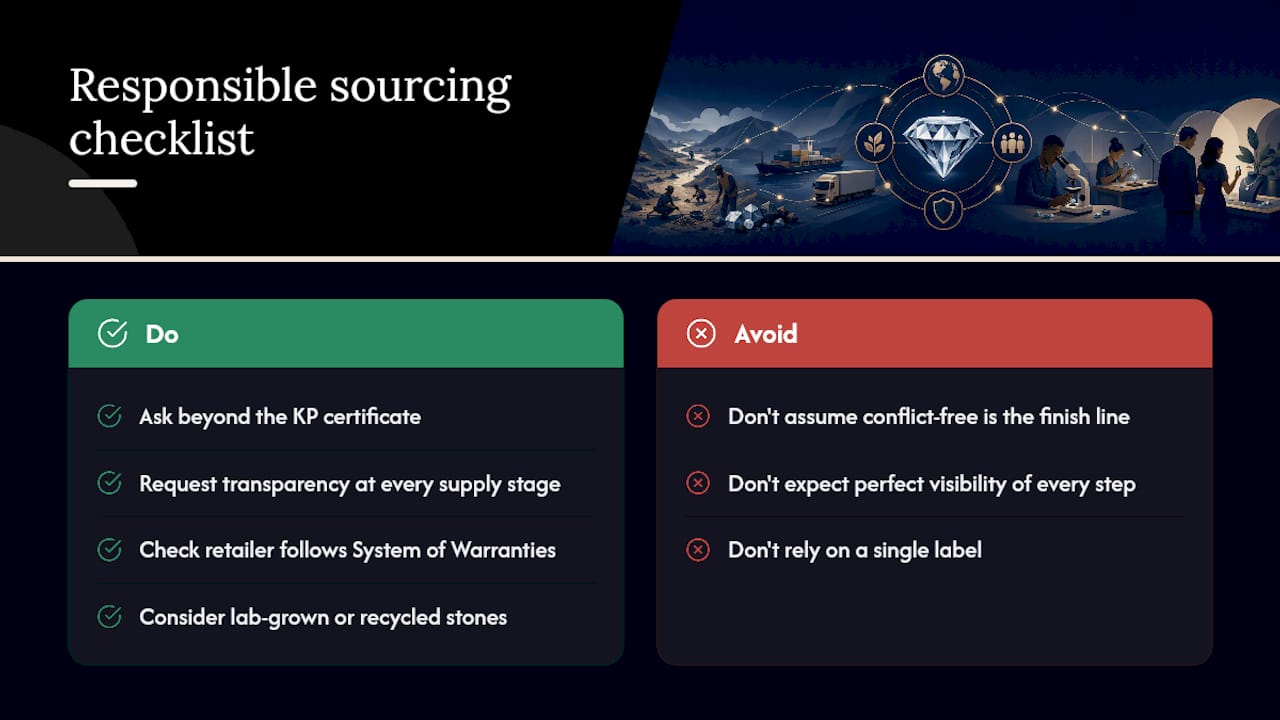
The conflict-free label is a starting point, not a finish line. But the label’s narrow scope means that buyers who care about how workers are treated, how land is managed, or how communities benefit from mining need to ask more questions than a KP certificate can answer.
At Diamondsbydaisy, the position is that provenance transparency matters at every stage of the supply chain, not just at the rough-diamond export level. The pieces in the natural diamond jewelry collection are sourced with attention to documentation and quality, and the brand’s commitment is to give buyers the information they need to feel confident in their purchase.
The honest caveat: no retailer can guarantee perfect visibility into every step of a complex global supply chain. What a responsible retailer can do is follow the System of Warranties, seek suppliers with third-party certifications, publish a clear sourcing policy, and answer your questions directly. That’s the standard worth holding any jeweler to, including this one.
For buyers who want the broadest possible ethical assurance, lab-grown diamonds and recycled stones are genuine options worth considering alongside certified natural diamonds. The right choice depends on what matters most to you, and no single label answers every question.
Diamondsbydaisy curates natural diamond jewelry designed for everyday wear and meaningful gifting. Browse the sterling silver and natural diamond collection or explore the full range at Diamondsbydaisy to find pieces backed by the brand’s sourcing commitments and quality standards.
Sources
- Gia
- Kimberleyprocess
- Certification Standard for Sustainably Produced Gemstones | SCS Standards
- What conflict-free means in diamonds, and how the Kimberley Process works | Prism News
Recommended
- Buy Certified Diamond Jewelry Online: A 2026 Guide – Diamonds by daisy
- Diamond Love Pendant Necklace – Sterling Silver Natural Diamonds | Diamonds by Daisy – Diamonds by daisy
- Diamond Arrowhead Open Ring – Sterling Silver Natural Diamonds | Diamonds by Daisy – Diamonds by daisy
- Diamond Floral Stud Earrings – Sterling Silver Natural Diamonds | Diamonds by Daisy – Diamonds by daisy