

Bracelet Size Guide: How to Measure Your Wrist Correctly
Measure your wrist circumference where the bracelet will actually sit, then add 0.25 to 1 inch depending on how loose you want it to hang. That single number, wrist measurement plus fit allowance, is the bracelet length you should buy.
If you want it snug against the skin, add 0.25 to 0.5 inch. For a comfortable everyday fit that moves a little, add 0.75 to 1.0 inch. Anything over an inch reads as loose and will slide around your hand.
No tape measure handy? Standard charts list women’s average bracelet size at around 7 inches and men’s around 8 inches. It’s a rough placeholder, not a substitute for measuring, but it works in a pinch for gifts.
- Snug: wrist + 0.25 to 0.5 in
- Comfortable: wrist + 0.75 to 1.0 in
- Loose: wrist + over 1 in
- No time to measure: try 7 in (women’s average) or 8 in (men’s average) as a starting point
Key Takeaways
Getting bracelet fit right comes down to one formula: measure your wrist accurately, then add the allowance that matches how you want the piece to sit.
| Point | Details |
|---|---|
| Use the core formula | Wrist circumference plus 0.25 to 1 inch of allowance equals the bracelet length to buy. |
| Match allowance to feel | Snug adds 0.25 to 0.5 in, comfortable adds 0.75 to 1.0 in, loose adds over 1 in. |
| Size bangles by hand, not wrist | Measure knuckles with fingers folded, since bangles must slide over the hand to reach the wrist. |
| Trust a well-fitting bracelet you already own | Measuring an existing piece end to end often beats measuring bare wrist alone. |
| Choose adjustable styles for uncertain fits | Diamondsbydaisy’s slider and stacking bracelets list exact adjustable ranges to remove the guesswork. |
Where to Verify Bracelet Sizing Information
- Jewelers Mutual’s measuring guide: step-by-step tape and string measuring instructions with fit allowance ranges.
- David Yurman’s bracelet size guide: diameter-to-circumference conversion math and style-specific sizing notes.
- Tiffany & Co.'s size chart: named size labels mapped to wrist circumference ranges.
- JAXXON’s printable sizer guide: a downloadable, printable wrist sizer for tape-free measuring.
Table of Contents
- How Do You Measure Your Wrist for a Bracelet?
- What Bracelet Size Should You Buy Based on Your Wrist?
- Does Bracelet Sizing Change by Style?
- Can You Use an Old Bracelet to Find Your Size?
- How Do You Fix a Bracelet That Doesn’t Fit?
- Frequently Asked Questions
- Sources
How Do You Measure Your Wrist for a Bracelet?
You have three practical options, and none of them require special equipment.
- Soft tape measure. Wrap it around your wrist right where the bracelet will actually rest, typically just above the wrist bone. Keep your hand relaxed, not flexed, and don’t cinch the tape tight enough to leave a mark. Read the number in both inches and centimeters so you can cross-check it against any size chart.
- String or paper strip. No tape measure? Wrap a piece of string or a strip of paper around your wrist at the same spot, mark where it overlaps with a pen, then lay it flat against a ruler. This method is just as accurate as a tape measure once you’re careful about the overlap point.
- Printable sizer. Several jewelry brands offer downloadable, printable wrist sizers you can wrap and cut to fit, which is a solid backup if you’re ordering a piece as a surprise and can’t ask the recipient to measure themselves, so long as you print it at 100% scale and not “fit to page.”
For slip-on bangles, the math changes slightly. Fold your fingers into your palm as if making a loose fist, then measure around the widest part of your hand, across the knuckles. That number, not your wrist circumference, tells you whether a solid bangle will actually slide over your hand.
A few common snags: people with larger palms relative to wrist size often need a bangle a full size up from what their wrist measurement alone would suggest. Swelling from heat, exercise, or time of day can shift your reading by a quarter inch or more, so measure at a normal moment, not right after a workout. And if you already wear a favorite bracelet daily, check where it’s worn thin. That wear pattern tells you exactly where your true measuring point is.
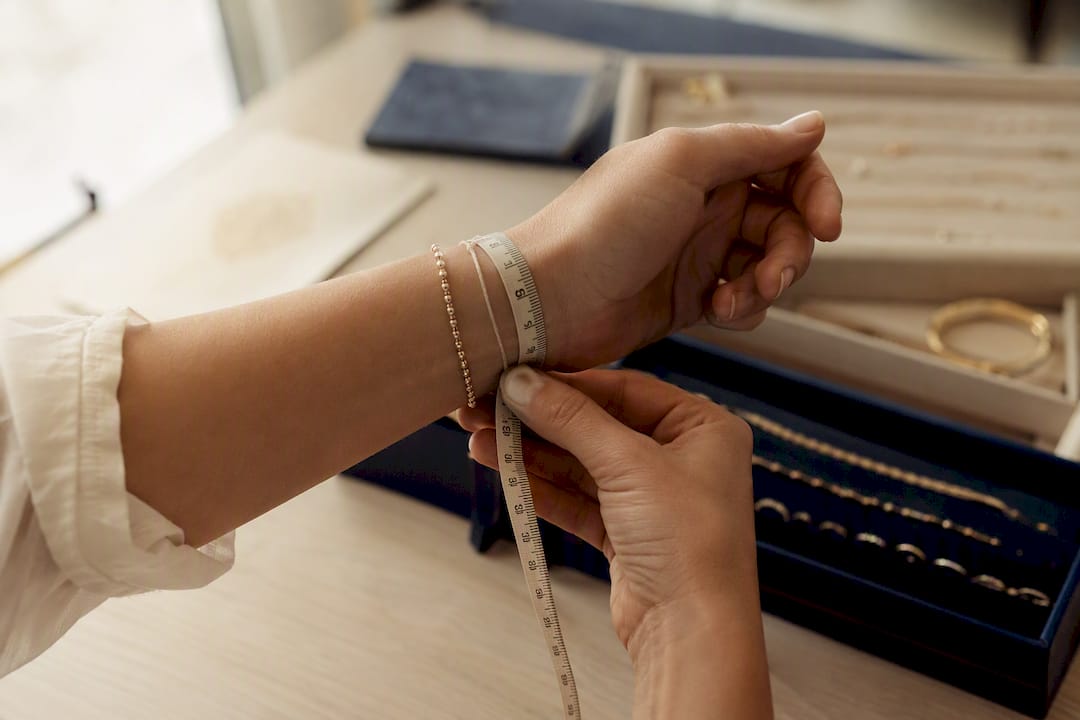
Pro Tip: Measure your wrist twice, once in the morning and once in the evening. Wrist size can shift slightly throughout the day, and splitting the difference gives you a more honest number.
What Bracelet Size Should You Buy Based on Your Wrist?
Once you have your wrist number, the formula is simple: measured wrist + your chosen allowance = the bracelet length to order. A 6-inch wrist with a comfortable 0.75 inch allowance means you’re shopping for a 6.75 inch bracelet.
Here’s where it gets slightly trickier: not every seller measures the same way. Some list bangle size as inner diameter, some as inner circumference, and some just print a size label like “Small” or “Medium” without explaining either. If a listing only gives you a diameter, multiply it by pi, roughly 3.14, to get the circumference you can compare against your own wrist measurement.
| Wrist Circumference | Bracelet Length to Buy (Comfortable Fit) | Typical Size Label |
|---|---|---|
| 6 in | 6.25 in | XS/S |
| 6.25 in | 6.75 in | S/M |
| 6.75 in | 7 in | M |
| 7 in | 7.75 in | M/L |
| 7.75 in | 8 in | L/XL |
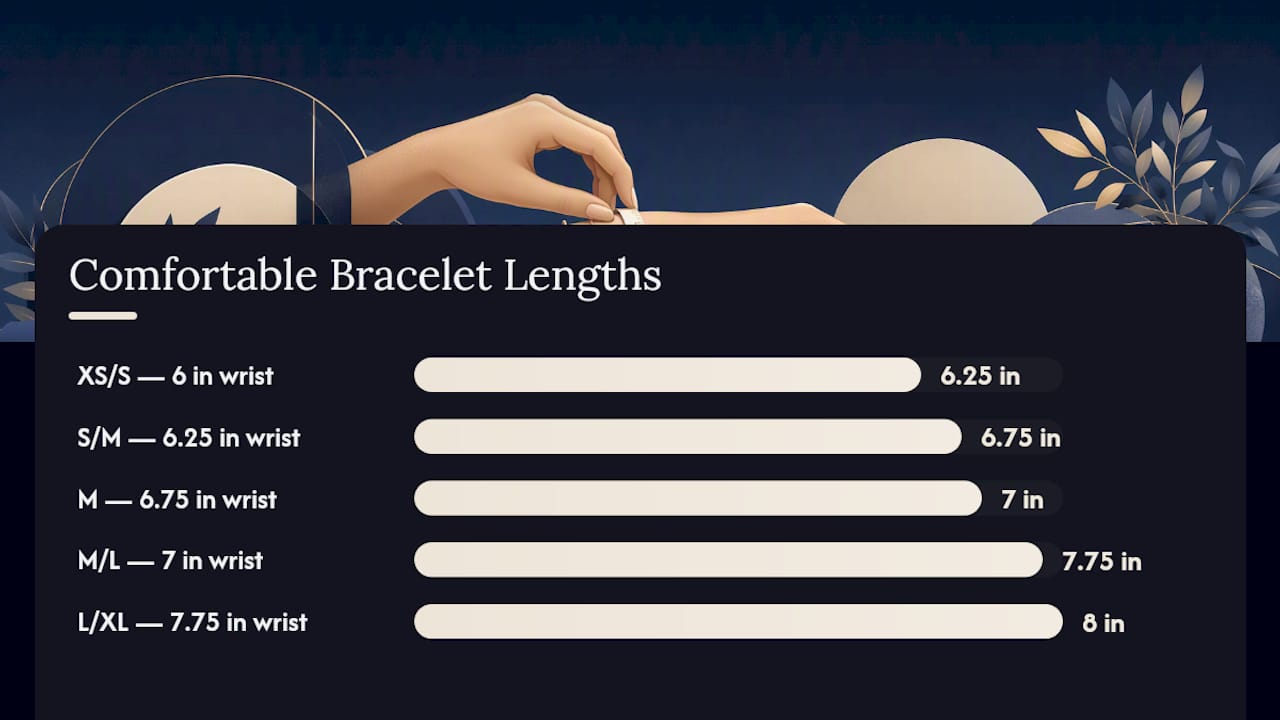
Named sizes vary by brand, but as a reference point, Tiffany & Co.'s published chart lists “Medium” at roughly 5.76 to 6.25 inches of wrist circumference, which lines up closely with the ranges above.
Standard sizing guides put the average women’s bracelet at around 7 inches and the average men’s bracelet around 8 inches. Those numbers are useful for gift-buying when you can’t ask, but they’re averages, not guarantees, and plenty of wrists fall well outside them.
Does Bracelet Sizing Change by Style?
Yes, and this is where a lot of people order the wrong size even after measuring correctly. Construction and closure type change how much allowance you actually need.
- Bangles need to clear your knuckles to go on, so size by hand or knuckle circumference, not wrist alone. A hinged bangle, however, opens and closes like a clasp, so it can sit closer to your actual wrist size than a solid slip-on style requires.
- Cuffs are open-ended and meant to sit snugly, sometimes gripping the wrist slightly. Add only 0.25 to 0.5 inch here. Diamondsbydaisy’s dual cuff bracelet set is a good example of a style built for that snugger, structured fit.
- Chain and link bracelets are the most forgiving. Many use jump rings at the clasp, so you can size to your wrist plus your preferred allowance, or simply pick an adjustable length if the design offers one.
- Slider and adjustable bracelets solve the guesswork almost entirely. Check the listed adjustable range on the product page. A rose gold slider bracelet, for instance, might list a 6 to 8 inch range, meaning it fits comfortably across most adult wrists without you doing any math at all.
Can You Use an Old Bracelet to Find Your Size?
If you own a bracelet that already fits the way you like, it’s often a better sizing tool than measuring your bare wrist, because it shows you exactly how a real design behaves on your arm, clasp and all.
- Lay the bracelet flat on a table, unclasped, and measure it end to end, from the clasp to the jump ring on the opposite end.
- For a bangle, measure the inner diameter straight across, then multiply by pi if you need to compare it against a circumference-based size chart.
- Use that number as your target length or diameter for future purchases, especially from the same brand or a similar style.
- Adjust slightly if you’re stacking multiple bracelets (size up a touch to avoid crowding) or switching brands, since sizing conventions aren’t standardized across jewelers.
How Do You Fix a Bracelet That Doesn’t Fit?
A bracelet that’s slightly off doesn’t always mean a return. A few fixes are worth trying first.
- Extenders add 1 to 2 inches to a chain clasp and work well for a bracelet that’s just a bit too tight, though they’ll leave a small dangling chain visible.
- Silicone inserts or clasp adjustments offer a temporary fix for bangles or cuffs, but they’re not a permanent solution and can wear out.
- Link removal or addition is the most reliable permanent fix for chain bracelets, and most jewelers can do it in minutes.
- Solid bangles and cuffs are usually impossible to resize without reshaping the metal entirely, so check your size twice before buying one of these styles.
- Wrist size shifts slightly with seasons, weight changes, and swelling, so a piece that’s snug in summer heat may fit differently in winter.
Pro Tip: If you’re between two sizes, size up rather than down, especially for gifts. A slightly loose bracelet is comfortable; a slightly tight one is unwearable.
Why Trust This Bracelet Sizing Guide?
This guide draws its allowance ranges and measuring steps directly from established jeweler resources, cross-checked against multiple brand size charts to confirm the numbers hold up.
Get the fit right and a bracelet disappears into your day. Get it wrong and you’re either tugging at it or watching it slide off your hand.
Diamondsbydaisy applies these same standards across its own pieces, including the adjustable slider bracelet, the layered circle stacking bracelet, and the structured dual cuff set.
A Quick Note on Gifting the Right Fit
When Diamondsbydaisy has to guess a size, adjustable pieces win every time. They remove the anxiety of buying jewelry for someone else. If it still doesn’t sit right, our return and resizing policy covers you.
Shop Bracelets That Fit Almost Any Wrist
Guessing a loved one’s wrist size is one of the more stressful parts of buying jewelry as a gift, and it’s exactly why adjustable construction earns its place in a lot of jewelry boxes. Instead of locking you into one measurement, an adjustable slider mechanism lets the bracelet expand or contract within a listed range, so you’re not stuck betting on a single number.
Diamondsbydaisy’s slider bracelet and stacking circle bracelet are both built with this kind of flexibility in mind, and each product page lists its exact length range so you’re never buying blind. If you’d rather browse a full range of fit-friendly styles at once, the collection page groups adjustable and stacking pieces together for easier comparison. Check the listed range against your own measurement, or against the wrist size of the person you’re shopping for, and add the piece to your cart with confidence instead of a guess.
Frequently Asked Questions
What is the average bracelet size for women? Most charts list the average women’s bracelet at around 7 inches, though your actual wrist measurement plus your preferred fit allowance is always more reliable than an average.
How do I know if a bracelet is too big? If it slides past your wrist bone onto the back of your hand while your arm hangs naturally, or rotates constantly around your wrist, it’s likely more than an inch beyond a comfortable fit.
Can I resize a bracelet myself at home? Chain and link bracelets can sometimes be shortened by removing a link if you have the right tools, but bangles and cuffs generally require a jeweler since reshaping solid metal at home risks damaging the piece.
Is bracelet sizing the same as ring or watch sizing? No. Rings size to finger circumference with much smaller allowances, and watches typically size larger than bracelets to accommodate the watch face and clasp mechanism, so don’t reuse a ring or watch measurement for bracelets.
What if my wrist measurement falls between two chart sizes? Round up rather than down, particularly for bangles and gifts, since a slightly loose bracelet stays wearable while a slightly tight one often doesn’t.
Sources
- How to Measure Bracelet Size | Jewelers Mutual
- Bracelet Size Guide | David Yurman
- Bracelet Size Guide & Chart: What Size Bracelet Do I Wear? | Tiffany & Co. US