

No Replating or Lower Price? Platinum vs White Gold for Engagement Rings
Platinum wins for heirloom pieces, low-maintenance lifestyles, and sensitive skin, while white gold wins on upfront cost if you don’t mind periodic upkeep. The decision comes down to three trade-offs: platinum costs more but never needs replating, white gold scratches less but loses its bright white finish over time, and platinum’s extra weight and prong strength make it the safer bet for larger, heirloom-bound stones.
TL;DR:
- White gold’s rhodium plating requires reapplication every 12 to 24 months, costing $50 to $150 each time, which adds long-term maintenance expenses.
- Platinum maintains its color and prong strength without replating, but it costs 30% to 60% more upfront and is significantly heavier.
- White gold is harder initially but wears down over time as tiny amounts of metal are lost with scratches, unlike platinum, which displaces and develops a patina.
- For sensitive skin, platinum offers a safer, nickel-free option, while white gold often contains nickel unless specifically replaced with palladium.
- When choosing, consider platinum for longevity and hypoallergenicity or white gold for budget-friendly options with periodic upkeep.
Table of Contents
- Platinum vs White Gold at a Glance
- Why They Look Different: Alloys, Karats, and What the Stamps Mean
- Durability and Wear: What Happens After Years on Your Finger
- Rhodium Replating, Repair Costs, and the Real Price of Ownership
- Which Metal Is Safer for Sensitive Skin?
- How Weight and Density Change the Way a Ring Feels
- How to Choose: A Decision Checklist
- A Curator’s View on Platinum, White Gold, and What Actually Matters
- Explore Curated Bridal Pieces Built to Last
- Where These Facts Come From
- Sources
Platinum vs White Gold at a Glance
Before you dive into alloys and hardness scales, here’s the shorthand version.
- Composition: Platinum is naturally white, usually sold as Pt950 (95% pure). White gold is yellow gold alloyed with white metals, then plated.
- Maintenance cost: Platinum needs occasional polishing only. White gold replating typically runs $50 to $150 per visit.
- Hypoallergenic status: Platinum is generally safe for sensitive skin. White gold can contain nickel, a common allergen.
- Weight: Platinum is noticeably heavier on the hand.
Statistic to remember: that 12 to 24 month replating window isn’t a worst case scenario. It’s the standard maintenance rhythm most white gold owners settle into, and it’s worth budgeting for before you buy rather than after your ring starts looking dull.
Why They Look Different: Alloys, Karats, and What the Stamps Mean
Platinum’s whiteness is chemical, not cosmetic. It’s a naturally silvery gray-white metal, and jewelers typically work with Pt950, meaning 95% pure platinum alloyed with a small amount of iridium or ruthenium for workability. There’s no coating involved, so what you see on day one is what you’ll see in twenty years, aside from a soft patina that develops with wear.
White gold starts as yellow gold, which is alloyed with white metals like palladium, silver, or nickel to lighten its color. Even at its whitest, that alloy still carries a faint yellowish or grayish cast, so jewelers apply a rhodium plating on top to achieve the bright, icy white most buyers picture when they hear “white gold.” That plating is the entire reason white gold needs upkeep that platinum doesn’t.
Karat matters here too. 14K white gold contains 58.3% pure gold and more alloy metal, making it slightly harder but often more prone to a warmer undertone once the rhodium wears thin. 18K white gold contains 75% pure gold, feels a bit softer, and tends to show a richer luster once you look past the plating.
When you’re shopping, check the hallmark stamped inside the band:
- Pt950 or Plat signals platinum at 95% purity.
- 18K or 750 signals 18-karat gold.
- 14K or 585 signals 14-karat gold.
- A maker’s mark alongside these numbers helps you trace the piece back to its source if questions come up later.
Don’t hesitate to ask your jeweler directly which alloy metals are used in a white gold piece. Some retailers use nickel for cost reasons, others use palladium for a smoother, hypoallergenic finish, and that one detail can matter enormously if you’re prone to skin reactions.
Durability and Wear: What Happens After Years on Your Finger
Here’s where a lot of buyers get surprised: white gold is actually the harder metal, but that doesn’t mean it holds up better long term. White gold measures around 210 on the Vickers hardness scale, compared to platinum’s roughly 135. That means white gold resists surface scratches more effectively in the short run.
The catch is what happens at the microscopic level. When white gold gets scratched, it loses tiny amounts of metal with every mark, meaning the metal is being worn away bit by bit. Platinum behaves differently. When it scratches, the metal displaces rather than disappears. It shifts rather than sheds, which is why platinum rings develop a soft patina over the years instead of thinning out.
That distinction matters most at the prongs. Platinum prongs bend under pressure but keep their mass, which is exactly why platinum settings are often recommended for larger diamonds or stones you plan to pass down. White gold prongs, by contrast, can thin gradually with wear and sometimes need retipping to keep a stone secure.
- Have prongs inspected once a year, regardless of which metal you choose.
- Ask for reinforced or thicker prong settings if your center stone is a carat or larger.
- Expect white gold prongs to need attention sooner than platinum prongs on a ring worn daily.
Pro Tip: If you work with your hands often, whether that’s gardening, gym sessions, or a hands-on job, ask your jeweler about prong thickness before you buy. A slightly thicker prong costs little upfront and can save you a repair bill (and a moment of panic) five years down the road.
Rhodium Replating, Repair Costs, and the Real Price of Ownership
The sticker price is only half the story. White gold’s rhodium layer is measured in microns, thin enough that everyday friction, hand sanitizer, and chlorine gradually wear it down. That’s why most owners plan on replating every 12 to 24 months, at a typical cost of $50 to $150 per service.
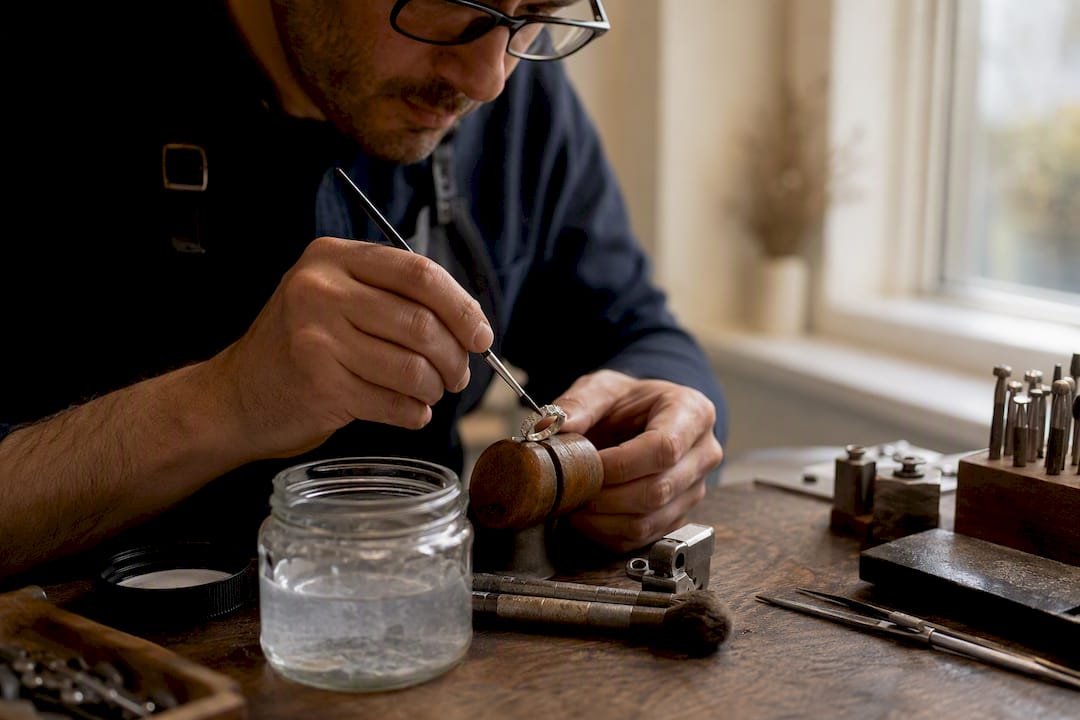
Platinum skips that cycle entirely. It doesn’t need replating because there’s no plating to begin with, and routine care is limited to occasional professional cleaning and polishing.
Statistic worth budgeting around: over a decade, ten annual replating services at even the low end of that range add up to several hundred dollars, enough to close a meaningful chunk of platinum’s upfront premium.
Other service costs to factor in:
- Resizing: Both metals can be resized, but platinum’s higher melting point and density make the labor more time-consuming and typically pricier.
- Prong retipping: More common on white gold rings due to gradual metal loss.
- General repairs: Platinum repairs often run higher due to the specialized equipment and higher heat required to work the metal.
Here’s a rough five to ten year snapshot. Say you buy an 18K white gold ring for $2,000 and a comparable platinum ring for $3,000. Over ten years of annual replating at $100 a visit, the white gold ring accumulates roughly $1,000 in maintenance, narrowing the gap to about $0. Over shorter timeframes, platinum’s premium stays significant, but the math shifts if you’re planning to wear the ring for decades. Some buyers instead put that price difference toward a larger center stone, choosing white gold specifically to stretch their diamond budget further.
Which Metal Is Safer for Sensitive Skin?
If you or your partner has reacted to costume jewelry before, this section matters more than color or price. Nickel, one of the most common alloying metals in white gold, is also one of the most common triggers for contact dermatitis. Redness, itching, or a rash under the ring is usually the tell.
Platinum sidesteps this almost entirely. Its purity and biocompatibility make it a safe bet for people with metal sensitivities, which is part of why it’s a frequent recommendation for engagement rings worn daily for years.
If you love the white gold look but worry about reactions, you have options:
- Ask specifically for palladium-based white gold instead of nickel alloys. It costs a bit more but eliminates the main allergen.
- Request a nickel-free certification in writing if your jeweler offers one.
- If you’ve already had a reaction, a rhodium-safe liner inside the band can sometimes help, though switching to platinum is the more permanent fix.
None of this makes white gold unwearable for sensitive skin. It just means asking one extra question before you buy.
How Weight and Density Change the Way a Ring Feels
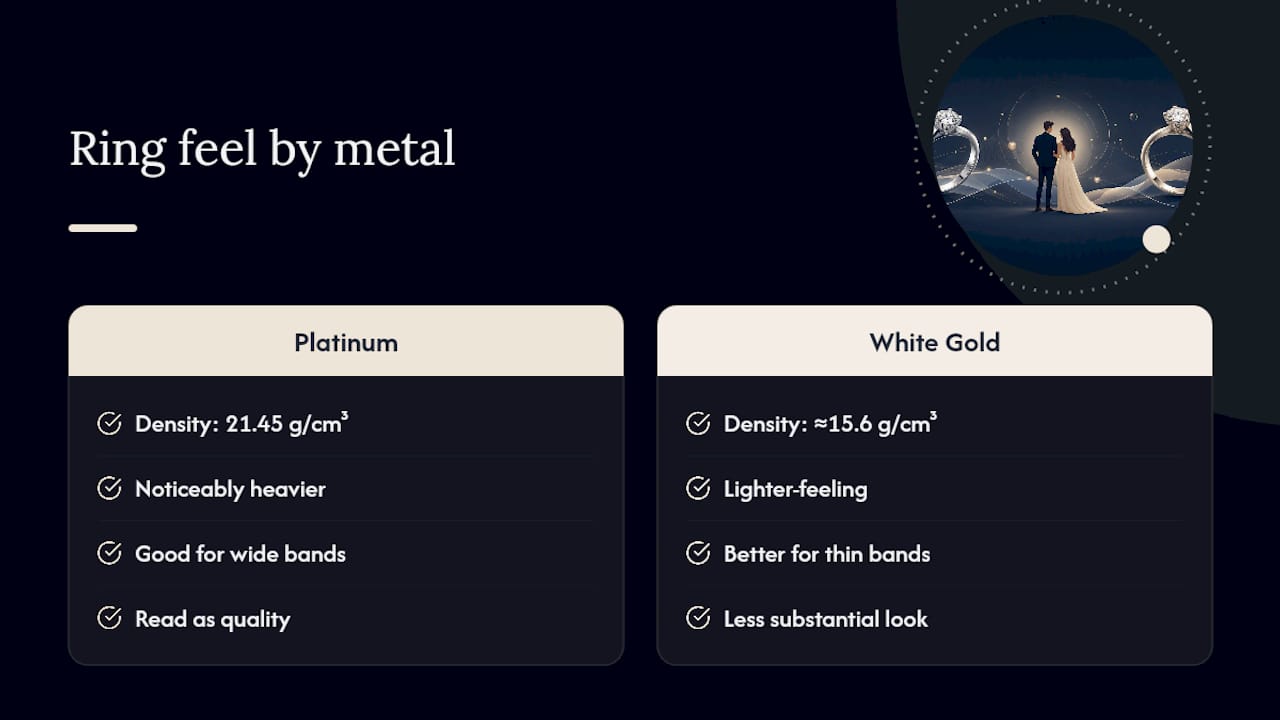
Platinum is roughly 21.45 g/cm³ compared to white gold’s approximately 15.6 g/cm³, which translates to a noticeably heavier ring even at identical dimensions. Some buyers read that heft as quality. Your hand knows the ring is there, and for many people, that’s reassuring rather than annoying.
Others find the added weight tiring after a full day, especially with wider bands, where the density difference compounds. A 3mm platinum band feels substantial; an 8mm platinum band can feel like a genuine statement piece on the finger.
If you’re torn, try on both metals in the same band width and setting style before deciding. Wider, bolder designs tend to suit platinum’s heft, while delicate, thin bands often feel more comfortable in lighter white gold.
How to Choose: A Decision Checklist
Match your priorities to the checklist below, then map them to a metal.
- Do you want a ring that lasts generations without replating? Choose platinum.
- Is a lower upfront price your top priority? Choose white gold, and plan for replating costs.
- Do you or your partner have sensitive skin or a nickel allergy? Choose platinum, or palladium-based white gold.
- Is your center stone one carat or larger? Platinum’s prong strength offers better long-term security.
- Do you prefer a lighter, barely-there feel on the hand? Choose white gold.
Three quick scenarios: a couple planning to pass the ring down as an heirloom typically leans platinum, since it never needs replating and holds prong strength over decades. A couple stretching their budget toward a bigger diamond often chooses white gold, accepting the maintenance trade-off for more stone. A buyer with a known nickel allergy should default to platinum or specifically request palladium white gold.
Before you buy, ask your jeweler these questions directly:
- What karat and alloy is this white gold, and does it contain nickel?
- How often will this specific setting need rhodium replating?
- What’s the prong thickness, and is there a warranty covering retipping?
Pro Tip: Bring this checklist with you to the store. Jewelers respect a buyer who asks specific questions, and you’ll often get a more honest answer about maintenance costs than if you just ask “which one is better.”
A Curator’s View on Platinum, White Gold, and What Actually Matters
Most guides frame this as platinum versus white gold like it’s a competition with one correct answer. It isn’t. At Diamonds by Daisy, both metals earn a place in our curated collection because they solve different problems for different people, and pretending otherwise does readers a disservice.
What I’d push back on is the assumption that white gold is the “compromise” choice. For a buyer who wants a beautiful, substantial 18K piece and doesn’t mind an occasional trip to the jeweler, that’s not settling. That’s a deliberate trade, and it’s often the smarter one if it means putting more of your budget into the diamond itself rather than the metal around it.
— Georgia
Explore Curated Bridal Pieces Built to Last
Whichever metal you land on, Diamonds by Daisy’s curated approach means you’re not choosing between quality and style. We select pieces for craftsmanship and lasting wear, not just how they photograph, so you can shop with confidence instead of guesswork.
If you’re drawn to platinum’s low-maintenance elegance or white gold’s brighter price point, our Bridal & Wedding Jewellery collection has curated options across both, alongside settings designed with real prong security in mind. Prefer to see a specific piece up close first? Our Diamond Bridal Ring Set is a solid starting point if you want a ready-to-wear option rather than a custom build. Browse the collection, compare a few settings side by side, and reach out if you want guidance narrowing it down to the one that fits your hand and your budget.