

Luxury Jewellery Craftsmanship Standards: A UK Comparison Guide
Table of Contents
- What Defines Luxury Jewellery Craftsmanship Standards?
- Hallmarking Standards in UK Jewellery: Legal Requirements and Quality Markers
- Identifying Quality Jewellery UK: Certification and Grading Standards
- Fine Jewellery vs. Luxury Jewellery UK: Comparing Craftsmanship Standards
- Bespoke Jewellery London and Artisanal Craftsmanship: The Handmade Advantage
- Comparing Luxury Jewellery Craftsmanship Standards: Key Benchmarks Table
- Sustainability and Ethical Sourcing: Modern Craftsmanship Standards
- Maintenance and Longevity: The True Test of Craftsmanship Quality
Last Updated: July 29, 2026
When evaluating fine and luxury jewellery, understanding the standards that distinguish craftsmanship quality is essential. This guide from Diamonds by daisy explores comparing luxury jewelry craftsmanship standards across the UK market, helping you identify what truly separates investment-grade pieces from mass-produced alternatives. Whether you're purchasing an engagement ring, a heritage timepiece, or a statement necklace, knowing how to assess craftsmanship standards ensures you're making an informed decision about quality and value.
The distinction between fine jewellery and haute joaillerie is rooted in measurable, verifiable standards that professional craftspeople, independent certifiers, and heritage houses use to evaluate each piece.
What Defines Luxury Jewellery Craftsmanship Standards?
Luxury jewellery craftsmanship standards represent a set of technical, aesthetic, and material criteria that separate bespoke and high-end pieces from conventional fine jewellery. These standards encompass precious metal purity, gemstone quality, hand-finishing techniques, design integrity, and production exclusivity. According to The Goldsmiths' Company Assay Office guidance on precious metal standards, hallmarking verifies metal composition, but true craftsmanship standards go deeper, they assess the skill, time, and materials invested in creating a single piece.
The Four Pillars of Luxury Craftsmanship
Comparing luxury jewelry craftsmanship standards requires evaluating four interconnected elements: material integrity (sourcing, purity, and ethical provenance of precious metals and gemstones); hand-finishing (meticulous work by bench jewellers who polish, set, and perfect each element); design execution (how faithfully the final piece matches the original vision); and exclusivity (whether the piece is one-of-a-kind, limited edition, or produced in restricted quantities).
Heritage houses like Cartier, Van Cleef & Arpels, and Boucheron maintain strict internal standards for every piece. Emerging artisanal makers often match or exceed these standards through obsessive attention to detail. The key is knowing how to read hallmarks, certifications, and maker's marks that prove a piece meets established craftsmanship standards.
Hallmarking Standards in UK Jewellery: Legal Requirements and Quality Markers
Hallmarking is the official UK assay system that guarantees precious metal purity. Every item of gold, silver, platinum, or palladium sold in the United Kingdom must be hallmarked by law, unless it's below specific weight thresholds.
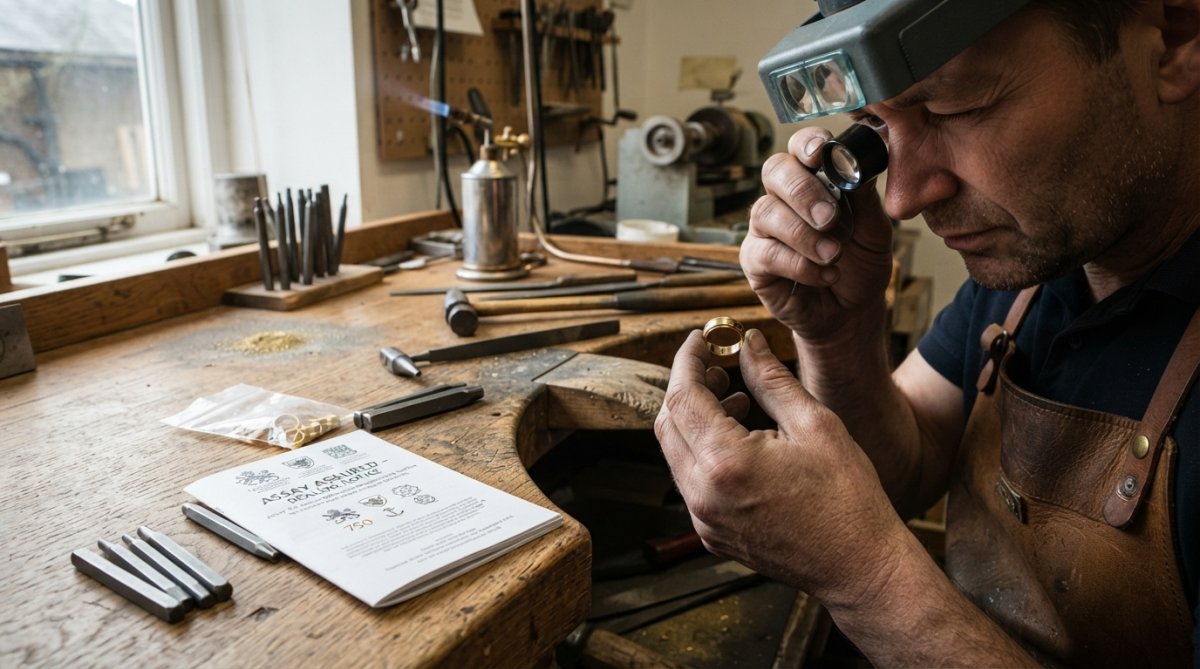
The Goldsmiths' Company Assay Office: 700 Years of Verification
The Goldsmiths' Company Assay Office in London is the oldest assay office in the world, operating continuously since 1300. It remains one of four authorised hallmarking offices in the UK, alongside Birmingham, Sheffield, and Edinburgh. The Goldsmiths' Company Assay Office provides hallmarking services and metal analysis for jewellers, manufacturers, and individual makers seeking verification of precious metal content.
When you purchase a hallmarked piece, you're relying on centuries of standardised testing. The assay office uses advanced analytical techniques to confirm that a piece marked as 18-carat gold actually contains 75% pure gold, or that platinum meets the 950 standard (95% pure).
Reading the Hallmark: What Each Symbol Means
A UK hallmark contains three essential components: the fineness mark (375 for 9-carat gold, 585 for 14-carat, 750 for 18-carat, 950 for platinum); the assay office mark (London's mark is a leopard's head); and the date letter, which changes annually and allows you to identify when the piece was hallmarked.
A piece hallmarked in 18-carat gold signals a maker who invested in higher-purity material, often a marker of quality-focused production. Conversely, 9-carat gold indicates cost-conscious manufacturing. Neither is inherently wrong; it depends on the piece's intended purpose and price point.
Identifying Quality Jewellery UK: Certification and Grading Standards
Beyond hallmarking, independent gemstone grading provides a second layer of verification essential for comparing luxury jewelry craftsmanship standards.
Independent Gemstone Grading: GIA, HRD Antwerp, and AnchorCert
The Gemological Institute of America (GIA) is globally recognised as the industry standard, grading diamonds using the 4Cs system. GIA Diamond Grading Reports assess carat, colour, clarity, and cut with international recognition and include a plotted clarity diagram and laser inscription of the report number on the diamond itself.
HRD Antwerp, based in Belgium, offers European-standard diamond and jewellery certification. AnchorCert Gem Lab, the gemological division of the Birmingham Assay Office, provides UK-based independent grading. AnchorCert Gem Lab offers UKAS-accredited gemstone identification and grading reports, ensuring international recognition of its assessments.
For significant diamond or coloured stone purchases, certification from one of these labs is essential. It provides objective proof of quality, treatment history, and establishes a baseline for insurance and potential resale value.
The 4Cs and Beyond: What Certification Actually Reveals
The 4Cs, carat weight, colour, clarity, and cut, form the foundation of diamond grading. Carat measures weight (one carat equals 200 milligrams). Colour grades diamonds from D (colourless) to Z (light colour). Clarity assesses inclusions visible under 10x magnification, ranging from Flawless (FL) to Included (I). Cut evaluates how well the diamond's proportions allow light to reflect, affecting brilliance.
Certification also discloses whether a diamond is natural or laboratory-grown, whether it's been treated to improve colour or clarity, and its fluorescence under UV light. For coloured gemstones, certification identifies the stone's species, origin (if determinable), and any treatments applied. A treated ruby at £1,500 differs fundamentally from an untreated ruby of similar appearance costing £8,000.
Fine Jewellery vs. Luxury Jewellery UK: Comparing Craftsmanship Standards
Fine jewellery refers to pieces made from precious metals and genuine gemstones, meeting basic quality standards. Luxury jewellery, or haute joaillerie, represents the upper tier, pieces distinguished by exceptional materials, masterful execution, design originality, and restricted production.
Material Integrity and Precious Metal Sourcing
Luxury jewellery makers source precious metals with greater scrutiny than mass-market producers. Many now prioritise conflict-free and ethically mined metals, working with suppliers who can trace material back to responsible mining operations. Diamonds by daisy emphasises handpicked gemstones and precious metals selected for quality and ethical sourcing.
The distinction extends to metal choice. A luxury piece in 18-carat gold uses higher-purity material than 14-carat alternatives, offering greater durability and better longevity for hand-finishing techniques. Platinum, favoured by heritage houses, requires specialised skills to work with and demands precision setting to showcase gemstones effectively.
Hand-Finishing and Bench Jeweller Expertise
A bench jeweller is a skilled artisan who performs hand-finishing work: polishing, setting stones, engraving, and perfecting surfaces. Luxury pieces often involve 40-100 hours of bench work per item. Mass-produced fine jewellery might receive 2-8 hours.
Hand-finishing reveals itself in subtle ways. Examine the inside of a ring; luxury pieces show perfectly smooth, polished interior surfaces. The prongs holding a stone should be symmetrical, precisely shaped, and seamlessly integrated with the band. These details require skill, experience, and time.
Production Quality and Exclusivity Metrics
A heritage house producing 500 pieces of a specific design annually maintains tighter quality control than a manufacturer producing 5,000 units. Limited edition pieces, numbered and documented, carry inherent value from exclusivity. One-of-a-kind bespoke pieces represent the highest tier.
Production limits enforce quality because they allow smaller teams to maintain oversight. Each piece receives individual attention rather than flowing through an assembly line. This approach is economically viable only for luxury positioning.
Bespoke Jewellery London and Artisanal Craftsmanship: The Handmade Advantage
Bespoke jewellery represents the pinnacle of comparing luxury jewelry craftsmanship standards. When a client commissions a custom piece, they're engaging directly with a designer and maker who will create something unique to their specifications.
From Sketch to Final Piece: Design Integrity in Bespoke Work
The bespoke process begins with consultation and sketching. The designer listens to the client's vision, then produces detailed drawings showing proportions, stone placement, and finishing details. These sketches are refined through multiple iterations until the client approves the design.
Once approved, the maker sources materials, creates a wax model or CAD rendering to confirm proportions, then begins fabrication: casting or hand-forging the metal, setting stones, hand-finishing every surface, and final inspection. For complex pieces, this process spans 8-16 weeks or longer.
Design integrity in bespoke work means the final piece faithfully represents the approved design. Proportions match the sketches. Stone placement is precise. Symmetry is perfect. This level of control over design execution is impossible in production jewellery.
Limited Edition vs. One-of-a-Kind: Understanding Exclusivity
Limited edition pieces are produced in restricted quantities, perhaps 50 or 100 units of a specific design. Each piece is numbered and documented. One-of-a-kind pieces are entirely unique; no other example exists. Both represent higher craftsmanship standards than unlimited production.
A limited edition piece appeals to collectors seeking exclusivity without the premium cost of bespoke work. One-of-a-kind pieces command the highest prices because they're truly irreplaceable.
| Exclusivity Type | Production Quantity | Typical Price Range | Best For |
|---|---|---|---|
| Mass Production | 1,000+ units | Entry-level luxury | Accessible quality |
| Limited Edition | 50-500 units | Mid-range luxury | Collectors, exclusivity seekers |
| One-of-a-Kind | 1 unit | Premium luxury | Bespoke clients, investment pieces |
Comparing Luxury Jewellery Craftsmanship Standards: Key Benchmarks
Understanding the technical standards used to evaluate luxury jewellery helps you assess pieces objectively.
Craftsmanship Standards Across Heritage Houses and Emerging Makers
Heritage houses like Cartier, Boucheron, and Graff maintain published standards for every piece. Their reputation depends on consistency; every piece must meet their standards. This consistency is enforced through rigorous training, standardised processes, and regular audits.
Emerging artisanal makers often exceed these standards through obsessive attention to detail. A London-based independent jeweller might hand-finish each piece for 80 hours, surpassing heritage house standards for labour investment. The difference is scale: heritage houses balance craftsmanship with production efficiency, while independent makers prioritise quality above all else.
When comparing luxury jewelry craftsmanship standards between makers, ask specific questions: How many hours of hand-finishing does each piece receive? What materials are sourced and from where? What certifications accompany the piece? How many pieces does the maker produce annually?
Sustainability and Ethical Sourcing: Modern Craftsmanship Standards
Contemporary craftsmanship standards increasingly include ethical and environmental considerations. Responsible sourcing of precious metals and gemstones is no longer optional for luxury makers.
Provenance and Conflict-Free Certification
Conflict-free diamonds and gemstones are sourced from mines and suppliers certified to meet standards preventing funding of armed conflict. The Responsible Jewellery Council (RJC) standard assesses environmental impact, labour practices, and community benefit. The Responsible Jewellery Council provides certification standards for ethical and sustainable jewellery production across mining, manufacturing, and retail.
For gemstones, provenance, the documented origin and ownership history, adds both ethical assurance and value. A ruby certified as coming from a specific mine carries different meaning than one with unknown origin.
Responsible Metal Sourcing and Supply Chain Transparency
Precious metals sourcing now includes considerations of responsible mining practices, worker safety, and environmental stewardship. Recycled precious metals offer an alternative to newly mined material, reducing environmental impact while maintaining quality. Many luxury makers now blend recycled and newly mined metals.
Transparency in supply chains distinguishes luxury makers. Diamonds by daisy emphasises the curation and selection of gemstones and precious metals with attention to quality and ethical considerations, reflecting modern standards for responsible luxury jewellery.
Maintenance and Longevity: The True Test of Craftsmanship Quality
Craftsmanship standards ultimately prove themselves through time. A well-made piece maintains its beauty and structural integrity for decades or centuries.
Setting Techniques and Stone Security
The way a stone is set determines its security and longevity. Prong settings, where metal claws hold the stone, require precise shaping and careful tightening to secure the stone without damaging it. A poorly executed prong setting may loosen within months. A masterfully executed setting remains secure for a lifetime.
Bezel settings, where metal surrounds the stone's edge, offer greater security but require perfect fit. Tension settings demand precision engineering. Luxury makers inspect stone settings under magnification before releasing pieces and document setting specifications so future repairs can match original standards.
Lifetime Value: Investment Potential and Resale Considerations
A piece made to luxury craftsmanship standards retains value better than mass-produced alternatives. Investment-grade pieces from heritage houses, renowned independent makers, or with documented provenance often appreciate or hold value across decades.
A bespoke engagement ring from a master jeweller may cost significantly more than a mass-produced alternative, but it will likely retain 60-80% of its value if resold, whereas mass-produced pieces often retain only 30-40%. The difference is craftsmanship.
Comparing luxury jewelry craftsmanship standards requires understanding hallmarking, gemstone certification, material sourcing, hand-finishing techniques, and production exclusivity. At Diamonds by daisy, each piece is meticulously crafted with handpicked gemstones and precious metals, designed to meet the highest craftsmanship standards while providing a 30-day satisfaction guarantee. This commitment to quality and your peace of mind ensures your purchase is both beautiful and trustworthy.
Frequently Asked Questions
What are the key differences between fine jewellery and luxury jewellery in the UK?
Fine jewellery uses quality precious metals and gemstones with good craftsmanship, while luxury jewellery, or haute joaillerie, represents the pinnacle of artisanal excellence. Luxury pieces feature exceptional material rarity, meticulous hand-finishing by master bench jewellers, limited production quantities, and often heritage provenance. The distinction lies in exclusivity, design integrity, and the masterpiece quality of execution. Fine jewellery offers elegance and quality; luxury jewellery offers investment-grade artistry and personal significance.
How do UK hallmarking standards verify precious metal quality in luxury jewellery?
The Goldsmiths' Company Assay Office, established over 700 years ago, administers hallmarking under the Hallmarking Act. All precious metals in the UK must be hallmarked to prove purity, gold (9ct, 14ct, 18ct, 22ct), silver (925, 950), platinum, and palladium. Each hallmark includes a maker's mark, metal purity mark, and assay office mark. This legal requirement ensures material integrity and protects consumers from misrepresentation. For luxury jewellery, hallmarking is non-negotiable proof of authenticity and metal composition.
What certifications should I look for when identifying quality jewellery in the UK?
Seek independent gemstone grading from accredited laboratories: GIA (Gemological Institute of America) for diamonds using the 4Cs standard, AnchorCert Gem Lab (UKAS-accredited division of Birmingham Assay Office) for comprehensive gemstone identification, or HRD Antwerp for European certification. These reports verify carat weight, colour, clarity, and cut, plus treatment disclosure. For overall jewellery assessment, request hallmarking documentation from The Goldsmiths' Company. Avoid sellers who cannot provide third-party certification or grading reports, this is a red flag for luxury claims.
What makes bespoke jewellery in London different from mass-produced luxury pieces?
Bespoke jewellery involves direct collaboration between artisan and client, from initial sketch through final setting. Each piece is one-of-a-kind, reflecting personal significance and design originality. The bench jeweller controls every detail, material selection, hand-finishing techniques, and setting precision, ensuring uncompromised quality. Mass-produced luxury jewellery, while high-quality, follows established designs and manufacturing processes. Bespoke work offers exclusivity, customisation, and the assurance that your piece is a true masterpiece rather than a limited-edition variant. This craftsmanship advantage justifies premium pricing.
How do I know if a luxury jewellery piece will hold its investment value?
Invest in pieces with strong provenance, those from established heritage jewellery houses or respected artisans with documented craftsmanship standards. Verify hallmarking, obtain independent gemstone certification (especially for diamonds), and ensure ethical sourcing documentation. Pieces featuring rare gemstones, exceptional hand-finishing, and limited production are more likely to retain value. Avoid mass-produced 'luxury' items without certification. Request a 30-day satisfaction guarantee (as offered by reputable retailers) to ensure confidence in your purchase. For significant investments, consider professional valuation services to support future resale or insurance claims.
This article was written using GrandRanker