

Can You Exchange Earrings? UK Returns Guide 2026
Table of Contents
- Can You Exchange Earrings? The Honest Answer
- Can You Return Earrings If You Don't Like Them?
- Earring Return Policy: What Retailers Actually Require
- Can You Exchange Earrings Bought Online?
- Faulty Earrings Consumer Rights: What the Law Says
- Hygiene Rules: Why Some Shops Refuse Earring Exchanges
- Final Sale, Gift Exchanges and Alternative Outcomes
- Frequently Asked Questions
Last Updated: October 6, 2026
Can You Exchange Earrings? The Honest Answer
Yes, you can exchange earrings at many shops, but it depends on where you bought them, their condition, and why you want to swap them.
Most people assume earrings are non-returnable everywhere. That is not quite true. The rules split into three groups: faulty items, unwanted items, and hygiene-restricted items.
For a faulty pair, you have strong rights under the Consumer Rights Act 2015.
Below, we break down what actually happens in practice, what to prepare, and how to get the outcome you want.
Can You Return Earrings If You Don't Like Them?
You can return earrings for a change of mind only if the retailer's policy allows it. There is no automatic legal right to return unwanted items bought in a shop.
That catches people out. The law protects you when goods are faulty. It does not force a shop to take back a pair you simply changed your mind about.
Change of Mind vs Faulty Items
These two situations are treated very differently:
- Change of mind: depends entirely on the shop's return policy
- Faulty or misdescribed: your legal rights apply, regardless of policy
- Wrong item sent: the retailer must fix it, usually with a refund or replacement
For a change of mind, the shop sets the rules. Many offer a goodwill period, often 30 days. Some do not.
For faulty earrings, the shop cannot hide behind a "no returns" sign. The law overrides it.
What to Prepare Before Requesting an Exchange
A little prep makes the whole process smoother. Have these ready before you contact anyone:
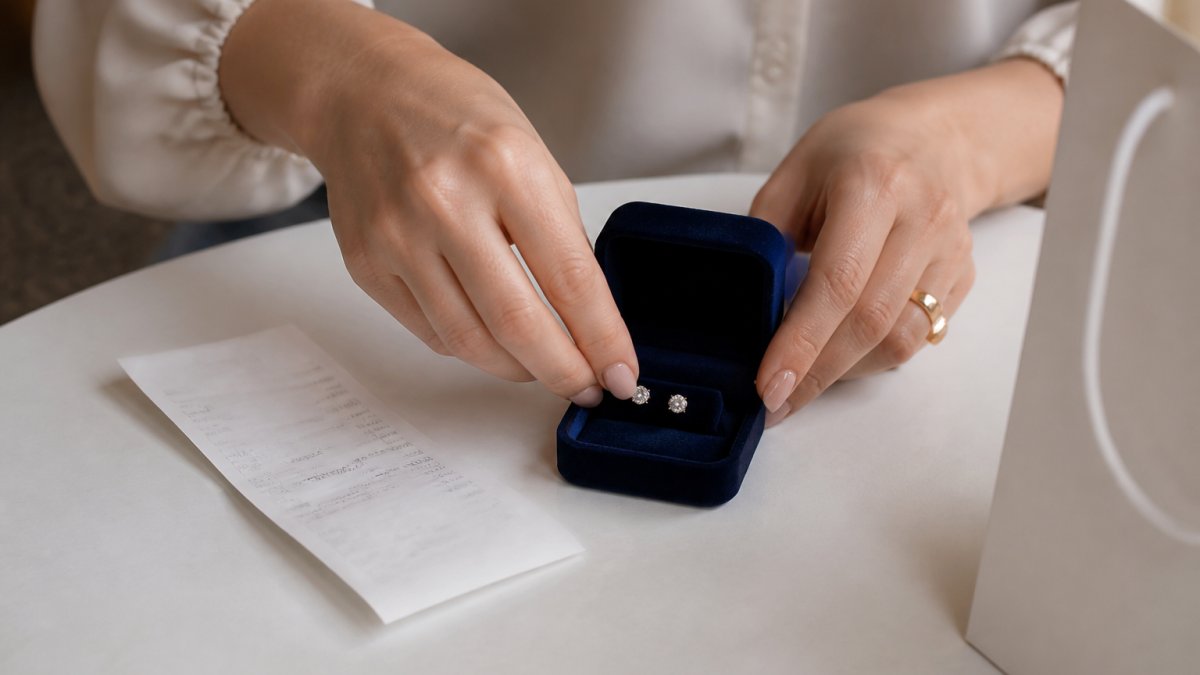
- Proof of purchase (receipt, order confirmation email, or bank statement)
- The original packaging, including the box and any tags
- The earrings themselves, unworn and clean
Earring Return Policy: What Retailers Actually Require
Most earring return policies share three common requirements: a time limit, proof of purchase, and the item in resalable condition. Miss any one of them and the shop can refuse.
Return Periods and Time Limits
Return periods vary widely. A common window is 30 days from purchase or delivery.
The clock usually starts on the day you receive the item, not the day you ordered it. For online orders, that means delivery day.
Always check the specific window before you assume you are too late. A quick look at the policy page saves a wasted trip.
Original Packaging and Proof of Purchase
Shops want earrings back in a condition they can resell. That means:
- Original box or pouch
- No signs of wear
- Tags still attached, where relevant
Without proof of purchase, most retailers cannot process anything. Keep your confirmation email safe.
Can You Exchange Earrings Bought Online?
Online earring exchanges are usually easier than in-store ones, thanks to distance selling rules. You generally get a cooling-off period after delivery.
That period is often 14 days to cancel and a further 14 days to send the item back. This right applies to most online orders, though there are exceptions.
Which? explains your online shopping rights in plain terms if you want the full picture.
Online vs In-Store Purchase Rules
The two channels work differently:
| Purchase type | Change-of-mind return | Faulty item return |
|---|---|---|
| Online | Usually allowed within the cooling-off period | Always allowed, plus refund of return postage |
| In-store | Only if the shop's policy allows it | Always allowed by law |
Buying online gives you more protection for change of mind. Buying in person puts you at the mercy of the shop's own policy.
Return Shipping and Delivery Options
When you return by post, you usually pay the return shipping for a change of mind. For faulty items, the retailer should cover it.
Keep proof of posting. If the parcel goes missing, that slip is your evidence. Some shops offer a local store drop-off as an alternative.
Faulty Earrings Consumer Rights: What the Law Says
Faulty earrings are covered by the Consumer Rights Act 2015, and your rights override any store policy.
The remedy depends on timing:
- Within 30 days: a full refund, no questions
- After 30 days: a repair or replacement first
- If neither works: a partial or full refund
The Citizens Advice guide to faulty goods sets out these tiers clearly. A broken clasp or a stone that falls out is a fault, not wear and tear.
This is where many shoppers give up too early. A shop saying "no returns" does not cancel your legal rights.
Hygiene Rules: Why Some Shops Refuse Earring Exchanges
Hygiene is the single biggest reason earring exchanges get refused, and it is the one factor that separates earrings from almost every other item of jewellery.
This is a genuine public-health concern rather than a convenient excuse. A retailer that resells a returned earring risks passing on bacteria, and it also risks the reputational damage of a customer noticing that a "new" pair has clearly been handled.
The Unopened Versus Opened Distinction
The practical dividing line is almost always the packaging seal, not the earring itself. A common pattern is:
- Sealed and unopened: many retailers will accept a change-of-mind exchange or refund, because the item can be returned to stock
- Seal broken or packaging discarded: most retailers refuse a change-of-mind exchange, even if the earrings have never been worn
- Clearly worn: refusal is near-universal, and the shop is within its rights to decline
Some retailers go further and refuse all pierced jewellery outright, sealed or not. Others apply the seal rule only to studs and hoops that pass through the ear, and treat clip-on earrings, ear cuffs and magnetic styles as ordinary fashion jewellery with normal return terms. If you are buying a gift, that distinction matters: a clip-on pair is far more likely to be exchangeable than a pierced pair.
How Retailers Differ in Practice
There is no single industry standard, so the policy wording is what counts. A few patterns show up repeatedly:
- High-street fashion jewellers often allow exchange of sealed pierced earrings within a short window, typically 14 to 30 days, and refuse anything opened
- Fine jewellers and independent boutiques frequently exclude pierced earrings from change-of-mind returns entirely, but will still honour faulty-item remedies
- Online-only retailers tend to apply the same hygiene exclusion, but the statutory cancellation right for distance sales can still apply if the seal is intact
What This Means for Your Exchange
Before you buy pierced earrings, check three things: whether the retailer accepts change-of-mind exchanges on pierced jewellery at all, whether the seal must be intact, and how long the window runs.
If you have already opened the packaging and the shop refuses, ask specifically whether the refusal is a hygiene policy or a legal position. If it is hygiene only, a faulty-item claim is still open to you.
Final Sale, Gift Exchanges and Alternative Outcomes
Final sale and gift purchases are where earring exchanges get most complicated, because the usual assumptions about receipts and refunds break down. Both situations have their own logic, and both have outcomes that are not simply "refund" or "no refund".
Final Sale Items
A final sale label means the retailer has excluded the item from change-of-mind returns. If a final-sale pair of earrings arrives with a broken clasp, a missing stone, or a description that does not match what was sent, the Consumer Rights Act 2015 still applies and the retailer must provide a remedy.
The practical trap is that final sale is sometimes applied at the till without the customer noticing, or buried in the product page.
Gift Exchanges and Gift Receipts
A gift receipt is the single most useful thing you can ask for when buying earrings for someone else. It typically shows the item, the date and the price paid, but omits the payment method.
Without a gift receipt, outcomes depend on the retailer:
- Exchange without receipt: some shops will exchange for another item of equal or higher value if the earrings are in resalable condition and the price can be verified
- Store credit or credit note: a common middle ground, often issued for the value paid rather than the current selling price
- Refund to original payment method: usually refused without proof of purchase, because the shop cannot confirm where or when the item was bought
If the recipient has no receipt and the shop will not help, the person who bought the earrings can usually request the exchange themselves using their own order confirmation or bank statement.
Alternative Outcomes When a Straight Exchange Is Not Possible
A straight swap for the same item in a different size or colour is not always available, particularly with pierced jewellery where hygiene rules bite. The realistic alternatives are:
- Store credit or a credit note for the value paid, which can usually be spent on anything in store rather than just earrings
- Exchange for a different item of equal or greater value, with the difference paid by the customer
- Refund to the original payment method, normally only with proof of purchase and within the retailer's window
At Diamonds by daisy, every piece comes with a 30-day satisfaction guarantee.
Frequently Asked Questions
Can shops refuse to exchange earrings for hygiene reasons?
Yes, many shops refuse earring exchanges on hygiene grounds, especially for pierced jewellery that has been worn. Once earrings touch the skin or pass through a piercing, they cannot be resold as new. This is a store policy rather than a legal right, so it varies by retailer. Some brands accept exchanges if the earrings remain unworn and the original packaging and tags are intact. Always check the earring return policy before buying, particularly for stud earrings and piercing jewellery.
What should I do if my earrings are faulty?
If your earrings arrive damaged, misdescribed or develop a fault, you have strong consumer rights under the Consumer Rights Act 2015. Contact the retailer within 30 days of receiving the item for a full refund. After 30 days but within six months, you can request a repair or replacement. Keep your proof of purchase, order number and photos of the fault. Most retailers respond within 24 hours when you provide clear evidence and a description of the issue.
Can you exchange earrings bought online?
Online earring exchanges depend on the retailer's policy and whether the earrings are piercing jewellery. Under the Consumer Contracts Regulations 2013, you have 14 days from delivery to cancel most online orders. However, earrings for pierced ears are often excluded for hygiene reasons. If the earrings are unworn, in original packaging and not a final sale item, many retailers offer an exchange or refund. Check the return period and conditions before starting the process.
What do I need to exchange earrings?
To exchange earrings, gather your proof of purchase (receipt or order number), the original packaging and any tags or certificates. The earrings should be unworn and in resalable condition unless faulty. Contact customer service or visit a local store to start the process. If returning by post, use a tracked delivery service and keep the tracking number. Some retailers require you to contact them within 24 hours of receiving a faulty item, so act quickly if there is a problem.
Getting an earring exchange right comes down to three things: acting quickly, keeping your proof of purchase, and knowing your rights. When a shop makes it harder than it should be, a clear policy and a fair guarantee make all the difference. At Diamonds by daisy, we back every piece with a 30-day satisfaction guarantee, handpicked gemstones, and timeless designs made to last. Browse the collection and add to cart with confidence.